Economic Calendar

Monday, November 24, 2008

APEC leaders commit to quick economic action

Updated: 2008-11-24

(China Daily) Lima -- The United States, China, Japan and 18 other economies in Asia and the Americas promised fast and decisive action on Sunday to prevent a severe global economic downturn.


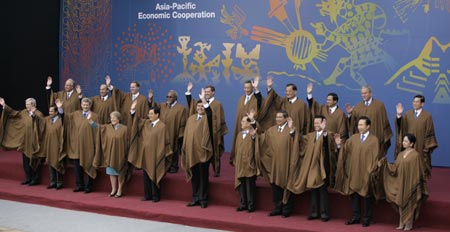
Leaders pose for a group photo while wearing typical ponchos from Peru, during a break in the Asia-Pacific Economic Cooperation (APEC) summit in Lima, November 23, 2008. [Agencies]

With recession gripping parts of the world and financial markets in chaos, leaders at the 21-member Asia-Pacific Economic Cooperation forum, or APEC, said the slowdown is "one of the most serious economic challenges we have ever faced."


They said free trade and higher government spending were key to resolving the crisis and supported a big push to revive long-stalled global trade talks by seeking agreements in the contentious sectors of farming and manufactured goods.

The leaders promised to "take all necessary economic and financial measures to resolve this crisis."

Their declaration at the end of a two-day summit in Peru echoed measures called for by the Group of 20 major economies at a meeting in Washington a week earlier, and widened support for drastic action to stimulate lending and spending.

APEC members account for more than half of the world's economic output and also include Canada, Indonesia, Mexico, Chile, New Zealand, Singapore, South Korea and China's Hong Kong. Nine of them belong to the G20.

They pledged at the summit to work together to ease the turmoil, agreed not to adopt new trade barriers for a year and called for better regulation of the financial industry.

They also supported overhauls of the International Monetary Fund and World Bank at a time when more countries need emergency bailouts to avert economic disaster.

"The global political and economic architecture is undergoing the deepest and most complicated changes since the Cold War," Chinese President Hu Jintao told Russia's Dmitry Medvedev at the summit.

Medvedev said the non-binding declaration might still allow countries to help domestic producers.

"On the one hand we took an obligation not to resort to protectionism, but of course we will draft measures to help our producers survive, help them with credits and some reasonable measures," he said.

Japan reiterated an offer of $100 billion in funding for the IMF.

Trade Deadlock

APEC, which groups some of the most open economies in the world, warned that countries should not be tempted to use protectionist measures even if job losses mount.

"We are convinced that we can overcome this crisis in a period of 18 months," the leaders said at the summit.

US President George W. Bush, on his last scheduled foreign trip before leaving office in January, held bilateral meetings with the leaders of China, Japan and Russia.

He tried to use the meeting to revive global trade talks before handing off to President-elect Barack Obama, who has expressed more caution about free trade than Bush.

A senior US official told reporters in Geneva he saw a "very high probability" that trade ministers would return to Geneva next month to try to get a breakthrough in the so-called Doha round of trade talks.

Major economies have slashed interest rates and spent hundreds of billions of dollars to help struggling banks after the meltdown in the US housing market sparked a worldwide credit crisis.

Now countries are looking at stimulus plans that include boosting government spending and cutting taxes.

Obama said on Saturday he was crafting an aggressive two-year stimulus plan to revive the country's troubled economy.

Canada could dip into a technical recession later this year or early next year, and will use fiscal stimulus if needed, Canadian Prime Minister Stephen Harper said.

APEC meetings over the last eight years have often been marked by anti-Bush protests and demonstrations against free trade, but protests were muted in Peru, perhaps because Bush is so close to leaving office.


Read more...

Citigroup, Fed Said to Weigh Plan to Limit Losses

By Bradley Keoun, Alison Vekshin and Christine Harper

Nov. 23 (Bloomberg) -- Citigroup Inc. and U.S. regulators are in talks to limit the bank’s potential losses on more than $100 billion of toxic assets after the stock’s plunge last week sparked concerns about the company’s fate, four people familiar with the matter said.

The Federal Reserve and Treasury Department have been locked in discussions with Citigroup and other regulators throughout the weekend and a deal may be reached as soon as today, according to the people, who declined to be identified because the negotiations are confidential. The plan under consideration calls for the assets to remain at Citigroup, with the government agreeing to assume losses beyond a specified amount, two of the people said.

The holdings that may be guaranteed are a portion of the $400 billion pile of mortgages, bonds, auto loans and corporate loans that Chief Executive Officer Vikram Pandit pledged in May to shed within three years, the two people said. While the amount to be covered under the plan is under discussion, the talks are focused on about $100 billion to $200 billion of the assets, they said.

“If anybody’s too big to fail from the financial system’s point of view, it’s Citi,” said Brian Barish, president of Cambiar Investments LLC in Denver, which manages about $6 billion and doesn’t own Citigroup stock. “The government doesn’t need to be in this to make money. If they lose a few bucks on this, but save the system, it’ll be worth it.”

Share Decline

Citigroup lost 60 percent of its market value last week as investor confidence in the New York-based company’s prospects faltered after four consecutive quarterly losses. Unless the bank takes steps to halt the slide, the share-decline may rattle Citigroup’s customers, counterparties and employees, threatening the operations of the second-biggest U.S. bank by assets, according to a report by David Hendler, an analyst at CreditSights Inc. in New York.

“We sense that Citi’s board will also recognize the difficult chain of events which can be brought about by its low stock price, and prefer to take action,” Hendler wrote in the report yesterday.

Federal Reserve Board spokeswoman Michelle Smith and Citigroup spokesman Michael Hanretta declined to comment today. Citigroup Chief Financial Officer Gary Crittenden and Chief Risk Officer Brian Leach are leading the negotiations for the bank, one person familiar with the matter said.

‘Breathing Room’

The aid plan under consideration would give Citigroup “a little bit of breathing room, but long-term things may deteriorate” in areas of the company that wouldn’t be covered, said Peter Kovalski, a portfolio manager at Alpine Woods Capital Investors LLC in Purchase, New York, which manages $8 billion including Citigroup stock. “The Achilles’ heel with Citi also is their exposure to emerging markets and what’s going to happen when emerging markets turn down, as they’re doing now.”

Pandit, 51, told employees on a Nov. 21 conference call that he doesn’t plan to break up the company. He and Crittenden said they don’t expect to sell the Smith Barney brokerage unit, two people who listened to the call said at the time.

Citigroup’s board, led by Chairman Win Bischoff and independent director Richard Parsons, met the same day to discuss the bank’s options.

Citigroup issued a statement last week saying the company has “a very strong capital and liquidity position and a unique global franchise.”

Interventions

The proposal under consideration is a variation on a theme that has played out in government interventions during the past year, including JPMorgan Chase & Co.’s purchase of Bear Stearns Cos., Citigroup’s failed effort to buy Wachovia Corp. and the Swiss government’s rescue financing of UBS AG. In each case, the government required the bank to absorb initial losses and agreed to guarantee deficits beyond that amount.

JPMorgan took the first $1.15 billion of losses on a $30 billion portfolio of Bear Stearns’s devalued assets, with the Fed agreeing to finance the rest.

In September, Citigroup agreed to suffer the first $42 billion of losses on Wachovia’s loan porfolio, with the Federal Deposit Insurance Corp. taking the rest, in a deal that was canceled after Wells Fargo & Co. stepped in to buy Wachovia.

The Swiss government required UBS in October to inject 6 billion Swiss francs ($4.91 billion) into a special purpose vehicle backed with $54 billion of central bank loans to allow the bank to carve off about $60 billion of assets.

To help shore up Citigroup, the FDIC could provide loan-loss support or the U.S. Treasury could contribute money from the $700 billion Troubled Asset Relief Program passed by Congress in October, Hendler’s report said.

Credit Ratings

“The FDIC does not comment on open and operating institutions,” Andrew Gray, a spokesman for the agency, said in an e-mailed statement today.

Citigroup’s debt remains on review for downgrade by both Moody’s Investors Service and Standard & Poor’s. Moody’s rates Citigroup’s senior unsecured debt Aa3, while S&P has an AA- rating. A downgrade to A1 by Moody’s or to A+ by S&P is possible as the bank’s falling stock price could be deemed to hamper the company’s “financial flexibility,” the report said.

A single-A rating at the parent-company level should be manageable as long as the company’s banking subsidiaries maintain double-A ratings, CreditSights said. JPMorgan, now the biggest U.S. bank by assets, managed to endure with single-A ratings earlier in the decade, the report notes.

To contact the reporters on this story: Bradley Keoun in New York at bkeoun@bloomberg.net; Alison Vekshin in Washington at o avekshin@bloomberg.net; Christine Harper in New York at charper@bloomberg.net.


Read more...

Obama Will Thrive Among Competing Power Centers: Albert R. Hunt

Commentary by Albert R. Hunt

Nov. 24 (Bloomberg) -- Barack Obama will surround his presidency with powerful men and women. The models of Abraham Lincoln, Franklin Delano Roosevelt and Ronald Reagan are instructive. So is that of George W. Bush.

The current president, eight years ago, selected the formidable Colin Powell as his secretary of State, and the almost-as-formidable Donald Rumsfeld as his Defense secretary. They produced a team of rivals that thoughtlessly, and with little serious debate, started a war and devastated America’s standing in the world.

The lesson is not to avoid strong-minded people with different views; it is to appreciate that this works only with a strong-minded, temperamentally secure president who thrives on intellectual combat.

The inspiration for Obama is Doris Kearns Goodwin’s “Team of Rivals,” a riveting and much-acclaimed account of how Lincoln recruited for his Cabinet former political opponents who initially thought themselves superior to the man who went on to become America’s greatest president.

Actually it’s more a team of heavyweights than of rivals. The president-elect already has assembled an unusually strong White House staff and now it appears it will be even more powerful with former Treasury Secretary Larry Summers on economics and former Marine Corps Commandant James Jones on national security. The Cabinet will be as strong with Hillary Clinton at State, Robert Gates perhaps being retained at Defense, and New York Federal Reserve President Timothy Geithner being tapped as Treasury secretary.

Geithner may look like a teenager, but that belies his expertise and the respect he commands in global financial circles. With the financial crisis, Summers’s role at the White House may be Kissingerian in scope.

Franklin Roosevelt would love this assemblage.

‘Know Who He Is’

This will at times make governance harder; choosing between strong points of view is tough. It is also a challenge.

“My definition of a strong president,” says Howard Baker, who as a U.S. senator served with five presidents and later was Reagan’s chief of staff, “is he must know who he is, what he believes, and not be afraid of strong people or to disagree with them.”

Conversations with three men who intimately understand the American presidency -- Baker, presidential historian Michael Beschloss and Harry McPherson, former counsel to Lyndon Johnson -- produce a consensus: Experience shows that competing or complementary power centers are essential to a successful presidency. It also shows it will be a task to make it work.

“It’s very tough,” says Beschloss. “It starts off with high policy and then often gets down to personal stuff. A president has to be very comfortable with smart people arguing with one another.”

No Automatic Success

They all note situations, including in Bush’s presidency, where the healthy clash of ideas and people didn’t materialize. In the first two years of Bill Clinton’s administration, the foreign policy team was so ill-suited for the tasks that coherent debate was rare.

McPherson recently reread the notes of Johnson’s internal deliberations over going to war in Vietnam. There was a clash of ideas. The problem was the vocal dissenter, George Ball, was so outnumbered that a balanced contest never transpired.

The successful presidencies, however, underscore the value. Goodwin’s “Team of Rivals” chronicles the contribution Secretary of State William Seward made to the Lincoln years and how close the two men became. Seward, who barely lost the nomination fight to Lincoln in 1860, was a senator from New York when tapped as the nation’s chief diplomat.

Relishing Rivalries

No president relished such strong rivalries as much as Roosevelt: Interior Secretary Harold Ickes against Agriculture Secretary Henry Wallace; isolationists against internationalists; and battles among most of his major economic advisers, especially early in his first term, when experimentation was the order of the day.

“FDR actually enjoyed conflict,” notes Beschloss. “He worried if one side got too powerful, and liked to keep both off balance. He also felt it kept his administration alive with ideas.”

Temperamentally, Reagan lacked Roosevelt’s manipulative magic, yet he benefited from internal conflict between Secretary of State George Shultz and Defense chief Caspar Weinberger on how to deal with the Soviet Union. “Reagan really valued the pressure brought by Shultz and Weinberger’s disagreements,” says Baker. The result was a hard line, which played a role in the eventual Soviet collapse, and an important accommodation at the end.

Republicans Welcome

The Obama Cabinet will be full of heavy hitters. In some administrations, a White House staff with such clout would dominate. Obama, however, also seems intent on assembling a Cabinet that wouldn’t allow that.

Choosing Tom Daschle, a former Senate majority leader with lots of knowledge and connections, suggests Obama won’t make the mistake of trying to craft a health-care overhaul from the White House. Arizona Governor Janet Napolitano will be a force at Homeland Security. And a few Obama insiders insist there will be more than a token Republican in his government; they will be sprinkled throughout the agencies.

Baker, Beschloss and McPherson all praise the idea of Clinton as secretary of State, while recognizing the perils. “She’s very talented,” says McPherson. “The issue is whether it’s worth the struggles that almost invariably surround Bill Clinton.”

Tension With Bill

The negotiations over what the former president would “give up” so his wife can be the top diplomat are unseemly. Tension with her husband comes with the territory.

There will be Obama loyalists in the White House suspicious of Hillary Clinton’s motives; if given a free hand to staff the State Department, the danger is she’ll enlist too many sycophants who don’t care about the president.

Then again there will be a powerful White House staff and most likely an influential Defense chief to provide a check.

(Albert R. Hunt is the executive editor for Washington at Bloomberg News. The opinions expressed are his own.)

To contact the writer of this column: Albert R. Hunt in Washington at ahunt1@bloomberg.net


Read more...

BP Says Compressor Failure Shuts Gasoline Unit at Texas City

By Christian Schmollinger

Nov. 24 (Bloomberg) -- BP Plc, Europe’s second-largest oil company by market value, said a compressor failure caused a gasoline-making unit to shut at its Texas City, Texas, refinery.

A hydrogen compressor tripped offline on Nov. 22 forcing its ultracracker unit to shut down, according to a filing with the Texas Commission on Environmental Quality. The emissions release should end by tomorrow, BP said.

The refinery expects to release 7,000 pounds of carbon monoxide and 2,000 pounds of nitrogen oxide, the filing said.

The Texas City refinery can processes as much as 467,720 barrels of oil a day.

To contact the reporter on this story: Christian Schmollinger in Singapore at christian.s@bloomberg.net


Read more...

Cnooc, Partners May Spend $29 Billion on South China Sea Fields

By Wang Ying

Nov. 24 (Bloomberg) -- Cnooc Ltd., China's top offshore oil producer, and its partners may spend about 200 billion yuan ($29 billion) to develop fuel deposits in the South China Sea in the nation's biggest push to tap reserves off the country's coast.

The investments between next year and 2020 include an estimated 15 billion yuan by parent China National Offshore Oil Corp. to build deepwater drilling equipment, Luo Donghong, chief development engineer at Cnooc's Shenzhen unit, told reporters and analysts on Nov. 22. He didn't name the partners.

China, the world's second-biggest oil user, is expediting projects including gas pipeline and oil refineries to spur growth as global economies sink into recession. Cnooc will drill twice the current depth for fuel as companies including Royal Dutch Shell Plc delay worldwide ventures after the credit crisis contributed to oil prices falling 66 percent from its July record.

``The company will maintain its exploration budget for the South China Sea next year as the region hasn't seen any `big impact' from the credit crunch,'' Li Fanrong, general manager of the unit of the Beijing-based company, said in the southern city of Shenzhen. ``The investment is only a rough estimate that reflects the immense potential of oil and gas reserves in the South China Sea.''

The region, covering 3.5 million square kilometers, stretches from Singapore to the Straits of Taiwan. Rising energy demand in the world's fourth-biggest economy is prompting state-controlled Cnooc to boost exploration in an area, about a third of the size of China, where nations including Vietnam and the Philippines have laid territorial claims.

Oil Disputes

In July, the Chinese government opposed a plan by Exxon Mobil Corp., the world's biggest oil company, to explore for fuel in the area with Vietnam, saying the project marks a breach of its historical claim to the region.

Geological fuel reserves in the deepwater fields of the South China Sea may reach 22 billion barrels of oil equivalent by 2020 and the overall annual output may rise to 350 million barrels, Luo said. China may consume 8.2 million barrels of oil a day in 2009, according to the International Energy Agency, the Paris-based adviser to 28 oil-consuming nations.

The country will overtake the U.S. as the world's biggest oil and gas consumer in about five years, Shell said in September. China's demand for natural gas is ``huge'' in the coastal provinces of Guangdong, Fujian and Zhejiang, said Li.

Cnooc and its future partners aim to drill up to 3,000 meters deep in the offshore area by 2020, compared with the current maximum depth of 1,485 meters, said Luo. ``Deepwater is a key area for future incremental reserves,'' he said.

Current Partners

``The actual spending for the South China Sea will depend on other variables including the price of raw materials such as steel,'' said Li.

Cnooc's current exploration partners in the South China Sea include Devon Energy Corp., Husky Energy Inc. and Anadarko Petroleum Corp., Luo said. The Chinese explorer will invest $1.04 billion in exploration in 2008 as it aims to at least replace any reserves it depletes each year, Cnooc said in January.

The company plans to produce between 195 million and 199 million barrels of oil equivalent this year, compared with last year's output of between 169 million and 171 million barrels, it said then.

To contact the reporter on this story: Wang Ying in Beijing at ywang30@bloomberg.net.


Read more...

Malaysian Ringgit Near Two-Year Low Before Central Bank Meeting

By David Yong

Nov. 24 (Bloomberg) -- Malaysia’s ringgit was near a two- year low against the dollar before central bank policy makers meet today for their final scheduled meeting on interest rates for 2008.

Half of the 16 economists surveyed by Bloomberg News predict Bank Negara Malaysia will maintain its overnight rate at 3.5 percent. Seven expect a cut to 3.25 percent and one called for a 50 basis-point reduction. The central bank has kept the benchmark on hold for 20 straight meetings since April 2006. The ringgit has lost 8.7 percent this year as investors exited emerging- market assets amid the global economic slowdown.

“Cutting interest rates to reflate the economy may come at the cost of a weakening currency, so it’s a difficult choice,” said Zulkifli Hamzah, head of research at MIDF Amanah Investment Bank Bhd. in Kuala Lumpur. “They may prefer to let the fiscal stimulus work its way first.”

The ringgit traded at 3.6150 per dollar as of 9:10 a.m. in Kuala Lumpur, according to data compiled by Bloomberg. It reached 3.6425 on Nov. 21, the lowest level since November 2006.

To contact the reporter on this story: David Yong in Singapore at dyong@bloomberg.net.


Read more...

Australia, N.Z. Dollars Fall on Citigroup Speculation, Stocks

By Candice Zachariahs

Nov. 24 (Bloomberg) -- The Australian and New Zealand dollars slid as investors dumped higher-yielding currencies on concern over a U.S. government rescue of Citigroup Inc.

The currencies fell as Australian financial stocks led declines in the country’s shares amid reports indicating U.S. regulators held talks with Citigroup to limit its potential losses after the bank’s shares plunged 60 percent last week.

“People are unwilling to take large positions just on the uncertainty of whether or not the U.S. Fed and Treasury will broker a deal on Citigroup,” said Danica Hampton, a currency strategist at Bank of New Zealand Ltd. based in Wellington. “The key driver for the Aussie and kiwi this week will again be global sentiment,” she said, calling the currencies by their nicknames.

Australia’s currency dropped 1.2 percent to 62.50 U.S. cents as of 12:26 p.m. in Sydney from 63.25 cents late in New York trading on Nov. 21. The currency slumped 1.9 percent to 59.53 yen.

New Zealand’s dollar fell 1.3 percent to 53.01 U.S. cents from 53.71 in New York last week. It bought 50.40 yen from 51.43.

The currencies fell as Australian and South Korean stocks dropped amid speculation by investors and analysts that the U.S. government will have to help Citigroup. The bank’s $2 trillion of assets dwarfs companies such as American International Group Inc. that received government support this year.

Treasury Secretary Henry Paulson and Federal Reserve Chairman Ben S. Bernanke may favor a rescue to avoid a repeat of the chaotic aftermath of Lehman Brothers Holdings Inc.’s Sept. 15 bankruptcy.

“Citi is in the category of ‘too big to fail,’” said Michael Holland, chairman and founder of Holland & Co. in New York, which oversees $4 billion. “There is a commitment from this administration and the next to do what it takes to save Citi.”

Trading may be thin in the Asian session today as Japanese markets are closed because of a holiday, Hampton said.

Shorts Fall

Futures traders decreased their bets that the Australian dollar will decline against the U.S. dollar, figures from the Washington-based Commodity Futures Trading Commission show.

The difference in the number of wagers by hedge funds and other large speculators on a decline in the Australian dollar compared with those on a gain -- so-called net shorts -- was 5,790 on Nov. 18, compared with net shorts of 8,604 a week earlier.

Australian government bonds were little changed with the yield on the 10-year note falling 1 basis points, or 0.01 percentage point, to 4.62 percent, according to data compiled by Bloomberg. The price of the 5.25 percent security due March 2019 gained 0.109, or A$1.09 per A$1,000 face amount, to 105.151.

New Zealand’s two-year swap rate, a fixed payment made to receive floating rates, fell to 5.15 percent from 5.18 on Nov. 21.

To contact the reporter on this story: Candice Zachariahs in Sydney at czachariahs2@bloomberg.net


Read more...

Recession’s Grip Forces U.S. to Flood World With More Dollars

By Rich Miller

Nov. 24 (Bloomberg) -- The world needs more dollars. The United States is preparing to provide them.

In an all-out assault on capitalism’s worst crisis since the Great Depression, the U.S. is taking on the role of both lender and borrower of last resort for the global economy.

The Federal Reserve, which has already pumped out hundreds of billions of dollars, might formally adopt a policy of flooding the world financial system with even more money. The Treasury, on course to borrow some $1.5 trillion this fiscal year, may tap global capital markets for even more to finance a fiscal stimulus package of as much as $700 billion and provide additional bailout money for banks.

“You want to do everything you can when you’re facing the threat of a deflationary breakdown of the economy,” says Michael Feroli, a former Fed official who is now an economist at JPMorgan Chase & Co. in New York. He sees the central bank cutting the overnight lending rate to zero in January and holding it there throughout the year.

Fed Chairman Ben S. Bernanke and Treasury Secretary Henry Paulson are being forced to pull out the stops because the extraordinary actions they’ve taken so far have failed to gain much traction. Credit markets are collapsing, stock prices are plunging and the world economy is sinking into a recession.

As the economy deteriorates, deflation -- a sustained decline in wages and prices -- is emerging as a new threat. U.S. government figures last week showed that consumer prices excluding food and fuel costs fell in October for the first time since 1982.

Shell-Shocked

Investors, shell-shocked by the turmoil, are piling into super-safe Treasury securities, even as the U.S. government ships more supply out the door. Three-month bill rates dropped last week to 0.01 percent, the lowest since at least January 1940, and yields on Treasuries maturing in two through 30 years all fell to the least since the government began regular sales of the securities.

And the dollar has risen as loss-ridden banks worldwide husband their resources, even after receiving generous dollops of liquidity from the Fed. The U.S. currency has surged about 17 percent against the euro -- signaling demand for still more dollars -- in the two months since the crisis deepened after the failure of Lehman Brothers Holdings Inc. Meanwhile, gold is down almost 25 percent from its peak in March.

Swap Lines

To help fight the worldwide dollar squeeze, the Fed has set up currency swap lines with more than a dozen other central banks. Some arrangements, including those with Europe, Britain and Japan, are open-ended, allowing the Fed’s counterparts to draw as many dollars as they need. The U.S. has also established individual $30 billion swap lines with Brazil, Mexico, South Korea and Singapore.

In a speech to a banking conference on Nov. 14, Bernanke characterized these efforts as an “internationally coordinated approach” among central banks to fulfill their function as lenders of last resort.

As the Fed has stepped up its efforts to combat the credit crisis, its balance sheet has mushroomed. Assets rose to $2.2 trillion on Nov. 19 from $924 billion on Sept. 10, just before the bankruptcy of Lehman Brothers shook the global financial system.

The central bank’s holdings are likely to increase further. “I would not be surprised to see them aggregate to $3 trillion -- roughly 20 percent of GDP -- by the time we ring in the new year,” Dallas Fed President Richard Fisher told the Texas Cattle Feeders Association on Nov. 4.

Only the Start

That may be only the start if the Fed cuts its benchmark rate, now at 1 percent, to zero and adopts what economists call a policy of “quantitative easing.” Under such a strategy, it would concentrate on expanding the amount of reserves in the banking system because it could no longer reduce the cost of that money.

The Bank of Japan followed this policy in the early part of the decade as it struggled to rescue the world’s second-largest economy from the grip of deflation. Its balance sheet eventually rose to the equivalent of about 30 percent of gross domestic product, says Tom Gallagher, head of policy research for International Strategy and Investment Group in Washington.

“The Fed could blow through the BOJ’s ceiling,” he adds - - ballooning the central bank’s holdings to more than $4 trillion.

The Treasury is also heading into uncharted territory as it taps capital markets for cash to help finance its bailout fund for the banking system and plug holes in the federal budget caused by the weak economy.

Money From Abroad

Much of that money will come from abroad. “Foreigners don’t seem to be interested in any kind of risky U.S. asset,” says Brad Setser, a former Treasury official now at the Council on Foreign Relations in New York. So, “instead, they are buying Treasuries.” That includes China, which recently passed Japan as the biggest holder of Treasuries.

On Nov. 3, the department tripled its estimate of planned debt sales in the final three months of the year to a record $550 billion. Paulson told a conference in Washington Nov. 17 that the U.S. will issue some $1.5 trillion worth of Treasury securities in the fiscal year that began Oct. 1.

That number, too, could grow. Lawrence Summers, Treasury secretary under President Bill Clinton and an adviser to President-elect Barack Obama, told the same conference that the U.S. needs a “speedy, substantial and sustained” stimulus package to aid the economy.

More Government Spending

“Government may have to spend $600 billion to $700 billion next year to reverse the downward cycle,” Robert Reich, another Obama adviser and a professor at the University of California at Berkeley, wrote in his personal blog Nov. 9.

Kenneth Rogoff, a professor at Harvard University in Cambridge, Massachusetts, and former chief economist at the International Monetary Fund, says the new administration will also have to ask Congress for more money to repair the financial system, over and above the $700 billion already authorized for Paulson’s Troubled Asset Relief Program.

“By the time all this ends, the TARP is going to be closer to $2 trillion than $1 trillion,” ISI’s Gallagher says.

Paulson has already committed $290 billion from the program to buy preferred shares in banks and troubled insurer American International Group Inc.

There’s always a danger the Fed and Treasury may go too far, setting the stage for a big rise in inflation or another asset bubble down the road as the economy revs up and investors get back their nerve. That’s what happened in the early part of the decade as ultra-easy Fed policy and Treasury tax cuts helped fuel a credit boom since gone bust.

Bernanke and Paulson might welcome a bit of that exuberance right now -- even at the risk of higher inflation later -- as they try to prevent the biggest credit catastrophe in decades from sending the economy into a deflationary nosedive.

“It’s true that, over the long run, too much money creates inflation,” says Lyle Gramley, a former Fed governor now at the Stanford Group Co. in Washington. “But they’re trying to keep the economy from going over the precipice and into the abyss.”

To contact the reporter on this story: Rich Miller in Washington rmiller28@bloomberg.net


Read more...

Yen Gains as U.S. Government Weighs Up Citigroup Rescue Plan

By Candice Zachariahs

Nov. 24 (Bloomberg) -- The yen climbed against the dollar and the euro as discussions over a possible U.S. government bailout of Citigroup Inc. prompted investors to shun higher- yielding overseas assets funded from Japan.

Japan's currency also advanced against the Australian and New Zealand dollars, two favorites of so-called carry trades, as U.S. regulators held talks with Citigroup to limit the lender's potential losses on more than $100 billion of toxic assets after the bank's shares plunged 60 percent last week.

``The fact that we're waiting for further news on official support for Citigroup is leaving markets a little bit on the defensive,'' said Tony Morriss, a senior currency strategist at Australia & New Zealand Banking Group in Sydney. ``These issues around Citi are a particularly U.S. problem.''

Japan's currency rose 0.8 percent to 95.15 per dollar as of 10:08 a.m. in Tokyo from 95.94 in New York on Nov. 21. It climbed 0.8 percent to 119.75 per euro. The dollar was little changed at $1.2587 per euro. Foreign-exchange movements may be exaggerated because trading volumes are lower than usual due to a Japanese public holiday today, Morriss said.

The yen climbed 2 percent to 59.48 versus the Australian dollar and 1.9 percent to 50.44 against the New Zealand dollar. Japan's benchmark interest rate of 0.3 percent is the lowest among major economies.

The Federal Reserve and Treasury Department were locked in discussions with Citigroup and other regulators throughout the weekend and a deal may be reached before the start of trading this week in New York, according to people familiar with the talks. The non-performing assets would remain at Citigroup, with the government agreeing to assume losses beyond a specified amount, two of the people said.

To contact the reporters on this story: Candice Zachariahs in Sydney at czachariahs2@bloomberg.net


Read more...

Asia Commodities Day Ahead: HudBay Falls on Lundin Acquisition

Nov. 24 (Bloomberg) -- HudBay Minerals Inc. plunged the most in more than six years after agreeing to acquire Lundin Mining Corp. Copper fell; gold, silver and platinum climbed. International Paper Co. will indefinitely shut a Louisiana mill representing 13 percent of the company’s global pulp capacity. Argentina’s government and the Buenos Aires Cereals Exchange lowered estimates for this year’s wheat and corn harvests. Corn, soybeans and wheat declined.

INDUSTRIAL METALS, MINING

HudBay Plunges on Agreement to Acquire Lundin Mining

HudBay Minerals Inc. plunged the most in more than six years in Toronto after agreeing to acquire Lundin Mining Corp. to gain operations in Europe. HudBay declined C$2.07, or 40 percent, to C$3.16 at 4:17 p.m. in Toronto Stock Exchange trading.

Katanga Halts Output of Cobalt Concentrate Amid Falling Prices

Katanga Mining Ltd. has temporarily halted production of cobalt concentrate because of low prices.

Copper Posts Biggest Weekly Drop in Month on Dim Demand Outlook

Copper futures fell in New York, capping the biggest weekly decline in a month, as slumping equity markets renewed concern that the global recession will curb demand for raw materials including metals. Copper lost 0.1 cent to $1.579 a pound in New York.

BlackRock’s Hambro Says Mining Stocks to Rebound on Cutbacks

BlackRock Inc., the largest publicly traded asset manager in the U.S., said mining stocks are at “ridiculously low levels” and will recover from a record slump after government fiscal stimulus plans and production cutbacks.

FORESTRY PRODUCTS

International Paper Shuts 13% of Global Pulp Capacity

International Paper Co., the world’s biggest maker of corrugated packaging, will indefinitely shut a Louisiana mill representing 13 percent of the company’s global pulp capacity because of declining demand and a weak economy.

PRECIOUS METALS, GEMS

Gold Surges Amid Deflation Concern; Silver, Platinum Rebound

Gold climbed, capping the biggest weekly gain since September, as the global economic slump dragged down asset prices and boosted the appeal of the precious metal as a store of value. Gold jumped $43.10, or 5.8 percent, to $791.80 an ounce in New York. Silver gained 45.6 cents, or 5 percent, to $9.505 an ounce. Platinum climbed $35.60, or 4.5 percent, to $825.70 an ounce. Palladium dropped 80 cents, or 0.4 percent, to $180.25 an ounce.

AGRICULTURAL COMMODITIES

Pork-Belly Supplies Rise as Output Exceeds Demand

U.S. inventories of frozen pork bellies at the end of October were 12 percent higher than a year earlier, the government said, as pork production exceeded consumer demand for bacon.

Argentine Corn, Wheat Crops Damaged After Frost, Drought

Argentina’s wheat and corn crops were damaged by drought and an overnight frost, prompting the government and the Buenos Aires Cereals Exchange to lower their estimates for this year’s harvests.

Grain, Soybeans Drop as U.S. Slowdown Cuts World Food Demand

Corn and soybeans fell to the lowest prices in more than a year and wheat dropped for a fifth straight session on concern that the slowing global economy will depress demand for food, animal feed and fuel made from crops. Corn dropped 25.25 cents, or 6.9 percent, to $3.385 a bushel in Chicago. Soybeans slid 16 cents, or 1.9 percent, to $8.40 a bushel. Wheat tumbled 13 cents, or 2.4 percent, to $5.18 a bushel.

Cattle Drop as Economic Slump May Curb Beef Sales; Hogs Fall

Cattle futures fell for the fifth session in six as tumbling U.S. equities raised concern that an economic slump will prompt consumers to spend less on food. Cattle dropped 1.025 cents, or 1.2 percent, to 85.5 cents a pound in Chicago. Feeder cattle fell 0.35 cent, or 0.4 percent, to 89.4 cents a pound. Hogs declined 0.575 cent, or 0.9 percent, to 64.1 cents a pound.

SOFT COMMODITIES

Cotton Price Rises Amid Bounce in Crude Oil, Equities Markets

Cotton prices rose the most in more than a month, gaining in tandem with other commodities, as U.S. stocks and crude oil rebounded. Cotton futures gained 1.89 cents, or 4.7 percent, to 41.8 cents a pound in New York.

Sugar Falls in New York Amid Credit Crunch, Crude-Oil Decline

Sugar fell in New York, declining for the third week in a row, as the credit crisis stifles purchases by refiners and the plunging price of crude oil erodes the appeal of ethanol made from cane. Raw sugar dropped 0.23 cent, or 2 percent, to 11.28 cents a pound in New York.

Cocoa Rises to Biggest Weekly Gain in Nine; Orange Juice Falls

Cocoa climbed in New York, notching its biggest weekly increase since September, as output declined from Ivory Coast, the world’s largest producer. Cocoa gained $36, or 1.8 percent, to $2,045 a metric ton in New York. Orange juice fell 0.15 cent, or 0.2 percent, to 76.8 cents a pound.

Coffee Prices Post Biggest Weekly Drop in Month Amid Recession

Coffee futures fell, capping the biggest weekly decline in a month, as a widening global recession threatens to curb commodity demand and exports of newly harvested beans increased from Brazil, the biggest grower. Arabica coffee dropped 0.6 cent, or 0.5 percent, to $1.1075 a pound in New York. In London, robusta coffee slipped $6, or 0.3 percent, to $1,813 a metric ton.

CHEMICALS

Celanese Falls on Concern Demand Drop Will Sap Profit

Celanese Corp., the world’s largest producer of acetyl chemicals, fell in New York trading after the company abandoned its 2008 profit forecast, prompting concerns that earnings next year will tumble. Celanese dropped 86 cents, or 10 percent, to $7.60 at 4:15 p.m. in New York Stock Exchange composite trading.


Read more...

Corn May Fall on Slowing Demand, Soybeans May Gain, Survey Says

By Jeff Wilson

Nov. 24 (Bloomberg) -- Corn prices may fall to a 15-month low as a global economic slump reduces demand for animal feed and fuel. Soybeans may rise for the first time in four weeks as dry weather hurts South American crops.

Twenty-one of 36 traders and advisers surveyed Nov. 21 from Tokyo to Chicago predicted corn will fall, and 21 of 37 respondents said soybeans will climb. Corn fell 11 percent to $3.385 a bushel last week in Chicago. Soybeans dropped 6.2 percent to $8.40 a bushel. Corn and soybeans are down 58 percent and 49 percent, respectively, from records this year.

Last week's declines in corn and soybeans were a surprise to the majority of respondents surveyed on Nov. 14. Since 2004, 55 percent of the surveys were correct for corn and 57 percent for soybeans.

Weekly results: Bullish on corn: 15 Bullish on soybeans: 21 Bearish on corn: 21 Bearish on soybeans: 16

To contact the reporter on this story: Jeff Wilson in Chicago at jwilson29@bloomberg.net.


Read more...

Gold May Fall as Investors Sell to Raise Cash Amid Equity Loss

By Pham-Duy Nguyen

Nov. 24 (Bloomberg) -- Gold may fall for the first week in four on speculation that the 10 percent price gain in November will spur investors to sell the metal to raise funds and cover losses in other markets, including equities.

Eighteen of 40 traders, investors and analysts surveyed from Mumbai to Chicago on Nov. 20 and Nov. 21 advised selling gold, which rose 6.6 percent last week to $791.80 an ounce in New York. Seventeen said to buy, and five were neutral.

Last week's gain was the biggest since Sept. 19 and the metal is headed for the largest monthly rise since January. Gold plunged 18 percent in October when the Standard & Poor's 500 Index lost 17 percent. The S&P is down 23 percent this month.

Most analysts surveyed on Nov. 13 and Nov. 14 anticipated gold's gains last week. The survey has forecast prices accurately in 142 of 238 weeks, or 60 percent of the time.

Last week's survey results: Bullish: 17 Bearish: 18 Neutral: 5

To contact the reporter on this story: Pham-Duy Nguyen in Seattle at pnguyen@bloomberg.net.


Read more...

Australia’s Newcastle Coal Price Slumps 12% to 10-Month Low

By Jesse Riseborough

Nov. 24 (Bloomberg) -- Power station coal prices at Australia’s Newcastle port, a benchmark for Asia, slumped 12 percent to a 10-month low after a decline in the price of oil.

The weekly index for thermal coal prices at the New South Wales port fell $11.83 to $85.69 a metric ton in the week ended Nov. 21 to the lowest since Jan. 18, according to the globalCOAL NEWC Index. That’s the biggest weekly slump for at least eight years, according to data compiled by Bloomberg.

Crude oil, down 66 percent from a July 11 record, slumped 13 percent last week as a deepening global financial crisis reduces energy demand. Goldman Sachs JBWere Pty last week cut its forecast for 2009 coal prices to $90 a ton, implying a 28 percent decline from this year’s contract of $125 a ton.

“The thermal market has been closely tracking the oil price as it is an energy market,” Mark Pervan, a senior commodity strategist at Australia and New Zealand Banking Group Ltd. in Melbourne, said today.

Producers that had switched to mining semi-soft coal used by steelmakers to gain from higher prices had returned to supplying power station coal after demand for the metal eased, contributing to the slump in the energy coal market, Pervan said.

The weekly globalCOAL index is down 56 percent from a record of $194.79 for the week ended July 4. The monthly index fell 26 percent to $106.92 a ton in October, from $144.82 the previous month.

Xstrata Plc, the world’s largest exporter of power-station coal, BHP Billiton Ltd. and Rio Tinto Group are among mining companies that ship coal through Newcastle.

To contact the reporter on this story: Jesse Riseborough in Melbourne at jriseborough@bloomberg.net


Read more...

Oil Rises a Second Day on Speculation OPEC Will Prevent Glut

By Gavin Evans

Nov. 24 (Bloomberg) -- Crude oil rose for a second day in New York on speculation further production cuts by the Organization of Petroleum Exporting Countries will prevent a glut in supplies.

Slowing global demand has left a 1 million barrel-a-day oversupply that needs to be removed by year-end, Venezuela’s Oil Minister Rafael Ramirez said yesterday. Prices below $50 a barrel risk stalling new developments by smaller oil companies, Total SA Chief Executive Officer Christophe de Margerie said.

OPEC “have got to be pretty careful how they attempt to manipulate this,” Mark Pervan, senior commodity strategist at Australia & New Zealand Banking Group Ltd. in Melbourne, said in a Bloomberg Television interview. “There’s some expectation they’ll cut production further, but they’re likely to look to the new year before assessing it again.”

Crude oil for January delivery rose as much as $1.41, or 2.8 percent, to $51.34 a barrel in after-hours electronic trading on the New York Mercantile Exchange. It was at $50.74 at 8:10 a.m. in Singapore.

Oil rose 1 percent to $49.93 a barrel on Nov. 21, the first increase in six days, as a report forecast a 3.8 percent decline in OPEC shipments this month and the Standard & Poor’s 500 Index climbed from an 11-year low. Oil traded at a three-year low of $48.25 earlier that session.

Brent crude oil for January settlement rose 80 cents, or 1.6 percent, to $49.99 a barrel on London’s ICE Futures Europe exchange today. It gained 2.3 percent to $49.19 on Nov. 21.

Recession, OPEC

New York oil futures have dropped 65 percent since reaching a record $147.27 a barrel on July 11. Prices fell as the U.S., Japan, and much of Europe slipped into recession, equity prices slumped, and a rising U.S. currency reduced the appeal of dollar-priced commodities.

Oil ministers from the 13-nation OPEC group meet in Cairo on Nov. 29. Venezuela, OPEC’s fifth-largest producer, will be seeking a one million barrel-a-day cut and assurance that the 1.5 million barrel reduction agreed on Oct. 24 is being implemented, Ramirez said.

OPEC’s “not having a lot of leverage on prices,” ANZ’s Pervan said. “The large cutbacks we’ve seen in the last month or two really haven’t impacted positively on prices. And I think they’re concerned that as they cut production and prices fall, they’re getting a double whammy on revenue.”

Oil inventories in the U.S., the world’s largest consumer, are at their highest in six months after rising for eight straight weeks, according to Energy Department data. Reports tomorrow will probably show the world’s largest economy contracted more than earlier forecast in the third quarter.

Of all commodities, oil is the most exposed to the U.S. economy, which is the “epicenter” of the global slowdown now underway, Pervan said. Prices may drop below $40 a barrel in the first quarter as the contraction continues, he said.

“As far as we can see, demand conditions are likely to get weaker before they get stronger in oil over the next six months,” he said.

To contact the reporter on this story: Gavin Evans in Wellington at gavinevans@bloomberg.net


Read more...

Australian, South Korean Financial Shares Drop; BHP Advances

By Malcolm Scott

Nov. 24 (Bloomberg) -- Australian and South Korean financial stocks fell as last week’s plunge in Citigroup Inc. shares sparked concerns about the fate of the U.S. bank and its $2 trillion of assets.

Commonwealth Bank of Australia Ltd. and Shinhan Financial Group Co. lost more than 3 percent. BHP Billiton Ltd., the world’s largest mining company, rose 1.3 percent as copper and aluminum rebounded from three-year lows. Woodside Petroleum Ltd. surged 1.8 percent after oil climbed 2.2 percent in Asian trading.

“The Citigroup plight is seen as an example of the fact that the situation for the financial sector globally isn’t getting better,” said Angus Gluskie, who manages the equivalent of $226 million at White Funds Management in Sydney.

Australia’s S&P/ASX 200 Index fell 0.7 percent to 3,390.30 at 11:45 a.m. in Sydney. The benchmark index is trading at about 9.2 times reported earnings, compared with an average 16 in the past five years. South Korea’s Kospi Index gained 0.6 percent.

Japanese markets are closed for a holiday. The MSCI Asia Pacific excluding Japan Index added 0.4 percent to 207.34, with seven of its 10 industry groups advancing. The gauge is down 61 percent this year.

The rate Australian banks charge each other for three-month loans rose 3.8 basis points to 4.47 percent in Sydney. The cost of borrowing in dollars for three months in London rose for the first time in four days on Nov. 21 as concern about credit losses and writedowns overshadowed interest-rate reductions and cash funding by central banks.

Government Takeover?

Citigroup, whose shares lost 60 percent last week, and U.S. regulators are in talks about a plan to limit the bank’s potential losses from toxic assets, people familiar with the matter said. December futures on the Standard & Poor’s 500 Index gained 1.2 percent as Democratic lawmakers pledged to agree on an economic stimulus package by January.

U.S. stocks rallied Nov. 21, pushing the S&P 500 up 6.3 percent, after President-elect Barack Obama picked New York Federal Reserve Bank chief Timothy Geithner to head the Treasury. Concern Citigroup may need a government takeover sent bank stocks in the S&P 500 down 24 percent last week, the steepest slide in at least 19 years.

“The market was calling for either a breakup or some kind of resolution” for Citigroup, said Jack Ablin, who helps manage about $60 billion as chief investment officer of Harris Private Bank in Chicago. “This is going to be the main focus of market activity.”

To contact the writer on the story: Malcolm Scott in Sydney at Mscott23@bloomberg.net.


Read more...

U.S. Stock Futures Gain After Fed, Citigroup Weigh Loss Limits

By Eric Martin

Nov. 24 (Bloomberg) -- U.S. stock futures rose on speculation the government will help Citigroup Inc. weather mortgage losses and after Democratic lawmakers pledged to agree on an economic stimulus package by January.

December futures on the Standard & Poor’s 500 Index climbed 3.3 points, or 0.4 percent, to 795.3 as of 10:08 a.m. in Tokyo. The benchmark gauge dropped 8.4 percent to 800.03 last week and closed at an 11-year low of 752.44 on Nov. 20.

Citigroup, which lost 60 percent last week to $3.77, and U.S. regulators are in talks about a plan to limit the bank’s potential losses from toxic assets, people familiar with the matter said. Futures were also boosted after Senator Charles Schumer of New York said Democrats will propose between $500 billion and $700 billion of federal stimulus.

“With Citigroup hanging in the low single digits, the market was calling for either a breakup or some kind of resolution,” said Jack Ablin, who helps manage about $60 billion as chief investment officer of Harris Private Bank in Chicago. “This is going to be the main focus of market activity. It should be good news.”

South Korea’s Kospi Index gained 0.6 percent. Japanese markets are closed for a holiday.

The S&P 500 tumbled 46 percent this year, poised for its biggest annual decline since 1931, after almost $1 trillion of bank losses shrunk the economy and corporate profits fell for five straight quarters. Concern Citigroup may need a government takeover sent bank stocks in the S&P 500 down 24 percent last week, the steepest slide in at least 19 years.

Citigroup Talks

Regulators, including the Federal Reserve and Treasury Department, were locked in discussions with Citigroup this weekend, according to three people who declined to be identified because the negotiations are confidential.

More than $7 trillion was erased this year from U.S. equity markets. Concern the recession is worsening was spurred last week after jobless claims approached the highest level since 1982, prices paid to U.S. producers plunged by the most on record and the Federal Reserve said manufacturing in the Philadelphia area shrank at the fastest pace in 18 years.

Stocks rallied Nov. 21, pushing the S&P 500 up 6.3 percent, after President-elect Barack Obama picked New York Federal Reserve Bank chief Timothy Geithner to head the Treasury.

Geithner will be nominated Treasury secretary, and Lawrence Summers will head the National Economic Council, Democratic aides said. Summers served as President Bill Clinton’s last Treasury chief.

Stimulus Package

House Speaker Nancy Pelosi said any stimulus package must be several hundred billion dollars. “The sooner we do one, the smaller it can be,” she said on the CBS “Face the Nation” program.

The S&P 500 fetches 9.2 times analysts’ forecast for next year’s earnings, the cheapest compared with historical profits since 1998, according to data compiled by Bloomberg and S&P.

In aggregate, earnings fell 18 percent for the 479 companies in the S&P 500 that reported third-quarter results through Nov. 20, according to data compiled by Bloomberg. Companies scheduled to report this week include Campbell Soup Co., Deere & Co. and Tiffany & Co.

As Treasuries rose, the dividend yield on the S&P 500 exceeded the benchmark 10-year note’s yield for the first time since 1958. The 10-year yield declined to 3.20 percent from 3.74 percent, and touched 2.99 percent, the lowest since the government began regular issuance of the securities.

A measure of the cost of using options to insure against declines in the S&P 500 gained 9.6 percent last week and rose to a record 80.86 on Nov. 20. The VIX, as the Chicago Board Options Exchange Volatility Index is known, fell on Nov. 21 to 72.67 as stocks climbed.

To contact the reporter on this story: Eric Martin in New York at emartin21@bloomberg.net.


Read more...

Obama Will Get Stimulus Bill First Day, Democrats Say

By Daniel Whitten

Nov. 23 (Bloomberg) -- Congress will send President-elect Barack Obama an economic stimulus package the day he takes office Jan. 20, two Democratic lawmakers said today.

Senator Charles Schumer of New York said on ABC’s “This Week” program that the package will be between $500 billion and $700 billion. House Majority Leader Steny Hoyer, of Maryland, said on “Fox News Sunday” that he believed the Inauguration Day goal would be met, but he declined to put a price tag on the bill.

“I think Congress will work with the president elect starting now and will have a major stimulus package on his desk by Inauguration Day,” Schumer said. “I think it has to be deep. My view it has to be between five and $700 billion.”

Obama said yesterday he aims to save or create 2.5 million jobs in his two-year plan to stimulate an economy facing a “crisis of historic proportions.”

The U.S. economic slowdown has been exacerbated by the worst credit crisis in seven decades. More firings will weigh on the economy and consumer spending will pressure Obama and Congress to agree on legislation that will stimulate growth, economists say.

Economic Team

Obama is moving quickly to assemble his economic team.

Timothy Geithner, head of the Federal Reserve Bank of New York, will be nominated Treasury secretary, and Lawrence Summers will head the National Economic Council, Democratic aides said. Summers served as President Bill Clinton’s last Treasury chief.

House Speaker Nancy Pelosi today said any stimulus package must be several hundred billion dollars. “The sooner we do one, the smaller it can be,” she said on the CBS “Face the Nation” program.

Senator Richard Shelby, the Alabama Republican who is the ranking member of the Senate Banking Committee, said he wants to see the details of a stimulus package before deciding whether to back it. “I want to support things that are meaningful for the economy,” Shelby told ABC.

Obama’s stimulus plan involves an infusion of cash for middle-class tax cuts, rebuilding roads, bridges and schools, building broadband Internet access and investing in clean energy.

Tax Cut Expiration

Obama strategist David Axelrod suggested that Obama might consider delaying a repeal of Bush administration tax cuts for the wealthy by allowing them to expire as scheduled at the end of 2010. “Those considerations will be made,” he said.

The president-elect is “committed to getting middle-class tax relief in the pipeline quickly, and there’s no doubt that we’re going to have to make some hard decisions in order to pay for the things we need,” Axelrod told Fox today. “The main thing right now is to get this economic recovery package on the road, to get money in the pockets of the middle class.”

Senator Carl Levin, a Michigan Democrat, opposed allowing the tax cuts “for the upper brackets” to expire, saying on CNN’s “Late Edition” program that Congress should move more quickly to end them. “We just can’t afford to continue them,” he said.

House Republican Leader John Boehner of Ohio pushed for cutting the capital-gains tax to stimulate the economy.

Capital Gains Tax

“If we’re really serious about creating jobs, what we ought to do is we ought to eliminate the capital-gains tax,” Boehner said on Fox. “Why not lower capital gains taxes for -- and corporate income taxes for corporations in America to help keep jobs here?”

Senator Joe Lieberman, an independent from Connecticut argued for action before President George w. Bush leaves office Jan. 20.

“I’m concerned that we’re between presidents now, and in the meantime, the economy continues to cycle down, and, to a lot of people, out of control,” Lieberman said on CNN’s “Late Edition” program.

Policy makers have “to get banks to start lending money again,” Lieberman said. “They’re not lending money, and, until they do, this economy is going to go nowhere.”

To contact the reporter on this story: tseeley@bloomberg.net; Daniel Whitten in Washington at dwhitten2@bloomberg.net.


Read more...

Bernanke Tells New Yorker He Underestimated Housing Meltdown

By Daniel Whitten

Nov. 23 (Bloomberg) -- Federal Reserve Chairman Ben S. Bernanke said he underestimated the impact subprime mortgages would have on the economy, according to an interview to appear in the New Yorker magazine’s Dec. 1 edition.

“I and others were mistaken early on in saying that the subprime crisis would be contained,” Bernanke said. “The causal relationship between the housing problem and the broad financial system was very complex and difficult to predict.”

Widespread failures of U.S. subprime mortgages, home loans to borrowers with poor credit records, started in 2007, touching off a financial crisis that has spread to other sectors of the world economy.

The article, entitled “Anatomy of a Meltdown,” said Bernanke and Treasury Secretary Henry Paulson tried what Bernanke and his Fed colleagues called a “finger-in-the-dike” strategy to keep the financial sector operating long enough so that it could repair itself. As recently as this Sept. 1, the article said, Bernanke thought that strategy would work.

To contact the reporters on this story: Daniel Whitten in Washington at dwhitten2@bloomberg.net.


Read more...