Economic Calendar

Sunday, December 7, 2008

Serbian Cabinet Approves ’09 Budget With Deficit at 1.5% of GDP

By Aleksandra Nenadovic

Dec. 6 (Bloomberg) -- The Serbian government adopted a draft 2009 budget that projects a deficit equivalent to 1.5 percent of gross domestic product, in line with recommendations from the International Monetary Fund and narrower than this year.

“The government has adopted a budget that makes no one happy,” Finance MinisterDiana Dragutinovic said at the press conference in Belgrade today. “This is a restrictive budget, and the government has acted responsibly.”

GDP growth is forecast at 3.5 percent, about half the pace of 2008. Inflation is projected at 8 percent, or 1.5 percentage points less than this year. The budget deficit this year is predicted to be 2.7 percent of GDP.

The cabinet’s approval came after a month-long delay, as the parties in Mirko Cvetkovic coalition government argued over distribution of cuts through ministries.

Parliament is scheduled to debate the proposed budget in the coming week.

The draft budget projects the current account deficit at 16.3 percent of GDP in 2009, 2.2 percentage points less than in 2008. State revenue is projected at 698.7 billion dinars ($10.2 billion) and expenditure at 748.3 billion dinars.

Serbia secured a $516 million standby loan on Nov. 14 from the International Monetary Fund, the fourth eastern European nation to tap the institution for funds, to help stabilize the economy during the global financial crisis.

The IMF warned that government overspending may push the current-account deficit in 2008 above 18 percent of GDP, which it must cover through increased borrowing.

To contact the reporter on this story: Aleksandra Nenadovic in Belgrade at anenadovic@bloomberg.net.


Read more...

Qantas, British Airways Heads to Meet in Hong Kong, Review Says

By Jesse Riseborough

Dec. 6 (Bloomberg) -- Qantas Airways Ltd. Chief Executive Officer Alan Joyce and British Airways Plc counterpart Willie Walsh will meet in Hong Kong this weekend for talks on a potential merger, the Australian Financial Review reported.

The outcome of their discussions will be put before the boards of both companies to determine whether the merger should proceed, the paper said, without citing anybody.

Qantas advisers, Macquarie Group Ltd. and Greenhill & Co., will resume talks with British Airways advisers UBS AG after the Christmas break to complete an appropriate merger ratio, the paper said.

To contact the reporter on this story: Jesse Riseborough in Melbourne at jriseborough@bloomberg.net


Read more...

Newcastle Coal Price Drops for a Fourth Week Amid Demand Slump

By Jesse Riseborough

Dec. 6 (Bloomberg) -- Power station coal prices at Australia’s Newcastle port, a benchmark for Asia, dropped for a fourth week, declining to the lowest in almost 14 months as demand from utilities weakened.

The weekly index for power-station coal prices at the New South Wales port fell $2.10, or 2.7 percent, to $76.09 a metric ton in the week ended yesterday, according to the globalCOAL NEWC Index. That’s the lowest price since Oct. 19, 2007, and a 61 percent decline from a July record.

Contract prices for the fuel, at a record $125 a ton this year, may drop next year as power demand falls on the global recession, Merrill Lynch & Co. analysts said. Xstrata Plc, the world’s largest shipper of power-station coal and BHP Billiton Ltd. are among companies that ship coal through Newcastle.

Merrill Lynch cut its forecast for 2009 contract prices, for the year starting April 1, by 38 percent to $80 a ton, analysts led by Sydney-based Vicky Binns said in a report dated yesterday. The monthly globalCOAL index fell 15 percent to $91.36 a ton in November, from $106.92 the previous month.

“Adding downward pressure on Newcastle thermal coal prices is that producers selling thermal coal into spot markets may be willing to take a hit on prices so as not to lose port allocations for 2009,” Merrill said. “Previous capacity allocation systems at Newcastle have used historical shipping performance in determining forward capacity allocations.”

To contact the reporter on this story: Jesse Riseborough in Melbourne at jriseborough@bloomberg.net


Read more...

ANZ Cuts 800 Workers, 2% of Workforce, on Economic Downturn

By Jesse Riseborough

Dec. 6 (Bloomberg) -- Australia & New Zealand Banking Group Ltd., the nation’s fourth-largest, will cut 800 workers, or 2 percent of its workforce, amid a global economic downturn.

Chief Executive Officer Mike Smith told staff at a briefing yesterday of the job losses, Kevin Foley, a spokesman for Melbourne-based ANZ, said today by telephone. ANZ said on Nov. 14 that more than 500 jobs would be cut to cushion the company from the impact of the global credit crisis.

“It’s to reduce the numbers of middle-management employees,” Foley said. Staff in branches who dealt directly with customers and those in call centers “are largely unaffected,” he said.

Royal Bank of Scotland Plc is also cutting between 120 and 150 workers from the Australian unit of ABN Amro Holding NV, which it acquired this year, the Australian Financial Review said today.

To contact the reporter for this story: Jesse Riseborough in Melbourne at jriseborough@bloomberg.net


Read more...

BHP May Cut Ore Output 25% on Demand, Merrill Says

By Jesse Riseborough

Dec. 6 (Bloomberg) -- BHP Billiton Ltd., the world’s largest mining company, may need to cut iron ore production by about a quarter next year as a slump in global steel output curbs demand for the raw material, Merrill Lynch & Co. said.

BHP, the world’s third-biggest iron ore producer, may curb output from mines in Western Australia by 30 million metric tons amid a slump in prices, Merrill Lynch analysts led by Sydney- based Vicky Binns said in a report dated yesterday. Output this year may be cut by 4 million tons, the report said.

The global financial crisis has reduced demand for steel, forcing mills in Asia, Europe and North America to slash output, curbing the need for ore. Cia. Vale do Rio Doce and Rio Tinto Group, the world’s two biggest producers of the ore, have already cut output, while BHP has yet to announce a reduction.

“After four very tight years, the iron ore market is now in oversupply on our forecasts, driven there primarily by a collapse in steel production,” Merrill said. Global iron ore demand will fall 1.1 percent next year, according to Merrill Lynch, down from an earlier forecast for a 6.3 percent gain.

Boost Capacity

BHP produced 122 million tons of iron ore last fiscal year and has flagged plans to boost capacity in Western Australia to 300 million tons by 2015. The Melbourne-based company last month approved a $4.8 billion expansion of its operations in the state, increasing capacity to 205 million tons by the second half of the 2011 calendar year.

BHP may cut output of iron ore from its mines in Western Australia by 17 percent this year, Macquarie Group Ltd. analysts said in a Nov. 18 report. The company said last month that customers had requested a deferral of iron ore shipments equal to 5 percent of its budget for 2008.

Contract prices for iron ore may decline 20 percent, to about $73 a ton for benchmark Australian ore, in the year starting April 1, Merrill Lynch said. That’s down from its earlier forecast for prices to remain unchanged at a record $92 a ton.

Commodity prices plunged to their lowest in more than six years yesterday on concern the deepening global recession will cut demand. The Reuters/Jefferies CRB Index of 19 raw materials, including oil, copper and corn, is headed for the biggest annual drop since its debut in 1956 after plunging 56 percent from a July record.

Mining Index

The slump has led to a 69 percent decline in the Bloomberg World Mining Index of 162 global stocks this year. BHP’s shares in Australia have dropped 35 percent this year, closing yesterday at A$26.15 after losing 4.9 percent.

“The problem for commodities at the moment is the complete lack of visibility on current quarter and 2009 actual demand and real consumption,” Macquarie analysts led by Jim Lennon said in a report e-mailed today. “The collapse in demand in the current quarter has been easily the largest anyone in all the industries we cover can recall, and we speak to some old people.”

Merrill Lynch slashed its forecasts for metals and bulk commodities, iron ore and coal. Copper may average $1.80 a pounce next year, down 20 percent from an earlier forecast, aluminum 88 cents a pound, down 20 percent, zinc 58 cents a pound, down 13 percent, and gold $897 an ounce, a 12 percent decline.

The medium- to longer-term outlook for the mining sector was positive as demand for commodities from China continued, Merrill said. “If investors can handle the volatility and are prepared to look more long term, then the next three-to-six months will offer great opportunity,” the report said.

To contact the reporter on this story: Jesse Riseborough in Melbourne at jriseborough@bloomberg.net


Read more...

Australian Treasurer, Trade Minister Head to China for Talks

By Jesse Riseborough

Dec. 6 (Bloomberg) -- Australian Treasurer Wayne Swan and Trade Minister Simon Crean departed for China today for talks on growing commerce between the two nations and the response to turmoil in global economies.

Swan and Crean will meet senior officials in Beijing including Zhang Ping, the head of China’s National Development and Reform Commission, and Commerce Minister Chen Deming, according to an joint e-mailed statement from the treasurer and trade minister today.

“The purpose of the trip is to discuss our growing investment and trade relationship,” the statement said. “Ministers will also discuss the international response to the global financial crisis, and the role of G20.”

China was Australia’s largest trade partner in 2007 with two-way trade in goods and services totaling A$58 billion ($37 billion), the statement said.

To contact the reporter on this story: Jesse Riseborough in Melbourne at jriseborough@bloomberg.net


Read more...

Nanjing’s Chairman Says Steel Prices Have Bottomed

By Helen Yuan and Lee Spears

Dec. 6 (Bloomberg) -- Nanjing Iron & Steel United Co., the Chinese steelmaker part-owned by billionaire Guo Guangchang, said steel prices in the world’s biggest user of the alloy have bottomed and output may recover on the state’s stimulus package.

Lower raw-material prices will allow producers to raise output, Chairman Yang Siming said today in an interview in Shanghai, where he’s attending an industry conference. “Next year, our construction-steel sales will benefit from the government’s plan to boost infrastructure investment.”

China last month announced a 4 trillion yuan ($584 billion) stimulus package to revive growth in the world’s fourth-largest economy. All Chinese steelmakers were unprofitable in October after demand from manufacturers plunged, according to the China Iron & Steel Association.

“The steel market will lead other industries in recovering under the government’s stimulus plan,” Qi Xiangdong, the association’s vice chairman, told the Shanghai conference. The industry group represents most of China’s large state-owned steel mills, including Baosteel Group Corp., the largest mill.

“Steel prices have bottomed,” Nanjing’s Yang said in the interview. The company’s production this month would recover to October’s level after four months of declines, he said, without giving figures.

Yang’s comments echo remarks yesterday from Lakshmi Mittal, chief executive officer of the world’s largest steelmaker, who said steel demand may rebound next year and the company wouldn’t deepen output cuts. ArcelorMittal has reduced output by about a third and slashed staff to cope with the global recession.

Prices Gain

Steel prices in China have risen for three straight weeks, gaining 2.4 percent this week to 3,681 yuan ($538) a ton after plunging as much as 45 percent from a June 5 record, according to data from Beijing Antaike Information Development Co.

The Nanjing, eastern China-based steelmaker had profit of 50 million yuan ($7.3 million) in October after cutting output, while the industry in China booked a collective loss, Yang said. China’s mills cut output by 10 percent in August, 30 percent in September and October, and 40 percent in November, he said.

Nanjing Steel has asked iron-ore suppliers including BHP Billiton Ltd., Rio Tinto Plc and Cia Vale do Rio Doce to slow deliveries, Chairman Yang said. About 70 percent of the ore bought by the mill is used to fill long-term contracts, he said.

China’s economy grew 9 percent in the third quarter, the slowest pace in 5 years, because of a slump in property and export demand. Government investment in the fourth quarter on railways will create demand for 1.6 million metric tons of steel and 10 million tons of cement, and provide 500,000 jobs, the National Development and Reform Commission said on Dec. 1.

China’s 71 largest steelmakers posted a combined loss of 5.8 billion yuan in October, the first time the entire industry has been money-losing, according to the China Iron & Steel Association. Baosteel Group is facing its “most difficult” period since its founding 30 years ago, General Manager He Wenbo said last month.

To contact the reporters on this story: Lee Spears in Beijing at lspears2@bloomberg.net; Helen Yuan in Shanghai at hyuan@bloomberg.net


Read more...

Pakistan May Miss Growth Target, Inflation May Be 22%, SBP Says

By Farhan Sharif

Dec. 6 (Bloomberg) -- Pakistan’s central bank said the nation’s economy may miss growth targets and inflation may rise as high as 22 percent.

The State Bank of Pakistan, in an annual report today, said the economic growth rate during fiscal year the fiscal year that is about to end is expected to be around 3.5 percent to 4.5 percent compared with a target of 5.8 percent.

Pakistan’s economy may expand as little as 3 percent this fiscal year in response to a “tightening” of economic policies and slowing growth among the nation’s trading partners, the International Monetary Fund said in a statement this week. That would be the slowest pace since 2000, when South Asia’s second- largest economy grew 2 percent.

In order to secure an IMF loan, Pakistan’s government and central bank have agreed to eliminate electricity subsidies by the end of June 2009 and to continue to adjust fuel prices to reflect international prices. That should reduce the budget deficit as a proportion of gross domestic product to 3.3 percent by 2009-10 from 4.2 percent in 2008-09 and 7.4 percent this year, the IMF said.

Pakistan was forced to turn to the IMF for a bailout after its foreign reserves shrunk 75 percent in a year to $3.45 billion.

To contact the reporters on this story: Farhan Sharif in Karachi, Pakistan, at fsharif2@bloomberg.net.


Read more...

Asian Currencies: Taiwan Dollar, Yuan Drop on Slowdown, Stocks

By David Yong

Dec. 6 (Bloomberg) -- Asian currencies fell this week, led by Taiwan’s dollar and the Chinese yuan, after reports showed exports in the region slumped because of recessions in the U.S., Europe and Japan.

Eight of the region’s 10 most-traded currencies excluding the yen dropped this week as investors became net sellers of shares from South Korea, Thailand and the Philippines. The Korean won, Malaysia’s ringgit and Singapore’s dollar fell after manufacturing in China, the fastest-growing major economy, shrank by the most on record, damping regional trade outlook.

“Attention has been on the trade numbers” and that is likely to see the Taiwan dollar weaken further, said Maya Pinto, an economist at IDEAglobal in Singapore. “We’ve seen foreigners exiting the stock market in the past three session.”

Taiwan’s dollar declined 0.8 percent to NT$33.549, according to Taipei Forex Inc., after reaching NT$33.612, the weakest level since Oct. 28. The yuan’s five-day 0.7 percent drop to 6.8812 is the steepest since a dollar peg was scrapped in July 2005. The ringgit fell 0.4 percent to 3.6350, near the lowest in more than two years.

Taiwan’s exports dropped 12.4 percent in November from a year earlier, the most since February 2002, according to a Bloomberg News survey of economists before the Ministry of Finance report on Dec. 8.

Cutting Forecasts

Taiwan Semiconductor Manufacturing Co., the largest producer of chips designed by other companies, on Dec. 1 cut sales and profit forecasts for this quarter, while rival United Microelectronics Corp. yesterday asked employees not to forgo vacations for pay to save costs.

The Chinese yuan posted a weekly decline on speculation Treasury Secretary Henry Paulson’s calls for a stronger currency won’t stop China from weakening it to support exporters. Manufacturing in Asia’s second-largest economy shrank by the most on record and export orders plunged, the China Federation of Logistics and Purchasing said on Dec. 1.

Korea’s won lost 0.4 percent to 1,475.50 per dollar, extending a four-month slide as overseas investors pulled $37 billion out of local shares this year, according to Bloomberg data. Banks and companies sought more dollars to repay overseas debt amid a funding squeeze.

“Concerns over a shortage of dollars remain, with the funding difficulties at banks not showing any sign of thawing,” said Park June Geun, a currency dealer in Seoul at BNP Paribas, Europe’s third-largest bank by market value.

Korea’s one-year cross-currency swap rate was below zero for a record 12th day signaling demand for dollars. The swap, which should be positive for lending won because of higher benchmark interest rates, reached a record minus 0.7 on Dec. 4 versus an average of 3.3 percent in the five years before July 2007 when the global credit crunch began.

Slower Recovery

Malaysia’s ringgit added to four months of decline after the government on Dec. 4 said exports slumped 2.6 percent in October, the first decline since July 2007.

“If all the stimulus plans don’t kick in fast enough, recovery may take longer than expected in 2010,” said Wan Suhaimi Saidi, an economist at Kenanga Investment Bank Bhd. in Kuala Lumpur. “The bias will be for more rate cuts and that will likely have some impact on the ringgit.”

Bank Negara Malaysia lowered its overnight policy rate to 3.25 percent on Nov. 24, after holding it at 3.5 percent in 20 meetings since April 2006, citing exports slowdown and rising unemployment risks. Policy makers next meet on Jan. 21.

Rupiah Rallies

Indonesia’s rupiah capped its best week in more than seven years, rising 3.4 percent to 11,705 a dollar, on speculation a surprise central-bank cut in borrowing costs on Dec. 4 will revive appetite for the nation’s securities.

Bank Indonesia lowered its benchmark reference rate for bill sales to 9.25 percent from 9.5 percent to shield Southeast Asia’s biggest economy from the global recession. The central bank slashed its growth forecast for 2009 to 4.5 percent, the slowest in seven years.

Elsewhere, Thailand’s baht dropped 0.4 percent this week to 35.65 a dollar, Singapore’s dollar weakened 0.9 percent to S$1.5225 and the Philippine peso weakened 0.3 percent to 49.08. The Vietnamese dong was little changed at 16,978.50.

To contact the reporter on this story: David Yong in Singapore at dyong@bloomberg.net.


Read more...

Asian Stocks Fall This Week as Recession Deepens, Oil Plunges

By Chua Kong Ho

Dec. 6 (Bloomberg) -- Asian stocks fell this week as the deepening global recession slashed consumer demand, driving commodity prices lower and dragging down materials companies and oil drillers.

BHP Billiton Ltd., the world’s biggest mining company, dropped 16 percent after oil fell more than $100 a barrel from its record in July and copper prices slumped. Honda Motor Co. sank 21 percent as November U.S. sales plunged the most since 1981. Surfwear maker Billabong International Ltd. tumbled 25 percent in Sydney after cutting its earnings forecast as its U.S. customers deferred deliveries amid the economic contraction.

“The world is in recession and earnings will fall next year for most companies the world over, including Asia,” said Hugh Young, managing director at Aberdeen Asset Management Ltd. in Singapore, overseeing about $45 billion. “Asia is in pretty good shape for surviving, not in great shape for growing.”

The MSCI Asia Pacific Index fell 3.8 percent to 79.52 this week. Raw-materials producers had the biggest percentage decline among the 10 industry groups.

MSCI’s Asian index has plunged 50 percent in 2008 as global financial companies’ losses and writedowns from the collapse of the U.S. subprime-mortgage market neared $1 trillion. Shares on the MSCI gauge are now valued at 9.7 times trailing earnings after falling to as low as 8.2 times last month. That’s half the 19.5 times on Nov. 11 last year, when the measure hit a peak of 172.32. Prior to the current market turmoil, the price-earnings ratio never dropped below 10, according to Bloomberg data.

U.S. Recession

The U.S. entered a recession in December 2007, the National Bureau of Economic Research, a private, non-profit panel of economists that dates American business cycles, said Dec. 1. A government report said the number of Americans receiving jobless benefits in the week ended Nov. 22 jumped to the most since December 1982. A separate report showed orders at U.S. factories in October sank the most since July 2000.

Central banks worldwide stepped up efforts to arrest the economic slowdown. The European Central Bank cut its main refinancing rate by 75 basis points, the most in its 10-year history, while the Bank of England cut its benchmark rate to 2 percent, the lowest level since 1951. The Swedish and Danish central banks also lowered their key rates. The Bank of Korea said it would make a one-time interest payment on central bank reserves and buy more securities.

Japan’s Nikkei 225 Stock Average dropped 7 percent to 7,917.51. Australia’s S&P/ASX 200 Index retreated 6.8 percent. Most markets in Asia fell this week.

BHP declined 16 percent to A$26.15. Inpex Corp., Japan’s largest explorer, sank 14 percent to 529,000 yen. Woodside Petroleum Ltd., Australia’s second-biggest oil producer, retreated 16 percent to A$30.46.

Commodities Retreat

Crude oil has dropped from a peak of $147.27 on July 11 to $41.65 a barrel on the New York Mercantile Exchange. Oil prices may slide below $25 a barrel next year if the global recession spills over into China, Francisco Blanch, a London-based analyst at Merrill Lynch, said Dec. 4.

A measure of six metals traded on the London Metal Exchange, including copper and zinc, fell 14.8 percent this week.

“We’re in an environment where demand is coming off, and that’s putting commodities under pressure,” said Matt Riordan, who helps manage $3 billion at Paradise Investment Management in Sydney. “Things have been slowing down pretty sharply.”

Rio Tinto Group, the third-largest mining company, tumbled 31 percent to A$32, the biggest percentage decline on MSCI’s Asian gauge, on concern it may have difficulty refinancing debt due next year. The company plans to close its iron-ore mines in Western Australia for 12 days as part of an earlier decision to reduce output.

Vehicle Sales

Honda, Japan’s No. 2 automaker, fell 21 percent to 1,653 yen. The carmaker withdrew from Formula One racing, cutting at least 20 billion yen ($216 million) in costs, after its U.S. vehicle sales plunged 32 percent in November.

Toyota Motor Corp. dropped 12 percent to 2,650 yen. Bridgestone Corp., the world’s largest tiremaker, dropped 14 percent to 1,376 yen.

General Motors Corp. Chef Executive Rick Wagoner told lawmakers he would accept strict conditions for a U.S. loan to stay afloat, including a promise to return the money and file for bankruptcy if his company doesn’t fulfill the terms.

Sack Workers

“Regardless of whether the U.S. automakers go bankrupt or stay afloat, they’ll have to sack workers,” said Yoshinori Nagano, a senior strategist at Daiwa Asset Management Co., which manages about $96 billion in Tokyo. “Should the companies collapse, it may trigger a series of business failures and worsen an already weakened U.S. economy.”

Billabong declined 25 percent to A$7.94. The U.S. recession has accelerated a slowdown in demand for clothing and surfing accessories, causing earnings per share to fall in the six months ending December, the Gold Coast, Australia-based company said Dec 4.

Indonesia’s PT Bumi Resources, Asia’s biggest exporter of power-station coal, slumped 25 percent to 760 rupiah after the country’s stock exchange said the company should use internal funds to fund a repurchase of its shares, instead of selling debt.

To contact the reporter responsible for this story: Chua Kong Ho in Shanghai at kchua6@bloomberg.net


Read more...

BHP May Cut Ore Output 25% on Demand, Merrill Says

By Jesse Riseborough

Dec. 6 (Bloomberg) -- BHP Billiton Ltd., the world’s largest mining company, may need to cut iron ore production by about a quarter next year as a slump in global steel output curbs demand for the raw material, Merrill Lynch & Co. said.

BHP, the world’s third-biggest iron ore producer, may curb output from mines in Western Australia by 30 million metric tons amid a slump in prices, Merrill Lynch analysts led by Sydney- based Vicky Binns said in a report dated yesterday. Output this year may be cut by 4 million tons, the report said.

The global financial crisis has reduced demand for steel, forcing mills in Asia, Europe and North America to slash output, curbing the need for ore. Cia. Vale do Rio Doce and Rio Tinto Group, the world’s two biggest producers of the ore, have already cut output, while BHP has yet to announce a reduction.

“After four very tight years, the iron ore market is now in oversupply on our forecasts, driven there primarily by a collapse in steel production,” Merrill said. Global iron ore demand will fall 1.1 percent next year, according to Merrill Lynch, down from an earlier forecast for a 6.3 percent gain.

Boost Capacity

BHP produced 122 million tons of iron ore last fiscal year and has flagged plans to boost capacity in Western Australia to 300 million tons by 2015. The Melbourne-based company last month approved a $4.8 billion expansion of its operations in the state, increasing capacity to 205 million tons by the second half of the 2011 calendar year.

BHP may cut output of iron ore from its mines in Western Australia by 17 percent this year, Macquarie Group Ltd. analysts said in a Nov. 18 report. The company said last month that customers had requested a deferral of iron ore shipments equal to 5 percent of its budget for 2008.

Contract prices for iron ore may decline 20 percent, to about $73 a ton for benchmark Australian ore, in the year starting April 1, Merrill Lynch said. That’s down from its earlier forecast for prices to remain unchanged at a record $92 a ton.

Commodity prices plunged to their lowest in more than six years yesterday on concern the deepening global recession will cut demand. The Reuters/Jefferies CRB Index of 19 raw materials, including oil, copper and corn, is headed for the biggest annual drop since its debut in 1956 after plunging 56 percent from a July record.

Mining Index

The slump has led to a 69 percent decline in the Bloomberg World Mining Index of 162 global stocks this year. BHP’s shares in Australia have dropped 35 percent this year, closing yesterday at A$26.15 after losing 4.9 percent.

“The problem for commodities at the moment is the complete lack of visibility on current quarter and 2009 actual demand and real consumption,” Macquarie analysts led by Jim Lennon said in a report e-mailed today. “The collapse in demand in the current quarter has been easily the largest anyone in all the industries we cover can recall, and we speak to some old people.”

Merrill Lynch slashed its forecasts for metals and bulk commodities, iron ore and coal. Copper may average $1.80 a pounce next year, down 20 percent from an earlier forecast, aluminum 88 cents a pound, down 20 percent, zinc 58 cents a pound, down 13 percent, and gold $897 an ounce, a 12 percent decline.

The medium- to longer-term outlook for the mining sector was positive as demand for commodities from China continued, Merrill said. “If investors can handle the volatility and are prepared to look more long term, then the next three-to-six months will offer great opportunity,” the report said.

To contact the reporter on this story: Jesse Riseborough in Melbourne at jriseborough@bloomberg.net


Read more...

U.S., China See Doha Round Completed This Year, USDA Chief Says

By Richard Dobson

Dec. 6 (Bloomberg) -- The U.S. and China are confident that the seven-year Doha round of global trade talks can be completed by the end of this year, U.S. Agriculture Secretary Ed Schafer said.

“Both China and the U.S. remain confident that a successful round can be completed here in the next few weeks,” Schafer told reporters today in Shanghai. Schafer attended the Strategic Economic Dialogue between the U.S. and China in Beijing that ended yesterday.

World Trade Organization negotiators have been trying to reach an agreement since 2001 to cut agriculture subsidies and tariffs on industrial goods. WTO Director General Pascal Lamy has said he is considering calling a ministerial meeting of the group in the second week of December to complete the talks.

“The U.S. is prepared to make the appropriate commitments on subsidies for the Doha round, but those commitments must come with increased market access for our products in other countries around the world,” Schafer said.

China’s Commerce Minister Chen Deming said on Dec. 4 that an agreement had been reached with the U.S. to push forward on completion of the Doha trade round by the end of December, according to the Xinhua News Agency.

Chen said he hoped the U.S. would also show flexibility and noted that while the U.S. was concerned with agriculture and non- agricultural market access issues, China hoped for more focus on concerns of developing countries, Xinhua reported.

Trade Barriers

The last attempt to get an outline of a new global trade agreement in July broke down as the U.S. faced off against India and China over their demands that developing nations be allowed to erect new barriers to agricultural imports.

“I seriously doubt it can be completed,” said Andy Xie, founder of Rosetta Stone Advisors in Shanghai and formerly Morgan Stanley’s chief Asia economist. “I don’t think the developed economies can make enough compromises on agriculture subsidies for the emerging economies to get on side.”

Lamy said Nov. 29 he would make a decision within a week on whether to call a three-day meeting between Dec. 10 and Dec. 19.

At the completion of the Strategic Economic Dialogue yesterday, China and the U.S. pledged $20 billion to fund trade and agreed to deepen financial ties, stepping up efforts to counter the credit crisis in their final economic talks before President-elect Barack Obama takes office Jan. 20.

To contact the reporter on this story: Richard Dobson in Shanghai at Rdobson4@bloomberg.net


Read more...

India Cuts Interest Rates After Terrorist Attacks

By Cherian Thomas and Anoop Agrawal

Dec. 6 (Bloomberg) -- India’s central bank cut interest rates for the third time in less than two months after last week’s terror attacks shook investor confidence in an economy already weakened by a global recession.

The Reserve Bank of India reduced its repurchase rate to 6.5 percent from 7.5 percent, Governor Duvvuri Subbarao told reporters in Mumbai. The bank also cut the reverse repurchase rate at which it borrows overnight to 5 percent from 6 percent. The cut in the reverse repurchase rate was the first since 2003.

Companies including Merck KGaA, Daiichi Sankyo Co., GlaxoSmithKline Plc and Sanofi-Aventis SA have halted business trips to India after terrorists attacked luxury hotels in the financial capital of Mumbai on Nov. 26 and killed 163 people. The tragedy came as India’s economy faces its weakest economic expansion in six years, dragged down by the global recession.

“The downside risks to growth have increased after the terror attacks,” said N.R. Bhanumurthy, an economist at the Institute of Economic Growth in New Delhi. “We expect the central bank to loosen monetary policy further.”

The government will also announce a fiscal stimulus package to support industries, Commerce Minister Kamal Nath said yesterday. India may unveil a 750 billion rupee ($15 billion) plan to boost growth, the Economic Times reported Dec. 4, without saying where it got the information. The announcement may be made tomorrow, according to the Press Trust of India.

Industry Funding

Lower interest rates will allow Indian companies to turn to local banks for funding rather than rely on lenders in the U.S. and Europe, where a credit crunch has dried up money. Forty percent of Indian industry’s funding in the year ended March 31 came from borrowings from abroad and the sale of new shares in the stock market, according to Tehmina Khan, international economist at Capital Economics Ltd. in London.

India’s financial markets are closed today. Bonds gained for a fourth week at the end of trading yesterday, pushing yields to 6.76 percent, the lowest level since April 2005, on speculation slowing inflation will prompt the central bank to reduce borrowing costs.

Today’s move by Subbarao was made easier after the government reduced fuel prices yesterday by as much as 10 percent, which may further drive down inflation from the current seven- month low of 8.40 percent.

“We think much will depend on the government’s approach in dealing with terrorism” to remove the negative business sentiment, said Rajeev Malik, regional economist at Macquarie Group Ltd. in Singapore.

Tackling Terrorism

Prime Minister Manmohan Singh this week moved Palaniappan Chidambaram, one of his most able ministers who oversaw record average economic growth of 8.9 percent since 2004, to the home portfolio from the finance ministry to tackle the threat of terrorism.

Singh, who opened up India to foreign investors as finance minister in the early 1990s, has taken charge of the finance portfolio. He said Nov. 30 that India will establish four more hubs for its elite National Security Guards to be stationed in various metropolitan cities and frame laws to set up a federal investigative agency.

Singh’s government, which hasn’t revised its growth forecast since last month’s Mumbai assault, expects the economy to slow to as much as 7 percent in the year to March 31, the weakest pace since 2003. Subbarao said today that the “moderation in growth will be more than anticipated.”

He said the central bank will provide 70 billion rupees of refinance credit to small and medium industries and is working on a 40 billion rupee refinance plan for mortgage companies.

Growth, Inflation

India’s economic expansion is slowing due to a decline in exports and investments from abroad, as well as interest-rate increases earlier this year to control inflation that accelerated to a 16-year high in August.

The government wants lower borrowing costs to push growth back up to around 9 percent, a pace it says needs to be sustained to reduce poverty. The World Bank estimates 76 percent of India’s 1.2 billion people live on less than $2 a day.

Governor Subbarao presided over India’s first rate reduction in four years on Oct. 20, reversing the tight policy stance the central bank had followed since 2004, as he prioritized growth over fighting inflation.

Today’s move by the central bank came after non-state lenders including ICICI Bank Ltd. said they wanted a looser monetary policy before they start to cut their lending rates. Only state-run banks, which control half the assets in India’s banking sector, have lowered their prime lending rates following the reduction in central bank rates so far.

Stocks, Vehicle Sales

India’s consumers, who account for 60 percent of the economy, are also spending less in response to a declining stock market. The benchmark Sensitive Index has dropped 56 percent this year as overseas investors sold a record $13.5 billion of equities. Foreign lenders are shying from emerging markets like India as the U.S., Japan and Europe succumb to recession.

Industrial production, which makes up a quarter of India’s $1.2 trillion economy, may drop in October for the first time in at least 14 years. Motor vehicle sales sank 14 percent in October. The industrial output data will be announced on Dec. 12.

“Historically, there has been a close relationship between the output of consumer durables and motor vehicle sales,” said Robert Prior-Wandesforde, senior Asian economist at HSBC Group Plc in Singapore. “The case for further policy rate cuts is building up strongly.”

To contact the reporters on this story: Cherian Thomas in New Delhi at cthomas1@bloomberg.net; Anoop Agrawal in Mumbai at aagrawal8@bloomberg.net.


Read more...

Japan 5-Year Notes Complete 2nd Weekly Drop on Supply Concerns

By Theresa Barraclough

Dec. 6 (Bloomberg) -- Japanese five-year government notes completed a second weekly drop on concern the Ministry of Finance will increase debt sales next year to fund economic- stimulus spending.

Five-year yields yesterday climbed from near the lowest since April after the Nikkei newspaper said bond sales may exceed the government’s 30 trillion yen ($325 billion) ceiling for the year ending March 31. The Tokyo interbank offered rate for yen loans, known as Tibor, increased for a 20th day yesterday, adding to speculation higher costs will deter investors from borrowing to buy debt.

“Investors are very aware of next year’s issuance plan so bonds tend to be weak this time of year,” said Takashi Nishimura, an analyst in Tokyo at Mitsubishi UFJ Securities Co., a unit of Japan’s largest bank by assets. “Tibor is one of the hurdles for the JGB market.”

The yield on the 1 percent note due September 2013 rose one basis point this week to 0.88 percent in Tokyo at Japan Bond Trading Co., the nation’s largest interdealer debt broker. The price declined 0.048 yen to 100.550 yen. A basis point is 0.01 percentage point.

Ten-year bond futures for December delivery declined 0.25 this week to 139.13 as of the afternoon close on the Tokyo Stock Exchange yesterday.

Tibor increased to 0.899 percent yesterday, from 0.876 on Nov. 28, according to data compiled by Bloomberg. That’s the highest since March 1998.

Lower Revenue

The government may lower its estimate for this fiscal year’s tax revenue by 6.5 trillion yen because of a decline in corporate earnings, the Nikkei newspaper said yesterday, citing an unidentified official.

The Ministry of Finance said Dec. 3 it may increase sales of short- and mid-term government debt, reiterating comments it make last month.

“Fears of a loosening of fiscal policy will probably limit the room for JGB yields to decline, despite growing deflation expectations,” Tomoko Fujii, Tokyo-based head of Japan economics and strategy at Bank of America Corp., wrote in a report on Dec. 4.

Ten-year bonds yesterday completed a fourth week of gains before a central bank report next week economists estimate will show wholesale inflation slowed last month. Yields fell 2.5 basis points this week.

Inflation-linked bonds worldwide are yielding more than conventional debt, signaling investors expect deflation, or a decline in consumer prices.

Producer Prices

The extra yield 10-year conventional Japanese bonds offer over similar-maturity inflation-linked debt, known as the breakeven rate, was minus 259 basis points yesterday, according to data compiled by Bloomberg. The U.S. five-year breakeven rate was minus 39 basis points and the three-year U.K. breakeven spread was minus 197 basis points on Dec. 4.

Producer prices, the costs companies pay for energy and raw materials, may have increased 2.8 percent in November from a year earlier, down from a 4.8 percent gain in October, according to a Bloomberg News survey of economists. The Bank of Japan report is due Dec. 10.

There was a 25 percent chance yesterday the central bank will cut interest rates by the end of March, according to calculations by JPMorgan Chase & Co. using overnight interest- rate swaps. The BOJ’s target rate is 0.30 percent.

The central bank on Dec. 2 said it will start corporate debt rated BBB or higher as collateral from commercial banks on Dec. 9 to encourage them to lend more to companies.

To contact the reporter on this story: Theresa Barraclough in Tokyo at tbarraclough@bloomberg.net.


Read more...

South African Rand Declines in Week on Global Recession Concern

By Vernon Wessels

Dec. 6 (Bloomberg) -- South Africa’s rand fell against the dollar this past week as the stock market declined with those around the world on concern the global economy is headed toward a recession.

The rand weakened as the country’s benchmark index of equities fell in the week by the most since October on concern slumping economies in the U.S. and euro region will erode demand for higher-yielding emerging-market assets. South Africa’s currency also slipped after reports showed manufacturing shrank at the fastest pace in at least nine years in November.

“There is general apathy toward emerging markets like South Africa because of the global slowdown,” said David Gracey, head of foreign-exchange trading at Nedbank Group Ltd. in Johannesburg. “There isn’t a lot of offshore flow” into the country because of the negative economic data, he said.

The rand fell 3.8 percent this past week to 10.4300 per dollar by 5:35 p.m. in Johannesburg yesterday. Against the euro, it dropped 3.6 percent to 13.2122.

South Africa’s benchmark FTSE/JSE Africa All Share Index fell 9.1 percent this past week, the biggest drop since the five days ended Oct. 10. The MSCI World Index lost 8.2 percent.

Africa’s biggest economy relies on purchases of its stocks and bonds to fund the current-account deficit, which will reach 7.6 percent of gross domestic product this year, Finance Minister Trevor Manuel said on Oct. 21. Economic growth will slow to 3.7 percent this year from 5.1 percent in 2007, he predicted.

Foreigners sold almost 68 billion rand ($6.6 billion) more than they bought of the country’s assets.

Limited Declines

Declines for the rand may be limited amid speculation the central bank will lower interest rates on Dec. 11, helping to boost growth in the continent’s biggest economy.

“The global environment has deteriorated so rapidly that they’ll have to consider a rate cut,” said George Glynos, the managing director of Econometrix Treasury Management in Johannesburg. “Investors may rotate increasingly back into South African bonds and equities as the growth outlook improves.”

Slowing inflation and lower oil prices may persuade the South African Reserve Bank to cut its main rate from 12 percent, the highest level in more than five years.

Consumer-price growth slowed for a second month in October, easing to 12.4 percent, still double the central bank’s 6 percent ceiling. Oil has slipped almost 70 percent since reaching a record on July 11.

Government bonds rose in the week, with the yield on the benchmark 13.5 percent security due September 2015 falling 21 basis points to 8.07 percent. The yield on the 13 percent note maturing in August 2010 dropped 40 basis points to 7.91 percent. Yields move inversely to bond prices.

To contact the reporter on this story: Vernon Wessels in Johannesburg at vwessels@bloomberg.net


Read more...

Saturday, December 6, 2008

Paulson signs out with hugs, laughs

Updated: 2008-12-06
By Wu Jiao and Li Xiaokun (China Daily)


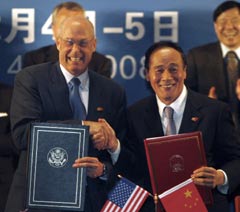
US Treasury Secretary Henry Paulson (L) and Chinese Vice Premier Wang Qishan (R) trade agreements and shake hands at the Eco Partnership signing ceremony during the US China Strategic Economic Dialogue in Beijing December 4, 2008. [Agencies]

In his many years as the United States' top China hand, Henry Paulson captured the hearts, or at least the cameras, of the Chinese media.

Images of him hugging former vice-premier Wu Yi and fervently shaking hands with her successor Wang Qishan were just two among many that made the front pages of the nation's press.

On Friday, the 62-year-old Treasury secretary gave photographers one more opportunity, as he addressed the fifth Sino-US SED, his last time as head of the US delegation.

The former Wall Street banker, and member of the outgoing Bush administration, will step down next month.

In a farewell speech to his Chinese counterparts, Paulson said: "We all can be proud of what we have built through the SED.

Our countries will no doubt face challenges, but with the foundation of mutual respect, trust and candor fostered by the SED, I have no doubt we will come through them."

Clearly in high spirits, Paulson laughed heartily several times during his meeting with President Hu Jintao on Friday afternoon at the Great Hall of the People, providing plenty of his trademark photo opportunities.


Chinese President Hu Jintao (R) meets with United States Treasury Secretary Henry Paulson at the Great Hall of the People in Beijing, capital of China, Dec. 5, 2008. [Agencies]

The past five rounds of SED talks, all of which Paulson took part in, have tackled many difficult issues, including food safety, trade and the environment.

Wu Xiaoqiu, an economics professor at Beijing's Renmin University of China, said: "Dialogue and communication is the right way to solve problems between the two major economies."

While Paulson has been criticized by some US lawmakers for not pressing China on its currency, he once told reporters that it was the SED that prevented Congress from passing legislation that would have deepened tensions between the two countries.

The question now is who will continue Paulson's work.

Although New York Federal Reserve President Timothy Geithner, who assisted Paulson in the recent US bailout action, has been named as the next Treasury secretary, some experts wonder if the Treasury Department will continue to be a key agency in steering the bilateral relationship, or even if the SED will continue at all.

Lawrence Summers, the incoming director of the National Economic Council; Vice-President-Elect Joseph Biden Jr; and Senator Hillary Rodham Clinton, Obama's choice for secretary of state, are all expected to be major coordinators on China policy.

However, none of them has the China experience that Paulson brought with him from his tenure at Goldman Sachs.

Paulson demurred on the question of how the Obama administration will handle the SED and China relations.

On his departure from the Treasury, he said earlier that he expects China to continue to play a part in his life, although he drew the line at learning Mandarin. "I've got a very poor ear for languages," he said.


Read more...

Asian Stocks Fall This Week as Recession Deepens, Oil Plunges

By Chua Kong Ho

Dec. 6 (Bloomberg) -- Asian stocks fell this week as the deepening global recession slashed consumer demand, driving commodity prices lower and dragging down materials companies and oil drillers.

BHP Billiton Ltd., the world’s biggest mining company, dropped 16 percent after oil fell more than $100 a barrel from its record in July and copper prices slumped. Honda Motor Co. sank 21 percent as November U.S. sales plunged the most since 1981. Surfwear maker Billabong International Ltd. tumbled 25 percent in Sydney after cutting its earnings forecast as its U.S. customers deferred deliveries amid the economic contraction.

“The world is in recession and earnings will fall next year for most companies the world over, including Asia,” said Hugh Young, managing director at Aberdeen Asset Management Ltd. in Singapore, overseeing about $45 billion. “Asia is in pretty good shape for surviving, not in great shape for growing.”

The MSCI Asia Pacific Index fell 3.8 percent to 79.52 this week. Raw-materials producers had the biggest percentage decline among the 10 industry groups.

MSCI’s Asian index has plunged 50 percent in 2008 as global financial companies’ losses and writedowns from the collapse of the U.S. subprime-mortgage market neared $1 trillion. Shares on the MSCI gauge are now valued at 9.7 times trailing earnings after falling to as low as 8.2 times last month. That’s half the 19.5 times on Nov. 11 last year, when the measure hit a peak of 172.32. Prior to the current market turmoil, the price-earnings ratio never dropped below 10, according to Bloomberg data.

U.S. Recession

The U.S. entered a recession in December 2007, the National Bureau of Economic Research, a private, non-profit panel of economists that dates American business cycles, said Dec. 1. A government report said the number of Americans receiving jobless benefits in the week ended Nov. 22 jumped to the most since December 1982. A separate report showed orders at U.S. factories in October sank the most since July 2000.

Central banks worldwide stepped up efforts to arrest the economic slowdown. The European Central Bank cut its main refinancing rate by 75 basis points, the most in its 10-year history, while the Bank of England cut its benchmark rate to 2 percent, the lowest level since 1951. The Swedish and Danish central banks also lowered their key rates. The Bank of Korea said it would make a one-time interest payment on central bank reserves and buy more securities.

Japan’s Nikkei 225 Stock Average dropped 7 percent to 7,917.51. Australia’s S&P/ASX 200 Index retreated 6.8 percent. Most markets in Asia fell this week.

BHP declined 16 percent to A$26.15. Inpex Corp., Japan’s largest explorer, sank 14 percent to 529,000 yen. Woodside Petroleum Ltd., Australia’s second-biggest oil producer, retreated 16 percent to A$30.46.

Commodities Retreat

Crude oil has dropped from a peak of $147.27 on July 11 to $41.65 a barrel on the New York Mercantile Exchange. Oil prices may slide below $25 a barrel next year if the global recession spills over into China, Francisco Blanch, a London-based analyst at Merrill Lynch, said Dec. 4.

A measure of six metals traded on the London Metal Exchange, including copper and zinc, fell 14.8 percent this week.

“We’re in an environment where demand is coming off, and that’s putting commodities under pressure,” said Matt Riordan, who helps manage $3 billion at Paradise Investment Management in Sydney. “Things have been slowing down pretty sharply.”

Rio Tinto Group, the third-largest mining company, tumbled 31 percent to A$32, the biggest percentage decline on MSCI’s Asian gauge, on concern it may have difficulty refinancing debt due next year. The company plans to close its iron-ore mines in Western Australia for 12 days as part of an earlier decision to reduce output.

Vehicle Sales

Honda, Japan’s No. 2 automaker, fell 21 percent to 1,653 yen. The carmaker withdrew from Formula One racing, cutting at least 20 billion yen ($216 million) in costs, after its U.S. vehicle sales plunged 32 percent in November.

Toyota Motor Corp. dropped 12 percent to 2,650 yen. Bridgestone Corp., the world’s largest tiremaker, dropped 14 percent to 1,376 yen.

General Motors Corp. Chef Executive Rick Wagoner told lawmakers he would accept strict conditions for a U.S. loan to stay afloat, including a promise to return the money and file for bankruptcy if his company doesn’t fulfill the terms.

Sack Workers

“Regardless of whether the U.S. automakers go bankrupt or stay afloat, they’ll have to sack workers,” said Yoshinori Nagano, a senior strategist at Daiwa Asset Management Co., which manages about $96 billion in Tokyo. “Should the companies collapse, it may trigger a series of business failures and worsen an already weakened U.S. economy.”

Billabong declined 25 percent to A$7.94. The U.S. recession has accelerated a slowdown in demand for clothing and surfing accessories, causing earnings per share to fall in the six months ending December, the Gold Coast, Australia-based company said Dec 4.

Indonesia’s PT Bumi Resources, Asia’s biggest exporter of power-station coal, slumped 25 percent to 760 rupiah after the country’s stock exchange said the company should use internal funds to fund a repurchase of its shares, instead of selling debt.

To contact the reporter responsible for this story: Chua Kong Ho in Shanghai at kchua6@bloomberg.net


Read more...

Brazilian Stocks Gain on Rate-Cut Speculation; Bolsa Rises

By Paulo Winterstein and Alexander Ragir

Dec. 5 (Bloomberg) -- Brazilian stocks staged a late-day rally, paring losses for the week, on speculation that slowing economic growth and easing inflation may give the central bank room to cut interest rates next year.

Banco do Brasil SA, Latin America’s biggest government- controlled bank, jumped 7.9 percent, leading gains for financial companies as traders increased bets the benchmark rate will fall half a percentage point by January 2010. B2W Cia. Global do Varejo, Brazil’s largest online retailer, climbed the most on the Bovespa index on the prospect that lower rates will spur consumer spending. Vivo Participacoes SA rose for a second day as investors sold commodity producers and bought phone stocks.

“The good inflation signals takes away the possibility some economists were floating that there could be inflation with very low growth,” said Joao Pedro Brugger, chief equity portfolio manager at Leme Investimentos in Florianopolis, Brazil, which oversees about $35 million. “It gives space for the central bank to join other policy makers in aggressively cutting rates to stimulate the economy.”

The Bovespa rose 0.6 percent to 35,347.39, paring a weekly drop to 3.4 percent. The BM&FBovespa Small Cap index gained 1 percent. The BM&FBovespa MidLarge Cap index added 0.2 percent. Mexico’s Bolsa advanced 0.8 percent and Chile’s Ipsa increased 0.1 percent.

Inflation in Latin America’s biggest economy slowed to 0.36 percent in November, lower than the forecasts from all 40 economists in a Bloomberg survey. A separate report earlier this week showed industrial output growth slowed more than forecast in October, signaling the global slowdown is hitting Brazil harder and faster than economists predicted.

Yields Drop

The yield on Brazil’s overnight futures contract for January 2010 delivery fell 37 basis points, the sixth straight daily decline, to 13.33 percent. The rate is the lowest since April 17 and is 42 basis points, or 0.42 percentage point, below the central bank’s overnight rate.

Itau Corretora said today that with Brazil’s growth outlook worsening, its estimate of 13 percent for the benchmark lending rate was “too high.” Raymond James & Associates has forecast a half-percentage point cut to 13.25 percent next year. The next rate-setting policy meeting is scheduled for Dec. 9-10.

The European Central bank cut interest rates by three- quarters of a percentage point yesterday to contain the fallout from the financial crisis. Central banks in England, Sweden and Indonesia also lowered borrowing costs.

Banco do Brasil climbed 7.9 percent to 15.75 reais, the highest in a month.

B2W Varejo lead a rally in retailers, advancing 8.8 percent to 22.35 reais for the biggest gain since October.

Telephone Shares

Vivo, Brazil’s largest mobile-phone carrier, rose 6.6 percent to 31.85 reais.

“When commodities prices fall, as we see today, phone carriers’ shares become more attractive,” Alex Pardellas, analyst at Banif Investment Banking in Sao Paulo, said in an interview yesterday.

The Bovespa earlier dropped as much as 3.2 percent after metal prices tumbled and Banco Santander SA recommended avoiding flat-steel makers because of the “dreary” outlook for auto sales. Usinas Siderurgicas de Minas Gerais SA, Brazil’s second- biggest steelmaker, fell 1.8 percent to 22.20 reias.

Petroleo Brasileiro SA slid 2.4 percent to 18.16 reais as crude prices tumbled to the lowest in almost four years. Petrobras, as the state-controlled oil company is known, lost 9.5 percent for the week.

Mexico’s Bolsa index also reversed earlier declines, led by plastics maker Mexichem SAB after it said sales next year will rise by almost a third.

Mexichem, Latin America’s largest maker of plastic pipes, rose the most in the Bolsa index after it said its 2008 sales may reach 30.3 billion pesos ($2.2 billion), a 32 percent jump from last year. The shares gained 5.9 percent to 12.30 pesos.

Argentina’s Merval index increased 0.8 percent, Colombia’s IGBC index fell 1 percent and Peru’s Lima General index declined 2.7 percent.

To contact the reporter on this story: Paulo Winterstein in Sao Paulo at pwinterstein@bloomberg.net; Alexander Ragir in Rio de Janeiro at aragir@bloomberg.net.


Read more...

U.S. Stocks Jump as Hartford Surges on Boosted Profit Forecast

By Elizabeth Stanton

Dec. 5 (Bloomberg) -- U.S. stocks jumped, reversing an early slide, as Hartford Financial Services Group Inc. led a rally in insurers after increasing its profit forecast and saying it’s weathering the credit crisis.

Hartford, which tumbled 92 percent in 2008 before today, doubled and all 21 insurance companies in the Standard & Poor’s 500 Index advanced. Prudential Financial Inc. and MetLife Inc. climbed at least 22 percent as UBS AG said they may benefit from potential regulatory changes. The gains helped the market overcome a morning tumble spurred by government data showing the nation lost the most jobs in 34 years last month as the recession deepened.

“The bad news is out; people know the economy’s lousy,” said Barry James, president of James Investment Research in Xenia, Ohio, which oversees $2 billion. “The market is so oversold that we’re entering into what I’d call a bear-market rally.”

The S&P 500 rose 3.7 percent to 876.07 after retreating 3.2 percent earlier. All 10 industry groups advanced as the benchmark index for U.S. stocks pared losses in its fourth weekly retreat since October. The Russell 2000 Index of small U.S. companies climbed 4.9 percent to 461.09. The Dow Jones Industrial Average added 259.18 points, or 3.1 percent, to 8,635.42.

Rebound Extended

The S&P 500 extended its rebound from an 11-year low on Nov. 20 to 16 percent, gains driven in part by speculation the Federal Reserve will cut interest rates and Congress will pass another economic stimulus. Still, the benchmark index for U.S. equities is down 40 percent in 2008, headed for its worst year since 1931, after the collapse of the subprime mortgage market reduced average profits for five consecutive quarters.

The S&P 500 trimmed its weekly loss to 2.3 percent, while the Dow fell 2.2 percent and the Nasdaq Composite decreased 1.7 percent in the week.

Hartford jumped a record 102 percent to $14.59 and pared its yearly loss to 73 percent. The insurer raised its full-year operating profit forecast and said the capital outlook at its insurance subsidiaries is “strong.” The company’s operating businesses are “performing well, particularly in light of the challenging markets,” Chief Executive Officer Ramani Ayer said.

Insurance Rally

The S&P 500 Financials Index added 8.6 percent for the steepest advance among 10 industry groups, as insurance companies climbed 14 percent collectively. Prudential jumped 35 percent to $28.52. MetLife gained 22 percent to $30.76. Bank of America Corp., JPMorgan Chase & Co. and Citigroup Inc. each climbed at least 4.1 percent.

Hartford, Prudential, MetLife, Lincoln National Corp. and money manager Ameriprise Financial Inc. would benefit if the National Association of Insurance Commissioners opts to relax capital requirements for managers of variable annuities, UBS’s Andrew Kligerman wrote in a report today. The association is likely to reach a decision by year-end and could announce one as early as Dec. 9, Kligerman said.

Annuities are retirement products that guarantee buyers income for life in return for an up-front payment.

Financial stocks in the S&P 500 last week traded for an average of 0.8 times book value, the lowest in at l3 years. Banks are posed for their worst annual drop on record and have plunged 66 percent since reaching an all-time high in February 2007.

SanDisk, Micron

SanDisk Corp. climbed 14 percent to $9.23. The world’s largest maker of memory cards used in digital cameras is poised to benefit from a reduction in the supply of so-called NAND semiconductors, American Technology Research said in upgrading the stock to “buy” from “neutral.”

AmTech analyst Dinesh Moorjani also upgraded Micron Technology Inc. to “buy,” citing falling supply. The largest U.S. memory chip maker gained 13 percent to $2.04, helping push an index of technology companies to the second-biggest advance in the S&P 500.

The market’s earlier retreat came after the Labor Department reported that the nation lost 533,000 jobs last month, 59 percent more than the average estimate in a Bloomberg survey. The decrease exceeded all 73 forecasts in the survey. The unemployment rate rose to 6.7 percent, the highest level since 1993.

“We’re looking at a pretty ugly economic outlook, but an awful lot of that is being reflected” in stock prices, Leo Grohowski, chief investment officer at Bank of New York Mellon Wealth Management, which oversees $158 billion, said on Bloomberg Television.

General Motors Corp. fell 0.7 percent to $4.08 after saying it will cut production at four North American plants next year. GM, the biggest U.S. automaker, and rivals Ford Motor Co. and Chrysler LLC are asking Congress for a combined $34 billion to stay afloat. Lawmakers are considering options such as providing automakers with enough aid to get them through next year’s first quarter on condition they make significant progress on restructuring their operations.

To contact the reporter on this story: Elizabeth Stanton in New York at estanton@bloomberg.net.


Read more...