Economic Calendar

Sunday, December 14, 2008

U.K. Government May Extend Aid to Carmakers as Job Threat Rises

By Craig Stirling

Dec. 14 (Bloomberg) -- Prime Minister Gordon Brown’s government is considering financial aid for carmakers as the threat of job losses mounts in an industry that almost 800,000 British workers depend on.

Business Secretary Peter Mandelson may offer loan guarantees to auto companies’ finance arms to raise sales and grant a loan to Tata Motors Ltd.’s Jaguar business, the Sunday Times reported today, without saying how it obtained the information. One option is to use 400 billion pounds ($597 billion) set aside for the banking industry to make low-cost loans, the newspaper said.

“What we need is short-term support, short-term access to cash now to make sure that our companies stay alive,” Tony Woodley, joint leader of Unite, the country’s biggest union, told Sky News today. “It was right to bail out the banks and it’s absolutely appropriate now to do something about manufacturing.”

U.S. President George W. Bush’s administration said last week it will consider using money from the $700 billion bank bailout fund to prevent automakers General Motors Corp. or Chrysler LLC from “collapsing.” Brown wants to limit the fallout in Britain as the recession threatens to push unemployment to an eight-year high.

The U.K. government is monitoring the situation with the car industry, a spokesman for the Department for Business, Enterprise and Regulatory Reform said by phone today.

Exceptional Measures

Ministers have said they want to do all they can to help viable businesses and the government needs to ensure it’s taking action to help companies through difficult times, said the official, who declined to be identified in line with U.K. government practice. Any direct intervention would be exceptional, he said.

“People are worried about their jobs, they’re worried about their homes, and that’s exactly when you need governments to step in and act to do something about that to help people through it,” U.K. Treasury Chief Secretary Yvette Cooper said in an interview on the BBC’s Sunday AM show.

Any deal to guarantee car loans would be good news for the industry, Denis Chick, Luton-based director of communications at GM’s U.K. business, said in an interview.

“We can’t get money out of banks to loan to customers to buy cars,” Chick said. “We are doing everything we can to avoid forced redundancies.”

Brown said last week that the government is working on the “second stage” of a rescue for banks, which are reluctant to lend even after tapping into a 50 billion-pound program to bolster their capital. The government now faces pressure to extend aid elsewhere as manufacturing endures the worst stretch of contraction since 1980 and construction slumps.

‘Difficult Time’

Total manufacturing jobs fell by 55,000 in the third quarter from a year earlier to 2.86 million. Unemployment data due on Dec. 17 may show claims for U.K. jobless benefit rose in November to the highest since 2000, according to the median forecast of 24 economists in a Bloomberg News survey.

The British auto industry supports 200,000 manufacturing jobs and another 580,000 workers in other areas such as sales, servicing and refueling, according to data on the Web site of the U.K. Society of Motor Manufacturers and Traders.

Carmakers need “an ability to access liquidity at such a very, very difficult time, and not just from the manufacturers here,” said Woodley, speaking at Ellesmere Port in northwest England, where GM’s U.K. division makes Vauxhall cars. “The component companies are going to jettison tens of thousands of workers unless of course there’s a clear plan.”

GM Measures

GM has offered staff at Ellesmere Port as much as nine months vacation paid at 30 percent of salary as it seeks to cut costs and avoid job losses.

The company’s two priorities are to sell cars and save money, and GM isn’t tight for cash in Britain, Chick said.

Conservative Party lawmaker Michael Fallon, a member of Parliament’s Treasury Committee, said the government should avoid favoritism in its plans. The Conservatives had support of 41 percent of voters in a YouGov Plc poll published in the Sunday Times today, compared with 35 percent for Brown’s Labour Party.

“We’ve got to be very, very careful not to single out particular plants or indeed particular industries in a recession and give them job protection or whatever against the changes that are necessary while other people, particularly smaller businesses, go to the wall,” Fallon told Sky News.

To contact the reporter on this story: Craig Stirling in London at cstirling1@bloomberg.net.


Read more...

Total Refineries Resume Operation After Strike, Spokesman Says

By Sandrine Rastello

Dec. 14 (Bloomberg) -- Total SA refineries in France are functioning normally after a two-day strike disrupted operations at Europe’s third-biggest oil company.

“Work resumed on all sites yesterday evening,” Charles Foulard, a spokesman for the Confederation Generale du Travail labor union said by telephone today. Employees who had voted to halt production yesterday changed their mind after colleagues at two other sites opted against it, he said.

Total on Dec. 12 completed a wage increase proposal for the whole company that will be submitted to unions this week, company spokesman Michael Crochet-Vourey said. The CGT union has decided not to sign it, Foulard said.

Total operates six refineries in France, which have a total capacity of about 52.7 million tons a year, according to data on the Web site of the Union Francaise des Industries Petrolieres, an oil industry trade organization.

To contact the reporters on this story: Sandrine Rastello in Qatar at srastello@bloomberg.net


Read more...

Reichmuth Warns Investors of $330 Million in Madoff Losses

By Naomi Kresge

Dec. 14 (Bloomberg) -- Swiss private bank Reichmuth & Co. warned investors in its Reichmuth Matterhorn fund of hedge funds that they face losses of as much as $330 million related to Bernard Madoff’s investment advisory business.

In a letter to clients, the bank, based in the Swiss city of Lucerne, said the “performance impact” on its fund would amount to a decline of 8.6 percent in the value of its assets. The fund totals about $3.9 billion, Chief Executive Officer Christof Reichmuth said in an interview today.

“It’s unbelievable that no auditor, no administrator, no fund manager noticed this fraud,” Reichmuth said by telephone. “We will have to wait to find out how that was possible.”

Madoff, 70, who had advised the U.S. Securities and Exchange Commission how to regulate markets, was arrested Dec. 11 and charged with operating what he told his sons was a long-running Ponzi scheme in the New York-based firm’s business advising rich people, hedge funds and institutions.

Reichmuth Matterhorn invested in four hedge funds that had business relationships with Madoff, CEO Reichmuth said.

With the potential loss, the Matterhorn fund would be down 18.4 percent for the year to November, according to the letter to clients, which was posted on the bank’s Web site.

“The occurrence is inexplicable,” the letter said. “Further, all periodically proved transactions appeared plausible. Yet no one is immune against fraud,” it said.

To contact the reporter on this story: Naomi Kresge in Zurich at nkresge@bloomberg.net


Read more...

Russia Won’t Let Ruble Float Free, Deputy Central Banker Says

By Greg Walters

Dec. 14 (Bloomberg) -- Russia won’t let the ruble float freely and may continue to widen the band in which the currency is allowed to trade, the first deputy chairman of Russia’s central bank, Alexei Ulyukayev, said.

“We will not allow it to float freely and we won’t scrap the limits,” Ulyukayev said in an interview with the radio station Ekho Moskvy posted on its Web site. “We have widened the boundaries and apparently, in some way, will continue to widen them to make it a quasi-free flotation.”

The bank has widened the trading band six times, “each time symmetrically and by about 1 percent,” he said.

The ruble was at 31.9090 versus the central bank’s currency basket as of 5 p.m. Dec. 12, the weakest end of the band that was widened by 30 kopeks, or 1 percent, Dec. 11. U.S. dollars make up 55 percent of the basket. The rest is in euros. It is used to limit currency swings that affect exporters. Ulyukayev said the ruble’s recent trend lower may reverse.

“Let’s talk in a few months, when we see it can move in more than one direction,” he said.

To contact the reporter on this story: Greg Walters in Moscow gwalters1@bloomberg.net


Read more...

CVM Minerals Cuts Price for Hong Kong Initial Offer

By Joshua Fellman

Dec. 14 (Bloomberg) -- CVM Minerals Ltd., a Malaysia-based magnesium producer, cut the offering price for its initial stock sale in Hong Kong to HK$1.05 per share from HK$1.18.

Global financial turmoil and adverse market conditions prompted the price cut, CVM said in a filing to Hong Kong’s stock exchange today. The company will raise a net HK$80.9 million ($10 million) from the share sale, according to its revised prospectus.

Applicants for shares in CVM must confirm their requests for their orders to be processed, the statement said.

Hong Kong IPOs: {TNI HK INI }


Read more...

Ocean Grand Chemical Will Seek to Buy Stake in Bankrupt 3D-Gold

By Joshua Fellman

Dec. 14 (Bloomberg) -- Ocean Grand Chemicals Holdings Ltd. will submit an application to liquidators to buy an interest in Hong Kong retailer 3D-Gold Jewellery Holdings Ltd.

Should Ocean Grand unit China Gold Silver Group Co. win the bid, it will enter a restructuring agreement with the provisional liquidators to acquire the stake, Ocean Grand said in a filing to Hong Kong’s stock exchange today.


Read more...

Yanjing Brewery Raises 1.12 Billion Yuan in Private Share Sale

By Lee Spears

Dec. 14 (Bloomberg) -- Beijing Yanjing Brewery Co., China's third-biggest brewer, raised 1.12 billion yuan ($164 million) in a private share sale, the company said in a statement to the Shenzhen stock exchange.

The company sold 110 million new shares at 10.20 yuan apiece, a 21 percent discount to the stock's closing price on Dec. 12. The proceeds will be used to finance production expansion.

Yanjing Brewery's parent bought 88.3 million shares, and three investment companies bought the remainder, the statement said.

To contact the reporter on this story: Lee Spears in Beijing at lspears2@bloomberg.net.


Read more...

Hainan Airlines to Buy Hotel, Office Tower Assets in Beijing

By Lee Spears

Dec. 14 (Bloomberg) -- Hainan Airlines Co., the Chinese airline backed by U.S. billionaire George Soros, will pay 2.35 billion yuan ($343 million) to buy a hotel stake and an office tower in Beijing.

Hainan Airlines plans to pay 619 million yuan to buy 45 percent of Beijing Yanjing Hotel Co. from its affiliate Hainan Hotels and Resorts, it said in a statement to the Shenzhen stock exchange yesterday.

The airline will also pay 1.73 billion yuan to buy 65 percent of Beijing Kehang Investment Ltd. from Yangzijiang Real Estate Group and another 30 percent of Beijing Kehang from Hainan Hotels and Resorts, the statement said.

The transactions will be settled in cash and are pending the approval of Hainan Airlines shareholders, the statement said.

To contact the reporter on this story: Lee Spears in Beijing at lspears2@bloomberg.net.


Read more...

Citic Pacific Denies Police Investigation of Currency Losses

By Aaron Pan

Dec. 14 (Bloomberg) -- Citic Pacific Ltd., a unit of China’s biggest state-owned investment company, denied a report that Hong Kong police are investigating possible criminal liability in connection to losses from unauthorized currency bets.

The Sunday Morning Post reported today, citing an unidentified person close to the matter, that police are investigating possible fraud and the reasons for a six-week delay in disclosing the losses.

Hong Kong-based Citic Pacific said in October that wrong-way bets on the Australian dollar may cost it about $2.2 billion, the biggest currency trading loss by a China-backed company.

“Neither the company nor management have been approached by the police in connection with these matters,” Tim Payne, a employee of Brunswick Group Ltd., engaged by Citic Pacific to speak on its behalf, said in a phone interview today.

Anita Chow, a Hong Kong police spokeswoman, said the force doesn’t comment on individual cases. “We maintain close communication with financial monitoring organizations,” Chow said in a phone interview today.

To contact the reporter on this story: Aaron Pan in Hong Kong at Apan8@bloomberg.net


Read more...

Pakistan Bourse to Lift Trading Curb Even as Court Orders Delay

By Khalid Qayum and Farhan Sharif

Dec. 14 (Bloomberg) -- The Karachi Stock Exchange, Pakistan’s biggest, plans to lift stock trading limits tomorrow as scheduled even as a high court judge ordered a delay, a board member said.

The stock exchange is also seeking guidance from the Securities & Exchange Commission, which said yesterday it would “challenge” the court order if it’s forced to hold back the removal of the trading restriction tomorrow. A judge at the Sindh High Court ordered the delay until at least Dec. 16, the Business Plus news channel reported.

“As of now, the market will open tomorrow,” Dawood Jan Muhammed, a director on the Karachi exchange’s board, said in a phone interview today. A letter seeking further clarification was sent by the board to the regulator yesterday, he added.

The trading curbs have prevented stocks from falling below their Aug. 27 closing prices, shielding investors from a record sell-off. The MSCI AC Asia Pacific Index has fallen 31 percent since the restriction was first imposed on Aug. 27. The rupee has fallen more than 21 percent this year, and is set for its biggest annual decline in more than two decades.

“We are reviewing the order and our lawyers will guide us on how to proceed on it,” Razi-ur-Rahman Khan, chairman of the Islamabad-based regulator, said in a telephone interview late yesterday. “If the court ruling is against our order of lifting limits on share trading on Dec. 15, we will challenge it in court.”

Brokers of Pakistani stocks want the government to support the stock market with a 20 billion rupee ($254 million) fund and provide a mechanism to manage the continuous funding system, or purchasing shares through borrowed funds, before the trading limits are lifted.

Shares May Fall

Pakistan stocks may decline as much as 50 percent after trading limits are lifted tomorrow, almost four months after they were initially imposed amid political upheaval, Citigroup Inc. said on Dec. 12. The stock exchange is expected to retain a 5 percent daily trading limit that existed before the curbs were imposed.

Pakistan will be removed from the MSCI Emerging Markets Index this month because of the restrictions on selling stock, MSCI Inc. said this week. The deletion will take effect at the close of trading on Dec. 31. The regulator announced the lifting of trading curbs on Dec. 11.

The Karachi 100 Index now trades at 9.9 times earnings, compared with the MSCI Emerging Markets Index’s 8.3 times. That makes Pakistan Asia’s fourth-most expensive market, tracking benchmarks in China, Japan and New Zealand.

The Karachi 100’s gains diminished this year -- after rising 11-fold when Pakistan’s economy expanded at least 4.7 percent a year between the end of 2001 and 2007 -- as the global credit freeze sent the rupee to a record low, the balance of payments deficit expanded to its widest level ever and inflation rose to a 30-year high.

The benchmark index has declined 35 percent this year, on course to complete its worst annual performance in 10 years. The emerging markets index has lost 56 percent.

To contact the reporters on this story: Khalid Qayum in Islamabad at kqayum@bloomberg.net; Farhan Sharif in Karachi at fsharif2@bloomberg.net


Read more...

China to Raise Money Supply 17% in 2009, Boost Loans

By Lee Spears

Dec. 14 (Bloomberg) -- China aims to increase its money supply 17 percent in 2009 and encourage lending to boost domestic consumption and buoy growth in the world’s fourth-largest economy.

M2, the broadest measure, including cash and all deposits, will increase 17 percent, the State Council said in a statement on its Web site. The government will also suspend the issue of three-year central-bank notes and aims to increase total financial-institution lending by 4 trillion yuan ($584 billion) next year, the statement said.

The People’s Bank of China is taking measures to boost liquidity and bank lending that the economy needs to sustain growth amid a global recession. The government last month announced 4 trillion yuan of spending through 2010 to spur more investment by municipalities and enterprises.

“Policy at the moment is generally being focused on boosting liquidity in the banking sector and making sure that is lent to fund investment in infrastructure projects,” Glenn Maguire, chief Asia-Pacific economist at Societe Generale SA in Hong Kong, said today.

Money supply gained 15 percent in October from a year earlier. China cut interest rates by the most in 11 years last month and has lowered the proportion of deposits that lenders must set aside as reserves. It has also scrapped temporary loan controls and sold fewer bills to try to boost liquidity.

China will boost policy-directed bank loans over the 2008 level of 100 billion yuan and will aim to increase total lending by financial institutions by 4 trillion yuan, said the statement, dated Dec. 8 and posted on the Web site late yesterday.

Corporate Bonds

One-year and three-month central bank notes will be issued less frequently, the statement said.

The government will encourage the expansion and development of corporate bonds, short-term financing bonds and medium-term notes, the statement said. Preference will be given to the issuance of bonds that fund infrastructure, post-earthquake construction and environmental protection, it said.

Banks should “give lending support to companies with relatively sound fundamentals, relatively good credit records, who are competitive, who have a market, who have orders but are having temporary operating or financial difficulties,” the statement said.

The government told banks to lend more to support areas in line with those promoted by government policy, including infrastructure, rural development, high technology and environmental technology. It also advised them to limit lending to processors and other industries that are big energy consumers.

Directions to Banks

“Commercial banks and other financial institutions should continue to deepen reforms of all kinds, improve management, internal controls and risk-prevention systems,” the statement said. “They should manage a balance between using finance to boost economic growth and guarding against financial risk; they should avoid being blindly reluctant to lend during an economic downturn.”

The statement also said new futures for commodities, including products including steel and grain, should be introduced to meet the needs of economic development.

The government will “take effective measures to stabilize the stock market,” the State Council statement said. Mainland China’s benchmark CSI 300 Index has lost 63 percent this year, making it the second-worst performer in Asia.

China will “increase flexibility” for lowering lending rates and also increase flexibility in foreign-exchange rates as it aims to maintain a “stable, balanced” yuan exchange rate, the statement said.

To contact the reporter on this story: Lee Spears in Beijing at lspears2@bloomberg.net.


Read more...

Nations show unity at 1st trilateral summit

Updated: 2008-12-14

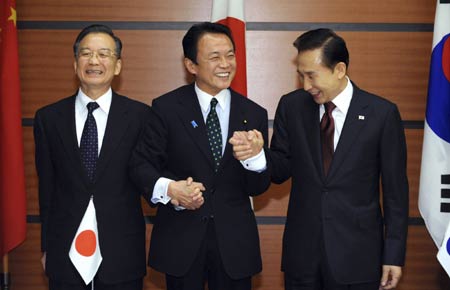
(China Daily) FUKUOKA, Japan – The leaders of China, Japan and South Korea said Saturday that Asia must be the engine of growth to counter global financial turmoil and vowed to rev up their economies with infrastructure projects and bolster domestic demand.


From left to right: Chinese Premier Wen Jiabao, Japanese Prime Minister Taro Aso, and South Korean President Lee Myung-bak grasp hands after their signing of a tripartite declaration agreement at a three-country summit at the Kyushu National Museum in Dazaifu, southern Japan, December 13, 2008. [Agencies]

The Asian nations, which together make up 75 percent of the east Asian economy, were holding their first-ever three-way summit, with Chinese Premier Wen Jiabao, Japanese Prime Minister Taro Aso and South Korean President Lee Myung-bak attending.

The global financial slowdown was atop their agenda.


"The current financial crisis continues to spread," Wen said at a joint news conference. "We are important economic players in Asia and the world, and we must strive to respond to this once-in-a-century crisis."

In a joint statement, the leaders said they believed Asia must be a center of growth to counter the sliding world economy. They said they would push domestic demand and infrastructure projects while refraining from raising new barriers to investment or trade over the next 12 months.

"The three leaders shared the view that efforts need to be strengthened to minimize the negative impacts that the current financial turmoil could have on the world economy," the statement said. "Asian countries are expected to play a role as the center of world economic growth."

Meeting ahead of the summit, Aso and Lee welcomed a deal reached the night before to increase a bilateral currency swap arrangement to the equivalent of $20 billion. The Bank of Korea also announced a deal with the People's Bank of China worth about $26 billion.

"This is very meaningful," Lee said of the currency swap arrangement. "We translated cooperation into action."

Swaps generally entail one central bank borrowing a currency from another and offering an equivalent amount of its own as collateral.

Seoul has seen its own currency reserves dwindle and feared that without the swap arrangements it could suffer a foreign exchange crisis because of the global financial turmoil. The South Korean won has declined 32 percent this year amid record selling of South Korean stocks by foreign investors.

The three leaders said they planned to make the trilateral summit an annual event and strengthen ties through increased political and cultural exchanges.

"Politically and economically, we have a very significant presence in the region," Aso said. "We should have had this kind of a summit sooner."

Though their countries are often at odds over the legacy of Japan's militarist past, solidarity was the word of the day.

Officials said the summit was intended to be a show of unity in the face of the global economic downturn and was an important step toward better relations overall between the three neighbors.

Left off the table was lingering animosity over Japan's pre-1945 colonization of Korea and its often brutal aggression on the Asian mainland in the first half of the last century. Such issues have frequently flared up in the past and continue to be a thorn in relations.

Japanese officials said it was "significant" that the three countries were putting such issues behind them and trying to approach the summit with a more forward-looking stance.

Read more...

American Air, Baggage Handlers End Talks; Mediation May Be Next

By Mary Schlangenstein

Dec. 13 (Bloomberg) -- American Airlines and a union representing about 14,000 baggage handlers and other ground workers ended talks after the sides failed to reach a contract after almost two weeks of negotiations.

American, the second-biggest U.S. carrier, and the Transport Workers Union agreed in advance to ask the National Mediation Board for help should they fail to agree during daily talks that began Dec. 2. Talks extended beyond an original Dec. 8 deadline in an effort to reach a contract.

“We discontinued the negotiation last night,” said Tami McLallen, a spokeswoman for American, a unit of AMR Corp. She declined to confirm a mediator will be brought in, saying more details will be released on Monday.

American is already in assisted talks with two other groups, its pilots and its flight dispatchers. The Fort Worth, Texas- based airliner is trying to control the cost of new labor contracts as demand declines and fuel prices reached records earlier this year.

The negotiations with the ground workers had focused on wages, benefits and work rules. Talks between American and the Transport Workers Union, which represents 25,000 employees in seven work groups, began in November 2007.

The TWU group in the suspended talks represents baggage and cargo handlers, fleet service workers, aircraft-part clerks, simulator technicians and ground school and simulator instructors.

To contact the reporter on this story: Mary Schlangenstein in Dallas at maryc.s@bloomberg.net


Read more...

Access International Says Funds Invested With Madoff

By Saijel Kishan

Dec. 13 (Bloomberg) -- Access International Advisors LLC said some of its funds invested with Bernard Madoff, who was charged with perpetrating a $50 billion fraud on hedge funds and wealthy investors.

Access, a New York-based investment firm, said in a letter to clients yesterday that funds including LUXALPHA SICAV- American Selection invested with Bernard L. Madoff Investment Securities LLC and that it’s working with counsel to assess the situation. Access called Madoff’s arrest “a shocking development.”

The LUXALPHA SICAV fund had $1.4 billion in assets as of Nov. 17, according to data compiled by Bloomberg. Investors in the fund include Rothschild & Cie Gestion, a unit of the Rothschild group, through its Elite fund.

Madoff, 70, confessed to employees this week that his investment company was “a giant Ponzi scheme” that cost clients $50 billion. Yesterday, a federal judge in New York ordered any remaining assets frozen while the FBI and other investigators try to determine what happened and where the money went.

To contact the reporters on this story: Saijel Kishan in New York at skishan@bloomberg.net


Read more...

Dollar Slumps Versus Yen as Automakers Raise Recession Concern

By Jamie McGee and Michael J. Moore

Dec. 13 (Bloomberg) -- The dollar fell to a 13-year low against the yen on concern General Motors Corp. and Chrysler LLC will collapse into bankruptcy without a rescue from the Bush administration.

Japan’s yen also pared its gain against major currencies on speculation investors will curb so-called carry trades and after Finance Minister Shoichi Nakagawa said the country isn’t considering foreign-exchange intervention. The euro posted its biggest weekly gain against the dollar since the currency’s 1999 debut on bets the Federal Reserve will lower borrowing costs to near zero next week while European Central Bank officials suggested they may be approaching the end of interest-rate cuts.

“We would expect the yen to remain strong,” Nick Bennenbroek, head of currency strategy at Wells Fargo & Co. in New York, said in an interview on Bloomberg Television. “The auto situation adds to that.”

The dollar fell 1.8 percent this week to 91.21 yen, from 92.83 on Dec. 5. It touched 88.53 yesterday, the lowest level since August 1995. The U.S. currency’s six weeks of declines is the longest stretch of losses since December 2004.

The euro increased 5.1 percent to $1.3369 from $1.2718, a record weekly gain. The euro advanced 3 percent to 121.83 yen from 118.18.

Won, Sterling

The South Korean won was the biggest gainer versus the dollar this week, climbing 7.5 percent to 1,372.45. South Korea agreed on bilateral currency swap accords with Japan and China to protect financial stability in Asia.

Sterling fell to 89.97 pence per euro, the weakest since the European currency began trading. HBOS Plc said this year’s charge for bad loans rose to 5 billion pounds ($7.5 billion).

The ICE’s Dollar Index, which tracks the greenback against the euro, the yen, the pound, the Canadian dollar, the Swiss franc and Sweden’s krona, fell 4 percent to 83.644. It touched 88.464 on Nov. 21, the highest since April 2006.

“The dollar’s status as a safe-haven currency is being challenged,” said Bilal Hafeez, global head of currency strategy in London at Deutsche Bank AG.

GM and Chrysler won a reprieve until January after the Bush administration said yesterday it may finance an industry rescue with funds set aside for banks. The White House’s reversal on tapping the Troubled Asset Relief Program for short-term aid followed the Senate’s rejection of a short-term loan package for GM and Cerberus Capital Management LP’s Chrysler.

U.S. retail sales fell in November for a record fifth consecutive month, led by slumping auto dealers and service stations. The 1.8 percent decrease reported yesterday by the Commerce Department extended the longest stretch of declines since records began in 1992.

Rate Expectations

Traders expect the Fed to cut borrowing costs to the lowest ever at its Dec. 16 meeting. Futures on the Chicago Board of Trade show a 74 percent chance the central bank will lower the 1 percent target rate to 0.25 percent. The rest of the bets are for a reduction to 0.5 percent.

European Central Bank council member Axel Weber said on Dec. 11 he “would like to avoid” lowering the euro zone’s interest rate below 2 percent. The ECB reduced the main refinancing rate by 0.75 percentage point to 2.5 percent, the most in its history.

The U.S. currency fell 18 percent against the yen this year, the most since 1987, as $986 billion of credit-market losses at the world’s largest financial companies since the start of 2007 sparked a seizure in money markets and threw the U.S. economy into a recession.

Yen Strength

“We still think there is room for the yen to strengthen,” said Vassili Serebriakov, a currency strategist at Wells Fargo & Co. in New York. “Market volatility will likely remain high and will contribute to yen strength.” The yen will appreciate to below 90 per dollar again in coming weeks, he forecasts.

Nakagawa told reporters in Tokyo yesterday that Japan isn’t considering currency intervention right now. Japan last intervened on its own when it sold a record 20.4 trillion yen ($227 billion) in 2003 and 14.8 trillion yen in the first quarter of 2004, when the yen gained to 103.42 per dollar.

Governments intervene in currency markets when they buy or sell currencies to influence exchange rates.

The pound weakened after HBOS, which agreed to a takeover by Lloyds TSB Group Plc, said bad loans will keep rising as credit conditions deteriorate, signaling the U.K. economic slump is intensifying. The implied yield on the March short-sterling futures contract fell as traders increased bets the Bank of England will keep cutting interest rates to revive the economy.

The Bank of England cut its interest rate to 2 percent on Dec. 4, from 5.5 percent at the start of the year, as policy makers tried to limit the fallout from the global financial crisis.

To contact the reporters on this story: Jamie McGee in New York at jmcgee8@bloomberg.net; Michael J. Moore in New York at mmoore55@bloomberg.net


Read more...

Toyota Delays Investment Amid Sales Decline, Nikkei Reports

By Kanoko Matsuyama

Dec. 14 (Bloomberg) -- Toyota Motor Corp. will delay investment in boosting capacity at its overseas factories as declining sales and a strengthening yen reduce earnings, the Nikkei newspaper reported.

The automaker will freeze investment in a plant in Tianjin, China that makes Crown sedans and delay starting operations at a factory in Changchun until after 2011, the Nikkei reported without saying where it obtained the information.

The company, based in Toyota City, Japan, will also delay making Corolla cars in Brazil and India, the Nikkei said.

“We have been reviewing our new projects including in India, Brazil, China and the U.S., as we announced on Nov. 6,” Hideaki Homma, spokesman for Toyota, said today by telephone when called by Bloomberg. “Nothing has been decided. We will report if there are any changes to plans.”

Toyota has been spending 1.5 trillion yen annually ($16.46 billion) on new facilities worldwide in the past few years, the Nikkei said.

To contact the reporter on this story: Kanoko Matsuyama in Tokyo at at kmatsuyama2@bloomberg.net.


Read more...

Japan Asks Central Bank to Buy Commercial Paper, Nikkei Reports

By Kanoko Matsuyama

Dec. 14 (Bloomberg) -- Japan’s government is asking its central bank to consider buying commercial paper held by financial institutions, the Nikkei newspaper reported today, without saying where it obtained the information.

The Bank of Japan currently takes commercial paper as collateral when it lends money to banks, and it was unclear if the central bank would make purchases, the Nikkei said.

The Japanese government decided to buy commercial paper directly through the Development Bank of Japan in the second stimulus package, the Nikkei said.

To contact the reporter on this story: Kanoko Matsuyama in Tokyo at at kmatsuyama2@bloomberg.net.


Read more...

Pakistani Exchange Seeks Clarification on Trading Limit Removal

By Khalid Qayum and Farhan Sharif

Dec. 14 (Bloomberg) -- The Karachi Stock Exchange, Pakistan’s biggest, is seeking “clarification” from the regulator on the lifting of stock trading limits tomorrow, Managing Director Adnan Afridi said, after a court order threatened to delay the plan.

The Securities & Exchange Commission said yesterday it will “challenge” a court order if it’s forced to delay the removal of the trading restriction tomorrow. A judge at Pakistan’s Sindh High Court ordered the easing of trading limits be delayed until at least Dec. 16, the Business Plus news channel reported, citing the court’s order.

“We are reviewing the order and our lawyers will guide us on how to proceed on it,” Razi-ur-Rahman Khan, chairman of the Islamabad-based regulator, said in a telephone interview late yesterday. “If the court ruling is against our order of lifting limits on share trading on Dec. 15, we will challenge it in court.”

The trading curbs have prevented stocks from falling below their Aug. 27 closing prices, shielding investors from a record sell-off. The MSCI AC Asia Pacific Index has fallen 31 percent since the restriction was first imposed on Aug. 27. The rupee has fallen more than 21 percent this year, and is set for its biggest annual decline in more than two decades.

Afridi also said in the telephone interview yesterday that the exchange will review the court order with its directors, and plans to seek further clarification from the commission.

Brokers of Pakistani stocks want the government to support the stock market with a 20 billion rupee ($254 million) fund and provide a mechanism to manage the continuous funding system, or purchasing shares through borrowed funds, before the trading limits are lifted.

Defaults

“Without the support fund and continuous funding system, there might be defaults by lots of brokers in the first few days,” said Shuja Rizvi, director of broking operations at Capital One Equities in Karachi. The investors and brokers are in no position to return borrowed funds, he said.

Pakistan stocks may decline as much as 50 percent after trading limits are lifted on Dec. 15, almost four months after they were initially imposed amid political upheaval, Citigroup Inc. said. The stock exchange is expected to retain a 5 percent daily trading limit that existed before the curbs were imposed.

“On fears of selling by foreigners and unwinding of leveraged positions, the market is expected to decline by 40 percent to 50 percent from the floor level,” Salman Ali, a Citigroup research director based in Karachi, said in a Dec. 12 report. “The currency may also come under pressure.”

Pakistan will be removed from the MSCI Emerging Markets Index this month because of the restrictions on selling stock, MSCI Inc. said this week. The deletion will take effect at the close of trading on Dec. 31.

Expensive Market

The Karachi 100 Index now trades at 9.9 times earnings, compared with the MSCI Emerging Markets Index’s 8.3 times. That makes Pakistan Asia’s fourth-most expensive market, tracking benchmarks in China, Japan and New Zealand.

The Karachi 100’s gains diminished this year -- after rising 11-fold when Pakistan’s economy expanded at least 4.7 percent a year between the end of 2001 and 2007 -- as the global credit freeze sent the rupee to a record low, the balance of payments deficit expanded to its widest level ever and inflation rose to a 30-year high.

The benchmark index has declined 35 percent this year, on course to complete its worst annual performance in 10 years. The emerging markets index has lost 56 percent.

To contact the reporters on this story: Khalid Qayum in Islamabad at kqayum@bloomberg.net; Farhan Sharif in Karachi at fsharif2@bloomberg.net


Read more...

EU Negotiators Strike Deal on National 2020 Emission Targets

By John Rega and Fred Pals

Dec. 13 (Bloomberg) -- Belgium’s government will push to proceed with the sale of Fortis assets to BNP Paribas SA even after the country’s appeals court froze the deal because it didn’t have shareholder approval.

The Brussels Court of Appeals ruled yesterday that the 14.5 billion-euro ($19 billion) asset sale must be put to investors for a vote before Feb. 12. The court also appointed a panel to write a report on terms of the deal and threatened Belgium with a 5 billion-euro fine if it sells Fortis before the shareholder vote.

“Advisers are now examining what is possible and what is not possible,” Peter Poulussen, the Brussels-based spokesman for Prime Minister Yves Leterme, said today in a telephone interview. No action has been taken, and the Belgian government will decide its next steps at a Dec. 15 meeting, he said.

Fortis, Belgium’s biggest financial-services firm, was forced to sell most of its assets for 27 billion euros between Oct. 3 and Oct. 6 after bailout funds from three countries failed to shore up confidence. The company, part of the group that paid 72 billion euros last year for Amsterdam-based ABN Amro Holding NV, ran out of short-term funding amid the global credit crisis.

The sale to Paris-based BNP Paribas “constitutes the best guarantee,” Leterme’s office said today in an e-mailed statement. The top priority is protecting bank workers and clients, it said.

Le Soir newspaper said on its Web site today that Belgium expects to appeal. A Belgian prosecutor will report Monday on whether the the government followed proper procedures, Justice Minister Jo Vandeurzen said today in a statement.

‘Best Deal’

“It is logical the Belgian government will maintain that this is the best deal, said Niels Lemmers, lawyer of the Dutch shareholder group VEB, in a telephone interview. ‘‘But the experts will now get their chance to look at the value of the transactions.’’

The court decision complicates BNP Paribas’s plan to complete the purchase quickly and preserve Fortis’s customer base. BNP Paribas agreed Oct. 5 to buy 75 percent of Fortis Bank and take over Fortis Insurance Belgium NV.

The court also ordered BNP Paribas to continue providing funding to Fortis Bank to prevent a collapse before the shareholder vote. BNP Paribas said yesterday in a statement that it will seek to close the purchase and the ruling doesn’t call the transaction into question.

Fortis will study the decision before it responds, Kathleen Steel, a company spokeswoman in Brussels, said by telephone. ‘‘It is highly probable” that the company will postpone a shareholder meeting scheduled for Dec. 19. “We were surprised like a lot of people were surprised,” Steel said of the outcome of the ruling.

‘Major Victory’

The court’s decision was “a major victory for shareholders that have been deprived of their most essential rights,” said Mischael Modrikamen, the lawyer representing about 2,000 Fortis investors who appealed a Nov. 18 Brussels commercial court ruling.

The ruling won’t affect the Dutch government’s purchase of Fortis assets for 16.8 billion euros on Oct. 3, the Finance Ministry said. “The ruling says explicitly the transaction has been concluded and can’t be frozen,” Lies Weitenberg, a spokeswoman of the Finance Ministry, said in phone interview today. “The Dutch state remains the owner and the bank’s clients have no reason to worry,” she added.

The Netherlands took full control of the Dutch units of Fortis and ABN Amro after deciding the initial rescue didn’t go far enough. Dutch Finance Minister Wouter Bos announced last month the Netherlands will combine Dutch assets of ABN Amro and Fortis Bank and may sell or list it in 2011.

Lemmers, the attorney for the VEB shareholder group, said there’s little chance the Dutch side of the transaction can be reversed. “All of the shares have been tendered in the Netherlands, while in Belgium the transaction hasn’t been closed.”

To contact the reporters on this story: John Rega in Brussels at jrega@bloomberg.net. Fred Pals in Amsterdam at fpals@bloomberg.net


Read more...

Ecuador Wants ‘Big’ Discount in Debt Restructuring, Correa Says

By Stephan Kueffner

Dec. 13 (Bloomberg) -- Ecuadorean President Rafael Correa said he wants bondholders to accept a “very big” discount in debt renegotiations triggered by the South American country’s second default in a decade.

Correa, speaking in his regular Saturday radio-and- television broadcast, said he wants bondholders who had bought the debt in good faith to recoup some of their investment, while repeating his belief that most of the $3.9 billion owed is “illegal.”

“We’re preparing a restructuring plan with a very big discount because there is a legitimate part to the debt,” he said. “We want to present a proposal where some value of the debt is recognized but at a much lower price than what they say we owe.”

Correa, a 45-year-old economist, yesterday refused to give the order to make a $30.6 million interest payment due Dec. 15, when a monthlong grace period expired. The $510 million bonds due in 2012 plunged to 23 cents on the dollar from 31 cents the previous session and 97.5 cents three months ago.

“I really couldn’t give the authorization to pay the interest on those debts,” Correa said. “We know that this could bring us grave consequences and I personally assume full responsibility in case this costs the country too much.”

Prayed to God

Ecuador is preparing a legal defense and lawsuits as well to prevent Ecuadorean overseas assets from being seized. “There are great risks in this,” Correa said. “There are external vultures and internal vultures as well.”

By defaulting, Correa, an ally of Venezuelan President Hugo Chavez, fulfills a pledge he has made since a 2006 presidential campaign that ended in a landslide victory. His decision comes as a deepening global economic slump throttles demand for oil, the country’s biggest export. Ecuador, which defaulted in 1999, owes about $10 billion to bondholders, multilateral lenders and other countries.

“The debt has been repaid several times,” Correa said. “At the beginning of the ‘80s, we had $4 billion in debt. We’ve paid more than $7 billion over the past decades and still we have almost $3.6 billion in debt.”

A debt commission Correa formed last year said in a 172-page report in November that the global bonds due in 2012 and 2030 “show serious signs of illegality,” including issuance without proper government authorization. Correa invoked the 30-day grace period on the interest payment last month, saying he wanted to analyze the commission’s findings.

“I’ve lost a lot of sleep over this and prayed a lot so that God could help me make the right decision,” said the president, who has a doctorate from the University of Illinois at Urbana-Champaign.

To contact the reporter on this story: Stephan Kueffner in Quito at skueffner@bloomberg.net


Read more...

GM Feels Bankruptcy Taint as Skittish Customers Avoid Dealers

By Chris Burritt and Duane Stanford

Dec. 13 (Bloomberg) -- General Motors Corp. executives say they’ve resisted the bankruptcy option because customers would be scared off, anticipating the largest U.S. automaker will disappear for good.

Some consumers have already been spooked.

“I would not buy a car from a company that is going bankrupt,” Chris Hammer, a 58-year-old hotel bellhop in Greensboro, North Carolina, said after test-driving a red 2005 Mercedes Benz convertible. He won’t buy a GM car because sales outlets would close in a bankruptcy. “You may have to drive 30 or 40 miles to find a dealer with a mechanic to work on it.”

GM was thrown a lifeline yesterday by the White House, which said it will consider providing short-term aid after the Senate rejected a bailout plan for the auto industry. That won’t assuage car shoppers concerned about obtaining parts and service from the Detroit-based company, now leaking $67 million a day. Those worries come on top of tighter financing in an economic crisis.

“What sort of nut would by a Chevy Malibu right now?” said Mike Palmer, a Greensboro hair stylist. “If I knocked off the front-hood ornament, would I be able to replace it? I’d be worried about warranty problems.”

Palmer, 51, drives a 2001 Toyota Tacoma pickup truck. Debbie Henderson, one of his customers at Cutters II Hair Salon, said she’d “be afraid to buy a GM now.”

“If the company is going out of business, where are you going to get parts?” said Henderson, who works at a vinyl porch railing factory in Randleman, North Carolina. “It would be like buying something discontinued.”

‘Too Big to Fail’

GM Chief Executive Officer Rick Wagoner spoke with Treasury Secretary Henry Paulson yesterday about short-term aid that would stave off insolvency, a person familiar with the talks said. The White House said it may tap the Troubled Asset Relief Program to provide assistance to GM and Chrysler LLC, owned by Cerberus Capital Management LP.

Warranties would stay in effect and parts would still be available if GM sought protection, said Steve Burrow, sales manager at the Vestal Pontiac Buick and GMC Truck dealership in Kernersville, North Carolina.

Customers of the 44-year-old dealership aren’t asking about a possible GM bankruptcy, said Burrow, who’s 62 and a 12-year Vestal employee.

“Most people think GM is too big to fail, and I agree,” Burrow said. “So many things have been exaggerated.”

After falling in November, sales at the dealership have climbed 10 percent so far this month, compared with a year earlier, said Burrow, declining to provide figures.

“It’s more the economic climate than worry about whether GM is going to be around,” Burrow said.

Blind Spot, Noise

At Atlanta Toyota, one of Georgia’s largest Toyota dealers, eight car shoppers sat negotiating at round tables in the temporary sales center. Outside, amid construction on a multimillion-dollar expansion, customers roamed the lot.

Detroit-born Tom Ludwig, who opposes the bailout, waited to complete the financing on the first Toyota he would ever own. Ludwig test drove a Ford Fusion that had an annoying blind spot and a noisy engine, he said. He considered the price too high.

“It was almost as though there was no bankruptcy or hard times,” said Ludwig, who once owned a 1985 Ford LTD station wagon he drove 250,000 miles without replacing the engine or transmission.

New car purchases in 2008 are down 20 percent from last year, said David Hart, director of sales at Atlanta Toyota, which is located in the city suburbs of Gwinnett County. In November, the dealership sold about 200 cars, or 38 percent fewer than last year, Hart said. Many of those sales shifted to used cars, he said. The business remains profitable.

‘Spending Less’

“People are still buying but they’re spending less,” Hart, 30, said.

To boost sales and take customers, Atlanta Toyota is offering free financing on an unprecedented 11 models, Hart said, and giving a $5,000 rebate for the Highlander SUV.

“They see right now there’s an opportunity for them to capture market share,” Hart said.

Customers sense opportunity, too, Hart said. Some who demand prices below cost are turned away. Others browse, waiting for a lower price. One woman walked out after she couldn’t get a car that retailed for $40,000 down to $30,000.

At Rick Hendrick Chevrolet a couple miles away, there weren’t any customers on the lot. New Car Director A.J. Hardy said three cars sold that morning. Business has been down 20 percent the past two months, said Hardy, 46. GM is offering an $11,000 rebate of some models to spur sales.

Hardy’s biggest problem has been tighter financing for customers. He said he would support a bailout only if it changes the way GM does business.

“I don’t want to say I want General Motors to go bankrupt because it will hurt us some,” he said. “But if they did they would restructure and become stronger.”

To contact the reporters on this story: Chris Burritt in Greensboro at cburritt@bloomberg.net; Duane D. Stanford in Atlanta at Dstanford2@bloomberg.net.


Read more...

EU Negotiators Endorse 11% Boost in Imported Emission Credits

By Jonathan Stearns

Dec. 13 (Bloomberg) -- European Union negotiators agreed to let energy and manufacturing companies import 11 percent more emission credits through 2020 to reduce the cost of stricter domestic caps on pollution blamed for climate change.

The accord between European Parliament and national government representatives allows United Nations-backed credits created through energy-efficient projects in developing countries such as China to cover an estimated 1.554 billion metric tons of EU emissions in 2008-2020 rather than 1.394 billion tons as proposed by the European Commission in January. UN permits are cheaper than EU allowances and can be used as an alternative for compliance under the emissions-trading program.

The negotiators reached the deal today in Brussels, Philippe Ray, a spokesman for the French government, which holds the EU’s rotating presidency, said by telephone. The accord must be rubber-stamped by the 785-seat EU Parliament and national governments when they vote on broader emissions legislation underpinning the EU’s goal to cut greenhouse gases by a fifth in 2020 compared with 1990.

The provision on imported credits is part of a draft EU law to tighten annual carbon-dioxide curbs on electricity, steel, paper and other industries now in the EU emissions-trading system by 11 percent on average in 2013-2020 compared with 2008-2012. The system, the world’s biggest greenhouse-gas market, requires companies that exceed their quotas on CO2 discharges in the EU to buy permits from businesses that trimmed emissions.

Floors and Ceilings

In raising the ceiling on EU imports of UN credits, the accord among negotiators also narrows national differences in access to this market. Under the original proposal by the commission, the EU’s regulatory arm, the right to UN permits in 2008-2020 would range from zero for Estonia to 20 percent for Germany.

The agreement sets an 11 percent floor for companies with limits below that level and lets businesses with higher ceilings keep those, building on an existing plan to restrict the use of imported credits in 2013-2020 to unexhausted quotas fixed for 2008-2012.

The accord among negotiators to boost the overall level on imported credits by 160 million tons is a compromise because the EU Parliament’s environment committee voted in October to raise the ceiling by 168 million tons, or 12 percent, according to a negotiating paper.

The ceiling would apply as long as no international agreement has been reached to replace the global Kyoto Protocol, which expires in 2012. The right of EU companies to use UN credits would increase in the event of a new global accord.

Imported Credits

Meanwhile, the use of imported credits by companies in the emissions-trading system in 2008-2020 will represent a maximum 50 percent on average of their reduction efforts below 2005 levels.

Today’s accord among negotiators also establishes specific rights to use UN credits for three industries that will be newcomers to the emissions-trading system in 2013: aluminum, chemicals and airlines.

The level for aluminum and chemical companies, due to join the system in 2013, will be about 4.5 percent of their verified emissions in 2013-2020.

The amount for airlines, which will join in 2012 under a different law that has already been approved, will be around 1.5 percent in 2013-2020. The EU has already set a limit for carriers in 2012 of 15 percent.

On a separate part of the draft law on emissions trading in 2013-2020, the negotiators agreed to allocate fewer of the allowances that make up the shrinking EU CO2 quotas for free, backing a compromise struck yesterday by EU leaders.

Settled

The aim is to move toward permit auctions while giving relief to eastern European electricity producers that rely on coal and to steel, paper and other industries across the EU that face an economic slump.

Allowance auctions for existing eastern European power plants will start at 30 percent in 2013 and rise to 100 percent in 2020. All other EU utilities will face full auctioning starting in 2013, as proposed by the commission.

The auctioning rate for manufacturers will start at 20 percent in 2013 -- the level proposed by the commission -- and rise to 70 percent in 2020. The commission had sought 100 percent auctioning for manufacturers in 2020.

On a third element of the draft legislation, the negotiators endorsed yesterday’s decision by European heads of government to set aside 300 million EU emission allowances from a planned reserve for new plants to subsidize projects that aim to store CO2 underground. Companies including Vattenfall AB and Royal Dutch Shell Plc have called for government aid to develop the costly technology.

The EU Parliament is due to vote on the whole draft law on Dec. 17 in Strasbourg, France.

To contact the reporter on this story: Jonathan Stearns in Brussels at jstearns2@bloomberg.net


Read more...

Portugal Approves EU2.2 Billion Plan to Boost Economy

By Laura Cochrane and Joao Lima

Dec. 13 (Bloomberg) -- Portugal approved a 2.2 billion- euro ($2.9 billion) economic-stimulus package to modernize schools, boost jobs and fund exporters in a bid to limit the impact of Europe’s first recession in 15 years.

The package, passed today by the cabinet, is equivalent to 1.25 percent of the country’s gross domestic product and will result in a budget deficit of 3 percent of GDP next year, exceeding the government’s previous goal of 2.2 percent, according to an e-mailed presentation by Prime Minister Jose Socrates.

“This plan is an initiative for more public investment,” Socrates said on television station SIC Noticias.

Portugal’s economy shrank in the three months through September as exports dropped after some of its biggest European trading partners contracted. Europe’s economy entered a recession in the third quarter amid the worst financial-market turmoil since the Great Depression.

European Union leaders pledged economy-boosting steps in a proposed stimulus package worth about 1.5 percent of gross domestic product, according to a statement at a summit yesterday in Brussels. The figure is equal to 200 billion euros.

Of the total package in Portugal, 1.3 billion euros will be funded by the country’s budget, with the rest coming from European funds, Finance Ministry spokesman Vasco Noronha said today by telephone.

Support for Exporters

Portugal will spend about 800 million euros on “fiscal incentives,” Noronha said, including credit lines to support exporters, with a further 500 million euros set aside for schools, 250 million euros for energy installations and 580 million euros for employment programs.

Portugal’s economy shrank 0.1 percent from the second quarter, when it expanded 0.3 percent, the Lisbon-based National Statistics Institute said Dec. 9.

The economy of the 15 euro nations shrank 0.2 percent in the third quarter from the previous three months, when it also contracted 0.2 percent. European Central Bank forecasts show the euro-region economy will shrink about 0.5 percent next year, which would be its first full-year contraction since 1993.

With the 15 euro-region countries accounting for about two- thirds of Portugal’s exports, the Bank of Portugal on Nov. 18 cut its growth forecasts, saying the economy will expand 0.5 percent this year compared with 1.9 percent in 2007. The forecast for export growth was cut to 1.4 percent from the 4.4 percent estimate announced in July.

Central banks around the world are cutting borrowing costs as governments boost spending to contain the fallout from the financial crisis. The shrinking economy and intensification of the financial crisis have forced the ECB to reduce its benchmark lending rate by an unprecedented 1.75 percentage points in the past two months.

To contact the reporters on this story: Laura Cochrane in London at lcochrane3@bloomberg.net; Joao Lima in Lisbon at jlima1@bloomberg.net.


Read more...

Saturday, December 13, 2008

US Dollar: Further Weakness Ahead?

Daily Forex Fundamentals | Written by GFT | Dec 13 08 05:31 GMT |
EXPECTATIONS FOR UPCOMING FED MEETINGS

GFT Forex

** PERCENTAGES MAY NOT ADD UP TO 100% BECAUSE OF THE PROBABILITY OF LARGER OR SMALLER MOVES BEYOND THOSE SHOWN ON THIS TABLE

US DOLLAR: FURTHER WEAKNESS AHEAD?

The automaker bailout drama has exerted its toll on the financial markets. Last night, news that the bailout deal fell apart in the Senate drove the US dollar to a 13 year low against the Japanese Yen. Almost immediately, the dollar rebounded and its recovery accelerated after reports that the White House may provide assistance to the automakers by tapping the TARP funds. Stocks have rebounded from negative territory, but the unconvincing rally in both the currency and equity markets suggest that traders do not know what to make of the automaker bailout saga, which is sure to drag out into the New Year. With the Federal Reserve expected to cut interest rates on Tuesday, the US dollar could remain weak going into the rate decision.

Retail Sales and Producer Prices = Recession and Deflation

Even though US retail sales and producer prices were basically in line with expectations, the data was very weak and confirms that the Federal Reserve will need to cut interest rates again on Tuesday. Consumer spending fell for the fifth month in a row while producer prices dropped for the second straight month pointing to recessionary and deflationary conditions in US. The two biggest inputs into GDP are retail sales and trade. Consumers cut back spending more aggressively in October and November which suggests that GDP growth could take a big dive in the fourth quarter, especially with the widening trade deficit. The biggest drop in consumer spending came from gasoline station receipts. Prices at the pump have fallen more than 50 percent since the summer and gas stations have suffered as a result. The only silver lining in the retail sales report is the fact that not every sector saw slower sales. Electronics and sporting goods were in demand but the rebound after 4 consecutive months of softer spending is likely related to Black Friday sales. Consumer confidence for the month of December improved, which was a bit surprising but it is important to remember that the index remains near 1980 levels.

Federal Reserve: 50bp vs. 75bp

Although we are putting our confidence in the Federal Reserve and hope that they will be proactive in cutting rates by 75bp on Tuesday, a smaller 50bp rate cut is still on the table. The majority of economists are still calling only a half point rate cut, but as of Friday afternoon, Fed fund futures are pricing in a 70 percent chance of a 75bp rate cut. Taking interest rates to zero is all but inevitable but it is not clear how quickly the Federal Reserve wants to make that move. If the Fed cuts by 75bp on Tuesday, then zero interest rates will probably be reached at the March meeting but if they cut by 50bp instead, then we may not see rates at zero until late April. The Federal Reserve has extended their meeting to 2 days to explore all options but the bottom line is that they have to decide whether to deliver more stimulus now or postpone it for later. Both economists and Fed fund futures have incorrectly forecasted the Fed's move in the past and this time around one of them will be wrong.

Implications of the Fed's Rate Decision on Currencies

The weakness of the US dollar against the Japanese Yen reflects the market's expectation that after Tuesday, the US dollar will yield less than the Japanese Yen. If that comes to reality, we could see further weakness in the US dollar against all of the major currency pairs but if it doesn't and the Fed only cuts by 50bp, there could be a violent recovery in the US dollar. Either way, currency traders need to know that there could be a lot of volatility following the interest rate decision. The FOMC statement will also be heavily scrutinized for any indication of what the Federal Reserve will do next and because of that, traders need to be particularly careful with their positions going into the rate decision. The outcome could set the tone for trading until the end of the year. In addition to the FOMC meeting, consumer prices, the current account balance, housing and manufacturing data are due for release in the coming week.

EUR/USD: JANUARY RATE CUT NOT A DONE DEAL

Of all the high yielding currencies, the Euro was the only one to appreciate against the US dollar today. The move was certainly not spurred by economic data, which continued to disappoint, but instead by the market's realization that the Euro will remain the third highest yielding currency for some time. Industrial production dropped 1.2 percent in October while French business confidence plunged. Labor costs rose 4 percent, which may be a bit worrisome for the ECB, who is obsessed with inflation pressures. Higher labor markets could be yet another reason why they may want to refrain from cutting interest rates as aggressively as their peers. Yesterday, ECB member Weber said that a January rate cut is not a done deal. Comments today from Mersch and Constancio confirm that the central bank have not made up their minds yet. Both ECB members said there is still room for maneuver but everything is data dependent and they may not have much new information before February or March. Although there are a lot of important economic data due for release next week, the ECB may be alluding to the fact they want to see how the 75bp rate cut impacts the financial markets and the economy. Eurozone purchasing manager indices are due for release on Tuesday, consumer prices on Wednesday, German IFO index on Thursday and German producer prices on Friday.

EUR/GBP: NEAR TERM TOP?

It has been a tough week for the British pound, which fell to a record low against the Euro. In the past, the big action in the pound was against the US dollar and the Japanese Yen, while EUR/GBP would range trade away. However over the past few months, there has been a huge divergence between growth and monetary policy in the UK and growth in the Eurozone. The Eurozone economy has held up better than the UK but more importantly, the BoE has cut interest rates aggressively while the ECB has not. This has led to a dramatic run in EUR/GBP. Not only has the currency pair appreciated more than 16 percent in the past 2 months, but it rallied every single day this week. The strength of the Euro and the weakness of the British pound should be the factors that engineer a reversal in the currency pair next year. The weakness of the British pound and the aggressive interest rate cuts by the BoE will help to turn economy around in the second half of the year. The comparably restrictive monetary policy in the Eurozone and the strength of the Euro could crimp growth and delay a recovery. The price action in the EUR/GBP today suggests that some investors may already be realizing this notion. It will be a very busy week in the UK with consumer prices, the BoE minutes, employment data and retail sales due for release.

AUD/USD: RISK AVERSION HITS THE COMMODITY CURRENCIES

Commodity currencies are largely under pressure as new apprehensions have erupted in the face of the failure of the US auto bailout. Once again, risk aversion takes hold of the market. Concerns about the recession-prone Canadian economy have reignited today as Capacity Utilization falls to a record low. The figure, established in 1987, will prove to be a certain hindrance on growth as any level of corporate investment spending has been relinquished. New Motor Vehicle Sales fell -0.9%, after posting a gain of 2.4% last month. The signs that consumer and business spending will face renewed pressure should present an intensifying headache for the Bank of Canada. Thursday's Retail Sales and Friday's Consumer Price report will give more color on the state of the Canadian economy. The Reserve Bank of New Zealand has boosted its efforts in restoring liquidity for lending institutions by broadening its acceptance of investment vehicles to corporate bonds. The bank will now purchase investment grade dollar denominated corporate bonds in their open market operations. Next week's most important Australian economic figures will be the RBA minutes and Westpac Leading Index on Tuesday, New Home Sales on Wednesday, and Quarterly Wage Agreements on Friday. For New Zealand, we expect Business Confidence on Thursday.

USD/JPY: WILL THE BOJ INTERVENE?

The Japanese Yen surged to a 13 year high against the US dollar after news that the bailout plan for automakers has failed to pass the Senate. Although USD/JPY rebounded almost instantly after hitting a low of 88.22, the weakness of the currency leads many traders to wonder if and when the Bank of Japan will intervene. In our opinion, BoJ intervention will not happen anytime soon. As an export dependent nation, a strong currency is not in Japan's best interest. However unlike the past where the BoJ has intervened when USD/JPY fell below 105 and 100, we may not see any action by the Japanese government this time around. Since the problems are inherent in the US and the Eurozone, intervening at this time may be counterproductive for the Japanese. The only type of intervention that has ever worked is coordinated intervention. The BoJ will have a very tough time convincing Americans to take any steps that would lead to further strength in the US dollar. The Japanese government needs to stand aside and allow the US and Eurozone governments to take their own steps to spur growth. The Bank of Japan has an interest rate decision scheduled next week - no moves are expected from the central bank.

USD/JPY: Currency in Play for Next 24 Hours

The currency in play on Monday will be USD/JPY. Japan is set to release Tankan Surveys on Sunday at 6:50PM EST or 23:50GMT. The U.S. is set to release its Empire Manufacturing survey along with TIC flow at 8:30AM EST or 13:30GMT and 9:00AM EST or 14:00GMT on Monday, respectively. After hitting a 13 year low, USD/JPY retraced on the day forming a textbook example of candlestick hammer. The pair remains in the Sell-Zone that was derived using the Bollinger Bands. Although today's drastic recovery may signal a reversal for the currency pair, a close above 92.50 would be needed for the downtrend to be negated. Nevertheless, it is important to be cautious as volatility expanded drastically. Short term support is at the 2nd Standard Deviation of the Bollinger Bands at 90.60. Below that is today's 13-year low of 88.30. Resistance is placed at 92.50 which is the 1st Standard Deviation of the Bollinger Bands as well as 10-day SMA. The Tankan survey will contribute to the increase in volatility, for which, support and resistance may be tested.

GFT Forex

Kathy Lien
http://www.gftforex.com

DISCLAIMER: GFT refers to Global Futures & Forex, Ltd. and all of its divisions, branches and subsidiaries, including Global Forex Trading and GFT Global Markets UK Limited. GFT Global Markets UK Limited is authorized and regulated by the United Kingdom Financial Services Authority. Each investment product is offered only to and from jurisdictions where solicitation and sale are lawful. Trading of foreign exchange contracts, contracts for differences, derivatives and other investment products which are leveraged, can carry a high level of risk, and may not be suitable for all investors. It is possible to lose more than the initial investment. In Australia, GFT means Global Futures & Forex, Ltd. ARBN 103 508 461, AFS Licence 226625. A Product Disclosure Statement (PDS) is available at www.gft.com.au. You should read and consider the PDS before making any decision to deal in GFT products. © 2008 Global Futures & Forex, Ltd. All rights reserved.


Read more...