

By Chen Shiyin and Shani Raja
July 9 (Bloomberg) -- Asian stocks rose the most in three weeks, led by banks and industrial companies, after JPMorgan Chase & Co.'s chief executive officer said credit-market losses will ease and oil prices yesterday fell more than $5 a barrel.
Macquarie Group Ltd. led a rebound among financial stocks. Korean Air Lines Co. led carriers higher. Fanuc Ltd., Japan's No. 1 maker of industrial robots, advanced after the nation's machinery orders rose at 10 times the pace forecast by economists. Stocks pared gains after Iranian state television reported the country test-fired a missile capable of reaching Israel.
``The whole market has sold off more than is warranted,'' said Hans Kunnen, head of investment market research in Sydney at Colonial First State Global Management, which holds about $128 billion of assets. ``The market has priced in a recession rather than a slowdown, and I think that's overdoing it.''
The MSCI Asia-Pacific Index added 1 percent to 131.73 at 3:15 p.m. Tokyo time, set for its largest increase since June 16. The benchmark, which slumped to its lowest since November 2006 yesterday, has dropped 17 percent this year as record oil prices and credit-related losses offset efforts by central banks to bolster confidence in financial markets.
Japan's Nikkei 225 Stock Average climbed 0.2 percent to 13,052.13, trimming an increase of as much as 1.9 percent. Benchmark indexes advanced in most other Asian markets. Futures for the U.S Standard & Poor's 500 Index declined 0.2 percent.
U.S. stocks rallied yesterday, spurring the S&P 500 to its largest gain in a month. Financial shares jumped after JPMorgan's Jamie Dimon said the ``capital side of the crisis will ease,'' and Federal Reserve Chairman Ben S. Bernanke said he may extend an emergency-loan program for investment banks into next year.
Biggest Losers
Macquarie Group, Australia's No. 1 securities firm, jumped 6.1 percent to A$48.82. The cost to protect Australian corporate bonds from default declined the most in almost three months, according to Citigroup Inc. prices, indicating investors consider credit quality has improved.
Mitsubishi UFJ Financial Group Inc., Japan's largest publicly traded bank, climbed 2.3 percent to 955 yen. Mizuho Financial Group Inc., the third-biggest, rose 3.9 percent to 512,000 yen.
Banks also gained after the regulator for Freddie Mac and Fannie Mae, the largest U.S. mortgage-finance companies, said they have enough capital to survive a slump in the housing market and meet new accounting rules.
Credit Markets
The measure of financial companies on MSCI's Asian index has lost 21 percent this year, the biggest retreat among 10 industry groups, as the world's largest banks and securities firms posted writedowns and credit losses of about $403 billion. The financial index was valued at 12 times earnings yesterday, the cheapest since the gauge was developed on Dec. 31, 1998.
Kookmin Bank, South Korea's largest bank, rallied 2 percent to 56,100 won, rebounding from yesterday's record 8.6 percent drop. Macquarie Group raised its rating to ``outperform'' from ``neutral,'' citing the outlook for second-quarter earnings.
Airlines gained on speculation the retreat in oil will lower costs. Korean Air, South Korea's largest carrier, rose 3.5 percent to 40,000 won, its first gain since June 23. Qantas Airways Ltd., Australia's biggest, added 2.2 percent to A$3.27.
Air China Ltd., the nation's largest international carrier, surged 7.9 percent to HK$3.97 in Hong Kong. Air China and rival China Southern Airlines Co. said today they will raise ticket surcharges on international flights by as much as 38 percent tomorrow.
Oil's Decline
``The decline in oil gives investors room to breathe,'' Naoki Fujiwara, who oversees the equivalent of $720 million as chief fund manager at Shinkin Asset Management Co., said in Tokyo. ``Crude is the crux of material costs and the drop relieves concern about earnings and a slowdown in the global economy.''
Crude oil for August delivery slumped 3.8 percent to $136.04 a barrel on the New York Mercantile Exchange yesterday, the biggest drop since March 31. Futures, which reached a record high of $145.85 on July 3, have lost 6.4 percent in the previous two days and rose 0.6 percent to $136.85 after Iran fired the missile.
Japanese manufacturers gained after machinery orders rose 10.4 percent in May, compared with the 1.1 percent median estimate in a Bloomberg News survey of economists.
Fanuc, Japan's No. 1 maker of industrial robots, added 1 percent to 9,560 yen, while Sumitomo Heavy Industries Ltd., the country's largest maker of plastic injection-molding gear, climbed 0.7 percent to 679 yen.
China Unicom Ltd. and China Netcom Group Corp., which are merging their operations, gained the most this month in Hong Kong after Macquarie upgraded their ratings, saying they will benefit the most from an industry revamp. China Unicom, the smaller of the nation's two wireless carriers, advanced 3.6 percent to HK$14.92. China Netcom jumped 4.3 percent to HK$22.10.
Bond Sale
Promise Co. slumped 12 percent to 2,480 yen, the most in 13 years, after Japan's second-largest consumer-finance company scaled back a convertible bond sale, citing ``unstable'' markets.
A 17 percent drop in June sales dragged shares of AU Optronics Corp., Taiwan's No. 1 maker of liquid-crystal displays, lower by 6.9 percent to NT$41.80. AU Optronics also retreated after JPMorgan predicted the industry will incur losses in the first half of next year.
To contact the reporter for this story: Chen Shiyin in Singapore at schen37@bloomberg.net; Shani Raja in Sydney at sraja4@bloomberg.net.
Read more...
Wednesday, July 9, 2008

Japan Stocks Rise as Machine Orders Climb, Crude Prices Retreat
By Makiko Kitamura and Masaki Kondo

July 9 (Bloomberg) -- Japanese stocks advanced after machine orders surged almost 10 times faster than economists had expected and crude prices fell the most in three months, easing concern rising energy costs will reduce demand for equipment.
Fanuc Ltd., Japan's largest maker of industrial robots, rose for the first time in 12 days. Bridgestone Corp., the world's biggest tiremaker, climbed to the highest in two weeks on speculation falling crude prices will reduce manufacturing costs. Sony Corp., the world's second-biggest maker of electronics, reversed early gains after a missile test by Iran caused the yen to surge against the dollar.
``The report on machine orders shows corporate capital spending is robust, which is positive for the stock market,'' said Naoki Fujiwara, who oversees the equivalent of $720 million as chief fund manager at Tokyo-based Shinkin Asset Management Co. ``The decline in oil gives investors room to breathe.''
The Nikkei 225 Stock Average climbed 19.03, or 0.2 percent, to close at 13,052.13 in Tokyo, after rising as much as 1.9 percent. The broader Topix index added 2.02, or 0.2 percent, to 1,285.53, after gaining 2 percent. About the same number of shares rose and fell on the Topix.
Equipment orders, which signal capital spending in the next three to six months, rose 10.4 percent in May from April, the Cabinet Office said today before the stock market opened, while economists had estimated a 1.1 percent increase. Orders from the steel industry more than doubled and those for electrical machinery climbed by a third, according to the report.
Iran test-fired its long-range Shahab 3 missile capable of reaching Israel as part of war games today, Iran's Arabic state television Al-Alam reported. The test is part of war games by the Revolutionary Guards Corps in the Persian Gulf, it said.
The yen strengthened on speculation the missile test signals that international political tensions will escalate. The Japanese currency rose to as much as 107.05 versus the dollar from a low of 107.51. A stronger yen reduces the value of repatriated sales.
To contact the reporters for this story: Makiko Kitamura in Tokyo at mkitamura1@bloomberg.net; Masaki Kondo in Tokyo at mkondo3@bloomberg.net.
Read more...
China Stocks Rise to Four-Week High; Poly Advances on Forecast
By Zhang Shidong
July 9 (Bloomberg) -- China stocks rose to the highest in four weeks amid speculation earnings growth is robust enough to withstand government measures to curb inflation.
Poly Real Estate Group Co., the country's No. 2 developer by market value, and Cosco Shipping Co., a unit of China's biggest shipping company, gained after forecasting higher profits.
The CSI 300 Index, which tracks yuan-denominated A shares listed on China's two exchanges, gained 96.59, or 3.3 percent, to 2,998.43 as of 1:51 p.m. local time. About eight stocks rose for each that fell on the gauge, which was headed for its highest close since June 12. The gauge has lost 44 percent in a slump this year that erased as much as $2.2 trillion in market value.
``First-half corporate earnings have exceeded expectations,'' said Fan Dizhao, a Shanghai-based analyst at Guotai Asset Management Co., which oversees the equivalent of $7 billion. ``Sentiment has been improving as valuations have dropped to a very low level after the rout.''
A measure tracking financial stocks including Poly Real Estate jumped 5.1 percent, the most among the CSI 300's 10 industry groups.
Poly Real Estate jumped by the 10 percent daily cap to 17.27 yuan, set for the highest since June 6. The company said first- half profit may have surged between 220 and 270 percent from a year earlier.
China Vanke Co., Poly's larger rival, climbed 6.2 percent to 9.83 yuan, on course for its biggest advance since April 25. Gemdale Corp., a Chinese developer that partnered with ING Groep NV, jumped by the 10 percent daily limit to 10.10 yuan.
``There's still very strong underlying demand in China for property due to the ongoing urbanization,'' Karma Wilson, Head of Asian equities at AMP Capital Investors Ltd. in Sydney, said in an interview with Bloomberg Television today.
Central Bank Action
Cosco Shipping climbed 8 percent to 28.93 yuan, set for the biggest advance since April 25. First-half profit rose 141 percent from a year earlier, the company said. China Shipping Development Co., the nation's biggest oil carrier, gained 3.8 percent to 21.64 yuan. China Cosco Holdings Co., the country's largest container line, rose 4.7 percent to 21.50 yuan.
China Life Insurance Co., the nation's biggest insurer, surged by the 10 percent daily limit to 25.17 yuan. The stock jumped on expectations the firm will post ``solid'' first-half profits, said Olive Xia, an analyst at Core Pacific Yamaichi.
``The recent rebound on China's stock market is also helping, since it bolsters insurance companies' investment gains,'' said Xia, who is based in Shanghai.
The CSI 300's decline this year has made it the second-worst performing major stock index tracked by Bloomberg. Stocks have fallen as the central bank required lenders to set aside a record amount of money in reserve to curb inflation running at the highest in more than a decade. The People's Bank of China raised interest rates six times in 2007.
The Shanghai Composite Index, which tracks the bigger of China's stock exchanges, rose 2.9 percent to 2,894.45. The Shenzhen Composite Index added 1.5 percent to 870.63.
The following stocks rose or fell and the stock symbols are in brackets after companies' names.
China Garments Co. (000902 CH), a manufacturer of apparel and textile products, lost 0.07 yuan, or 1.6 percent, to 4.37. The company said its first-half loss probably widened to about 12 million yuan ($1.8 million) from 5.6 million yuan a year earlier because of rising labor costs and investment losses, according to a statement to the Shenzhen Stock Exchange today.
China Oilfield Services Ltd. (601808 CH), the drilling unit of the nation's third-largest oil producer, rose 0.73 yuan, or 3.1 percent, to 24.68, the fourth day of gains. Goldman Sachs Group Inc. raised the recommendation on the stock to ``buy'' from ``neutral'' after China Oilfield said on July 7 it will acquire Awilco Offshore ASA to expand its rig fleet.
Luthai Textile Co. (000726 CH), a textile producer, advanced 0.68 yuan, or 8.6 percent, to 8.58, set for the highest since June 5. The company said it won regulatory approval to sell as many as 150 million shares.
Hangzhou Iron & Steel Co. (600126 CH), a Chinese steelmaker, added 0.12 yuan, or 2 percent, to 6.11, set for the highest since June 18. The company said first-half profit rose more than 50 percent because of higher prices and lower costs, according to a statement to the Shanghai Stock Exchange.
Shanghai International Port (Group) Co. (600018 CH), the operator of the world's second-busiest container harbor, rose 0.09 yuan, or 1.8 percent, to 5.18, set for the highest since June 26. Shanghai Port said first-half profit may have jumped by 30 percent as the market environment remained ``healthy'' and it trimmed costs.
Zhongchu Development Stock Co. (600787 CH), a Chinese logistics company, surged 0.62 yuan, or the 10 percent daily limit, to 6.81. Net income rose about 150 percent for the six months ended June 30, from 56.6 million yuan for the same period a year earlier, because of expanded marketing operations and acquisitions, it said in a statement.
To contact the reporter on this story: Zhang Shidong in Shanghai at szhang5@bloomberg.net
Read more...
Australia Stocks: Alumina, Commonwealth Bank, Woodside, Santos
By Shani Raja
July 9 (Bloomberg) -- The S&P/ASX 200 Index rose 86.60 points, or 1.8 percent, to 5,019.50 at 2:10 p.m. in Sydney, the most since May 2. The broader All Ordinaries Index advanced 72, or 1.4 percent, to 5,094.40, while the futures index expiring in September jumped 1.2 percent to 5,018.
Financial stocks: National Australia Bank Ltd. (NAB AU), the nation's largest bank, gained A$1.11, or 4.2 percent, to A$27.46, the most since May 12. Commonwealth Bank of Australia rose 91 cents, or 2.2 percent, to A$41.64, overturning yesterday's 1.7 percent decline.
U.S. financial shares had their best gain in more than three months after JPMorgan's Jamie Dimon said buyers are returning to some types of mortgage products. Fannie Mae and Freddie Mac rebounded from their lowest levels in more than 13 years after a regulator said the mortgage-finance companies shouldn't have to raise more capital.
Alumina Ltd. (AWC AU), owner of 40 percent of the world's biggest producer of the material used to make aluminum, rose 25 cents, or 6.1 percent, to A$4.38, the most in almost five months. Partner Alcoa Inc. reported profit that topped analysts' estimates.
Asciano Group (AIO AU), Australia's largest port and rail operator, was the index's third-biggest gainer, rising 13 cents, or 4.8 percent, to A$2.85, the most since June 26. The company, which yesterday fell 19 percent, said it's made no decision about funding and that it was unaware of any reason for Tuesday's share slide.
Foster's Group Ltd. (FGL AU) dropped 7 cents, or 1.5 percent, to A$4.62, its lowest since August 2004. Coca-Cola Amatil Ltd. said it won't bid for Foster's A$10 billion ($9.5 billion) beer business, ending speculation of a joint venture with SABMiller Plc, the Australian Financial Review reported. Foster's beer business ``was not in good shape'' and did not represent ``compelling value,'' the newspaper cited Coca-Cola Amatil Chief Executive Officer Terry Davis as saying.
GPT Group (GPT AU) fell for a third day, dropping 10 cents, or 5.4 percent, to A$1.77, its lowest since 1984. The company's rating was cut to ``neutral'' from ``outperform'' by analyst David Burgess at Credit Suisse Group. GPT Group's credit rating was lowered yesterday by Standard & Poor's after the real estate investment trust cut its profit estimates 27 percent, citing deterioration in credit and property markets.
Santos Ltd. (STO AU) declined 20 cents, or 1.1 percent, to A$18.60, the lowest since May 16. Crude oil fell more than $5 a barrel, the biggest decline in three months, as signs that the global economy may slow prompted investors to sell commodities.
To contact the reporter on this story: Shani Raja in Sydney at sraja4@bloomberg.net.
Read more...
July 9 (Bloomberg) -- The S&P/ASX 200 Index rose 86.60 points, or 1.8 percent, to 5,019.50 at 2:10 p.m. in Sydney, the most since May 2. The broader All Ordinaries Index advanced 72, or 1.4 percent, to 5,094.40, while the futures index expiring in September jumped 1.2 percent to 5,018.
Financial stocks: National Australia Bank Ltd. (NAB AU), the nation's largest bank, gained A$1.11, or 4.2 percent, to A$27.46, the most since May 12. Commonwealth Bank of Australia rose 91 cents, or 2.2 percent, to A$41.64, overturning yesterday's 1.7 percent decline.
U.S. financial shares had their best gain in more than three months after JPMorgan's Jamie Dimon said buyers are returning to some types of mortgage products. Fannie Mae and Freddie Mac rebounded from their lowest levels in more than 13 years after a regulator said the mortgage-finance companies shouldn't have to raise more capital.
Alumina Ltd. (AWC AU), owner of 40 percent of the world's biggest producer of the material used to make aluminum, rose 25 cents, or 6.1 percent, to A$4.38, the most in almost five months. Partner Alcoa Inc. reported profit that topped analysts' estimates.
Asciano Group (AIO AU), Australia's largest port and rail operator, was the index's third-biggest gainer, rising 13 cents, or 4.8 percent, to A$2.85, the most since June 26. The company, which yesterday fell 19 percent, said it's made no decision about funding and that it was unaware of any reason for Tuesday's share slide.
Foster's Group Ltd. (FGL AU) dropped 7 cents, or 1.5 percent, to A$4.62, its lowest since August 2004. Coca-Cola Amatil Ltd. said it won't bid for Foster's A$10 billion ($9.5 billion) beer business, ending speculation of a joint venture with SABMiller Plc, the Australian Financial Review reported. Foster's beer business ``was not in good shape'' and did not represent ``compelling value,'' the newspaper cited Coca-Cola Amatil Chief Executive Officer Terry Davis as saying.
GPT Group (GPT AU) fell for a third day, dropping 10 cents, or 5.4 percent, to A$1.77, its lowest since 1984. The company's rating was cut to ``neutral'' from ``outperform'' by analyst David Burgess at Credit Suisse Group. GPT Group's credit rating was lowered yesterday by Standard & Poor's after the real estate investment trust cut its profit estimates 27 percent, citing deterioration in credit and property markets.
Santos Ltd. (STO AU) declined 20 cents, or 1.1 percent, to A$18.60, the lowest since May 16. Crude oil fell more than $5 a barrel, the biggest decline in three months, as signs that the global economy may slow prompted investors to sell commodities.
To contact the reporter on this story: Shani Raja in Sydney at sraja4@bloomberg.net.
Read more...
Air France, Carrefour, EADS, Renault: French Stocks Preview
By Ladka Bauerova and Adria Cimino
July 9 (Bloomberg) -- The following is a list of companies whose stocks may have unusual changes in Paris. Symbols are in parentheses after company names and prices are from the last close.
July futures on France's CAC 40 Index advanced 51.50 to 4,331 at 8:13 a.m. in Paris.
The CAC 40 lost 66.98, or 1.5 percent, to 4,275.61 yesterday. The SBF 120 Index lost 1.6 percent.
Air France-KLM Group (AF FP): Europe's biggest airline will raise fuel surcharges by 2 euros per segment on French flights and by as much as 14 euros per segment on international routes from July 10. The shares rose 42 cents, or 2.8 percent, to 15.22 euros.
Carrefour SA (CA FP): Europe's biggest retailer reports second-quarter revenue after the market close in Paris. The company may say sales climbed 7.1 percent to 24.2 billion euros ($38 billion), according to the median of six analyst estimates, after it added stores in Brazil and Indonesia to compensate for slower growth at home. The shares added 48 cents, or 1.5 percent, to 33.64 euros.
European Aeronautic Defense and Space Co. (EAD FP): The company, which owns plane maker Airbus SAS, said French police plan to question Andreas Sperl, one of its German executives, as part of a probe into insider trading. The shares fell 28 cents, or 2.3 percent, to 12.06 euros.
Gaz de France (GAZ FP): The law allowing the privatization of the operator of Europe's biggest natural-gas network will be published on July 17, French daily newspaper La Tribune reported. The shares declined 56 cents, or 1.4 percent, to 40.25 euros.
Imerys SA (NK FP): UBS AG cut its recommendation on shares of the world's biggest producer of minerals used to whiten paper and add colors to paint to ``short-term sell'' from ``buy.'' The stock lost 52 cents, or 1.3 percent, to 40.43 euros.
JCDecaux SA (DEC FP): The world's second-largest seller of outdoor advertising won the billboard contract for Algiers airport. It didn't give financial terms. The shares declined 54 cents, or 3.6 percent, to 14.55 euros.
Netgem SA (NTG FP): The supplier of set-top television boxes for Neuf Cegetel said second-quarter sales fell 1.4 percent to 17 million euros. The stock added 2 cents, or 1.2 percent, to 1.70 euros.
Renault SA (RNO FP): France's second-biggest carmaker will report first-half vehicle sales before the market opens in Paris. The shares fell 1.01 euros, or 2 percent, to 49.82 euros.
Saft Groupe SA (SAFT FP): The maker of batteries used in submarines and satellites won a 2.1 million-euro lithium battery order from the Australian army. Goldman Sachs Group Inc. cut its recommendation on the shares to ``neutral.'' The shares dropped 21 cents, or 0.8 percent, to 27.20 euros.
Ubisoft Entertainment SA (UBI FP): Europe's second-largest video-game maker bought Montreal-based Hybride Technologies to add an estimated 6 million to 7 million euros in annual sales. The shares fell 41 cents, or 0.7 percent, to 57.60 euros.
To contact the reporter on this story: Ladka Bauerova in Paris at lbauerova@bloomberg.net.
Read more...
July 9 (Bloomberg) -- The following is a list of companies whose stocks may have unusual changes in Paris. Symbols are in parentheses after company names and prices are from the last close.
July futures on France's CAC 40 Index advanced 51.50 to 4,331 at 8:13 a.m. in Paris.
The CAC 40 lost 66.98, or 1.5 percent, to 4,275.61 yesterday. The SBF 120 Index lost 1.6 percent.
Air France-KLM Group (AF FP): Europe's biggest airline will raise fuel surcharges by 2 euros per segment on French flights and by as much as 14 euros per segment on international routes from July 10. The shares rose 42 cents, or 2.8 percent, to 15.22 euros.
Carrefour SA (CA FP): Europe's biggest retailer reports second-quarter revenue after the market close in Paris. The company may say sales climbed 7.1 percent to 24.2 billion euros ($38 billion), according to the median of six analyst estimates, after it added stores in Brazil and Indonesia to compensate for slower growth at home. The shares added 48 cents, or 1.5 percent, to 33.64 euros.
European Aeronautic Defense and Space Co. (EAD FP): The company, which owns plane maker Airbus SAS, said French police plan to question Andreas Sperl, one of its German executives, as part of a probe into insider trading. The shares fell 28 cents, or 2.3 percent, to 12.06 euros.
Gaz de France (GAZ FP): The law allowing the privatization of the operator of Europe's biggest natural-gas network will be published on July 17, French daily newspaper La Tribune reported. The shares declined 56 cents, or 1.4 percent, to 40.25 euros.
Imerys SA (NK FP): UBS AG cut its recommendation on shares of the world's biggest producer of minerals used to whiten paper and add colors to paint to ``short-term sell'' from ``buy.'' The stock lost 52 cents, or 1.3 percent, to 40.43 euros.
JCDecaux SA (DEC FP): The world's second-largest seller of outdoor advertising won the billboard contract for Algiers airport. It didn't give financial terms. The shares declined 54 cents, or 3.6 percent, to 14.55 euros.
Netgem SA (NTG FP): The supplier of set-top television boxes for Neuf Cegetel said second-quarter sales fell 1.4 percent to 17 million euros. The stock added 2 cents, or 1.2 percent, to 1.70 euros.
Renault SA (RNO FP): France's second-biggest carmaker will report first-half vehicle sales before the market opens in Paris. The shares fell 1.01 euros, or 2 percent, to 49.82 euros.
Saft Groupe SA (SAFT FP): The maker of batteries used in submarines and satellites won a 2.1 million-euro lithium battery order from the Australian army. Goldman Sachs Group Inc. cut its recommendation on the shares to ``neutral.'' The shares dropped 21 cents, or 0.8 percent, to 27.20 euros.
Ubisoft Entertainment SA (UBI FP): Europe's second-largest video-game maker bought Montreal-based Hybride Technologies to add an estimated 6 million to 7 million euros in annual sales. The shares fell 41 cents, or 0.7 percent, to 57.60 euros.
To contact the reporter on this story: Ladka Bauerova in Paris at lbauerova@bloomberg.net.
Read more...
Lufthansa, Siemens, TUI, Volkswagen: German Equity Preview
By Nadja Brandt and Henrietta Rumberger
July 9 (Bloomberg) -- The following is a list of companies whose shares may have unusual price changes in Germany. Stock symbols are in parentheses, and share prices are from the previous close.
DAX futures expiring in September gained 61.5, or 1 percent, to 6,425.5 as of 8:19 a.m. in Frankfurt. Germany's benchmark DAX index fell 1.4 percent to 6,304.41.
Arques Industries AG (AQU GY): The investment company sold real estate in western Germany to the U.S. investment company W.P. Carey for 32 million euros ($50.3 million) to reduce debt. Arques shares rallied 49 cents, or 7.4 percent, to 7.08 euros.
CompuGroup Holding AG (COP GY): The maker of medical software cut its 2008 profit forecast as the implementation of Germany's health-care reforms causes delays in orders for the company's pharmaceutical communications business. The shares slipped 17 cents, or 2.2 percent, to 7.60 euros.
CropEnergies AG (CE2 GY): The ethanol maker said fiscal first-quarter profit fell 29 percent to 3 million euros on higher investments expenses. The shares added 3 cents, or 1.2 percent, to 2.55 euros.
Deutsche Lufthansa AG (LHA GY): Europe's second-biggest airline is scheduled to report monthly traffic figures. The shares advanced 40 cents, or 2.9 percent, to 14.16 euros.
EM.Sport Media AG (EV4 GY): The company partly owned by German media entrepreneur Leo Kirch plans to hold its annual shareholders' meeting. The shares dropped 12 cents, or 4.8 percent, to 2.38 euros.
Gerry Weber International AG (GWI1 GY): HSBC Holdings PLC recommended investors ``overweight'' shares of Germany's third- largest maker of women's clothing in new coverage. The stock rose 38 cents, or 2 percent, to 19.14 euros.
Kloeckner & Co. AG (KCO GY): UBS AG lowered its price estimate on shares of the steel trader 10 percent to 50 euros. The stock rose 88 cents, or 2.8 percent, to 32.09 euros.
Manz Automation AG (M5Z GY): Credit Suisse Group AG rated shares of the German robotic systems maker ``outperform'' in new coverage. The stock declined 7.25 euros, or 4.37 percent, to 158.65 euros.
MorphoSys AG (MOR GY): The biotechnology company that produces antibodies for drugmakers will get additional fees from Boehringer Ingelheim after the companies expanded a partnership to include the RapMAT technology. Morphosys shares lost 1.22 euros, or 2.9 percent, to 40.70.
Nordex AG (NDX1 GY): The German windmill maker cut its full-year earnings forecast, citing rising costs for expanding abroad.
The return on sales this year will be 5.5 percent to 6 percent compared with an earlier forecast for a 7 percent return, Nordex said today. The stock slipped 48 cents, or 1.7 percent, to 27.18 euros.
Siemens AG (SIE GY): Chief Executive Officer Peter Loescher talks to journalists at the Munich press club. Europe's largest engineering company this week said it plans to cut 16,750 jobs as it seeks to boost profit margins to the level of its competitors. The shares fell 1.14 euros, or 1.6 percent, to 69.67 euros.
TUI AG (TUI1 GY): The company's largest shareholder, billionaire John Fredriksen, offered to buy Russian steel billionaire Alexei Mordashov's stake in the company, Frankfurter Allgemeine Zeitung said, citing Fredriksen's business partner. The shares climbed 5 cents, or 0.3 percent, to 14.56 euros.
Volkswagen AG (VOW GY): Europe's largest carmaker plans to invest 600 million euros to establish a U.S. factory, Handelsblatt said, citing unidentified people at the company. The shares decreased 2.85 euros, or 1.6 percent, to 172.85 euros.
Wirecard AG (WDI GY): The vendor of online payment software to about 9,000 companies said second-quarter earnings before interest and taxes increased 67 percent to 12.2 million euros, citing preliminary figures.
To contact the reporter on this story: Nadja Brandt in Los Angeles at nbrandt@bloomberg.net; Henrietta Rumberger in Frankfurt at hrumberger@bloomberg.net.
Read more...
July 9 (Bloomberg) -- The following is a list of companies whose shares may have unusual price changes in Germany. Stock symbols are in parentheses, and share prices are from the previous close.
DAX futures expiring in September gained 61.5, or 1 percent, to 6,425.5 as of 8:19 a.m. in Frankfurt. Germany's benchmark DAX index fell 1.4 percent to 6,304.41.
Arques Industries AG (AQU GY): The investment company sold real estate in western Germany to the U.S. investment company W.P. Carey for 32 million euros ($50.3 million) to reduce debt. Arques shares rallied 49 cents, or 7.4 percent, to 7.08 euros.
CompuGroup Holding AG (COP GY): The maker of medical software cut its 2008 profit forecast as the implementation of Germany's health-care reforms causes delays in orders for the company's pharmaceutical communications business. The shares slipped 17 cents, or 2.2 percent, to 7.60 euros.
CropEnergies AG (CE2 GY): The ethanol maker said fiscal first-quarter profit fell 29 percent to 3 million euros on higher investments expenses. The shares added 3 cents, or 1.2 percent, to 2.55 euros.
Deutsche Lufthansa AG (LHA GY): Europe's second-biggest airline is scheduled to report monthly traffic figures. The shares advanced 40 cents, or 2.9 percent, to 14.16 euros.
EM.Sport Media AG (EV4 GY): The company partly owned by German media entrepreneur Leo Kirch plans to hold its annual shareholders' meeting. The shares dropped 12 cents, or 4.8 percent, to 2.38 euros.
Gerry Weber International AG (GWI1 GY): HSBC Holdings PLC recommended investors ``overweight'' shares of Germany's third- largest maker of women's clothing in new coverage. The stock rose 38 cents, or 2 percent, to 19.14 euros.
Kloeckner & Co. AG (KCO GY): UBS AG lowered its price estimate on shares of the steel trader 10 percent to 50 euros. The stock rose 88 cents, or 2.8 percent, to 32.09 euros.
Manz Automation AG (M5Z GY): Credit Suisse Group AG rated shares of the German robotic systems maker ``outperform'' in new coverage. The stock declined 7.25 euros, or 4.37 percent, to 158.65 euros.
MorphoSys AG (MOR GY): The biotechnology company that produces antibodies for drugmakers will get additional fees from Boehringer Ingelheim after the companies expanded a partnership to include the RapMAT technology. Morphosys shares lost 1.22 euros, or 2.9 percent, to 40.70.
Nordex AG (NDX1 GY): The German windmill maker cut its full-year earnings forecast, citing rising costs for expanding abroad.
The return on sales this year will be 5.5 percent to 6 percent compared with an earlier forecast for a 7 percent return, Nordex said today. The stock slipped 48 cents, or 1.7 percent, to 27.18 euros.
Siemens AG (SIE GY): Chief Executive Officer Peter Loescher talks to journalists at the Munich press club. Europe's largest engineering company this week said it plans to cut 16,750 jobs as it seeks to boost profit margins to the level of its competitors. The shares fell 1.14 euros, or 1.6 percent, to 69.67 euros.
TUI AG (TUI1 GY): The company's largest shareholder, billionaire John Fredriksen, offered to buy Russian steel billionaire Alexei Mordashov's stake in the company, Frankfurter Allgemeine Zeitung said, citing Fredriksen's business partner. The shares climbed 5 cents, or 0.3 percent, to 14.56 euros.
Volkswagen AG (VOW GY): Europe's largest carmaker plans to invest 600 million euros to establish a U.S. factory, Handelsblatt said, citing unidentified people at the company. The shares decreased 2.85 euros, or 1.6 percent, to 172.85 euros.
Wirecard AG (WDI GY): The vendor of online payment software to about 9,000 companies said second-quarter earnings before interest and taxes increased 67 percent to 12.2 million euros, citing preliminary figures.
To contact the reporter on this story: Nadja Brandt in Los Angeles at nbrandt@bloomberg.net; Henrietta Rumberger in Frankfurt at hrumberger@bloomberg.net.
Read more...
European Stock-Index Futures Climb; Barclays, Daimler May Rise
By Sarah Thompson
July 9 (Bloomberg) -- European stock-index futures rose, following gains in U.S. and Asian equities, as concerns eased banks will post more credit losses and lower oil prices boosted profit outlooks for automakers and airlines.
Barclays Plc and Credit Suisse Group AG may lead financial firms higher after JPMorgan Chase & Co. Chief Executive Officer Jamie Dimon said losses in credit markets will ease. U.S.-traded securities of Daimler AG and Air France-KLM Group gained as crude oil traded near a two-week low in New York. Norsk Hydro ASA might increase after Alcoa Inc., the world's third-largest aluminum producer, reported profit that topped analysts' estimates.
Futures on the Dow Jones Euro Stoxx 50 Index, a benchmark for the euro region, added 33, or 1 percent, to 3,346 at 7:39 a.m. in London. The U.K.'s FTSE 100 Index may gain 63, according to CMC Markets.
``Investors will enjoy a brief rally today thanks to oil coming off and positive comments from JPMorgan,'' said David Buik, a London-based market analyst at BGC Partners.
U.S. stocks rallied yesterday the most in a month after Dimon said buyers are returning to some types of mortgage products. Asian shares rose the most in almost three months today.
``We have got to a stage within the markets where there is a lot of bad sentiment,'' Lucy MacDonald, London-based chief investment officer of global equities at RCM Ltd., which has $100 billion, said in a Bloomberg Television interview. ``Any positive comment is going'' to produce a bounce, she said.
The Stoxx 600 has lost 23 percent this year as record oil prices, rising inflation and credit-related losses topping $400 billion threaten economic and profit growth.
Barclays
American depositary receipts of Barclays, the U.K.'s fourth-biggest bank, rose 3.8 percent from the close in London. ADRs of Credit Suisse, the second-largest Swiss bank, finished 3.3 percent above the Zurich close.
U.S.-traded securities of Daimler, the world's second- largest luxury carmaker, closed 1.6 percent higher than the finish in Frankfurt yesterday. ADRs of Air France, Europe's biggest airline, ended 1.2 percent above the close in Paris.
The price of crude oil dropped almost 4 percent yesterday as Iran downplayed the possibility of a war and the dollar rose, limiting the appeal of commodities.
Norsk Hydro, Nokia
Norsk Hydro, the world's fourth-largest aluminum producer, may gain.
Alcoa's Chief Executive Officer Klaus Kleinfeld, who took over in May, boosted aluminum prices in the quarter 6.2 percent to an average $3,058 a ton. The increase helped Alcoa post profit excluding certain items of 71 cents a share, topping the 65-cent average estimate of 17 analysts in a Bloomberg survey.
Nokia Oyj may advance. Dresdner Kleinwort raised its recommendation on the world's largest mobile-phone maker to ``buy'' from ``add.''
``The outlook into the second half looks strong, even in a weakening handset market, on the back of numerous new product launches,'' London-based analyst Janardan Menon wrote to clients. ``A high dividend yield and the share buyback program increase the stock's appeal.''
WPP, LSE
WPP Group Plc may fall. The world's second-largest advertising company made a hostile bid of 1.08 billion pounds ($2.13 billion) for Taylor Nelson Sofres Plc as it seeks to combine the market researcher with its Kantar unit.
London Stock Exchange Group Plc will probably gain after Europe's biggest market by value of companies listed said sales rose 8 percent to 178 million pounds in the fiscal first quarter ended June 30, exceeding the 159 million-pound estimate of analysts at Sanford C. Bernstein & Co.
Bovis Homes Group Plc might be active. The U.K.'s most profitable homebuilder said it will cut 40 percent of its workforce and lower its dividend after sales dropped 32 percent in the first half.
Redrow Plc is also likely to move after the U.K. homebuilder with the lowest average selling price said second- half reservations slumped 55 percent and cancellations increased ``significantly'' after mortgage lending dried up.
Tullow Oil Plc might increase after the U.K. explorer with the most licenses in Africa said it performed ``exceptionally well'' in the first half of this year.
To contact the reporter on this story: Sarah Thompson in London at sthompson17@bloomberg.net.
Read more...
July 9 (Bloomberg) -- European stock-index futures rose, following gains in U.S. and Asian equities, as concerns eased banks will post more credit losses and lower oil prices boosted profit outlooks for automakers and airlines.
Barclays Plc and Credit Suisse Group AG may lead financial firms higher after JPMorgan Chase & Co. Chief Executive Officer Jamie Dimon said losses in credit markets will ease. U.S.-traded securities of Daimler AG and Air France-KLM Group gained as crude oil traded near a two-week low in New York. Norsk Hydro ASA might increase after Alcoa Inc., the world's third-largest aluminum producer, reported profit that topped analysts' estimates.
Futures on the Dow Jones Euro Stoxx 50 Index, a benchmark for the euro region, added 33, or 1 percent, to 3,346 at 7:39 a.m. in London. The U.K.'s FTSE 100 Index may gain 63, according to CMC Markets.
``Investors will enjoy a brief rally today thanks to oil coming off and positive comments from JPMorgan,'' said David Buik, a London-based market analyst at BGC Partners.
U.S. stocks rallied yesterday the most in a month after Dimon said buyers are returning to some types of mortgage products. Asian shares rose the most in almost three months today.
``We have got to a stage within the markets where there is a lot of bad sentiment,'' Lucy MacDonald, London-based chief investment officer of global equities at RCM Ltd., which has $100 billion, said in a Bloomberg Television interview. ``Any positive comment is going'' to produce a bounce, she said.
The Stoxx 600 has lost 23 percent this year as record oil prices, rising inflation and credit-related losses topping $400 billion threaten economic and profit growth.
Barclays
American depositary receipts of Barclays, the U.K.'s fourth-biggest bank, rose 3.8 percent from the close in London. ADRs of Credit Suisse, the second-largest Swiss bank, finished 3.3 percent above the Zurich close.
U.S.-traded securities of Daimler, the world's second- largest luxury carmaker, closed 1.6 percent higher than the finish in Frankfurt yesterday. ADRs of Air France, Europe's biggest airline, ended 1.2 percent above the close in Paris.
The price of crude oil dropped almost 4 percent yesterday as Iran downplayed the possibility of a war and the dollar rose, limiting the appeal of commodities.
Norsk Hydro, Nokia
Norsk Hydro, the world's fourth-largest aluminum producer, may gain.
Alcoa's Chief Executive Officer Klaus Kleinfeld, who took over in May, boosted aluminum prices in the quarter 6.2 percent to an average $3,058 a ton. The increase helped Alcoa post profit excluding certain items of 71 cents a share, topping the 65-cent average estimate of 17 analysts in a Bloomberg survey.
Nokia Oyj may advance. Dresdner Kleinwort raised its recommendation on the world's largest mobile-phone maker to ``buy'' from ``add.''
``The outlook into the second half looks strong, even in a weakening handset market, on the back of numerous new product launches,'' London-based analyst Janardan Menon wrote to clients. ``A high dividend yield and the share buyback program increase the stock's appeal.''
WPP, LSE
WPP Group Plc may fall. The world's second-largest advertising company made a hostile bid of 1.08 billion pounds ($2.13 billion) for Taylor Nelson Sofres Plc as it seeks to combine the market researcher with its Kantar unit.
London Stock Exchange Group Plc will probably gain after Europe's biggest market by value of companies listed said sales rose 8 percent to 178 million pounds in the fiscal first quarter ended June 30, exceeding the 159 million-pound estimate of analysts at Sanford C. Bernstein & Co.
Bovis Homes Group Plc might be active. The U.K.'s most profitable homebuilder said it will cut 40 percent of its workforce and lower its dividend after sales dropped 32 percent in the first half.
Redrow Plc is also likely to move after the U.K. homebuilder with the lowest average selling price said second- half reservations slumped 55 percent and cancellations increased ``significantly'' after mortgage lending dried up.
Tullow Oil Plc might increase after the U.K. explorer with the most licenses in Africa said it performed ``exceptionally well'' in the first half of this year.
To contact the reporter on this story: Sarah Thompson in London at sthompson17@bloomberg.net.
Read more...
Alcoa Rises as Kleinfeld's Price Increase Limits Drop in Profit
By Dale Crofts
July 9 (Bloomberg) -- Alcoa Inc., the world's third-largest aluminum producer, gained in New York after higher prices for the metal helped the company limit a decline in second-quarter profit and top analysts' estimates.
Chief Executive Officer Klaus Kleinfeld, who took over in May, boosted aluminum prices in the quarter 6.2 percent to an average $3,058 a ton. The increase helped Alcoa post profit excluding certain items of 71 cents a share, topping the 65-cent average estimate of 17 analysts in a Bloomberg survey.
``This is a pretty solid quarter,'' Peter Klein, who helps oversee about $21 billion at Fifth Third Asset Management in Cleveland, said in an interview. ``They've certainly benefited from a rise in aluminum prices.''
Net income fell 24 percent to $546 million, or 66 cents a share, New York-based Alcoa said yesterday in a statement. Sales dropped 5.5 percent to $7.62 billion after the company sold its packaging unit.
Alcoa gained $1.05, or 3.2 percent, to $33.38 as of 7:26 p.m. in trading after the official close of the New York Stock Exchange. The shares had dropped 20 percent in the previous 12 months.
Alcoa was the first company in the Dow Jones Industrial Average to report results for the quarter through June. Earnings at companies in the index probably declined an average of 10 percent from the same period a year earlier, according to analyst estimates compiled by Bloomberg.
Emerging Markets
Increased consumption in emerging markets such as China and India is helping support prices for the lightweight metal used in beverage cans, automobiles and airplanes. Aluminum traded on the London Metal Exchange averaged 6.9 percent higher in the second quarter than a year earlier and reached a record $3,327 a metric ton on July 7.
The market this year will be ``essentially balanced'' because of supply disruptions in China and South Africa, Kleinfeld, 50, said today on a conference call with analysts. Global demand probably will grow about 7.6 percent this year, helping compensate for use that will decline about 5 percent in the U.S. and Europe, Alcoa said.
Operating income fell at three of the company's four units. Profit in the primary-metals business dropped 7.4 percent, and earnings in the alumina business slid 31 percent.
The company posted a charge of 5 cents a share in the second quarter because of reduced output in Texas and lost production at its alumina operations in Western Australia after an explosion curbed fuel supplies.
Australian Operations
The Australian alumina operations are running at full capacity again, and Chief Financial Officer Charles McLane said higher-cost replacement fuels will have a $45 million impact on net income in the third quarter. Reduced production at the Rockdale smelter in Texas will likely reduce profit by $22 million, he said on a call with analysts.
Alcoa slipped from its position as the world's largest aluminum producer after the merger that led to the creation of Russia's United Co. Rusal. Rio Tinto Group acquired Canadian aluminum producer Alcan Inc. for $38.1 billion last July, pushing Alcoa to third.
Alcoa teamed up with Aluminum Corp. of China, also known as Chinalco, to buy a 9 percent stake in Rio Tinto in February, and Alcoa now is seeking more joint ventures in China, the Middle East and North America. Kleinfeld said April 7 that he was holding talks with Chinalco about ``various options for the future.''
Alcoa expects to add as much as 50 cents to earnings per share in 2008 through new mining and metal investments, including the expansion of the Fjardaal smelter in Iceland, which will produce 300,000 tons of aluminum this year. The company is completing a 90,000-ton addition at the Pinjarra alumina refinery in Australia.
To contact the reporter on this story: Dale Crofts in Chicago at dcrofts@bloomberg.net.
Read more...
Aeroportuario Pacifico, Ferreyros, Oma: Latin Equity Preview
By William Freebairn
July 9 (Bloomberg) -- The following stocks may have significant gains or losses in Latin American markets. Symbols are in parentheses after company names, and stock prices are from the last session.
The MSCI index of Latin American shares fell 0.3 percent to 4,372.12 yesterday. Markets in Argentina and Brazil are closed today for holidays.
Mexico
Grupo Aeroportuario del Centro Norte SAB (OMAB MM): The operator of 13 Mexican airports said passenger traffic rose 3.1 percent in June from a year earlier. Passenger use increased 6.4 percent in Monterrey, the company's largest city, the company said in a statement to Mexico's stock exchange yesterday. Oma, as the company is known, gained 2.2 percent to 22.55 pesos.
Grupo Aeroportuario del Pacifico SAB (GAPB MM): Mexico's second-largest airport operator handled 4.8 percent fewer passengers in June than a year earlier. International passenger traffic fell 3.5 percent and domestic travel declined 5.4 percent, the company said in a statement to Mexico's stock exchange yesterday. Gap, as the company also is known, rose 0.3 percent to 30.93 pesos.
Peru
Ferreyros SA (EF/C PE): The Peruvian importer of Caterpillar Inc. tractors and other heavy machinery said it will appeal a government order that it owes taxes, interest and fines of 6.2 million soles ($2.2 million). The back taxes are from 2005, Ferreyros said in a filing with Peru's market regulator yesterday. Ferreyros fell 1.2 percent to 4.10 pesos.
To contact the reporter on this story: William Freebairn in Mexico City at wfreebairn@bloomberg.net.
Read more...
July 9 (Bloomberg) -- The following stocks may have significant gains or losses in Latin American markets. Symbols are in parentheses after company names, and stock prices are from the last session.
The MSCI index of Latin American shares fell 0.3 percent to 4,372.12 yesterday. Markets in Argentina and Brazil are closed today for holidays.
Mexico
Grupo Aeroportuario del Centro Norte SAB (OMAB MM): The operator of 13 Mexican airports said passenger traffic rose 3.1 percent in June from a year earlier. Passenger use increased 6.4 percent in Monterrey, the company's largest city, the company said in a statement to Mexico's stock exchange yesterday. Oma, as the company is known, gained 2.2 percent to 22.55 pesos.
Grupo Aeroportuario del Pacifico SAB (GAPB MM): Mexico's second-largest airport operator handled 4.8 percent fewer passengers in June than a year earlier. International passenger traffic fell 3.5 percent and domestic travel declined 5.4 percent, the company said in a statement to Mexico's stock exchange yesterday. Gap, as the company also is known, rose 0.3 percent to 30.93 pesos.
Peru
Ferreyros SA (EF/C PE): The Peruvian importer of Caterpillar Inc. tractors and other heavy machinery said it will appeal a government order that it owes taxes, interest and fines of 6.2 million soles ($2.2 million). The back taxes are from 2005, Ferreyros said in a filing with Peru's market regulator yesterday. Ferreyros fell 1.2 percent to 4.10 pesos.
To contact the reporter on this story: William Freebairn in Mexico City at wfreebairn@bloomberg.net.
Read more...
Platinum Futures Decline as Oil Plunge Signals Drop in Demand
By Dave McCombs
July 9 (Bloomberg) -- Platinum futures in Tokyo fell for a fourth time in five days as a plunge in crude oil signaled that a global commodities rally has pushed prices high enough to stifle economic growth and demand for metals and other materials.
Platinum for immediate delivery has dropped 15 percent from the record $2301.50 an ounce set on March 4 on signs of declining demand for the metal in vehicle emissions control systems and as a haven against inflation.
``Auto sales in Japan, U.S. and Europe have decreased, and so has demand for platinum,'' Kazuhiko Saito, a commodity strategist at Interes Capital Management, said today in Tokyo by telephone. ``The Tokyo platinum market will continue to decline as there's no fresh bull fundamentals.''
Platinum for June delivery in Tokyo dropped 91 yen, or 1.3 percent, to 6,679 yen a gram ($1,933 an ounce) at the 11 a.m. break on the Tokyo Commodity Exchange.
The most-active contract may drop to as low as 6,500 yen a gram this week, Saito said.
Metal for immediate delivery was little changed at $1,953.50 an ounce, at 12:05 p.m. in Tokyo, 0.1 percent higher than yesterday in New York.
Crude oil traded near $136 a barrel in Asia after falling the most in three months yesterday amid lingering concern that U.S. home prices may drop further, damping consumer confidence.
An index of pending U.S. home resales fell 4.7 percent in May following a revised 7.1 percent gain in April that was greater than previously reported, the National Association of Realtors said. The prospect of further price declines may be discouraging offers, while rising mortgage rates and tougher lending standards make it harder to qualify for loans.
More than half of platinum demand is from makers of emissions-control components for car and truck exhaust systems. U.S. auto sales fell last month to the lowest annual rate since 1993, as consumers shunned bigger vehicles and retailers ran short of smaller ones.
To contact the reporter for this story: Dave McCombs in Tokyo at dmccombs@bloomberg.net
Read more...
July 9 (Bloomberg) -- Platinum futures in Tokyo fell for a fourth time in five days as a plunge in crude oil signaled that a global commodities rally has pushed prices high enough to stifle economic growth and demand for metals and other materials.
Platinum for immediate delivery has dropped 15 percent from the record $2301.50 an ounce set on March 4 on signs of declining demand for the metal in vehicle emissions control systems and as a haven against inflation.
``Auto sales in Japan, U.S. and Europe have decreased, and so has demand for platinum,'' Kazuhiko Saito, a commodity strategist at Interes Capital Management, said today in Tokyo by telephone. ``The Tokyo platinum market will continue to decline as there's no fresh bull fundamentals.''
Platinum for June delivery in Tokyo dropped 91 yen, or 1.3 percent, to 6,679 yen a gram ($1,933 an ounce) at the 11 a.m. break on the Tokyo Commodity Exchange.
The most-active contract may drop to as low as 6,500 yen a gram this week, Saito said.
Metal for immediate delivery was little changed at $1,953.50 an ounce, at 12:05 p.m. in Tokyo, 0.1 percent higher than yesterday in New York.
Crude oil traded near $136 a barrel in Asia after falling the most in three months yesterday amid lingering concern that U.S. home prices may drop further, damping consumer confidence.
An index of pending U.S. home resales fell 4.7 percent in May following a revised 7.1 percent gain in April that was greater than previously reported, the National Association of Realtors said. The prospect of further price declines may be discouraging offers, while rising mortgage rates and tougher lending standards make it harder to qualify for loans.
More than half of platinum demand is from makers of emissions-control components for car and truck exhaust systems. U.S. auto sales fell last month to the lowest annual rate since 1993, as consumers shunned bigger vehicles and retailers ran short of smaller ones.
To contact the reporter for this story: Dave McCombs in Tokyo at dmccombs@bloomberg.net
Read more...
Gold Falls for Fifth Day After Dollar Gains, Crude Oil Declines
By Feiwen Rong
July 9 (Bloomberg) -- Gold fell for a fifth day in Asia as the dollar traded near a two-week high against the euro and crude oil fell, eroding the metal's appeal as a hedge against inflation.
The dollar also rose versus the yen after Federal Reserve Chairman Ben S. Bernanke said the central bank may extend its emergency-loan program for securities firms into next year. Crude oil in New York has dropped more than $9 from a record $145.85 a barrel on July 3. Gold fell 2.7 percent in the past four days.
The gold prices declined ``as oil prices fell and the U.S. dollar recovered some lost ground,'' Darren Heathcote, head of trading at Investec Bank Ltd., wrote in a report today.
Bullion for immediate delivery fell as much as $3.45, or 0.4 percent, to $916.17 an ounce before trading at $919.23 an ounce at 10:27 a.m. in Singapore. Silver added 0.2 percent to $17.7975 an ounce.
The dollar traded at $1.5661 at 10:29 a.m. in Singapore from $1.5670 in New York yesterday. It reached $1.5611 on July 7, the highest level since June 25. It traded at 107.48 yen from 107.50 yen yesterday. It touched 107.75 on July 7, the strongest level since June 26.
The dollar climbed 0.4 percent against the euro yesterday after Bernanke said in a speech in Arlington, Virginia, that the Fed is committed to financial stability and may extend the duration of funding to primary dealers.
Crude oil for August delivery traded at $136.16 a barrel after tumbling 3.8 percent yesterday.
Gold for August delivery fell 0.3 percent to $920.40 an ounce in after-hours electronic trading on Comex at 10:33 a.m. Singapore time.
Gold for June 2009 delivery fell 0.5 percent to 3,205 yen a gram ($927 an ounce) on the Tokyo Commodity Exchange at the 11 a.m. local time break, while gold for December delivery traded in Shanghai fell 1 percent to 203.35 yuan a gram ($922 an ounce) at the same time.
To contact the reporter for this story: Feiwen Rong in Singapore at frong2@bloomberg.net
Read more...
July 9 (Bloomberg) -- Gold fell for a fifth day in Asia as the dollar traded near a two-week high against the euro and crude oil fell, eroding the metal's appeal as a hedge against inflation.
The dollar also rose versus the yen after Federal Reserve Chairman Ben S. Bernanke said the central bank may extend its emergency-loan program for securities firms into next year. Crude oil in New York has dropped more than $9 from a record $145.85 a barrel on July 3. Gold fell 2.7 percent in the past four days.
The gold prices declined ``as oil prices fell and the U.S. dollar recovered some lost ground,'' Darren Heathcote, head of trading at Investec Bank Ltd., wrote in a report today.
Bullion for immediate delivery fell as much as $3.45, or 0.4 percent, to $916.17 an ounce before trading at $919.23 an ounce at 10:27 a.m. in Singapore. Silver added 0.2 percent to $17.7975 an ounce.
The dollar traded at $1.5661 at 10:29 a.m. in Singapore from $1.5670 in New York yesterday. It reached $1.5611 on July 7, the highest level since June 25. It traded at 107.48 yen from 107.50 yen yesterday. It touched 107.75 on July 7, the strongest level since June 26.
The dollar climbed 0.4 percent against the euro yesterday after Bernanke said in a speech in Arlington, Virginia, that the Fed is committed to financial stability and may extend the duration of funding to primary dealers.
Crude oil for August delivery traded at $136.16 a barrel after tumbling 3.8 percent yesterday.
Gold for August delivery fell 0.3 percent to $920.40 an ounce in after-hours electronic trading on Comex at 10:33 a.m. Singapore time.
Gold for June 2009 delivery fell 0.5 percent to 3,205 yen a gram ($927 an ounce) on the Tokyo Commodity Exchange at the 11 a.m. local time break, while gold for December delivery traded in Shanghai fell 1 percent to 203.35 yuan a gram ($922 an ounce) at the same time.
To contact the reporter for this story: Feiwen Rong in Singapore at frong2@bloomberg.net
Read more...
Asian Market Update USD continues to benefit from Fed's extension of liquidity
Daily Forex Fundamentals | Written by Trade The News | Jul 09 08 04:20 GMT |
USD continues to benefit from Fed's extension of liquidity
Forex: The USD continues to benefit from Fed Chairman Bernanke's extension of liquidity, and the currency managed to hold on to most of the gains made during the U.S. session. EUR/USD moved in a 20pip range, with 1.5650/55 providing some early support. Chartists say that the EUR/USD's intraday bias should still be mildly positive, as long as intraday low at 1.5611 holds. On the upside, if EUR/USD had to break above 1.5754 it might encourage stronger rise towards 1.5908 high. AUD/USD came under significant pressure in Asia, with the pair dropping from a session high at 0.9545 to 0.9480. The pair is currently hovering around 0.9490/95, the daily lows from May 20 and May 23. Stable oil prices in Asia meant that USD/CAD failed to extend the gains made during the U.S. session, and chartists say that a break of 1.0238 resistance is needed to confirm the rise from 1.0048 has resumed. The U.S. session low at 1.0175 also offered support during the Asian session. USD/JPY moved in a 10pip range, with traders now focusing on 107.70 (a level close to the 200 day MA).
Economic data underlines Japan's dependence on Asian, Middle East demand: (JP MAY MACHINE ORDERS MOM: 10.4% V 1.1% expected, 5.5% prior; YOY: 5.1% V -3.7% expected, 0.5% prior) Analysts said the data provides more evidence that Japan's manufacturing sector is being supported by demand from emerging economies, cushioning the impact of a U.S. slowdown. Considering the extreme volatility of the data series, the market didn't take it too seriously, and the reaction was limited. The data also failed to convince the skeptics. They continue to argue that Japan's deteriorating terms of trade, coupled with weakening corporate profits, mean that capital spending will slow down in the months ahead.
Aussie consumer mood sours: (AU JULY WESTPAC CONSUMER CONFIDENCE: -6.7% V -5.6% prior; Lowest reading since 1992) 'Following last month's 5.6 per cent fall this is another surprisingly large fall in the index,' said Westpac chief economist Bill Evans. 'Recall that it was already at a 16-year low and we have had another month of stable official interest rates,' he added. Another question asking people to compare their family finances with a year ago fell 6.2 per cent in the same period to 63.7.
Equities: At 0:10 EDT Japan's Nikkei is +1.36%, the S&P/ASX200 is +1.73%, South Korea's KOSPI is +1.16%, and the Shanghai composite index is +2.98%. The S&P500 futures contract gained +0.05% since the U.S. close, last trading at 1,274.30. The Nikkei 225 benefited from the sharp overnight decline in oil prices, with exporters, banks, airlines and steelmakers generally trading higher. The S&P/ASX200 continues to hover around the psychologically important 5,000 level, with financials leading the charge. Bargain hunting supported the Kospi, while oil refiners and airlines supported the upside in Shanghai.
Commodities: Nymex crude oil gained 0.23% between 18:00 EDT and 0:06 EDT, last trading at $136.30/bbl. Oil might have had a sharp pullback during the U.S. session, but many investors remain bullish. Since the G-8 meeting failed to come up with any concrete measures that can stem rising crude oil prices and reverse the trend, bulls argue that crude oil prices may resume their rise. Spot gold lost -0.42%, last trading at $919.40/oz.
Trade The News Staff
Trade The News, Inc.
Read more...
USD continues to benefit from Fed's extension of liquidity
Forex: The USD continues to benefit from Fed Chairman Bernanke's extension of liquidity, and the currency managed to hold on to most of the gains made during the U.S. session. EUR/USD moved in a 20pip range, with 1.5650/55 providing some early support. Chartists say that the EUR/USD's intraday bias should still be mildly positive, as long as intraday low at 1.5611 holds. On the upside, if EUR/USD had to break above 1.5754 it might encourage stronger rise towards 1.5908 high. AUD/USD came under significant pressure in Asia, with the pair dropping from a session high at 0.9545 to 0.9480. The pair is currently hovering around 0.9490/95, the daily lows from May 20 and May 23. Stable oil prices in Asia meant that USD/CAD failed to extend the gains made during the U.S. session, and chartists say that a break of 1.0238 resistance is needed to confirm the rise from 1.0048 has resumed. The U.S. session low at 1.0175 also offered support during the Asian session. USD/JPY moved in a 10pip range, with traders now focusing on 107.70 (a level close to the 200 day MA).
Economic data underlines Japan's dependence on Asian, Middle East demand: (JP MAY MACHINE ORDERS MOM: 10.4% V 1.1% expected, 5.5% prior; YOY: 5.1% V -3.7% expected, 0.5% prior) Analysts said the data provides more evidence that Japan's manufacturing sector is being supported by demand from emerging economies, cushioning the impact of a U.S. slowdown. Considering the extreme volatility of the data series, the market didn't take it too seriously, and the reaction was limited. The data also failed to convince the skeptics. They continue to argue that Japan's deteriorating terms of trade, coupled with weakening corporate profits, mean that capital spending will slow down in the months ahead.
Aussie consumer mood sours: (AU JULY WESTPAC CONSUMER CONFIDENCE: -6.7% V -5.6% prior; Lowest reading since 1992) 'Following last month's 5.6 per cent fall this is another surprisingly large fall in the index,' said Westpac chief economist Bill Evans. 'Recall that it was already at a 16-year low and we have had another month of stable official interest rates,' he added. Another question asking people to compare their family finances with a year ago fell 6.2 per cent in the same period to 63.7.
Equities: At 0:10 EDT Japan's Nikkei is +1.36%, the S&P/ASX200 is +1.73%, South Korea's KOSPI is +1.16%, and the Shanghai composite index is +2.98%. The S&P500 futures contract gained +0.05% since the U.S. close, last trading at 1,274.30. The Nikkei 225 benefited from the sharp overnight decline in oil prices, with exporters, banks, airlines and steelmakers generally trading higher. The S&P/ASX200 continues to hover around the psychologically important 5,000 level, with financials leading the charge. Bargain hunting supported the Kospi, while oil refiners and airlines supported the upside in Shanghai.
Commodities: Nymex crude oil gained 0.23% between 18:00 EDT and 0:06 EDT, last trading at $136.30/bbl. Oil might have had a sharp pullback during the U.S. session, but many investors remain bullish. Since the G-8 meeting failed to come up with any concrete measures that can stem rising crude oil prices and reverse the trend, bulls argue that crude oil prices may resume their rise. Spot gold lost -0.42%, last trading at $919.40/oz.
Trade The News Staff
Trade The News, Inc.
Read more...
British Pound Could Break 1.96 On Weak Trade Balance
Daily Forex Fundamentals | Written by DailyFX | Jul 09 08 02:17 GMT |
Read more...
What Are The Markets Facing?
The UK trade balance is due for release tomorrow and weak numbers could drive the British pound below 1.96 against the US dollar. The price action in the stock, bond and currency markets suggest that traders do not expect good news. Last month, manufacturing PMI fell to the lowest level since 2001. The export orders component of the report also deteriorated, which is why we believe that the UK trade deficit will continue to grow. As the Bank of England's monetary policy meeting approaches, more people are talking about the possibility of a rate cut this year. Recent data indicates that the UK economy is in serious trouble and a recession could be right around the corner.
Bonds - 10-Year UK Gilt Futures
Repeated disappointments in economic data have driven UK bond prices higher. The market has gone from pricing in a rate hike by the Bank of England sometime this year too the minor possibility of a rate cut. If the trade balance misses, bond prices could head towards resistance at 107. If it surprises to the upside, we could see a move back to support at 105.29 but that is still unlikely because even if the trade numbers are good, they will not be enough to convince the Bank of England to raise interest rates

FX - GBP/USD
Traders continue to push the British pound lower against the US dollar. Since last Wednesday, the currency pair has fallen close to 300 pips. It has now broken below the 100-day SMA, leaving the door open for a move down to support at 1.96. This level is the 23.6 percent fibo retracement of the 2.039 to 1.936 sell-off. The 100-day SMA at 1.98 is resistance. Judging from the price action of UK gilts, bond traders are leaning towards weaker numbers. This coincides with the FX market's outlook for the GBP/USD, which is in favor of further losses.

Equities - FTSE Index
The lack of recovery in the financial sector paired with fading growth prospects spurred bearish sentiment for the FTSE100. As growth concerns continue to press on investors, an improvement in the trade deficit could lift the index to test for resistance at 5,595 and then 5,700. However, if the trade conditions deteriorate, the index may fall below the near-term support at 5,354. Looking ahead, market participants should expect increased volatility on Thursday as the Bank of England meets to set the benchmark interest rate once again, which may give some insight to where the index may be heading.

Read more...
Forex and Dow Jones Recommended Levels
Daily Forex Technicals | Written by FXtechtrade | Jul 09 08 02:21 GMT |
EUR/USD
Today's support: - 1.5612(main), where correction is possible. Break would give 1.5596, where correction also may be. Then follows 1.5568. Break of the latter would result in 1.5543. If a strong impulse, we would see 1.5510. Continuation will give 1.5492.
Today's resistance: - 1.5686, 1.5708 and 1.5731(main). Break would give 1.5752, where a correction is possible. Then goes 1.5764. Break of the latter would result in 1.5795. If a strong impulse, we'd see 1.5820. Continuation will give 1.5846.
USD/JPY
Today's support: - 107.21 and 106.98(main). Break would bring 106.84, where correction is possible. Then 106.57. If a strong impulse, we would see 106.42. Continuation would give 106.20and 105.94.
Today's resistance: - 107.77 and 108.00(main), where a correction may happen. Break would bring 108.19, where also a correction may be. Then 108.37. If a strong impulse, we would see 108.68. Continuation will give 108.86 and 108.92.
DOW JONES INDEX
Today's support: - 11 324.53, 11 283.74, 11 261.20 and 11 238.40 (main), where a delay and correction may happen. Break of the latter will give 11 210.63, where correction also can be. Then follows 11 193.72. Be there a strong impulse, we would see 11 179.68. Continuation will bring 11 162.60.
Today's resistance: - 11 396.22, 11 418.80 and 11 441.26 (main), where a delay and correction may happen. Break would bring 11 469.38, where a correction may happen. Then follows 11 497.46, where a delay and correction could also be. Be there a strong impulse, we'd see 11 523.50. Continuation would bring 11 545.20.
FXtechtrade
http://www.fxtechtrade.com
Read more...
EUR/USD
Today's support: - 1.5612(main), where correction is possible. Break would give 1.5596, where correction also may be. Then follows 1.5568. Break of the latter would result in 1.5543. If a strong impulse, we would see 1.5510. Continuation will give 1.5492.
Today's resistance: - 1.5686, 1.5708 and 1.5731(main). Break would give 1.5752, where a correction is possible. Then goes 1.5764. Break of the latter would result in 1.5795. If a strong impulse, we'd see 1.5820. Continuation will give 1.5846.
USD/JPY
Today's support: - 107.21 and 106.98(main). Break would bring 106.84, where correction is possible. Then 106.57. If a strong impulse, we would see 106.42. Continuation would give 106.20and 105.94.
Today's resistance: - 107.77 and 108.00(main), where a correction may happen. Break would bring 108.19, where also a correction may be. Then 108.37. If a strong impulse, we would see 108.68. Continuation will give 108.86 and 108.92.
DOW JONES INDEX
Today's support: - 11 324.53, 11 283.74, 11 261.20 and 11 238.40 (main), where a delay and correction may happen. Break of the latter will give 11 210.63, where correction also can be. Then follows 11 193.72. Be there a strong impulse, we would see 11 179.68. Continuation will bring 11 162.60.
Today's resistance: - 11 396.22, 11 418.80 and 11 441.26 (main), where a delay and correction may happen. Break would bring 11 469.38, where a correction may happen. Then follows 11 497.46, where a delay and correction could also be. Be there a strong impulse, we'd see 11 523.50. Continuation would bring 11 545.20.
FXtechtrade
http://www.fxtechtrade.com
Read more...
Australian Dollar Falls as Home-Loan Demand, Confidence Drops
By Ron Harui
July 9 (Bloomberg) -- The Australian dollar fell and bonds rose after a government report showed home-loan approvals slid by the most in eight years and a private-sector survey of consumer confidence dropped to the lowest level since 1992.
The local dollar weakened against 15 of the 16 most-traded currencies as traders pared bets the central bank will raise interest rates from a 12-year high. Australia's dollar slid below 95 U.S. cents for the first time in almost three weeks as the slump in the number of loans granted to buy or build new homes declined four times as much as economists forecast in May.
``The market is probably a little bit sensitive to this sort of negative news, so it does appear as though we might see the Aussie a little bit lower,'' said Jim Vrondas, manager of corporate business at online foreign-exchange dealer OzForex Ltd. in Sydney, referring to the currency by its nickname.
Australia's currency fell to 95.03 U.S. cents at 12:04 p.m. in Sydney from 95.23 cents in late Asian trading yesterday. It reached 94.96 cents, the weakest level since June 24.
Home-loan approvals dropped 7.9 percent from April, when they declined a revised 4.2 percent, the statistics bureau said in Sydney today. It was the fourth straight monthly decrease. The median estimate in a Bloomberg News survey of 21 economists was for a 2 percent decrease in loan approvals.
Australia's consumer sentiment index fell 6.7 percent from June to 79 points, according to a Westpac Banking Corp. and Melbourne Institute survey. That was the sixth straight reading of less than 100, showing pessimists outnumber optimists.
Traders have assigned 28 percent odds to the Reserve Bank of Australia raising its 7.25 percent benchmark interest rate by a quarter-percentage point in the next 12 months, according to a Credit Suisse Group index based on trading in interest-rate swaps. The probabilities were 36 percent yesterday and 72 percent a week ago.
Australian two-year government bonds climbed for a fifth day, pushing the yield down 1 basis point to 6.69 percent. A basis point is 0.01 percentage point.
To contact the reporter on this story: Ron Harui in Singapore at rharui@bloomberg.net;
Read more...
July 9 (Bloomberg) -- The Australian dollar fell and bonds rose after a government report showed home-loan approvals slid by the most in eight years and a private-sector survey of consumer confidence dropped to the lowest level since 1992.
The local dollar weakened against 15 of the 16 most-traded currencies as traders pared bets the central bank will raise interest rates from a 12-year high. Australia's dollar slid below 95 U.S. cents for the first time in almost three weeks as the slump in the number of loans granted to buy or build new homes declined four times as much as economists forecast in May.
``The market is probably a little bit sensitive to this sort of negative news, so it does appear as though we might see the Aussie a little bit lower,'' said Jim Vrondas, manager of corporate business at online foreign-exchange dealer OzForex Ltd. in Sydney, referring to the currency by its nickname.
Australia's currency fell to 95.03 U.S. cents at 12:04 p.m. in Sydney from 95.23 cents in late Asian trading yesterday. It reached 94.96 cents, the weakest level since June 24.
Home-loan approvals dropped 7.9 percent from April, when they declined a revised 4.2 percent, the statistics bureau said in Sydney today. It was the fourth straight monthly decrease. The median estimate in a Bloomberg News survey of 21 economists was for a 2 percent decrease in loan approvals.
Australia's consumer sentiment index fell 6.7 percent from June to 79 points, according to a Westpac Banking Corp. and Melbourne Institute survey. That was the sixth straight reading of less than 100, showing pessimists outnumber optimists.
Traders have assigned 28 percent odds to the Reserve Bank of Australia raising its 7.25 percent benchmark interest rate by a quarter-percentage point in the next 12 months, according to a Credit Suisse Group index based on trading in interest-rate swaps. The probabilities were 36 percent yesterday and 72 percent a week ago.
Australian two-year government bonds climbed for a fifth day, pushing the yield down 1 basis point to 6.69 percent. A basis point is 0.01 percentage point.
To contact the reporter on this story: Ron Harui in Singapore at rharui@bloomberg.net;
Read more...
'We're not to blame' for food crisis
Updated: 2008-07-09 07:28
The causes for soaring food prices are multi-faceted and complex, he said, and urged the international community to raise its level of cooperation and take comprehensive steps to maintain food security.
All the five countries are major grain producers and consumers so "we should jointly encourage the international community" to intensify efforts to ensure food security, Hu said.
At the end of the meeting, the leaders of the five countries called for a shared responsibility to ensure world food security, and international cooperation to boost energy development and efficiency.
"We call upon the international community to devise better ways and means of producing and distributing food," a joint declaration said.
"Multi-billion (dollar) agricultural trade-distorting support in developed countries have hampered the development of food production in developing countries, critically reducing their possibilities of reaction to the present crisis," the declaration said.
The leaders stressed the "imperativeness of creating an enabling international environment for agro-produce related trade, establishing a just and reasonable international trade regime for agricultural products and concluding the Doha Round (of WTO talks) with meaningful commitments to agricultural subsidies reductions".
Prices of agricultural commodities have risen sharply over the past two years. The increase has been particularly sharp in the first six months of this year, with prices of rice, corn and wheat reaching record highs.
This has sparked riots in many countries and worsened the condition of 850 million people already in the grip of hunger.
The leaders said they "encourage collaborative action for better seeds and farm outputs that are sustainable and environmentally sound ... so as to create a conductive international environment for food security".
On biofuel, they said "it is essential to address the challenges and opportunities posed by biofuels". "It is important that public policies for production of biofuels contribute to sustainable development and the well-being of the most vulnerable people and do not threaten food security."
Biofuel production is expected to rise from 11 billion liters a year in 2007 to about 24 billion liters by 2017. This growth means more grains, oilseeds and sugarcane will be used to make biofuel.
Xinhua - China Daily
Read more...
SAPPORO, Japan: President Hu Jintao Tuesday denied that the growing demand in developing countries is responsible for rising food prices across the world.
This is a baseless accusation and shows the irresponsible attitude of those making it, he said.
Hu's remarks came at his meeting with leaders of four other developing countries, India, Brazil, South Africa and Mexico. 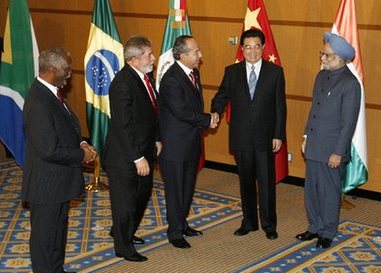 South Africa's President Thabo Mbeki, Brazil's President Luiz Inacio Lula da Silva, Mexico's President Felipe Calderon and China's President Hu Jintao look at India's Prime Minister Manmohan Singh (L-R) during a family photo on the sidelines of te G8 Summit in Sapporo, Japan, July 8, 2008. [Agencies] |
China and the four countries account for 42 percent of the world population and 12 percent of its GDP. The leaders will attend the final day of the annual Group of Eight (G8) Summit today, when climate change is likely to top the agenda.
The soaring food prices have "added to the difficulties (facing) global poverty reduction efforts, and affected regional stability", Hu said.
"Developing countries suffer most from rising food prices and we the five countries have all been affected."
What is needed, he said, is a more favorable external environment for the growth of developing countries.The causes for soaring food prices are multi-faceted and complex, he said, and urged the international community to raise its level of cooperation and take comprehensive steps to maintain food security.
All the five countries are major grain producers and consumers so "we should jointly encourage the international community" to intensify efforts to ensure food security, Hu said.
At the end of the meeting, the leaders of the five countries called for a shared responsibility to ensure world food security, and international cooperation to boost energy development and efficiency.
"We call upon the international community to devise better ways and means of producing and distributing food," a joint declaration said.
"Multi-billion (dollar) agricultural trade-distorting support in developed countries have hampered the development of food production in developing countries, critically reducing their possibilities of reaction to the present crisis," the declaration said.
The leaders stressed the "imperativeness of creating an enabling international environment for agro-produce related trade, establishing a just and reasonable international trade regime for agricultural products and concluding the Doha Round (of WTO talks) with meaningful commitments to agricultural subsidies reductions".
Prices of agricultural commodities have risen sharply over the past two years. The increase has been particularly sharp in the first six months of this year, with prices of rice, corn and wheat reaching record highs.
This has sparked riots in many countries and worsened the condition of 850 million people already in the grip of hunger.
The leaders said they "encourage collaborative action for better seeds and farm outputs that are sustainable and environmentally sound ... so as to create a conductive international environment for food security".
On biofuel, they said "it is essential to address the challenges and opportunities posed by biofuels". "It is important that public policies for production of biofuels contribute to sustainable development and the well-being of the most vulnerable people and do not threaten food security."
Biofuel production is expected to rise from 11 billion liters a year in 2007 to about 24 billion liters by 2017. This growth means more grains, oilseeds and sugarcane will be used to make biofuel.
Xinhua - China Daily
Read more...
South Korean Won Advances as Government Seeks to Boost Currency
By Judy Chen and William Sim
July 9 (Bloomberg) -- South Korea's won, the best- performing major currency this month, gained for a third day on speculation the government is seeking appreciation to rein in inflation at a decade high.
``The government spent about $1 billion to $2 billion yesterday to support the won,'' said Sam Hong, a Seoul-based currency trader at Shinhan Bank, a unit of South Korea's second- biggest financial group. ``The intervening power came from the coordination between the finance ministry and the central bank. They may come out one or two more times this week.''
Korea's currency climbed 0.4 percent to 1,028.5 against the dollar as of 12:05 p.m. in Seoul, from 1,033 yesterday, according to Seoul Money Brokerage Services Ltd.
Choi Jong Ku, director general of the finance ministry's international finance bureau, said today that South Korea will allow state-run companies to borrow money from overseas to stabilize the foreign-exchange market. The Ministry of Finance and Bank of Korea said on July 7 they will take steps to support the currency after the won slid 10.5 percent versus the dollar in the past year.
``We will allow state-run companies to borrow overseas and let them exchange the dollar into won from the local market,'' Choi said in a phone interview. ``In the past, we prevented companies from borrowing overseas because that would allow the won to strengthen.''
The government has changed its stance on foreign-exchange policy as a weaker won has made imported goods more expensive, raising living costs for consumers and production expenses for businesses. Inflation quickened to 5.5 percent in June, the fastest since 1998. Central banks intervene in currency markets by buying or selling foreign exchange.
Stocks, Bonds
Fund managers outside the nation have sold more local shares than they bought every day since June 5. President Lee Myung Bak said on July 6 he may lower his economic growth target for the next two years. The Kospi index of shares has slumped 18 percent in 2008.
``The interventions will help slow the won's move, but the country's fundamentals have clearly deteriorated,'' said Yen Ping Ho, a currency strategist at JPMorgan Chase & Co. in Singapore. ``We expect the won to remain weak.''
Government bonds advanced on speculation that the central bank will refrain from raising interest rates after oil prices dropped below $140 today.
``Investors seem less concerned about inflation as oil prices fell and the won gained,'' said Chang Jae Heuck, a Seoul- based fund manager at Hana Bank, a unit of South Korea's fourth- largest financial services company. ``They're betting the central bank will keep rates on hold tomorrow.''
The yield on the 5.25 percent note due March 2013 fell 1.5 basis points to 6.08 percent, according to Korea Exchange. The price climbed 0.20, or 20 won per 10,000 won face amount, to 98.40. A basis point is 0.01 percentage point.
To contact the reporters on this story: Judy Chen in Shanghai at xchen45@bloomberg.net; William Sim in Seoul at wsim2@bloomberg.net.
Read more...
July 9 (Bloomberg) -- South Korea's won, the best- performing major currency this month, gained for a third day on speculation the government is seeking appreciation to rein in inflation at a decade high.
``The government spent about $1 billion to $2 billion yesterday to support the won,'' said Sam Hong, a Seoul-based currency trader at Shinhan Bank, a unit of South Korea's second- biggest financial group. ``The intervening power came from the coordination between the finance ministry and the central bank. They may come out one or two more times this week.''
Korea's currency climbed 0.4 percent to 1,028.5 against the dollar as of 12:05 p.m. in Seoul, from 1,033 yesterday, according to Seoul Money Brokerage Services Ltd.
Choi Jong Ku, director general of the finance ministry's international finance bureau, said today that South Korea will allow state-run companies to borrow money from overseas to stabilize the foreign-exchange market. The Ministry of Finance and Bank of Korea said on July 7 they will take steps to support the currency after the won slid 10.5 percent versus the dollar in the past year.
``We will allow state-run companies to borrow overseas and let them exchange the dollar into won from the local market,'' Choi said in a phone interview. ``In the past, we prevented companies from borrowing overseas because that would allow the won to strengthen.''
The government has changed its stance on foreign-exchange policy as a weaker won has made imported goods more expensive, raising living costs for consumers and production expenses for businesses. Inflation quickened to 5.5 percent in June, the fastest since 1998. Central banks intervene in currency markets by buying or selling foreign exchange.
Stocks, Bonds
Fund managers outside the nation have sold more local shares than they bought every day since June 5. President Lee Myung Bak said on July 6 he may lower his economic growth target for the next two years. The Kospi index of shares has slumped 18 percent in 2008.
``The interventions will help slow the won's move, but the country's fundamentals have clearly deteriorated,'' said Yen Ping Ho, a currency strategist at JPMorgan Chase & Co. in Singapore. ``We expect the won to remain weak.''
Government bonds advanced on speculation that the central bank will refrain from raising interest rates after oil prices dropped below $140 today.
``Investors seem less concerned about inflation as oil prices fell and the won gained,'' said Chang Jae Heuck, a Seoul- based fund manager at Hana Bank, a unit of South Korea's fourth- largest financial services company. ``They're betting the central bank will keep rates on hold tomorrow.''
The yield on the 5.25 percent note due March 2013 fell 1.5 basis points to 6.08 percent, according to Korea Exchange. The price climbed 0.20, or 20 won per 10,000 won face amount, to 98.40. A basis point is 0.01 percentage point.
To contact the reporters on this story: Judy Chen in Shanghai at xchen45@bloomberg.net; William Sim in Seoul at wsim2@bloomberg.net.
Read more...
Malaysia's Ringgit Gains as Oil Slump Eases Inflation Concerns
By David Yong
July 9 (Bloomberg) -- Malaysia's ringgit gained by the most in three weeks on optimism a decline in crude oil prices will ease the pressure on inflation, boosting the appetite for local- currency assets.
The ringgit's five-day winning run is the longest since Feb. 27 as six of Asia's 10 most-traded currencies rose against the U.S. currency. Crude oil fell by 3.8 percent yesterday to $136 a barrel, the most since the end of March. Traders raised bets the ringgit's appreciation will quicken in 12 months, according to non-deliverable forward contracts.
``Lower oil prices are a big support for the ringgit and there's some confidence coming back in the forward market,'' said Awaluddin Shariff, a currency trader at EON Bank Bhd. in Kuala Lumpur. ``The market is also seeing some official support'' from central-bank buying, he said.
The ringgit climbed to 3.2480 per dollar as of 9:06 a.m. in Kuala Lumpur versus 3.2615 late yesterday, according to data compiled by Bloomberg. The currency may trade between 3.24 and 3.26 today, Awaluddin said.
Crude oil for August delivery fell 0.2 percent today to $135.78 a barrel on the New York Mercantile Exchange, adding to a 7 percent decline from a record $145.85 on July 3. Malaysia's inflation likely reached a nine-year high of 5 percent in June after the government raised fuel prices on June 5, Bank Negara Malaysia said last month.
Traders bet the ringgit will advance to 3.2360 over the next 12 months, according to non-deliverable forwards contracts, versus 3.2610 a week ago, according to data compiled by Bloomberg. The contracts are agreements in which assets are bought and sold at current prices for future delivery.
To contact the reporter on this story: David Yong in Singapore at dyong@bloomberg.net.
Read more...
July 9 (Bloomberg) -- Malaysia's ringgit gained by the most in three weeks on optimism a decline in crude oil prices will ease the pressure on inflation, boosting the appetite for local- currency assets.
The ringgit's five-day winning run is the longest since Feb. 27 as six of Asia's 10 most-traded currencies rose against the U.S. currency. Crude oil fell by 3.8 percent yesterday to $136 a barrel, the most since the end of March. Traders raised bets the ringgit's appreciation will quicken in 12 months, according to non-deliverable forward contracts.
``Lower oil prices are a big support for the ringgit and there's some confidence coming back in the forward market,'' said Awaluddin Shariff, a currency trader at EON Bank Bhd. in Kuala Lumpur. ``The market is also seeing some official support'' from central-bank buying, he said.
The ringgit climbed to 3.2480 per dollar as of 9:06 a.m. in Kuala Lumpur versus 3.2615 late yesterday, according to data compiled by Bloomberg. The currency may trade between 3.24 and 3.26 today, Awaluddin said.
Crude oil for August delivery fell 0.2 percent today to $135.78 a barrel on the New York Mercantile Exchange, adding to a 7 percent decline from a record $145.85 on July 3. Malaysia's inflation likely reached a nine-year high of 5 percent in June after the government raised fuel prices on June 5, Bank Negara Malaysia said last month.
Traders bet the ringgit will advance to 3.2360 over the next 12 months, according to non-deliverable forwards contracts, versus 3.2610 a week ago, according to data compiled by Bloomberg. The contracts are agreements in which assets are bought and sold at current prices for future delivery.
To contact the reporter on this story: David Yong in Singapore at dyong@bloomberg.net.
Read more...
Asian Stocks Advance on Credit-Market Outlook, Oil's Decline
By Chen Shiyin and Masaki Kondo
July 9 (Bloomberg) -- Asian stocks rallied the most in three weeks, led by banks and industrial companies, on speculation credit-market losses will ease and after crude oil prices retreated the most since March.
Mitsubishi UFJ Financial Group Inc. and Macquarie Group Ltd. advanced after JPMorgan Chase & Co.'s chief executive officer Jamie Dimon said buyers are returning to some types of mortgage products. Korean Air Lines Co. climbed for the first time in 12 days as crude tumbled more than $5 a barrel. Komatsu Ltd., the world's second-largest maker of earthmovers, gained in Tokyo after Japan's machinery orders rose more than economists forecast.
``The decline in oil gives investors room to breathe,'' Naoki Fujiwara, who oversees the equivalent of $720 million as chief fund manager at Shinkin Asset Management Co., said in Tokyo. ``Crude is the crux of material costs and the drop relieves concern about earnings and a slowdown in the global economy.''
The MSCI Asia-Pacific Index added 1.4 percent to 132.19 at 10:33 a.m. Tokyo time, set for its largest increase since June 16. The benchmark, which slumped to its lowest since November 2006 yesterday, has dropped 17 percent this year as record oil prices and credit-related losses offset efforts by central banks to bolster confidence in financial markets.
Japan's Nikkei 225 Stock Average climbed 1.3 percent to 13,197.59. Benchmark indexes advanced in all other markets open for trading.
U.S. stocks rallied yesterday, spurring the Standard & Poor's 500 Index to its largest gain in a month. Financial shares jumped after JPMorgan's Dimon said that the ``capital side of the crisis will ease'' and Federal Reserve Chairman Ben S. Bernanke said the central bank may extend its emergency-loan program for investment banks into next year.
Mitsubishi UFJ, Japan's largest publicly traded bank, climbed 2.9 percent to 961 yen. Mizuho Financial Group Inc., the third-biggest, rose 4.3 percent to 513,000 yen. Macquarie Group, Australia's No. 1 securities firm, jumped 4.4 percent to A$48.
Biggest Losers
Banks also rose after the regulator for Freddie Mac and Fannie Mae, the largest U.S. mortgage-finance companies, said they have enough capital to survive a slump in the housing market and meet new accounting rules.
A measure of financial companies on MSCI's Asian index has lost 21 percent this year, the biggest retreat among 10 industry groups, as the world's largest banks and securities firms reported writedowns and credit losses of about $403 billion.
Kookmin Bank, South Korea's largest bank, rallied 2.9 percent to 56,600 won, rebounding from yesterday's record 8.6 percent drop. Macquarie Group raised its recommendation to ``outperform'' from ``neutral,'' citing the outlook for second- quarter earnings.
Airlines gained on speculation the retreat in oil will lower costs. Korean Air, South Korea's largest carrier, rose 5.6 percent to 40,800 won, its first gain since June 23. Qantas Airways Ltd., Australia's biggest, gained 3.1 percent to A$3.30.
Oil's Drop
Crude oil for August delivery slumped 3.8 percent to $136.04 a barrel on the New York Mercantile Exchange yesterday, the biggest drop since March 31. Futures, which reached a record high of $145.85 on July 3, have lost 6.4 percent in the previous two days and were recently at $135.90.
Japanese manufacturers received a boost after machinery orders rose at 10 times the pace economists expected in May on higher demand for equipment used to make semiconductors and steel.
Komatsu added 2 percent to 2,810 yen. Fanuc Ltd., Japan's No. 1 maker of industrial robots, jumped 3.2 percent to 9,770 yen, while Sumitomo Heavy Industries Ltd., Japan's largest maker of plastic injection-molding gear, climbed 3.1 percent to 695 yen.
Equipment orders, which signal capital spending in the next three to six months, rose 10.4 percent in May from April, the Cabinet Office said today. That beat the 1.1 percent increase forecast by economists in a Bloomberg News survey.
Canon Inc., the camera maker that said this week it will build its first domestic manufacturing plant in 26 years, added 1.5 percent to 5,360 yen. Sony Corp., the world's second-largest consumer-electronics maker, rose 1.1 percent to 4,470 yen.
The reduction of a planned bond sale hurt Promise Co., which slumped 14 percent to 2,420 yen, the largest retreat on MSCI's regional index. Promise is Japan's second-largest consumer finance company.
To contact the reporter for this story: Chen Shiyin in Singapore at schen37@bloomberg.net; Masaki Kondo in Tokyo at mkondo3@bloomberg.net.
Read more...
Dollar Edges Higher On Jawboning
Daily Forex Fundamentals | Written by MG Financial Group | Jul 09 08 01:20 GMT |
The dollar edged up higher on Tuesday, rising to 1.5637 versus the euro and 107.51 against the yen as comments from Fed officials' added support for the greenback. Economic data released today included pending home sales and wholesale inventories. May pending home sales plunged sharply, down by 4.7% and reversing the 6.3% increase a month earlier. Meanwhile, wholesale inventories was marginally better than forecast at 0.8%, down from 1.3% from April.
Traders focused on Fed speak amid a quiet session for US economic reports. Fed Chairman Ben Bernanke propped up the dollar in the morning pledging to 'extend the duration of facilities for primary dealers beyond year-end, should current unusual and exigent circumstances continue to prevail in dealer funding markets'. Bernanke tempered heightened fears stemming from concerns over the solvency of Fannie Mae and Freddie Mac.
Hawkish comments from Richmond Fed President Jeffrey Lacker also benefited the dollar, saying the Fed must be prepared to raise rates even if unemployment remains high and growth is still weak. He also added that the Fed must act forcefully if inflation expectations erode and be vigilant of risks associated with persistent high inflation. Lacker said that downside risks to growth have diminished significantly since the start of the year while expectations for future inflation have become untethered. Interestingly, Lacker voted to leave policy unchanged at the Fed's June meeting with Plosser being the sole dissenter, voting for a rate hike in stead. Nonetheless, we expect the FOMC to leave rates unchanged until Q4 given the current economic outlook.
Euro Drifts Lower within Range
The euro consolidated lower against the dollar, easing to 1.5634 on the heels of Fed comments. In the coming session, markets will focus on Eurozone economic reports, including Germany's May trade balance and Q1 Eurozone revised GDP. Germany's trade surplus for May is expected to ease to 16.5 billion euros, down from 17.7 billion euros a month earlier. The revised Q1 Eurozone GDP is estimated to improve on a quarterly basis to 0.8%, up from 0.3% previously, and edge slightly to 2.2% from 2.1% a year earlier.
MG Financial Group
http://www.mgforex.com
Read more...
The dollar edged up higher on Tuesday, rising to 1.5637 versus the euro and 107.51 against the yen as comments from Fed officials' added support for the greenback. Economic data released today included pending home sales and wholesale inventories. May pending home sales plunged sharply, down by 4.7% and reversing the 6.3% increase a month earlier. Meanwhile, wholesale inventories was marginally better than forecast at 0.8%, down from 1.3% from April.
Traders focused on Fed speak amid a quiet session for US economic reports. Fed Chairman Ben Bernanke propped up the dollar in the morning pledging to 'extend the duration of facilities for primary dealers beyond year-end, should current unusual and exigent circumstances continue to prevail in dealer funding markets'. Bernanke tempered heightened fears stemming from concerns over the solvency of Fannie Mae and Freddie Mac.
Hawkish comments from Richmond Fed President Jeffrey Lacker also benefited the dollar, saying the Fed must be prepared to raise rates even if unemployment remains high and growth is still weak. He also added that the Fed must act forcefully if inflation expectations erode and be vigilant of risks associated with persistent high inflation. Lacker said that downside risks to growth have diminished significantly since the start of the year while expectations for future inflation have become untethered. Interestingly, Lacker voted to leave policy unchanged at the Fed's June meeting with Plosser being the sole dissenter, voting for a rate hike in stead. Nonetheless, we expect the FOMC to leave rates unchanged until Q4 given the current economic outlook.
Euro Drifts Lower within Range
The euro consolidated lower against the dollar, easing to 1.5634 on the heels of Fed comments. In the coming session, markets will focus on Eurozone economic reports, including Germany's May trade balance and Q1 Eurozone revised GDP. Germany's trade surplus for May is expected to ease to 16.5 billion euros, down from 17.7 billion euros a month earlier. The revised Q1 Eurozone GDP is estimated to improve on a quarterly basis to 0.8%, up from 0.3% previously, and edge slightly to 2.2% from 2.1% a year earlier.
MG Financial Group
http://www.mgforex.com
Read more...
Asian And European Stocks Slide Boosting Risk Aversion, Oil Retreats As NY Opens Restoring Dollar Strength
Daily Forex Fundamentals | Written by CMS Forex | Jul 09 08 01:12 GMT |
Read more...
NZ Business Confidence Starts at -64
In New Zealand, the latest Business Opinion Survey remained at -64 for the second quarter. The report points to a picture of stagflation as firm experience rising costs while domestic demand eases in the face of higher inflation and borrowing costs.
AUS Firm's Confidence Falls to 7 Year Low
In Australia, the NAB survey of business confidence fell to its lowest level in 7 years, measuring -9 in June a fall of 5 points from May. Firms say rising raw materials costs are cutting into profits, which is starting to affect employment.
JPN Eco Watchers Falls to 6 Yr Low
In Japan, economic conditions for merchants like taxi cab drivers, barbers and others that deal with customers, fell to a 6 year low. June's reading for the Eco Watcher survey fell to 29.5 as higher inflation curbs consumer spending, hurting business.
AUD/JPY - Ausse Slides vs Yen as Asian Stocks Weak

The Aussie-Yen pair fell for a second session overnight, touching 101.40, a 160-pip slide from its high yesterday. The Yen gained as a result of a fall in stocks in Australia and other Asian markets. European stocks were down as well, but the Yen gave up its gains starting 5-6AM.
NZD/USD - Kiwi Falls on Greenback Strength

The Kiwi-US Dollar pair tested the 0.7485 level, a slide of 100 pips from its open for the week. There was a move towards general Greenback strength in the middle of the European session as G8 leaders said rising oil and food costs pose a 'serious challenge' to the global economy. Oil prices receded, falling back to $135 a barrel at one point.
EUR/JPY - European Stocks Down Pressuring Euro, But Recover

The financial-sector led a broad decline in European stocks, as they fall to 3-year lows amid concerns about credit markets. This put pressure on the Euro-Yen pair and it hit a low near yesterday's support level at 167.20. Oil easing brought some life back into risk appetite, and the Euro managed to recover.
USD/JPY - Lower Oil and Bernanke Help Give Dollar Strength

The Dollar-Yen followed a similar path, as it drop overnight was stalled around 5 am EST and it rebounded to trade above its session open by noon time. US stocks were generally in the green. Ben Bernanke in a speech said the Federal Reserve should expand its role and supervise investment banks in order to prevent and limit financial market turmoil. He also said the bank may extend securities dealers' access to direct loans into 2009, helping shore up strength in US markets.
US Pending Home Sales Slip 4.7% in May
In the US, the pending home sales fell by a more than expected 4.7% for May. The decline continues to be very regional, and housing prices are very attractive to buyers. Sales are expected to be modest for the rest of the year. Construction activity is projected to be limited in the current economic environment, with the high inventory of homes and rising commodity prices.
US Inventories Rise 0.8% in May
Inventorires kept by US wholesale, the middleman between producer and retailers, rose 0.8% in May, matching expectations. Sales rose 1.6%, so the inventories-to-sales ratio declined to 1.08, continuing a trend of decline.
GBP/USD - Pound Recedes vs Dollar After Hitting 1.98

The Pound-Dollar slid 115 pips in the NY session after it had set an intra-session high at the 1.98 level. By 2 PM EST the Dollar had returned to 1.9680, the level it reached yesterday prior to the slide in US stocks. Traders pushed aside the home sales data from the US and focused more on Bernanke's comments, which helped the Dollar advance. The Dollar was also up on the Euro for the session.
Upcoming Releases
Tonight Australia posts its WMI consumer sentiment along with data on home loans. Japan reveals figures on machinery orders. Overnight Germany and the UK will release trade balance figures.
Tomorrow, Canada posts housing starts in a light fundamental docket for North America.
Hans Nilsson
Capital Market Services, L.L.C.
www.cmsfx.com
Read more...
New York Session Recap
Daily Forex Fundamentals | Written by Forex.com | Jul 09 08 01:04 GMT |
The greenback was bid in NY trading as the rally in US stocks, sharply lower oil prices, and some more hawkish rhetoric out of the Fed helped the buck extend gains. US stocks rallied with the S&P 500 up nearly 2% on the day after the market was comforted by comments from Fed Chairman Bernanke who noted that liquidity will be available to banks into 2009 and comments from Treasury Secretary Paulson who said that GSE legislation is key to boosting mortgage market confidence. Oil plunged roughly $3.50 in the session to just under $136/bbl, to boot.
Richmond Fed President Lacker offered up some USD positive musings in the NY session as well. The super hawk did not disappoint, noting that 'just as easing policy in response to emerging downside risks made sense, withdrawing some of that stimulus as those risks diminish makes eminent sense as well'. In contrast to Yellen's comments yesterday, Lacker is clearly in the rate hike camp. His comments offered support for the USD in the sense that they were mostly as expected. The buck would have likely sold off on dovish comments as it would seem the Fed's inflation fighting credentials were dissipating.
EUR/USD opened the session near 1.5695 and was sitting near the 1.5670 mark at the close. Meanwhile, the rally in US stocks helped prop up USD/JPY which jumped to a close near 107.50 after starting NY trading near the 106.80 level. However the pair closed below the 200-day moving average once again, which is something we would likely need to see before we can move definitively higher.
In the upcoming Asia Session we will see some potentially market moving data. UK nationwide consumer confidence is due up at 2300GMT and the market expects a pullback in June to 65 from last month's 69 result. Japanese machine orders are also on tap with a 1.1% increase expected in May -- watch for JPY selling if we get a negative number here. Last but not least, we will see Australian consumer confidence and while there is no consensus estimate, deterioration from the prior month should see AUD lower.
Upcoming Economic Data Releases (Asia Session) Prior Estimate
* 7/8 23:01 UK Nationwide Consumer Confidence JUN 69 - -
* 7/8 23:50 JN Machine Orders (MoM) MAY 5.5% 1.5%
* 7/8 23:50 JN Machine Orders YOY% MAY 0.5% -6.0%
* 7/9 0:30 AU Westpac Consumer Confidence JUL -5.6% - -
* 7/9 1:30 AU Home Loans MAY -3.0% - -
* 7/9 1:30 AU Investment Lending MAY 1.4% - -
* 7/9 1:30 AU Value of Loans MoM MAY - - - -
Forex.com
http://www.forex.com
Read more...
The greenback was bid in NY trading as the rally in US stocks, sharply lower oil prices, and some more hawkish rhetoric out of the Fed helped the buck extend gains. US stocks rallied with the S&P 500 up nearly 2% on the day after the market was comforted by comments from Fed Chairman Bernanke who noted that liquidity will be available to banks into 2009 and comments from Treasury Secretary Paulson who said that GSE legislation is key to boosting mortgage market confidence. Oil plunged roughly $3.50 in the session to just under $136/bbl, to boot.
Richmond Fed President Lacker offered up some USD positive musings in the NY session as well. The super hawk did not disappoint, noting that 'just as easing policy in response to emerging downside risks made sense, withdrawing some of that stimulus as those risks diminish makes eminent sense as well'. In contrast to Yellen's comments yesterday, Lacker is clearly in the rate hike camp. His comments offered support for the USD in the sense that they were mostly as expected. The buck would have likely sold off on dovish comments as it would seem the Fed's inflation fighting credentials were dissipating.
EUR/USD opened the session near 1.5695 and was sitting near the 1.5670 mark at the close. Meanwhile, the rally in US stocks helped prop up USD/JPY which jumped to a close near 107.50 after starting NY trading near the 106.80 level. However the pair closed below the 200-day moving average once again, which is something we would likely need to see before we can move definitively higher.
In the upcoming Asia Session we will see some potentially market moving data. UK nationwide consumer confidence is due up at 2300GMT and the market expects a pullback in June to 65 from last month's 69 result. Japanese machine orders are also on tap with a 1.1% increase expected in May -- watch for JPY selling if we get a negative number here. Last but not least, we will see Australian consumer confidence and while there is no consensus estimate, deterioration from the prior month should see AUD lower.
Upcoming Economic Data Releases (Asia Session) Prior Estimate
* 7/8 23:01 UK Nationwide Consumer Confidence JUN 69 - -
* 7/8 23:50 JN Machine Orders (MoM) MAY 5.5% 1.5%
* 7/8 23:50 JN Machine Orders YOY% MAY 0.5% -6.0%
* 7/9 0:30 AU Westpac Consumer Confidence JUL -5.6% - -
* 7/9 1:30 AU Home Loans MAY -3.0% - -
* 7/9 1:30 AU Investment Lending MAY 1.4% - -
* 7/9 1:30 AU Value of Loans MoM MAY - - - -
Forex.com
http://www.forex.com
Read more...
Japan Machine Orders Rise at 10 Times Estimated Pace
By Jason Clenfield
July 9 (Bloomberg) -- Orders for Japanese machinery rose at 10 times the pace economists expected in May, as demand increased for equipment used to make semiconductors and steel.
Equipment orders, which signal capital spending in the next three to six months, rose 10.4 percent from April when they climbed 5.5 percent, the Cabinet Office said today in Tokyo. The median estimate of 36 economists surveyed by Bloomberg News was for a 1.1 percent gain.
Canon Inc. this week said it plans to build its first domestic manufacturing plant in 26 years as global demand for digital cameras increases. Large companies plan to increase spending 2.4 percent in the year ending March, the central bank's Tankan survey showed last week.
``The manufacturing sector was strong because demand from emerging economies remains firm, despite slowing exports to the U.S.,'' said Junko Nishioka, an economist at RBS Securities Japan Ltd. in Tokyo. ``Capital spending will slow in the coming months, but the pace of decline should be moderate.''
The yen traded at 107.44 at per dollar at 10 a.m. in Tokyo from 107.51 before the report was published. The Topix Machinery Index climbed 1.6 percent, led by Komatsu Ltd., the world's second-biggest maker of earthmovers. Economists' predictions for orders ranged from a 5.2 percent gain to a 4.5 percent drop.
Orders from the steel industry surged 131 percent, and for electrical machinery climbed 34 percent, the Cabinet Office said. Demand for equipment used to make cars fell 3.3 percent.
Reaction to Declines
Today's number was a reaction to declines in February and March, when orders dropped 12.3 percent and 8.3 percent, and a profit squeeze caused by higher oil costs will prompt companies to cut spending in coming months, according to Eishi Yokoyama.
``Given that terms of trade are deteriorating and corporate profits are weakening, the outlook for Japan's capital investment warrants caution,'' said Yokoyama, an economist at AIG Global Investment Corp. in Tokyo. ``We probably need to expect weaker numbers from now on.''
Kawasaki Heavy Industries Ltd. in January canceled a 2006 plan to build a factory for industrial robots that would have cost as much as 10 billion yen ($93 million), company spokesman Katsuhiro Sato said yesterday. Weaker demand in the U.S. for cars and semiconductors means Kawasaki Heavy's existing assembly lines are sufficient to accommodate orders, he said.
Waning Confidence
Confidence at large manufacturers fell to a four-year low in June and companies expect profits to drop this year for the first time since the 2001 recession because of record energy and commodities costs, the Bank of Japan's Tankan survey showed.
Some economists say falling earnings won't discourage Japanese companies from spending.
``You invest in order to maximize profits in the future,'' said Julian Jessop, chief international economist at Capital Economics Ltd. in London. ``The fact that your profits are currently low is neither here nor there.''
Canon, whose profit the Nikkei newspaper reported may have fallen as much 18 percent in the six months through June, said this week it will build a factory in Nagasaki, southern Japan. The camera maker, which is turning to Asia and emerging markets as U.S. demand slows, said the plant will employ about 1,000 workers and start running in December 2009.
``In terms of looking where the demand for Japanese goods is going to come from, the continued strength of Asia is key,'' Jessop said. ``I wouldn't neglect the Middle East either, which are the winners from high oil prices.''
Businesses are also spending to replace worn out equipment rather than to meet new demand, according to a Cabinet Office survey taken in the first quarter. After 15 years of putting off repairs and maintenance, replacement spending has become unavoidable, according to Yoshihiko Senoo, head of economic research at the Cabinet Office.
To contact the reporter on this story: Jason Clenfield in Tokyo at jclenfield@bloomberg.net
Read more...
Dollar Trades Near Two-Week High Against Euro as Oil Declines
By Kosuke Goto and Stanley White
July 9 (Bloomberg) -- The dollar traded near a two-week high against the euro as crude oil prices fell and the Federal Reserve pledged to support credit markets, improving the outlook for the world's biggest economy.
The currency traded near a two-week high versus the yen after Fed Chairman Ben S. Bernanke said the central bank may extend its emergency-loan program for securities firms into next year. The British pound may decline as an industry report showed U.K. consumer confidence slid to the lowest level since at least 2004 in June.
``The dollar will remain strong today,'' said Michiyoshi Kato, a senior vice president of currency sales at Mizuho Corporate Bank Ltd. in Tokyo, a unit of Japan's second-largest publicly traded financial group. ``Bernanke's comments relieved concern about credit instability. Oil prices may peak out sooner or later.''
The dollar traded at $1.5669 at 9:42 a.m. in Tokyo from $1.5670 in New York yesterday. It reached $1.5611 on July 7, the highest level since June 25. It traded at 107.40 yen from 107.50 yen yesterday. It touched 107.75 on July 7, the strongest level since June 26. The euro was at 168.31 yen from 168.45 yen.
The U.S. currency may rise to $1.5610 per euro and 107.75 a dollar today, Kato forecast.
The pound traded at $1.9699 against the dollar, from $1.9695 yesterday when it completed its fifth straight decline. Britain's currency was at 79.53 pence per euro from 79.56.
A Nationwide Building Society index of consumer confidence declined 6 points to 63, the lowest since the survey began in May 2004.
Financial Stability
The dollar climbed 0.4 percent against the euro yesterday after Bernanke said in a speech in Arlington, Virginia, that the Fed is committed to financial stability and may extend the duration of funding to dealers obliged to bid at U.S. government debt auctions.
The Fed's Primary Dealer Credit Facility, which provides direct loans, and the Term Securities Lending Facility, which auctions as much as $200 billion in Treasuries, were created in March in response to the credit crisis.
``Bernanke's comments actually represented how bad the situation is in the U.S. financial sector,'' said Yuji Kameoka, a senior economist and currency analyst in Tokyo at Daiwa Institute of Research, a unit of Japan's second-largest brokerage. ``It's true his comments helped dispel fears about a credit crunch, but investors won't be able to buy the dollar aggressively on his comments.''
`Inflation Pressures'
The dollar has fallen 11 percent against the euro since September, when the Fed made the first of seven reductions in the target lending rate, now 2 percent, to prevent the housing slump and credit losses from plunging the U.S. economy into a recession.
Richmond Fed President Jeffrey Lacker told reporters in Washington yesterday that the weak dollar may fuel ``inflation pressures,'' echoing Bernanke's comments last month that policy makers are ``attentive'' to the effect of the dollar's decline. Bernanke and U.S. Treasury Secretary Henry Paulson are scheduled to testify before Congress tomorrow.
The Dollar Index traded on ICE futures in New York, which tracks the greenback against the currencies of six U.S. trading partners, was at 72.97 from 73.012 yesterday, when it reached the highest level since June 24.
Crude oil for August delivery traded at $136.05 a barrel after tumbling 3.8 percent yesterday, extending its decline from a record high of $145.85 on July 3. The euro-dollar exchange rate and oil have moved in the same direction 90 percent of the time during the past year, according to Bloomberg calculations based on the correlation of their value changes.
ECB's Trichet
Any gains in the euro may be limited by speculation European Central Bank President Jean-Claude Trichet will reiterate that he has no plans to raise interest rates further. The ECB said it has ``no bias'' for monetary policy after increasing borrowing costs by a quarter percentage point to 4.25 percent on July 3.
Trichet presents the central bank's annual report to the European Parliament at 9 a.m. in Strasbourg today. ECB board member Jose Manuel Gonzalez-Paramo also speaks at a conference in Madrid at 9:30 a.m.
``The chance of the euro breaking new record highs is receding,'' said Akifumi Uchida, deputy general manager of the marketing unit at Sumitomo Trust & Banking Co. in Tokyo. ``Trichet won't go out his way to talk about raising rates. He's pretty comfortable with where rates are now, and that takes the energy out of the euro.''
The 15-nation currency may fall to $1.56 today, he said.
To contact the reporters on this story: Kosuke Goto in Tokyo at kgoto2@bloomberg.net; Stanley White in Tokyo at swhite28@bloomberg.net
Read more...
July 9 (Bloomberg) -- The dollar traded near a two-week high against the euro as crude oil prices fell and the Federal Reserve pledged to support credit markets, improving the outlook for the world's biggest economy.
The currency traded near a two-week high versus the yen after Fed Chairman Ben S. Bernanke said the central bank may extend its emergency-loan program for securities firms into next year. The British pound may decline as an industry report showed U.K. consumer confidence slid to the lowest level since at least 2004 in June.
``The dollar will remain strong today,'' said Michiyoshi Kato, a senior vice president of currency sales at Mizuho Corporate Bank Ltd. in Tokyo, a unit of Japan's second-largest publicly traded financial group. ``Bernanke's comments relieved concern about credit instability. Oil prices may peak out sooner or later.''
The dollar traded at $1.5669 at 9:42 a.m. in Tokyo from $1.5670 in New York yesterday. It reached $1.5611 on July 7, the highest level since June 25. It traded at 107.40 yen from 107.50 yen yesterday. It touched 107.75 on July 7, the strongest level since June 26. The euro was at 168.31 yen from 168.45 yen.
The U.S. currency may rise to $1.5610 per euro and 107.75 a dollar today, Kato forecast.
The pound traded at $1.9699 against the dollar, from $1.9695 yesterday when it completed its fifth straight decline. Britain's currency was at 79.53 pence per euro from 79.56.
A Nationwide Building Society index of consumer confidence declined 6 points to 63, the lowest since the survey began in May 2004.
Financial Stability
The dollar climbed 0.4 percent against the euro yesterday after Bernanke said in a speech in Arlington, Virginia, that the Fed is committed to financial stability and may extend the duration of funding to dealers obliged to bid at U.S. government debt auctions.
The Fed's Primary Dealer Credit Facility, which provides direct loans, and the Term Securities Lending Facility, which auctions as much as $200 billion in Treasuries, were created in March in response to the credit crisis.
``Bernanke's comments actually represented how bad the situation is in the U.S. financial sector,'' said Yuji Kameoka, a senior economist and currency analyst in Tokyo at Daiwa Institute of Research, a unit of Japan's second-largest brokerage. ``It's true his comments helped dispel fears about a credit crunch, but investors won't be able to buy the dollar aggressively on his comments.''
`Inflation Pressures'
The dollar has fallen 11 percent against the euro since September, when the Fed made the first of seven reductions in the target lending rate, now 2 percent, to prevent the housing slump and credit losses from plunging the U.S. economy into a recession.
Richmond Fed President Jeffrey Lacker told reporters in Washington yesterday that the weak dollar may fuel ``inflation pressures,'' echoing Bernanke's comments last month that policy makers are ``attentive'' to the effect of the dollar's decline. Bernanke and U.S. Treasury Secretary Henry Paulson are scheduled to testify before Congress tomorrow.
The Dollar Index traded on ICE futures in New York, which tracks the greenback against the currencies of six U.S. trading partners, was at 72.97 from 73.012 yesterday, when it reached the highest level since June 24.
Crude oil for August delivery traded at $136.05 a barrel after tumbling 3.8 percent yesterday, extending its decline from a record high of $145.85 on July 3. The euro-dollar exchange rate and oil have moved in the same direction 90 percent of the time during the past year, according to Bloomberg calculations based on the correlation of their value changes.
ECB's Trichet
Any gains in the euro may be limited by speculation European Central Bank President Jean-Claude Trichet will reiterate that he has no plans to raise interest rates further. The ECB said it has ``no bias'' for monetary policy after increasing borrowing costs by a quarter percentage point to 4.25 percent on July 3.
Trichet presents the central bank's annual report to the European Parliament at 9 a.m. in Strasbourg today. ECB board member Jose Manuel Gonzalez-Paramo also speaks at a conference in Madrid at 9:30 a.m.
``The chance of the euro breaking new record highs is receding,'' said Akifumi Uchida, deputy general manager of the marketing unit at Sumitomo Trust & Banking Co. in Tokyo. ``Trichet won't go out his way to talk about raising rates. He's pretty comfortable with where rates are now, and that takes the energy out of the euro.''
The 15-nation currency may fall to $1.56 today, he said.
To contact the reporters on this story: Kosuke Goto in Tokyo at kgoto2@bloomberg.net; Stanley White in Tokyo at swhite28@bloomberg.net
Read more...
N.Z. Dollar Gains Most in 2 Months Versus Yen on Stock Rally
By Candice Zachariahs
July 9 (Bloomberg) -- The New Zealand dollar rose the most in almost two months against the yen as a rally in U.S. stocks encouraged investors to buy high-yielding assets.
The kiwi, as the local currency is called, gained as investors entered so-called carry trades, funded in Japan. The Standard & Poor's 500 Index strengthened 1.7 percent.
``Equities are doing well and risk appetite has recovered,'' said Richard Franulovich, a senior currency strategist at Westpac Banking Corp. in New York. ``There's no denying that the New Zealand dollar still offers an attractive return.''
New Zealand's dollar rose 1 percent to 81.01 yen at 8:38 a.m. in Wellington, from 80.23 yen in late Asian trading yesterday. The currency gained 1.3 percent on May 16. It bought 75.37 U.S. cents from 75.10 U.S. cents.
The benchmark interest rate in New Zealand is 8.25 percent compared with 0.5 percent in Japan and 2 percent in the U.S. In a carry trade, investors get funds in a country with low borrowing costs and invest in another with higher interest rates, earning the spread between the borrowing and lending rates. The risk is currency market moves erase those profits.
New Zealand's dollar is the worst performer of the 16 most- traded currencies in the past three months.
Reserve Bank Governor Alan Bollard said on June 5 it is ``likely'' he will reduce interest rates this year because weak economic growth is slowing inflation. Two of 13 economists surveyed by Bloomberg News expect a reduction to 8 percent at the next meeting on July 24.
To contact the reporter on this story: Candice Zachariahs in New York at czachariahs1@bloomberg.net
Read more...
July 9 (Bloomberg) -- The New Zealand dollar rose the most in almost two months against the yen as a rally in U.S. stocks encouraged investors to buy high-yielding assets.
The kiwi, as the local currency is called, gained as investors entered so-called carry trades, funded in Japan. The Standard & Poor's 500 Index strengthened 1.7 percent.
``Equities are doing well and risk appetite has recovered,'' said Richard Franulovich, a senior currency strategist at Westpac Banking Corp. in New York. ``There's no denying that the New Zealand dollar still offers an attractive return.''
New Zealand's dollar rose 1 percent to 81.01 yen at 8:38 a.m. in Wellington, from 80.23 yen in late Asian trading yesterday. The currency gained 1.3 percent on May 16. It bought 75.37 U.S. cents from 75.10 U.S. cents.
The benchmark interest rate in New Zealand is 8.25 percent compared with 0.5 percent in Japan and 2 percent in the U.S. In a carry trade, investors get funds in a country with low borrowing costs and invest in another with higher interest rates, earning the spread between the borrowing and lending rates. The risk is currency market moves erase those profits.
New Zealand's dollar is the worst performer of the 16 most- traded currencies in the past three months.
Reserve Bank Governor Alan Bollard said on June 5 it is ``likely'' he will reduce interest rates this year because weak economic growth is slowing inflation. Two of 13 economists surveyed by Bloomberg News expect a reduction to 8 percent at the next meeting on July 24.
To contact the reporter on this story: Candice Zachariahs in New York at czachariahs1@bloomberg.net
Read more...
Subscribe to:
Posts (Atom)


 Posts
Posts


