Economic Calendar

Saturday, November 8, 2008

Singapore Airlines, Pilots Union Reach Pay Agreement

By Nesa Subrahmaniyan

Nov. 8 (Bloomberg) -- Singapore Airlines Ltd., the world's largest carrier by market value, reached agreement with pilots on pay and other benefits after a year of negotiations.

The accord ``forms the basis of a Points of Agreement that has been signed,'' Singapore Airlines spokesman Stephen Forshaw said in an e-mailed statement that called the wage negotiations ``challenging.''

Agreement came as global air-passenger traffic fell for the first time in five years in September with the economic slowdown and credit-market crisis curbing travel. Singapore Airlines last month reported a decline in load factors amid falling demand, prompting it to cut flights to cities in Japan, South Korea, India, Malaysia and Vietnam.

``The bottom line is to reduce costs,'' said Steven Lim, who manages about $200 million at Daiwa SB Investments in Singapore. ``An agreement would certainly help as the operating environment gets adverse and the airline reorganizes routes.''

The terms have been backdated to November 2007 and are valid for three years, Singapore's Business Times reported today. The operating environment in the aviation industry has become more challenging, the newspaper said, citing Captain P. James, the head of the Air Line Pilots Association of Singapore. The city- state's Ministry of Manpower played a critical role in facilitating the agreement, the newspaper said.

Singapore Airlines on Nov. 6 said quarterly profit fell 36 percent, the biggest decline in more than three years, after it paid more for jet fuel and filled fewer seats.

Net income dropped to S$323.8 million ($219 million), or 27.1 cents a share, in the three months ended Sept. 30, from S$507.8 million, or 40.3 cents, a year earlier, the carrier said.

To contact the reporter on this story: Nesa Subrahmaniyan in Singapore at nesas@bloomberg.net.


Read more...

Las Vegas Sands `Committed' to $4 Billion Singapore Casino

By Jean Chua

Nov. 8 (Bloomberg) -- Billionaire Sheldon Adelson's Las Vegas Sands Corp. remains ``committed'' to its $4 billion Singapore casino and said the city-state approved its proposal for as many as 1,000 gaming tables.

The company met Singapore government officials this week to discuss completing the project, it said yesterday. Las Vegas Sands, which may be short of cash for $16 billion of projects in Asia, has no problems with its local borrowings, Oversea-Chinese Banking Corp. and DBS Group Holdings Ltd. said this week.

``The acceptance of our proposed casino layout by the Casino Regulatory Authority gives us the flexibility to increase our original table count of 600 to as much as 1,000 to meet demand,'' Adelson said in the statement.

Las Vegas Sands is seeking funds to stave off loan defaults in the face of ``substantial doubt'' about its ability to survive, it said Friday in a U.S. regulatory filing. Macau casino revenue, which supplies about two-thirds of sales, fell in the second and third quarters for the first time in at least three years.

The Singapore development is ``ring-fenced,'' and Las Vegas Sands has ``put in more equity than necessary,'' Oversea-Chinese Banking Chief Executive Officer David Conner said on Nov. 5. DBS Group Chief Executive Richard Stanley told reporters yesterday the bank sees ``no indication of default'' on the company's debt.

The two Singapore-based banks are among eight hired to arrange S$5 billion ($3.3 billion) of loans for the project. Las Vegas Sands has drawn down S$2 billion from the credit facility for the Singapore resort, it said in January.

``If this project were in the U.S., it would not be as significant,'' Song Seng-Wun, head of Singapore research with CIMB-GK Securities Pte, said by telephone today. ``If this is just an issue of funding rather than the long-term economic viability of the project, I believe the Singapore government would be ready to step in and explore all possible options to make sure it succeeds.''

Singapore in 2005 lifted a four-decade ban on casinos to diversify the economy and create jobs, giving Las Vegas Sands and Genting Bhd. approval to build gaming resorts.

To contact the reporter on this story: Jean Chua in Singapore at jchua4@bloomberg.net


Read more...

South African Rand Declines in Week on Global Recession Concern

By Garth Theunissen

Nov. 8 (Bloomberg) -- South Africa's rand dropped against the dollar last week as the country's stocks declined with those around the world on concern the global economy is headed toward a recession.

The rand weakened versus all 16 major currencies monitored by Bloomberg as the country's benchmark equity index declined on concern slowing expansion in the U.S. and European economies will erode demand for higher-yielding emerging-market assets. South Africa's currency also fell after reports showed manufacturing contracted for a sixth month in October and house prices rose at the slowest pace in more than 15 years.

``Economic data is looking really bad right across the world,'' said Kay Walsh, an economist and currency researcher at Rand Merchant Bank in Johannesburg. ``Industrial economies are on the verge of recession which makes investors very nervous of putting their money in riskier emerging markets.''

The rand fell 3.1 percent this past week to 10.0825 per dollar in Johannesburg, from 9.7800 on Oct. 31. Against the euro it dropped 3.8 percent to 12.9202, from 12.4475.

Rand Merchant Bank predicts the currency will trade at 9.5 per dollar by year-end and ``steadily weaken'' to 10.5 by the end of 2009, Walsh said.

South Africa's benchmark FTSE/JSE Africa All Share Index of stocks retreated more than 4 percent this past week, tracking a 3.6 percent decline in the MSCI World Index.

Africa's biggest economy relies on purchases of its stocks and bonds to fund the current-account deficit, which will reach 7.6 percent of gross domestic product this year, Finance Minister Trevor Manuel said on Oct. 21. Economic growth will slow to 3.7 percent this year from 5.1 percent in 2007, he predicted.

`Liquidity Dried Up'

``Global liquidity has dried up, which means there's less money flowing around to fund our consumption habits,'' said Walsh. ``The rand needs to adjust lower to correct our current- account gap.''

The rand lost more than 30 percent this year as foreigners sold almost 69 billion rand ($7.1 billion) more than they bought of the country's assets, amid the world's worst financial-market crisis since the 1930s.

Fears of a global recession forced the Bank of England to cut the U.K.'s key rate 1.5 percentage points on Nov. 6 while the European Central Bank lowered its rate by a half-point. Denmark and Switzerland also reduced rates, after the International Monetary Fund predicted economic contractions in the U.S., Japan and euro region next year.

Korea's central bank trimmed interest rates to 4 percent yesterday, the lowest level since 2006.

House Prices

South Africa's currency also weakened after manufacturing, which makes up which makes up 16 percent of the economy contracted, according the Investec Purchasing Managers Index. The pace of house-price growth slowed to an annual 1.2 percent last month, the weakest since January 1993, Absa Group Ltd., the country's biggest mortgage lender said Nov. 6.

The nation's foreign-currency reserves declined 4.4 percent to $32.9 billion by the end of October, compared with September, the South African Reserve Bank said yesterday. Reserves were expected to decline 1.2 percent, according to the median estimate of five economists surveyed by Bloomberg.

Government bonds rose in the week, with the yield on the benchmark 13.5 percent security due September 2015 losing 48 basis points to 8.61 percent. The yield on the 13 percent note maturing in August 2010 dropped 57 basis points to 9.10 percent. Yields move inversely to bond prices.

To contact the reporter on this story: Garth Theunissen in Johannesburg gtheunissen@bloomberg.net


Read more...

IMF: Growth to fall from 9.3% to 8.5%

Updated: 2008-11-08

(China Daily) The International Monetary Fund (IMF) has cut its forecast for China's economic growth in 2009 to 8.5 percent from 9.3 percent.

It also changed its estimate of developed countries' growth next year to a decline of 0.3 percent, from 0.5 percent growth.

The IMF now expects the global economy will grow 2.2 percent in 2009, 0.8 percentage point less than last month's estimate.

In the latest World Economic Outlook published in Washington DC on Thursday, ahead of the G20's Nov 15 meeting, the IMF urged countries to "stimulate their economies" in the face of a worse-than-expected global economic slowdown triggered by the US subprime mortgage crisis.

"Prospects for global growth have deteriorated over the past month, as financial sector de-leveraging has continued, and producer and consumer confidences have fallen," the report said.

Output is forecast to contract in advanced economies in 2009, the first such fall since World War II, the report said. It also said emerging economies' growth is projected to "appreciably" slow to 5 percent in 2009, down from 6.6 percent a year before.

"Countries in East Asia, including China, generally have suffered smaller markdowns, because their financial situations are typically more robust. They have benefited from improved terms of trade from falling commodity prices, and they have already initiated a shift toward macroeconomic policy easing," it said.

Since September, China has reversed its tightened monetary policy by cutting interest rates for a third consecutive time to ward off an economic slowdown amid the global financial crisis.

However, many analysts worried monetary policy may not be enough to invigorate the country's economy, as the export sector, a major driver of China's economic growth, is deteriorating because of weaker overseas demand.

It is estimated every 1 percent decline in United States' and Europe's GDP will create a 7 percent drop in China's export growth rate.

Ma Jun, chief economist of Deutsche Bank Greater China, said he was pessimistic about China's economic outlook next year.

"If no more active fiscal policies come out next year, the country's economic growth may drop to 6 percent," he said in a research report released recently.

"The central treasury should maintain its budget deficit for 2009 at 400 billion yuan ($58.7 billion), including a 100 billion fiscal surplus this year and the 300 billion in national bonds to be issued next year.

"The money input is expected to boost GDP growth by 2 percentage points," he added.

The IMF called for more macroeconomic policy stimuli to drive growth and create a context for the restoration of financial sector's healthiness.

"Room to ease monetary policy should be exploited, especially now that inflation concerns have moderated," the report said.

"Fiscal stimulus can be effective if it is well targeted and supported by accommodative monetary policy."

Agencies contributed to the story


Read more...

Obama vows to address economic crisis

Updated: 2008-11-08

(Xinhua)

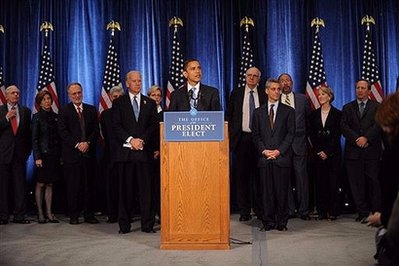
WASHINGTON - US President-elect Barack Obama vowed to address economic crisis after inauguration on Friday at his first press conference after he won the presidential elections, with his economic advisors and chief of staff at presence.


US President-elect Barack Obama (C) speaks to the press in Chicago. Obama on Friday said he would act "swiftly" as soon as he takes office to confront the economic crisis head on, during his first news conference since his historic election.[Agencies]

"Immediately after I become president I will confront this economic crisis head-on by taking all necessary steps to ease the credit crisis, help hardworking families, and restore growth and prosperity," Obama said at the press conference in Chicago after meeting with 17-member economic advisory team.

"America is a strong and resilient country, I know we will succeed if we put aside partisanship and politics, and work as one nation," he said.

Citing statistics, Obama warned the country is "facing the greatest economic challenge of our lifetime" with 240,000 jobs lost in October and nearly 1.2 million jobs cut this year, and tens of millions of families struggling to figure out how to pay the bills and stay in their homes.

He noted that a rescue plan for the middle class tops all priorities that can create jobs and provide relief to families, and urged a stimulus package to be passed "sooner rather than later."


"If it does not get done in a lame-duck session (of Congress), it would be the first thing I get done after I become the president of the United States," he said.

Those which were also mentioned as priorities included further expansion of unemployment benefit and working out policy options to help auto industry adjust, "the backbone of American manufacturing and a critical part of our attempt to reduce our dependence on foreign oil."

Obama said that he was also planning to review the implementation of the current financial program to ensure it is stabilizing financial markets, protecting taxpayers and helping homeowners.

While addressing immediate economic challenges, the transitional government should move forward with long-term policies to "grow our middle class and strengthen our economy."

"We cannot afford to wait on moving forward on the key priorities that I identified during the campaign, including clean energy, health care, education, and tax relief for middle-class families."

When asked whether Obama would announce his cabinet members, he said that although the issue is equally as important as economy, he was not be so rushed on the decision and would roll out the list next week.

On his first meeting with current president, George W. Bush, at the White House on Monday, Obama said that he was not going to anticipate problems but to seek partnership since the immediate priority is to make economy work.

To add some humor to the first public appearance as the president-elect, Obama responded with a joke to a reporter's question about the dog the future first family is to bring to the White House.

"With respect to the dog, this is a major issue. I think it has generated more interest on our website than just about anything," Obama said, adding that he was looking for a dog that is a hypoallergenic breed producing fewer allergic reactions, and from an animal shelter, where dog are often mixed-breeds.


Read more...

G-20 Urges Coordinated Stimulus to Ease Impact of Global Slump

By Ben Sills

Nov. 8 (Bloomberg) -- Finance officials from the Group of 20 nations will press their European colleagues to join a coordinated stimulus plan to tackle an impending recession when they meet in Sao Paulo this weekend.

U.K. Prime Minister Gordon Brown yesterday urged countries to heed the International Monetary Fund's call for coordinated action, even as other European Union leaders fretted about reining in budget deficits. A coordinated package would add 50 percent more to growth than a similar amount spent in ad hoc measures by individual nations, said Carl Weinberg, chief economist at High Frequency Economics in Valhalla, New York.

``There are big areas of difference out there,'' Weinberg said. ``The U.S. and IMF view is clearly that fiscal stimulus is needed. The Europeans are not quite so clear on this.''

The world's biggest industrialized economies will all contract next year for the first time in more than half a century as the financial market seizure leaves companies and consumers starved of credit, the IMF forecast last week.

The G20 meetings beginning today reunite officials for the second time in a month, after their first-ever emergency meeting in Washington in October. They'll meet again in Washington at a Nov. 14-15 summit of G20 heads of state.

``It's very clear that to navigate a path through the current difficulties and to regain some momentum in the world economy, the biggest economies need to be working together,'' U.K. Treasury Minister Stephen Timms said in an interview in Sao Paulo yesterday.

`Discipline'

The push for coordinated action by the U.S., U.K. and developing nations including Brazil suffered a setback Nov. 6 when France dropped calls for a joint stimulus package.

A memo prepared for the French-led summit of EU leaders in Brussels underscored the need for ``macroeconomic discipline,'' bowing to resistance to a pump-priming program. The memo, proposing a European strategy to take to next week's global economic crisis summit in Washington, endorses ``macroeconomic policies that are sustainable and oriented toward stability.''

``Interest in a fiscal stimulus varies considerably from country to country,'' Michael Mussa, former IMF chief economist, said in an interview from Washington. ``Germany is not very enthusiastic.''

Central banks are already coordinating their response to the financial crisis, which began with the collapse of the U.S. subprime-mortgage market. The Fed, the European Central Bank and the Bank of England led a coordinated interest rate cut on Oct. 8 and they have all followed up with further reductions in the past two weeks.

`Real Momentum'

``What we're going to see this weekend is some real momentum for action building up for the meeting in Washington,'' said U.K.'s Timms, adding that one area of focus will be ``international coordination.''

The finance ministers of Brazil, Russia, India and China issued a joint statement yesterday calling for a coordinated push to halt the spread of financial turmoil. A stimulus plan is ``essential'' for the global economy, they said.

Brazil has been pressing for a greater role for G20 in resolving the crisis, which has drained capital from Eastern Europe to Latin America at a time when emerging markets are being counted on to sustain almost all of the world's projected 2.2 percent economic growth next year, according to an IMF forecast.

Delegates will discuss ``important fiscal measures that can help revive economic growth,'' Brazilian central bank President Henrique Meirelles said yesterday.

Balancing Act

Canadian Prime Minister Stephen Harper said governments and central banks face a balancing act deciding how much to stimulate the global economy. There is ``a very real concern'' that policy makers may overdo support for the economy, jeopardizing longer term growth, he said Nov. 6. At the same time, he said his government is not ``by any means finished in terms of further steps that have to be taken.''

While Europe is dragging its feet on the fiscal stimulus, the U.S. may be the main opponent to tightening up financial regulation. European leaders want to give the IMF responsibility for financial stability around the world. The U.S. opposes any international regulator with cross-border authority, the New York Times reported Nov. 5, citing an unidentified senior U.S. official.

This weekend's meeting will explore ways ``to regulate global financial transactions that are outside government's control,'' Meirelles said.

One problem facing negotiators today: There will be no representatives to deal with from the incoming administration of President-elect Barack Obama. That limits the scope for a deal ahead of Washington.

House speaker Nancy Pelosi said Nov. 6 that she's negotiating with the Senate and outgoing President George W. Bush a $61 billion stimulus package, the second in a year, and Congress may introduce further measures when Obama takes office on Jan. 20.

``The magnitude of action taken is unprecedented in postwar era,'' said Mussa. ``What has not happened is for them to sit in a room and decide anything in coordination.''

To contact the reporter on this story: Ben Sills in Madrid at bsills@bloomberg.net


Read more...

Allianz Posts 2 Billion Euro Loss, May Miss Forecast

By Oliver Suess

Nov. 8 (Bloomberg) -- Allianz SE, Europe's second-biggest insurer by market-value, posted a 2 billion-euro ($2.6 billion) loss and said it may miss operating profit forecasts for this year and next because of the turmoil in financial markets.

Allianz had a net loss including discontinued operations in the third quarter, compared with net income of 1.9 billion euros a year earlier, the Munich-based insurer said in a statement today. That was less than the 3.85 billion-euro estimate of 14 analysts surveyed by Bloomberg. Net income from continuing operations, which reflects the sale of Dresdner, was 545 million euros, the company said, missing analysts' estimates of 782 million euros.

``Without a major equity market recovery, the operating profit outlook of 9 billion euros before banking for this year and next year cannot be reached,'' Allianz Chief Financial Officer Helmut Perlet said in the statement.

Allianz, led by Chief Executive Officer Michael Diekmann, agreed on Aug. 31 to sell Dresdner Bank to Frankfurt-based Commerzbank AG for cash and stock. Commerzbank shares lost about 40 percent of their value in the month ended Sept. 30. Discontinued operations, which reflect the sale of Dresdner effective from Sept. 1, accounted for ``transaction-based impairments according to IFRS 5'' of 1.4 billion euros as well as for a net loss of 1.2 billion euros from Dresdner's operations, Allianz said.

Allianz has said that its remaining stake in the combined Commerzbank-Dresdner will be almost 30 percent, making it the largest shareholder. The final size of the stake will depend on the exchange ratio of Commerzbank-Dresdner shares.

Phased Purchase

Commerzbank agreed to buy Dresdner in two steps, initially acquiring 60.2 percent with cash and stock before yearend. Commerzbank plans to buy the remainder by the end of 2009 with new shares stemming from a capital increase. Allianz reiterated in today's statement that the sale of Dresdner is ``on track.''

Allianz CEO Diekmann, 53, put Frankfurt-based Dresdner up for sale this year after subprime-related losses at the lender's Dresdner Kleinwort securities unit eroded profit. Dresdner, which Allianz bought for 23.5 billion euros in 2001, posted its fifth straight loss in the latest quarter as it ``continued to suffer from weak and volatile markets,'' Allianz said.

Dresdner had an operating loss of 835 million euros in the third quarter compared with an operating profit of 87 million euros a year earlier, Allianz said.

Capital Base

Allianz's capital base ``remains on a high level'' with shareholder's equity of 37.5 billion euros at the end of September compared with 47.8 billion euros a year ago, it said. Allianz's solvency ratio, ``net of a dividend accrual of 1.6 billion euros,'' stood at 157 percent at the end of the quarter.

The decline in financial markets worldwide hit the insurer's operating investment result with impairments of 1.6 billion euros, it said.

Allianz shares declined 55 percent since the beginning of the year in Frankfurt trading, giving the insurer a market value of 29.8 billion euros. The decline compared to a 42 percent decline of Paris-based Axa SA, which has a market value of 32.9 billion euros.

To contact the reporter on this story: Oliver Suess in Munich at osuess@bloomberg.net


Read more...

G-20 Urges Coordinated Stimulus to Ease Impact of Global Slump

Nov. 8 (Bloomberg) -- Finance officials from the Group of 20 nations will press their European colleagues to join a coordinated stimulus plan to tackle an impending recession when they meet in Sao Paulo this weekend.

U.K. Prime Minister Gordon Brown yesterday urged countries to heed the International Monetary Fund's call for coordinated action, even as other European Union leaders fretted about reining in budget deficits. A coordinated package would add 50 percent more to growth than a similar amount spent in ad hoc measures by individual nations, said Carl Weinberg, chief economist at High Frequency Economics in Valhalla, New York.

``There are big areas of difference out there,'' Weinberg said. ``The U.S. and IMF view is clearly that fiscal stimulus is needed. The Europeans are not quite so clear on this.''

The world's biggest industrialized economies will all contract next year for the first time in more than half a century as the financial market seizure leaves companies and consumers starved of credit, the IMF forecast last week.

The G20 meetings beginning today reunite officials for the second time in a month, after their first-ever emergency meeting in Washington in October. They'll meet again in Washington at a Nov. 14-15 summit of G20 heads of state.

``It's very clear that to navigate a path through the current difficulties and to regain some momentum in the world economy, the biggest economies need to be working together,'' U.K. Treasury Minister Stephen Timms said in an interview in Sao Paulo yesterday.

`Discipline'

The push for coordinated action by the U.S., U.K. and developing nations including Brazil suffered a setback Nov. 6 when France dropped calls for a joint stimulus package.

A memo prepared for the French-led summit of EU leaders in Brussels underscored the need for ``macroeconomic discipline,'' bowing to resistance to a pump-priming program. The memo, proposing a European strategy to take to next week's global economic crisis summit in Washington, endorses ``macroeconomic policies that are sustainable and oriented toward stability.''

``Interest in a fiscal stimulus varies considerably from country to country,'' Michael Mussa, former IMF chief economist, said in an interview from Washington. ``Germany is not very enthusiastic.''

Central banks are already coordinating their response to the financial crisis, which began with the collapse of the U.S. subprime-mortgage market. The Fed, the European Central Bank and the Bank of England led a coordinated interest rate cut on Oct. 8 and they have all followed up with further reductions in the past two weeks.

`Real Momentum'

``What we're going to see this weekend is some real momentum for action building up for the meeting in Washington,'' said U.K.'s Timms, adding that one area of focus will be ``international coordination.''

The finance ministers of Brazil, Russia, India and China issued a joint statement yesterday calling for a coordinated push to halt the spread of financial turmoil. A stimulus plan is ``essential'' for the global economy, they said.

Brazil has been pressing for a greater role for G20 in resolving the crisis, which has drained capital from Eastern Europe to Latin America at a time when emerging markets are being counted on to sustain almost all of the world's projected 2.2 percent economic growth next year, according to an IMF forecast.

Delegates will discuss ``important fiscal measures that can help revive economic growth,'' Brazilian central bank President Henrique Meirelles said yesterday.

Balancing Act

Canadian Prime Minister Stephen Harper said governments and central banks face a balancing act deciding how much to stimulate the global economy. There is ``a very real concern'' that policy makers may overdo support for the economy, jeopardizing longer term growth, he said Nov. 6. At the same time, he said his government is not ``by any means finished in terms of further steps that have to be taken.''

While Europe is dragging its feet on the fiscal stimulus, the U.S. may be the main opponent to tightening up financial regulation. European leaders want to give the IMF responsibility for financial stability around the world. The U.S. opposes any international regulator with cross-border authority, the New York Times reported Nov. 5, citing an unidentified senior U.S. official.

This weekend's meeting will explore ways ``to regulate global financial transactions that are outside government's control,'' Meirelles said.

One problem facing negotiators today: There will be no representatives to deal with from the incoming administration of President-elect Barack Obama. That limits the scope for a deal ahead of Washington.

House speaker Nancy Pelosi said Nov. 6 that she's negotiating with the Senate and outgoing President George W. Bush a $61 billion stimulus package, the second in a year, and Congress may introduce further measures when Obama takes office on Jan. 20.

``The magnitude of action taken is unprecedented in postwar era,'' said Mussa. ``What has not happened is for them to sit in a room and decide anything in coordination.''

To contact the reporter on this story: Ben Sills in Madrid at bsills@bloomberg.net


Read more...

PetroChina to Keep 2009 Spending at 2008 Levels, Chairman Says

By Wang Ying

Nov. 8 (Bloomberg) -- PetroChina Co., Asia's biggest oil producer, will maintain its pace of capital spending next year at 2008 levels.

Expenditure in 2009 ``won't decrease or increase,'' Chairman Jiang Jiemin said on the sidelines of an energy conference in Beijing today.

PetroChina, the Hong Kong-listed unit of China National Petroleum Corp., will spend a higher proportion of its investment on its ``core business'' next year, Jiang said on Oct. 21, without giving details. Capital expenditure for 2008 will remain unchanged at 207.9 billion yuan ($30.5 billion), Jiang said then.

The oil producer is also studying the possibility of acquiring energy companies made vulnerable by the global credit crisis to expand output and meet rising fuel demand in China.

``The financial crisis hasn't yet bottomed out,'' Jiang said today, when asked if PetroChina has decided on acquisition targets.

To contact the reporter on this story: Wang Ying in Beijing at ywang30@bloomberg.net.


Read more...

UBS Buys 900 Million Yuan of Chinese Shares, Morning Post Says

By Cathy Chan

Nov. 8 (Bloomberg) -- UBS Securities Co., one of China's first qualified foreign institutional investors, bought 900 million yuan ($132 million) of shares listed on China's stock exchange, the South China Morning Post reported, citing data from the Shanghai stock exchange.

The purchase, made through the off-market block trade system, is the latest sign that overseas investors are hunting for bargains on the stock exchange, the report said.

The Chinese securities unit of UBS AG first bought 300 million yuan on Nov. 6 and invested an additional 600 million yuan yesterday in 40 transactions on the block trading system, the Morning Post said, citing the stock exchange data. Ping An Insurance Group Co. of China and PetroChina Co. are among the stocks UBS purchased, the paper said.

To contact the reporter on this story: Cathy Chan in Hong Kong at kchan14@bloomberg.net.


Read more...

New South Wales Deficit to Force Spending Cuts, Australian Says

By Shani Raja

Nov. 8 (Bloomberg) -- Australia's News South Wales state faces a raft of spending cuts and higher taxes as its government grapples with a budget deficit of as much as A$1 billion ($672 million), the Weekend Australian reported.

The mini-budget on Nov. 11 will reveal a deficit of between A$900 million and A$1 billion, the paper said, citing state treasurer Eric Roozendaal, forcing spending cuts that may hinder the federal government's plans to revive the national economy.

To contact the reporter on this story: Shani Raja in Sydney at sraja4@bloomberg.net.


Read more...

China Ministry Plans 30 Billion Yuan Bonds, Morning Post Says

By Cathy Chan

Nov. 8 (Bloomberg) -- China plans to issue 30 billion yuan ($4.4 billion) of fixed-rate bonds next week to finance rail projects, South China Morning Post reported, citing the Ministry of Railways.

The ministry will sell 20 billion yuan of seven-year bonds on Nov. 12 and 10 billion yuan of 15-year-bonds on Nov. 13, the Hong Kong newspaper said. Yields will be between 3.52 percent and 4.52 percent, the paper said, citing the ministry.

Arranging the sale are BOC International (Holdings) Ltd. and UBS Securities Co., the Morning Post said.

To contact the reporter on this story: Cathy Chan in Hong Kong at kchan14@bloomberg.net.


Read more...

Australia's Regulator to Target Derivatives Market, Says Review

By Shani Raja

Nov. 8 (Bloomberg) -- The Australian Securities & Investments Commission is planning new regulations targeting hedge funds and derivatives markets, the Australian Financial Review reported in its weekend edition.

The regulator will seek to improve oversight of over-the- counter derivatives markets including credit default swaps, among other measures, the newspaper said, citing comments made by ASIC Chairman Tony D'Aloisio at the Australian Lawyers' Association conference in Sydney yesterday.

The regulator is also looking to examine brokers' conduct, the Review quoted D'Aloisio as saying.

To contact the reporter on this story: Shani Raja in Sydney at sraja4@bloomberg.net.


Read more...

Asian Currencies: Indian Rupee Leads Weekly Gains on Fund Flows

By Judy Chen and Anil Varma

Nov. 8 (Bloomberg) -- India's rupee led gains in Asian currencies, completing its best week in 12 years, on signs overseas funds are returning to buy local assets aided by cuts in borrowing costs by global central banks.

Seven of the 10 most-active currencies in Asia excluding the yen strengthened this week as the MSCI Asia Pacific Index rose 1.2 percent, extending last week's 6 percent advance. Indonesia's rupiah ended two weeks of losses after Standard & Poor's maintained its stable outlook on the nation's debt rating. Foreign investors bought $441 million more Indian shares than they sold in the five days through Nov. 6.

``The outlook for equities is much better than what it was at the peak of the global credit crisis,'' said K.V. Mallik, treasurer at state-owned UCO Bank in Kolkata. ``The climate for investments will improve soon and will help the rupee.''

The rupee climbed 3.8 percent 47.66 a dollar in Mumbai, from 49.4575 on Oct. 31, according to data compiled by Bloomberg. That is the biggest weekly gain since March 1996. Thailand's baht and the Philippine peso strengthened 0.3 percent to 34.96 and 48.81 respectively in the week.

Rate Cuts

The market value of equities worldwide increased to $31.8 trillion on Nov. 6, from $29.4 trillion reached on Oct. 27, the lowest since 2003, Bloomberg data show. Central banks in the U.K., Europe, Australia, South Korea and India added to last month's interest-rate reductions, helping stocks rebound.

The yen headed for weekly gains against the euro and the British pound on speculation global interest-rate cuts will make it less attractive to purchase overseas assets using funds from Japan.

European Central Bank President Jean-Claude Trichet said policy makers may lower rates further after cutting the main refinancing rate by a half-percentage point on Nov. 6 to 3.25 percent. The Bank of England slashed its key rate by 1.5 percentage points to 3 percent, the biggest reduction since 1992. Japan's benchmark rate is 0.3 percent.

The yen rose to 124.46 versus the euro in London from 125.30 at the end of last week. It climbed to 153.87 versus the pound, from 158.28 last week. The Japanese currency rose against the dollar, trading at 97.50 versus 98.46 last week.

Indonesia's rupiah reversed yesterday's losses to end the week stronger after the central bank said consumer prices are under control and that it would meet its year-end inflation target. The government will reduce gasoline prices by 8.3 percent from Dec. 1 and introduce monthly adjustments as global crude oil prices decline.

Stable Outlook

S&P affirmed its BB- rating on Indonesia's foreign-currency debt, citing falling debt levels and a narrowing deficit.

``The stable outlook helped,'' said Emanuel Kurniawan, head of foreign-exchange trading at PT Bank CIMB Niaga in Jakarta. ``The government can handle inflation,'' he said.

The rupiah rose 0.7 percent to 10,900 a dollar, from 10,975 a week earlier, Bloomberg data show.

Taiwan's dollar gained for a second week, the longest winning streak in more than three months, after Taiwan and China agreed this week to boost the number of direct flights across the Taiwan Strait and establish shipping links.

``It's difficult to see further weakening in the Taiwan dollar,'' said Daniel Soh, an economist at Forecast Pte in Singapore. ``The cross-strait policy measures will provide some support to the currency, as this is positive to the economies on both sides.''

The currency rose 0.5 percent to NT$32.824 against the dollar, from NT$33 on Oct. 31, according to Taipei Forex Inc.

Worst Performer

South Korea's won declined 2.8 percent this week to 1,328.80 per dollar, taking this year's loss to 30 percent, the worst performance among the 10 most-traded Asian currencies outside Japan.

Demand for the won has weakened as overseas investors pulled $36.5 billion out of Korean equities this year, according to data compiled by Bloomberg. The Kospi stock index has fallen 40 percent in 2008, heading for its worst year since 2002.

Korea's currency gained 0.2 percent yesterday, as local stocks rebounded after the central bank delivered its third interest-rate reduction in a month to support Asia's fourth- largest economy.

The Bank of Korea cut the benchmark rate to 4 percent, the lowest since 2006. The Kospi stock index soared 3.9 percent after sliding as much as 4.9 percent.

Elsewhere, the Vietnamese dong dropped 0.9 percent this week to 16,984 against the dollar after the central bank widened the daily trading band for the currency to 3 percent from 2 percent. The Malaysian ringgit weakened 0.2 percent to 3.5520.

To contact the reporters on this story: Judy Chen in Shanghai at xchen45@bloomberg.net; Anil Varma in Mumbai at avarma3@bloomberg.net


Read more...

Asia Stocks Rise for Second Week on Rate Cuts, Obama Victory

By Kyung Bok Cho and Chan Tien Hin

Nov. 8 (Bloomberg) -- Asian stocks rose for a second week, the first consecutive gain in six months, after central banks cut interest rates and Barack Obama's presidential victory in the U.S. sparked speculation his spending plans will stimulate growth.

Mizuho Financial Group Inc. jumped 20 percent, the best week since 2003, as Japan's three-month interbank rate tumbled the most in almost a decade. Shinhan Financial Group Ltd. gained 16 percent after South Korea pledged to pump $10.5 billion into its economy and the Bank of Korea lowered rates for the third time in a month. Nintendo Co., the world's biggest maker of handheld video-game consoles, rallied 7 percent after the election of Obama, who has urged Congress to pass a $175 billion economic stimulus bill.

``The stability of financial markets has been restored somewhat,'' said Hideyuki Ookoshi, who helps oversee about $365 million at Chiba-Gin Asset Management Co. in Tokyo. ``Investors are keeping a keen eye on government efforts to shore up banks' capital, which is the key to the recovery of global economies.''

The MSCI Asia Pacific Index added 1.5 percent to 87.23 in the five days to Nov. 7. It's the first time the gauge has risen for consecutive weeks since May. A measure of financial companies climbed 5.1 percent, the most among the index's 10 industry groups.

Japan's Nikkei 225 Stock Average rose 0.1 percent to 8,583.00, paring earlier gains as Toyota Motor Corp. lost 7.2 percent after the automaker slashed its profit forecast by 56 percent. Thailand's SET Index advanced 11 percent after protests by supporters of exiled former Prime Minister Thaksin Shinawatra ended peacefully, easing concern that political instability will continue.

Lending Rates Fall

MSCI's Asian index has lost 45 percent this year, exceeding declines for benchmark indexes in the U.S. and Europe, as the 15- month credit crisis curtailed lending, and fund redemptions and currency market volatility prompted an exodus of capital from the region.

Mizuho, Japan's second-largest bank, surged 20 percent to 278,000 yen, the biggest weekly advance since November 2003. Sumitomo Mitsui Financial Group Inc., the nation's third-largest lender, climbed 10 percent to 420,000 yen.

The Tokyo interbank offered rate, or Tibor, fell 9.8 basis points to 0.791 percent on Nov. 4, the most since December 1999, according to the Japanese Bankers Association. The Bank of Japan last week cut the key overnight lending rate to 0.3 percent from 0.5 percent, its first reduction in more than seven years.

China Construction Bank Corp., the nation's second largest, added 6.3 percent to HK$4.03 in Hong Kong. The city's three-month interbank offered rate declined to a six-week low on Nov. 3.

Rate Cuts

Shinhan, which runs South Korea's third-largest bank, added 16 percent to 36,400 won, the best weekly gain since February 2004. South Korea said it will invest an extra 14 trillion won ($10.5 billion) into its economy next year to prevent the first recession in a decade, while the central bank reduced its key rate by 25 basis points to 4 percent, the lowest since 2006.

QBE Insurance Group Ltd., Australia's largest property and casualty insurer, advanced 9.4 percent to A$27.90. ICICI Bank Ltd., India's second largest, advanced 29 percent to 398.75 rupiah.

Australia lowered its overnight cash rate target to 5.25 percent from 6 percent. The Reserve Bank of India on Nov. 1 pushed its repurchase rate down for the second time in two weeks.

Nintendo, which gets the biggest portion of its revenue from America, rose 7 percent to 32,750 yen in Osaka. Obama defeated Republican John McCain as voters chose him to lead what may be the broadest overhaul of the U.S. economy since Franklin D. Roosevelt's New Deal. Obama has proposed a $175 billion package that includes checks for consumers, a tax credit for job creation and spending on public works.

Obama ``will attempt to change the way the U.S. does business and how it conducts itself with the rest of the world,'' said Raymond Tang, who oversees $5.8 billion as chief investment officer at CIMB-Principal Asset Management Bhd. in Malaysia. ``It's a whole new world and a new fantastic point of view.''

News Corp., Sanyo

Toyota, Japan's largest automaker, dropped 7.2 percent to 3,460 yen. The company cut its forecast for net income by 56 percent after higher fuel costs and a credit crunch pushed industrywide October U.S. sales to the lowest level since 1983 on an annualized basis.

News Corp., the media company controlled by Rupert Murdoch, slumped 18 percent to A$12.20 in Sydney, the biggest weekly loss since December 1990. The company said 2009 profit will drop because of shrinking ad sales, compared with a previous projection for an increase.

Sanyo Electric Co., the world's biggest maker of rechargeable batteries, surged a record 40 percent to 203 yen in Tokyo. Panasonic Corp., the world's largest consumer-electronics maker, said it gained Sanyo's endorsement to take control of the company.

To contact the reporter for this story: Kyung Bok Cho in Seoul at kcho7@bloomberg.net; Chan Tien Hin in Kuala Lumpur at thchan@bloomberg.net.


Read more...

Japan Bonds Complete Weekly Decline on Supply Concerns, Stocks

By Theresa Barraclough

Nov. 8 (Bloomberg) -- Japan's 10-year bonds completed a weekly decline on concern the government will sell more debt as it initiates policies to boost economic growth.

Ten-year yields this week climbed to the highest since Oct. 28 as the Nikkei 225 Stock Average advanced, encouraging some investors to sell debt and purchase equities. The Ministry of Finance yesterday sold 40-year debt for only the third time since the securities were first issued last November.

Yields are likely to rise as ``fiscal policies, which will have to be implemented globally in order to sustain the banking sectors, are going to heavily affect the demand and supply in government bonds,'' said Alessio Caldarera, a fixed-income strategist at BNP Paribas Securities Japan Ltd. in Tokyo.

The yield on the 1.5 percent bond due September 2018 rose 3 basis points this week to 1.51 percent in Tokyo at Japan Bond Trading Co., the nation's largest interdealer debt broker. The price fell 0.258 yen to 99.914 yen on the week.

Five-year yields increased 5 basis points this week to 0.915. Ten-year bond futures for December delivery lost 0.58 this week to 137.40 at the Tokyo Stock Exchange. A basis point is 0.01 percentage point.

Parliament approved a 1.8 trillion yen ($18.5 billion) supplementary budget as part of a stimulus package on Oct. 16. Japan's Prime Minister Taro Aso on Oct. 30 promised to pump an additional 5 trillion yen into the economy.

Curve Steepens

Yields on longer-maturity notes may rise, steepening the so-called yield curve, Caldarera said. The curve plots the rates on bonds across the spectrum of various maturities. Twenty-year yields added 3.5 basis points this week to 2.155 percent.

The difference in yields between five- and 20-year bonds yesterday held near the widest in almost seven months. The spread was 1.23 percentage points yesterday, compared with 1.28 percentage points on Nov. 4, the most since April.

The Ministry of Finance yesterday sold 200 billion yen of the 40-year bonds with a coupon of 2.4 percent. The sale drew bids for 2.78 times the amount on offer, compared with a so- called bid-to-cover ratio of 4.55 times at the previous auction in May. The highest yield at the auction was 2.445 percent, lower than the 2.50 percent forecast in a Bloomberg News survey.

Solid Demand

The auction proves ``there is solid demand, but from limited investors as the highest yield was lower than expectations,'' said Takashi Nishimura, a Tokyo-based analyst at Mitsubishi UFJ Securities Co., a unit of Japan's largest bank by assets.

The yield on the current benchmark with the same coupon fell 1.5 basis points yesterday to 2.465 percent, the first time the security was traded since Oct. 27.

The decline in bonds was tempered after the International Monetary Fund on Nov. 6 predicted the first simultaneous recessions in the U.S., Japan and Europe in the post-World War II era.

``Markets have entered a vicious cycle of asset de- leveraging, price declines and investor redemptions,'' the IMF said in an update to its World Economic Outlook report, released in Washington. ``Global action to support financial markets and provide further fiscal stimulus and monetary easing can help limit the decline in world growth.''

Shrinking Economy

Japan's economy shrank 0.4 percent in the third quarter, a second consecutive negative reading, according to Bank of America Corp. The economy contracted an annualized 3 percent in the three months ended June 30, the Cabinet Office said Sept. 12.

``There should be room for JGB yields to decline,'' Tomoko Fujii, head of Japan economics and strategy at Bank of America Corp., wrote in a report on Nov. 6. Ten-year yields will probably drop to as low as 1.2 percent in the next few months, she said.

The Nikkei 225 yesterday fell 3.6 percent, lowering its weekly advance to 0.07 percent. Japan's bonds often move in the opposite direction to stocks. Benchmark 10-year yields had a correlation of 0.99 with the Nikkei this month, according to data compiled by Bloomberg. A value of 1 means the two moved in lockstep.

``The market is sensitive to stock movements,'' Mitsubishi UFJ's Nishimura.

To contact the reporter on this story: Theresa Barraclough in Tokyo at tbarraclough@bloomberg.net.


Read more...

China's Economic Growth May Slump as Spending Comes Too Late

By Paul Panckhurst and Li Yanping

Nov. 8 (Bloomberg) -- China's economy may expand at the slowest pace in nearly two decades next year as demand for exports slumps in the U.S. and Europe and government spending fails to bridge the gap.

Gross domestic product may advance 7.5 percent or less, the weakest since 1990, according to estimates by Credit Suisse AG, UBS AG and Deutsche Bank AG. Royal Bank of Scotland Plc predicts the economy will grow 8 percent next year, while 5 percent ``can't be ruled out.''

China hasn't yet ramped up spending on railways, roads, and low-cost housing by enough to stop a slowing economy from cooling more, economists said. At stake is the contribution to global growth -- 27 percent last year -- that Premier Wen Jiabao says is the nation's way of helping the world through the financial crisis.

``The government's fiscal stimulus plan may not come in time to avert a deeper economic slowdown,'' said Ha Jiming, chief economist at China International Capital Corp in Beijing. Growth may be 7.3 percent next year, he said.

Indicators from auto sales to power consumption and export orders are pointing down and a slump in the property market is also threatening growth.

``I'm getting pretty worried,'' said Paul Cavey, an economist at Macquarie Securities Ltd. in Hong Kong. ``It really looks like things are slowing down quite sharply and there's nothing in the works that can turn it around in the next six months or so.''

Influence Beyond Shores

China has averaged 9.9 percent growth for the past 30 years and its expansion underpins demand for the exports of its Asian neighbors and commodities from iron ore to soybeans.

China contributed the most to global growth in 2007, the International Monetary Fund said in a report in April this year. It used purchasing power parity calculations, which account for differences in the exchange rates of national currencies.

Exports may cool to 18.1 percent in October from a year earlier, compared with 21.5 percent in September, according to a survey of 17 economists by Bloomberg News. The report is due next week.

``Exports could suddenly decelerate sharply as the global credit crunch restrains normal business and trade financing,'' said Wang Tao, an economist at UBS. ``Anemic export growth could seriously affect manufacturing investment.''

Unsold Cars

Manufacturing contracted by the most since at least 2004 last month and export orders dropped to their lowest, according to CLSA Asia Pacific Markets. Unsold new vehicles were at a four- year high in September.

``The golden years have shuddered to a dramatic halt,'' said Stephen Green, head of China research at Standard Chartered Bank Plc in Shanghai. Green is reviewing his 7.9 percent forecast for next year because a ``big fiscal policy package'' hasn't arrived.

The government ordered Finance Minister Xie Xuren to return home early this week from an economic conference in Peru to deal with economic problems, an organizer of the event said.

The government is poised to this year announce a switch to a ``proactive'' fiscal policy in 2009 to sustain growth, China Business News reported, citing unidentified government officials. The change may come after an economic planning meeting to be held this month or next.

Though the government has pledged to boost infrastructure spending and Chinese media reported this week that road building may get a boost of 2.9 trillion yuan ($425 billion) over three to five years, nothing concrete has been announced.

China has taken some steps to spur its expansion. It cut interest rates three times since September, eliminated quotas that restrict bank lending and cut export taxes. It's also stalled the yuan's gains against the dollar to keep exports competitive.

That's not enough, said Ma Jun, chief China economist at Deutsche Bank in Hong Kong.

``Without fiscal stimulus, China's GDP growth will likely decelerate to 6 percent next year,'' said Ma. ``The downside risks to economic growth are significantly greater now than just a few months ago.''

To contact the reporter on this story: Paul Panckhurst in Beijing at ppanckhurst@bloomberg.netLi Yanping in Beijing at yli16@bloomberg.net


Read more...

Friday, November 7, 2008

Mid-Day Report: Little Reaction to Bad Non Farm Payroll Report

Market Overview | Written by ActionForex.com | Nov 07 08 14:39 GMT |

Markets showed little reaction to a bad non-farm payroll report today. Dollar is mildly lower but remains in range against majors. Stocks even open higher. Non Farm Payroll report released today showed -240k contract in Oct, much worse than expectation of -200K. Sep's figure was even worse after downward revision from -159k to -284k. Sep and Oct together recorded the worse two month slide since 2001. Unemployment rate surged much more than expected to 6.5%, highest level since 1994.

Canadian dollar, on the other hand, is lifted by unexpected expansion in the employment market. Canada added 9.5K jobs in Oct versus consensus of -10K. Unemployment climbed to 6.2% though.

Other data released earlier saw Swiss unemployment rate rose from 2.4% to 2.5% in Oct. Germany Trade surplus cam in at 13.7b. Germany industrial production dropped sharply by -2.1% mom, -3.6% yoy in Sep.

USD/JPY Mid-Day Outlook

Daily Pivots: (S1) 97.26; (P) 97.96; (R1) 98.44; More.

USD/JPY recovers mildly but after all it's still staying in tight range of 96.35 and 100.54. Outlook remains neutral for the moment. As discussed before, rebound from 90.92 could have completed at 100.54 already. Break of 96.35 minor support will confirm and bring deeper decline to retest 90.92 low. On the upside, above however, 100.54 will indicate that such rise from 90.92 is still in progress for 103.06 cluster resistance (61.8% retracement of 110.66 to 90.92 at 103.12).

In the bigger picture, stronger than expected rebound from 90.92 mixed up the near term picture. Nevertheless, as long as 103.06 cluster resistance holds, medium term outlook remains bearish. Prior break of 95.77 low confirms that whole down trend from 124.13 has resumed and should target 100% projection of 124.13 to 95.77 from 110.66 at 82.3 next. Also, note that the current development clears out the long term picture too. Price actions that started from 79.75 (95 low) has completed in form of a triangle that needed with five waves to 124.13. In other words fall from 124.13 is just part of an even larger scale down trend which could extend further to retest 79.75 low.

On the upside, sustained break of 103.06 cluster resistance will firstly argue that fall from 110.66 has completed. Secondly, it will also argue that a medium term low is in place at 90.92 and outlook will be turned neutral with focus back to 110.66 high.

USD/JPY 4 Hours Chart - Forex Newsletters, Forex Outlook, Forex Review, Forex Signal


Economic Indicators Update

GMT Ccy Events Actual Consensus Previous Revised
06:45 CHF Swiss Jobless rate Oct 2.50% 2.50% 2.40%
07:00 EUR Germany Trade balance (euro) Sep 13.7B 13.7B 13.1B
07:00 EUR Germany Current account Sep 15.0B 10.3B 7.3B 7.5B
07:00 EUR Germany Export M/M Sep 0.70% 0.40% -0.50% -0.30%
07:00 EUR Germany Import M/M Sep 0.90% -1.40% -2.50% -2.70%
11:00 EUR Germany Industrial prod'n M/M Sep -2.1% -2.00% 3.40% 1.60%
11:00 EUR Germany Industrial prod'n Y/Y Sep -3.60% -0.50% 1.70% 3.20%
12:00 CAD Canada Unemployment rate Oct 6.20% 6.20% 6.10%
12:00 CAD Canada Jobs change Oct 9.5K -10.0K 106.9K
13:30 USD U.S. Non-farm payrolls Oct -240K -200.0K -159.0K -284K
13:30 USD U.S. Unemployment rate Oct 6.50% 6.30% 6.10%
13:30 USD U.S. Avg. hourly earnings M/M Oct 0.20% 0.20% 0.20%
13:30 USD U.S. Avg. hourly earnings Y/Y Oct 3.50% 3.50% 3.40%
15:00 USD U.S. Pending home sales Sep
N/A 93.4M
15:00 USD U.S. Pending home sales M/M Sep
-3.00% 7.40%
15:00 USD U.S. Wholesale inventories Sep
0.30% 0.80%

Read more...

Non-Farm Payrolls Instant Insight: -524K Jobs Lost in 2 Months

Daily Forex Fundamentals | Written by GFT | Nov 07 08 14:32 GMT |

There is nothing good about today's labor market report - between September and October, 524k jobs were lost in the US economy. Even though last month's job losses were worse than the market expected (-240k), it was not as bad as everyone had feared. But if you count the big downward revision to the September number, the labor market is in its weakest shape in the past 5 years. What is the most shocking however is the fact that the unemployment rate jumped to 6.5%, the highest level in 14 years.

The manufacturing sector reported a 90k drop in jobs while average weekly hours and the monthly change in average hourly earnings remained stable.

Expect the Fed to respond with another 50bp rate cut this month as the job losses mount.

The bottom line is that the tenth consecutive month of negative job growth confirms that the labor market is in a recession and that the US economy is in trouble. Although we don't expect the job losses to end in October, we are very close to the -300k level and once we see that number exceeded, the slope or magnitude of job losses will begin to slow.

In the past 3 recessions, job losses have extended beyond 10 months but the largest single month job loss was marginally above 300k. The longest stretch of job losses in the past 30 years was between 1980 and 1982, when we saw 17 consecutive months of job losses. With market caps evaporating and lending still frozen, US companies will continue to tighten their belts and shed jobs.

The reaction in the currency market has been relatively tepid because there was an air pessimism going into the non-farm payrolls number. Everyone thought that NFPs would drop by 300k including myself and when you add the -125k September revision with the -240k October job loss, it has exceeded that number.

As we indicated in our non-farm payrolls preview, a weak NFP number may not permanently stop the dollar's rise. The dollar is appreciating not because of the strength of the US economy, but because money flocks into low yielding currencies during a global recession. In a very short period of time, the US dollar has become the second lowest yielding G7 currency.

The NFP number should be bearish for US equities today and by extension, USD/JPY and other the Japanese Yen crosses.

Kathy Lien
http://www.gftforex.com

DISCLAIMER: GFT refers to Global Futures & Forex, Ltd. and all of its divisions, branches and subsidiaries, including Global Forex Trading and GFT Global Markets UK Limited. GFT Global Markets UK Limited is authorized and regulated by the United Kingdom Financial Services Authority. Each investment product is offered only to and from jurisdictions where solicitation and sale are lawful. Trading of foreign exchange contracts, contracts for differences, derivatives and other investment products which are leveraged, can carry a high level of risk, and may not be suitable for all investors. It is possible to lose more than the initial investment. In Australia, GFT means Global Futures & Forex, Ltd. ARBN 103 508 461, AFS Licence 226625. A Product Disclosure Statement (PDS) is available at www.gft.com.au. You should read and consider the PDS before making any decision to deal in GFT products. © 2008 Global Futures & Forex, Ltd. All rights reserved.


Read more...

U.S. Non-Farm Payrolls Fall 240K in October, Unemployment Rate Surges to 14 Year High But What About the Dollar?

Daily Forex Fundamentals | Written by DailyFX | Nov 07 08 14:16 GMT |

U.S. Non-Farm Payrolls fell 240K in October following a 284K decline in September, and has certainly raised concerns that conditions may only get worse over the coming months as fears of a global meltdown intensify. In addition, the unemployment rate surged to 6.5% from 6.1% in the previous month to reach its highest level in 14 years. Meanwhile, Manufacturing Payrolls declined 90K during the same period despite expectations for a 65K decline.

The data suggests that private-sector consumption will weaken further as employment opportunities become increasingly scarce, which could lead policy makers to increase their efforts in order to avoid a deep and prolonged recession. Moreover, the larger than expected decline in employment failed to trigger a sell off in the U.S. dollar as the markets were already pricing a turn for the worst in the labor market. Despite the lack of reaction to the dismal data, the growth outlook for the world's largest economy has become increasingly bleak throughout the second half of the year, and economic activity may remain subdued well into 2009.

Forecast for U.S. dollar

There is a growing concern among foreign investors that any politically motivated measure will fail to restore investor's confidence in the global financial system and given the current market environment of uncertainty and de-leveraging in financial markets, the U.S. dollar is likely to remain vulnerable against lower yielding currencies like the Japanese yen. Moreover, even though the United States Federal Reserve has been taking a number of actions to stabilize financial markets, the U.S. economy will continue to face substantial challenges including further job losses, high energy prices and a rapid deleveraging in the financial sector. In addition, other investors are concerned with the fiscal impact of the bailout plan which could cost almost 5 percent of GDP. Currently, the United States federal government runs a deficit of $438bn, or 3 per cent of gross domestic product and the bailout costs could push the fiscal deficit next year to $1 trillion or 7% of GDP.

DailyFX

Disclaimer

Investment in the currency exchange is highly speculative and should only be done with risk capital. Prices rise and fall and past performance is no assurance of future performance. This website is an information site only. Accordingly we make no warranties or guarantees in respect of the content. The publications herein do not take into account the investment objectives, financial situation or particular needs of any particular person. Investors should obtain individual financial advice based on their own particular circumstances before making an investment decision on the basis of the recommendations in this website. While we try to ensure that all of the information provided on this website is kept up-to-date and accurate we accept no responsibility for any use made of the information provided. All intellectual property rights are the property of Daily FX. Daily FX and its affiliates, will not be held responsible for the reliability or accuracy of the information available on this site. The content herein is provided in good faith and believed to be accurate, however, there are no explicit or implicit warranties of accuracy or timeliness made by Daily FX or its affiliates. The reader agrees not to hold Daily FX or any of its affiliates liable for decisions that are based on information from this website. Daily FX highly recommends that before making a decision, the reader collects several opinions related to the decision and verifies facts from at least several independent sources.


Read more...