Economic Calendar

Saturday, December 13, 2008

Lufthansa Revives Talks With SAS Over Stake, Sueddeutsche Says

By Aaron Kirchfeld and Bo Nielsen

Dec. 13 (Bloomberg) -- Deutsche Lufthansa AG, Europe’s second-biggest airline, has revived talks with SAS Group on buying a stake in the Scandinavian airline, Sueddeutsche-Zeitung reported, without saying where it got the information.

Initial talks earlier this year collapsed because Cologne, Germany-based carrier Lufthansa and SAS had different visions, the newspaper said. Lufthansa Chief Executive Officer Wolfgang Mayrhuber, speaking on the sidelines of an event in Chicago, declined to comment on talks with SAS, Sueddeutsche said.

Lufthansa spokesman Wolfgang Weber declined to comment on “market rumors” when contacted by Bloomberg News today. “We don’t comment on this process,” said Elisabeth Manzi, director of media relations at SAS Group.

Analysts such as Geoff van Klaveren of Exane BNP Paribas have said Lufthansa is the most likely buyer of SAS after the Stockholm-based owner of Scandinavian Airlines said on Sept. 23 it’s in talks about a “structural solution” for the company.

Lufthansa, which has a market value of 4.83 billion euros ($6.45 billion), agreed earlier this month to buy 41.56 percent of Austrian Airlines AG to add destinations in eastern Europe. SAS is currently worth 5.74 billion kronor ($710 million).

Lufthansa “needs to do a lot more than it has,” Sueddeutsche cited Mayrhuber as saying when asked about acquisitions.

To contact the reporter on this story: Aaron Kirchfeld in Frankfurt at akirchfeld@bloomberg.net; Bo Nielsen at bnielsen4@bloomberg.net


Read more...

BAA May Need to Sell 3 U.K. Airports Including Gatwick, FT Says

By Paul Dobson

Dec. 13 (Bloomberg) -- BAA Ltd. needs to sell two more airports after disposing of Gatwick, south of London, to satisfy competition authority requirements, the Financial Times said, citing people familiar with the situation it didn’t identify.

Grupo Ferrovial SA’s BAA failed to persuade the U.K. Competition Commission that selling Gatwick airport would curb its dominance of the sector and will need to sell a second of its three London airports and one of Glasgow and Edinburgh airports, the Financial Times reported. BAA and the commission declined to comment, the newspaper said.

Damon Hunt, a BAA spokesman, said his company won’t receive a report from the competition authority about possible divestments until Dec. 17 and hasn’t seen a copy. The information in the Financial Times article didn’t come from BAA, he added, speaking in a telephone interview from London today.

To contact the reporter on this story: Paul Dobson in London at pdobson2@bloomberg.net


Read more...

European Stocks Post Weekly Gain; Lafarge, Holcim, Rio Advance

By Adria Cimino

Dec. 13 (Bloomberg) -- European stocks rose this week, led by construction companies and commodity producers, on speculation a U.S. stimulus plan will prevent a prolonged recession in the world’s largest economy.

Lafarge SA, the biggest cement maker, and Holcim Ltd. climbed at least 11 percent as President-elect Barack Obama said he is planning the most extensive public-works spending package since the 1950s. Rio Tinto Group, the third-largest mining company, surged 42 percent after saying it will reduce debt. Gains in the Dow Jones Stoxx 600 Index were limited after the Senate rejected a $14 billion plan to rescue U.S. carmakers.

The Stoxx 600 added 4.4 percent to 198.22, bringing the rebound from this year’s low in November to 8.8 percent as governments from the U.S. to India announced packages to buoy the global economy and prevent earnings from tumbling.

Stimulus “plans offer oxygen as we face an accumulation of bad news,” said Pierre Nebout, a fund manager at Edmond de Rothschild Asset Management in Paris, which oversees $3.9 billion in stocks. “The market welcomes them,” he said in a Bloomberg Television interview.

The Stoxx 600 has tumbled 46 percent in 2008 as almost $1 trillion in bank losses and writedowns froze credit markets and pushed the U.S., Europe and Japan into the first simultaneous recessions since World War II.

National benchmark indexes rose in all 18 western European markets this week except Iceland. Germany’s DAX Index added 6.4 percent. France’s CAC 40 climbed 7.6 percent and the U.K.’s FTSE 100 increased 5.7 percent.

Obama Plan

Lafarge gained 11 percent. Holcim, the world’s second- biggest cement maker, advanced 19 percent. Lafarge gets 24 percent of its sales in North America, while Holcim generates almost 20 percent of revenue there.

Obama said Dec. 6 he will boost investment in roads, bridges and public buildings to create and preserve 2.5 million jobs. That’s the largest public works program since President Dwight D. Eisenhower created the interstate highway system.

Mining stocks climbed 17 percent as a group this week, the best-performing industry in the Stoxx 600. Rio Tinto surged 42 percent after the company said it will cut 14,000 jobs and slash spending next year to reduce debt as the global financial crisis curbs demand for metals.

Lonmin Plc, the third-largest platinum producer, and Vedanta Resources Inc., the mining company controlled by billionaire Anil Agarwal, each soared 29 percent.

Metal Prices

Copper added 4.1 percent on the London Metal Exchange this week, while gold increased 8.7 percent. Platinum also advanced.

Energy shares posted the third-best weekly performance as a group in the Stoxx 600 as crude oil rebounded on the New York Mercantile Exchange.

The gain in crude prices “is good for oil companies and it’s a positive signal for the stock market,” Yves Bonzon, who helps manage about $348 billion as chief investment officer at Pictet & Cie in Geneva, said in a Bloomberg Television interview. “It rekindles hope that demand is stabilizing and the economic news will perhaps improve.”

BP Plc, Europe’s second-biggest oil company by market value, increased 8 percent. Total SA, the region’s largest refiner, rallied 12 percent.

Tullow Oil Plc, the U.K. explorer with the most licenses in Africa, jumped 30 percent after saying it will increase the size of its resource estimates following “successful” drilling at wells in Ghana and Uganda.

Failed Rescue

The Stoxx 600 pared its weekly gain, losing 2.7 percent Dec. 12, after the Senate’s rejection of a rescue for carmakers in the U.S. The bailout plan was thwarted when a bid to cut off debate on the bill the House passed on Dec. 11 fell short of the required 60 votes.

The Bush administration will “evaluate our options in light of the breakdown in Congress,” spokesman Tony Fratto said.

“It’s a spiral and touches other industries,” said Guillaume Chaloin, a fund manager at Meeschaert Asset Management in Paris, which oversees about $2.7 billion. The failure of the plan “means no boost for consumer spending and no stabilization of the economy,” he added.

Nokian Renkaat Oyj fell 7.3 percent this week after the Nordic region’s biggest tiremaker cut its full-year sales and earnings outlook.

Analysts expect profits at companies in the Stoxx 600 to fall 15 percent this year, compared with 11 percent growth forecast at the beginning of 2008.

Deepening Recession

Infineon Technologies AG, Europe’s second-largest chipmaker, slid 31 percent after competitors United Microelectronics Corp. and National Semiconductor Corp. cut quarterly sales forecasts.

Q-Cells SE tumbled 29 percent. Germany’s biggest solar company cut its 2008 and 2009 earnings forecasts as customers delayed orders on slowing economic growth and tighter financing.

Germany’s economy will shrink 2.2 percent next year and the contraction will continue into 2010, the Ifo institute said, while the U.K. economy may contract at the fastest pace since 1990 in the current quarter, according to the National Institute for Economic and Social Research.

Switzerland’s central bank reduced its interest rate to a four-year low of 0.5 percent this week and said further measures are possible as the economy faces a recession that may be the worst since 1982.

To contact the reporter on this story: Adria Cimino in Paris at acimino1@bloomberg.net.


Read more...

China Energy Use Per Unit of GDP Declines 3.46%, Xinhua Reports

By Lee Spears

Dec. 13 (Bloomberg) -- China's energy consumption per unit of gross domestic product fell 3.46 percent in the first three quarters of the year, Xinhua News Agency reported, citing Zhang Ping, head of the National Development and Reform Commission.

China needs a 4 percent average annual energy-intensity reduction to meet a government goal of decreasing the measure 20 percent in the five years through 2010, the official news agency said.

China made reductions of 1.79 percent in 2006 and 3.66 percent last year, Xinhua said.

To contact the reporter on this story: Lee Spears in Beijing at lspears2@bloomberg.net.


Read more...

China Should Upgrade Technology to Increase Demand, Zhou Says

By Li Yanping

Dec. 13 (Bloomberg) -- China central bank Governor Zhou Xiaochuan said companies and consumers should be encouraged to upgrade technology to boost demand at home as the global financial crisis hurts the nation’s economic growth.

“Upgrading technology can create huge demand,” Zhou said at a conference in Beijing today. Financial institutions should provide more funding so that companies can upgrade technology and consumers can buy more advanced products, he said.

Boosting domestic demand is the most important policy China will pursue to revive growth in the world’s fourth-largest economy, Zhou said. China’s economic slowdown is deepening, with overcapacity in almost all industries, and won’t bottom until after the first quarter of next year, officials said this week.

Zhou said that in the past China had had difficulty spurring domestic consumption because of a less developed social welfare system that encouraged savings and relatively slow income growth.

Exports fell for the first time in seven years in November, imports plunged and producer and consumer price inflation cooled as recessions in the U.S., Europe and Japan drove China’s economy into a slump.

“The international financial crisis is having a severe domestic impact,” Li Yizhong, head of the Ministry of Industry and Information Technology, said Dec. 12. “We don’t think we’ve bottomed out yet, and the impact will broaden further in December.”

Zhou’s bank last month cut the benchmark lending rate by the most in 11 years two weeks after the government pledged a 4 trillion yuan ($584 billion) stimulus package.

China’s growth has slowed for five consecutive quarters and its 9 percent third-quarter expansion was the weakest in five years. The World Bank last month forecast China’s growth next year at 7.5 percent, which would be the slowest pace in almost two decades.

Sustaining the economy is the government’s first priority, leaders said this week after an annual meeting to discuss economic policies for 2009. Zhang Ping, head of the National Development and Reform Commission, last month said the country faces “massive” job losses and social instability as faltering global demand cuts into exports.

The People’s Bank of China has shifted its monetary policy stance to “moderately loose” from “tight,” a policy adopted last year when the government ratcheted up interest rates and curbed lending to cool inflation that peaked at 8.7 percent in February. Inflation cooled to 2.4 percent last month.

Liu He, vice minister of the Central Leading Group on Financial and Economic Affairs, said yesterday that China’s expansion, which contributed the most to world growth last year, may slow in the first quarter next year.

China will have to run down excessive inventory for more than one quarter, causing economic indicators to worsen further, said Liu, whose group is a top policy-making body and advisor to government leaders.

To contact the reporters on this story: Li Yanping in Beijing at yli16@bloomberg.net


Read more...

Taiwan Approves Flights for First Week of Daily China Services

By Yu-huay Sun

Dec. 13 (Bloomberg) -- Taiwan's government gave approval for carriers to offer 101 flights in the first week of daily passenger services between the island and China, the Civil Aeronautics Administration in Taipei said.

Five Taiwan-based carriers and nine mainland Chinese airlines will carry out the flights from Dec. 15 to Dec. 21, the CAA said on its Web site today.

Services will increase to daily from four days a week after the two sides signed agreements last month to boost the number of flights across the Taiwan Strait and establish direct shipping and postal links. The changes follow the highest-level talks between the two sides on the island in almost 60 years.

Under the deal airplanes will no longer need to detour through Hong Kong airspace. Direct transportation links have been restricted since Taiwan and China split in a civil war in 1949.

By boosting ties with China, the island's biggest trading partner, Taiwan President Ma Ying-jeou hopes to revive the economy. The government on Nov. 20 forecast Taiwan will enter its first recession in seven years, joining Japan, the U.K. and Singapore in reporting two consecutive quarters of shrinking gross domestic product.

To contact the reporter on the story: Yu-huay Sun in Taipei ysun7@bloomberg.net


Read more...

Korea, Japan, China to Cooperate Amid Global Turmoil

By Seyoon Kim and Takashi Hirokawa

Dec. 13 (Bloomberg) -- South Korea, Japan and China agreed to set up regular meetings to consult on issues facing the regional economy and work more closely to help counter challenges stemming from the global financial turmoil.

Strengthened cooperation was necessary ``to cope with the situation, in an effective manner, where the world economy and the financial markets are facing serious challenges,'' South Korean President Lee Myung Bak, Japan's Prime Minister Taro Aso and China's Premier Wen Jiabao said in a joint statement. The leaders met today in Fukuoka, Japan.

The summit comes a day after South Korea agreed on bilateral currency swap accords with Japan and China, the world's biggest holders of foreign reserves, in an effort to ensure financial stability in Asia. South Korea and Japan will increase an existing won-yen arrangement to $20 billion while China and South Korea agreed on an accord worth 38 trillion won ($28 billion).

``Asian countries are expected to play a role as the center of world economic growth in order to reverse the downward trend of the world economy and return it to the path of sustainable growth,'' the leaders said in the statement provided by the South Korean presidential office. ``Our economies are dynamic, resilient and closely interlinked.''

Funds Access

South Korea's Lee pursued the swap arrangements to secure access to funds and prevent a repeat of the 1997 currency crisis that caused the won to plunge and required a $57 billion bailout from the International Monetary Fund. The won rose 7.5 percent against the dollar this week, completing the best weekly gain since the end of October, partly in anticipation of yesterday's announcements.

``It is great that the three nations can form a common basis for discussing many issues in East Asia,'' said Toshimitsu Shigemura, a professor at Waseda University in Tokyo. ``This is undoubtedly a historical step.''

South Korea, Japan and China today agreed to facilitate trade and investment in the region and ``confirmed the significance of measures that will reinforce growth and expand domestic demand,'' the statement said.

The countries will ``refrain from raising new barriers to investment or to trade in goods and services, from imposing new export restrictions,'' it said. The three nations account for 74 percent of East Asia's gross domestic product and two-thirds of regional trade volume, according to the Japanese foreign ministry.

Accelerate Plan

The leaders said they will work with the members of the Association of Southeast Asian Nations to speed up a plan agreed earlier this year that extends the so-called Chiang Mai Initiative, a deal allowing countries to lend each other money at favorable terms if help is needed to support exchange rates.

Finance ministers from 13 Asian nations, including South Korea, Japan and China, agreed in May to create a pool of at least $80 billion in foreign-exchange reserves.

The three countries called for a capital increase from the Asian Development Bank to help support developing countries.

``The Asian Development Bank would play an important role in assisting developing countries in the Asian region affected by the financial turmoil, in particular for infrastructure development and trade finance,'' the statement said.

The leaders reiterated a commitment to strengthen monitoring of the regional economy and financial markets, the statement said.

China wants contributions to the $80 billion fund to be made in accordance with the size of each country's foreign-exchange reserves while Japan wants to use the value of gross domestic product as a measure, South Korea said earlier this year. The remaining 20 percent of the fund will be provided by the 10 members of ASEAN.

North Korea

The three nations called for joint efforts to resolve the North Korean nuclear issue. The latest round of negotiations with North Korea and involving South Korea, China, Japan, Russia and the U.S., ended earlier this week after a fourth day of discussions in Beijing.

``The three countries will make concerted efforts with other relevant parties to forward the process of the six-party talks,'' the statement said.

South Korea, Japan and China will hold the trilateral summit on a regular basis and will meet in China in 2009. The nations will also share information on natural disasters and develop ways to ``reduce vulnerability'' and minimize the damages, they said.

Aso told Wen the intrusion of two Chinese survey ships into waters near disputed islands in the East China Sea was regrettable and urged Beijing not to let it happen again so as not to damage Sino-Japanese ties. Wen reiterated that the territory belonged to China and the matter should be resolved through dialogue.

To contact the reporters on this story: Seyoon Kim in Fukuoka, Japan or Skim7@bloomberg.net; Takashi Hirokawa in Fukuoka, Japan or thirokawa@bloomberg.net


Read more...

Canada to Aid Carmakers If U.S. Provides Its Own Support

By Hugo Miller and Alexandre Deslongchamps

Dec. 13 (Bloomberg) -- General Motors Corp., Chrysler LLC and Ford Motor Co. will get aid from Canada and the province of Ontario if the U.S. government provides its own support for the struggling carmakers, Industry Minister Tony Clement said.

“The federal and Ontario governments are ready to move quickly if and when the Americans approve a support package,” Clement told reporters in Toronto late yesterday.

Clement declined to say how much aid Canada will provide, saying it will be “proportional” to the size of the industry’s domestic operations relative to North America. Canada accounts for about 20 percent of production, he said.

The U.S. Senate on Dec. 11 rejected a $14 billion bailout, though the Treasury Department said it might step in to help “until Congress reconvenes.” If Canada were to provide support equal to a fifth of that package, it would amount to about $2.8 billion.

The Bush administration dropped its opposition to using a $700 billion bank bailout to provide financing for U.S. automakers in order to “prevent an imminent failure,” according to a statement.

GM has asked for C$800 million ($641 million) in aid from Canada by month’s end and an additional C$1.6 billion line of credit through the second quarter. Ford’s Canadian unit has asked for access to as much as C$2 billion in “stand-by” credit, to be used if the current economic crisis worsens. Chrysler LLC hasn’t said how much it’s seeking.

Leadership

“This is a great move of leadership and is hugely appreciated,” David Paterson, vice president of corporate and environmental affairs for GM’s Canadian unit, said in an interview after the announcement. “Now we need to see what Washington will do.”

“This is a great step forward in helping the Canadian automotive industry to weather this unprecedented downturn brought on by the global financial crisis,” Reid Bigland, president of Chrysler Canada, said in an e-mailed statement. “These funds will also help to solidify Canada’s significant automotive footprint.”

Clement said any aid from Canada would come with “conditions and expectations that the U.S. is part of the solution.” Calling the current crisis “an existential moment” for the auto industry, Clement said he expects aid to be announced by the U.S. government “very soon.”

Auto Towns

Bankruptcy for any of the Detroit Three would exacerbate Ontario’s economic slowdown in carmaking towns such as Oshawa, east of Toronto, and Windsor, across the Detroit River from Michigan. Ontario, Canada’s most populous province, produced more cars last year than the U.S. state of Michigan.

“We’re satisfied they sent out a signal that they’re ready to intervene,” said Ken Lewenza, president of the Canadian Auto Workers union, which represents 27,800 Chrysler, Ford and GM employees in Canada.

“What we’re looking for now from the companies is a sign that the aid will secure our facilities here and that our jobs will not go to the U.S. if they offer more money,” he said.

The number of people claiming unemployment benefits in Oshawa almost doubled in September from a year earlier, according to Statistics Canada. Jobless claims in Windsor climbed 30 percent in the same month.

Job losses are spreading beyond Ontario’s auto factories to parts suppliers, cutting the industry’s total employment to 181,000 people last year, down 18 percent from 2002, according to the Conference Board of Canada.

GM has 12,574 active workers in Canada, Chrysler 7,865 and Ford 7,402. Those figures exclude laid-off union employees who have recall rights.

To contact the reporter on this story: Hugo Miller in Toronto on hugomiller@bloomberg.net; Alexandre Deslongchamps in Ottawa at adeslongcham@bloomberg.net.


Read more...

Sinosteel Says Rio Joint Venture in Australia Still Operating

By Lee Spears

Dec. 13 (Bloomberg) -- Sinosteel Corp., China's second- largest iron ore trader, said its Channar joint venture with Rio Tinto Plc in Australia is operating normally, denying reports that the mine had closed down because of losses.

The mine is now increasing production after cutting some output at the end of November because of ``market reasons,'' Sinosteel said in a statement on its Web site today.

``All of Sinosteel's domestic and overseas units are operating normally, and not experiencing losses,'' the company statement said.

Losses had forced the closure of the Channar iron-ore mine, the Sydney Morning Herald reported yesterday, citing unidentified people.

To contact the reporter on this story: Lee Spears in Beijing at lspears2@bloomberg.net.


Read more...

Regulator Cai Cautions Chinese Banks on Overseas Acquisitions

By Zhang Dingmin

Dec. 13 (Bloomberg) -- Chinese banks should take a ``cautious'' stance toward overseas acquisitions as more losses at financial companies around the world remain to be exposed, China Banking Regulatory Commission Vice Chairman Cai Esheng said.

``What we should be cautious on now is acquisitions of financial institutions,'' Cai said in an interview today on the sidelines of a financial forum in Beijing. ``Industrial acquisitions, at home or abroad, present better opportunities.''

Cai's remarks come two days after reports that Bank of China Ltd. may have to delay a planned $342 million investment in La Compagnie Financiere Edmond De Rothschild as China's banking regulator withholds approval. A delay would highlight a tougher stance by the government after investments in foreign financial firms led to about $13 billion in paper losses over the past year.

``We can't simply say we're calling off or not calling off'' the overseas acquisition plans of all banks, Cai said. ``It's not just about a policy stance, there are also many specific issues,'' he said without giving details.

The commission supported acquisitions as long as they were in line with the market's development and could help improve the competitiveness of Chinese banks, he said.

China Investment Corp., the nation's $200 billion sovereign wealth fund, paid $5 billion last year for 9.9 percent of Morgan Stanley and invested $3 billion in Blackstone, the world's largest private-equity firm. Both New York-based companies have lost more than two-thirds of their market value since the investments were made.

China Development Bank, which funds the nation's public works, spent 2.2 billion euros ($2.9 billion) for 3.1 percent of Barclays Plc in July 2007 and bought another 136 million pounds ($203 million) of stock in June. The combined holding, which was diluted to 2.97 percent after Barclays' latest round of fundraising in November, is now worth $582 million.

To contact the reporter for this story: Zhang Dingmin in Beijing at Dzhang14@bloomberg.net


Read more...

Pakistani Bourse to Decide on Limit After Court Order

By Khalid Qayum and Farhan Sharif

Dec. 13 (Bloomberg) -- The Karachi Stock Exchange, Pakistan’s biggest, will decide later today whether to remove trading limits on shares from Dec. 15 after it reviews a court order that’s reportedly delaying the move, Managing Director Adnan Afridi said.

A judge at Pakistan’s Sindh High Court ordered the lifting of share trading limits to be delayed until at least Dec. 16 after an application filed by a local brokerage, the Business Plus news channel reported, citing the court’s order.

“We will decide only after we have seen the written court order,” Afridi said in a phone interview from Karachi today. The directors of the exchange may meet later today after getting the order, he said.

The trading curbs have prevented stocks from falling below their Aug. 27 closing prices, shielding investors from a record sell-off. The MSCI AC Asia Pacific Index has fallen 31 percent since the restriction was first imposed on Aug. 27. The rupee has fallen more than 21 percent this year, set for its biggest annual decline in more than two decades.

Brokers of Pakistani stocks want the government to support the stock market with a 20 billion rupee ($254 million) fund and provide a mechanism to manage the continuous funding system, or purchasing shares through borrowed funds, before the trading limits are lifted.

Support Fund

“Without the support fund and continuous funding system, there might be defaults by lots of brokers in the first few days,” said Shuja Rizvi, director of broking operations at Capital One Equities in Karachi. The investors and brokers are in no position to return borrowed funds, he said.

Pakistan stocks may decline as much as 50 percent after trading limits are lifted on Dec. 15, almost four months after they were initially imposed amid political upheaval, Citigroup Inc. said. The stock exchange is expected to retain a 5 percent daily trading limit that existed before the curbs were imposed.

“On fears of selling by foreigners and unwinding of leveraged positions, the market is expected to decline by 40 percent to 50 percent from the floor level,” Salman Ali, a Citigroup research director based in Karachi, said in a report yesterday. “The currency may also come under pressure.”

Pakistan will be removed from the MSCI Emerging Markets Index this month because of the restrictions on selling stock, MSCI Inc. said this week. The deletion will take effect at the close of trading on Dec. 31.

Valuations

The Karachi 100 Index now trades at 9.9 times earnings, compared with the MSCI Emerging Markets Index’s 8.3 times. That makes Pakistan Asia’s fourth-most expensive market, tracking benchmarks in China, Japan and New Zealand.

The Karachi 100’s gains diminished this year, after rising 11-fold as Pakistan’s economy expanded at least 4.7 percent a year between the end of 2001 and 2007, as the global credit freeze sent the rupee to a record low, the balance of payments deficit to its widest level ever and inflation to a 30-year high.

The benchmark index has declined 35 percent this year, on course to complete its worst annual performance in 10 years. The emerging markets index has lost 56 percent.

As much as $250 million of index-linked and program-trading funds track Pakistan under the MSCI Emerging Market indexes, representing about 20 percent of the stocks held by foreigners, Merrill Lynch estimated. Deletion from the global benchmarks could force the funds to withdraw from the market.

The price restriction had stalled most trading, leading JPMorgan Chase & Co., the biggest U.S. bank by assets, to end its stock brokerage services in Pakistan last month.

To contact the reporters on this story: Khalid Qayum in Islamabad at kqayum@bloomberg.net; Farhan Sharif in Karachi at fsharif2@bloomberg.net


Read more...

BOC Hong Kong Profit Warning May Signal Worsening Bank Outlook

By Hanny Wan

Dec. 13 (Bloomberg) -- BOC Hong Kong (Holdings) Ltd.'s first warning of an earnings drop since its 2002 initial share sale may foreshadow more profit declines by the city's banks.

BOC Hong Kong, the biggest bank by assets in the city, said yesterday parent Bank of China Ltd. will extend a $2.5 billion subordinated credit facility to strengthen the unit's capital base. BOC Hong Kong expects 2008 profit to ``decrease considerably'' as it writes down the value of its credit investment portfolio further, it said in a statement.

``It's a signal to the market that there could potentially be more local banks making further provisions for their toxic U.S. securities holdings,'' said Kenny Tang, executive director of Redford Securities Co. in Hong Kong.

The city's banks including Bank of East Asia Ltd., Hong Kong's third-biggest by assets, and Dah Sing Banking Group Ltd., have warned that the global financial crisis would damp profits. A collapse of the U.S. housing market and the lending freeze led global banks to post writedowns and losses of $987.6 billion.

``Everyone knows banks' earnings are going to look bad, but what bothers the market most is that nobody knows when all this is going to come to an end,'' Tang said.

BOC Hong Kong also said yesterday it will ``consider making provisions'' for its stake in Bank of East Asia. BOC Hong Kong, 66 percent owned by Bank of China, the nation's third-biggest by value, in June received a 660 million euro ($882 million) credit facility from its parent to be used to improve its ``capital base'' and develop its business.

Stocks Slump

More than $1.2 trillion has been wiped from Hong Kong's stock market since the beginning of this year, with the benchmark Hang Seng Index tumbling 47 percent. The city's home prices have fallen 22 percent since March, according to Centaline Property Agency Ltd. BOC Hong Kong has plunged 58 percent this year, closing at HK$9.10 yesterday.

``Bank stocks are going to be ugly on Monday. You would want to stay away from local banks,'' Tang from Redford Securities said. Mainland Chinese banks will be less affected due to support from the nation's loan growth, he said.

BOC Hong Kong booked a net impairment loss of HK$3.2 billion ($413 million) in the third quarter on U.S. credit investments, mainly related to non-agency securities backed by mortgages and senior unsecured debt issued by Lehman Brothers Holdings Inc.

The bank's investment in Hong Kong has suffered as the value of its 4.94 percent stake in Bank of East Asia has fallen. BOC Hong Kong bought the stake in November 2007 for HK$3.95 billion, or HK$51 a share. Bank of East Asia's shares have fallen 65 percent since the announcement, to close at HK$16.98 yesterday.

Bank of East Asia in October issued its first profit warning since it was incorporated in 1918, saying it would book an impairment loss of HK$3.5 billion this year after selling its entire portfolio of collateralized debt obligations.

To contact the reporter on this story: Hanny Wan in Hong Kong at hwan3@bloomberg.net


Read more...

South African Rand Posts Weekly Gain as Gold Prices Rebound

By Vernon Wessels and Garth Theunissen

Dec. 13 (Bloomberg) -- South Africa’s rand posted a weekly advance against the dollar buoyed by rising gold and platinum prices and a rebound in the country’s benchmark stock index.

Gold, South Africa’s biggest export, climbed 9 percent an ounce this week while the FTSE/JSE All Share Index increased 11 percent. The currency rose even as the Pretoria-based South African Reserve Bank cut its main interest rate for the first time in more than 3 1/2 years on signs that growth and inflation in Africa’s biggest economy are slowing. The bank reduced the repurchase rate by a half point to 11.5 percent on Dec. 11.

“The equity inflows would’ve helped the rand,” said Ian Martin, a senior currency trader at FirstRand Ltd.’s Rand Merchant Bank. “The economy has got the potential to grow.”

The rand strengthened 1 percent this past week to 10.2100 per dollar late yesterday in Johannesburg. Against the euro, it dropped 3.8 percent to 13.6042.

Policy makers, led by Governor Tito Mboweni, lowered borrowing costs as central banks around the world cut them to help boost economic growth amid the worst financial crisis since the Great Depression. Growth in Africa’s biggest economy slowed to an annualized 0.2 percent in the third quarter, from 5.1 percent in the previous three months as six rate increases since last year pushed the retail industry into recession.

Manufacturing, which accounts for 16 percent of the $278 billion economy, dropped for the first time in seven months, declining an annual 1.6 percent in October, Pretoria-based Statistics South Africa said on Dec. 9.

“Lots of folks out there are in distress,” Mboweni said in a televised speech from Pretoria yesterday. “One can’t conduct monetary policy as though you are an island, unaffected by what is happening on the mainland.”

Target Range

Inflation will probably drop within the 3 percent to 6 percent target range by the third quarter of next year, averaging 6.2 percent for 2009, Mboweni added. Consumer-price inflation slowed to 12.4 percent in October, from 13 percent the previous month and a record 13.6 percent in August. An almost 70 percent drop in oil prices from a July record eased concern over inflation, the Reserve Bank said in its Quarterly Bulletin.

Gold had the biggest gain in three months to trade at $823.54 an ounce as the dollar declined 3.6 percent against a weighted basket of six major currencies, boosting the appeal of the precious metal as an alternative asset.

“The dollar had a sell-off this week,” RMB’s Martin said. “Trading in the rand is thin and the currency is taking most of its direction from what is happening with the dollar.”

Government bonds advanced this past week, with the yield on the benchmark 13.5 percent security due September 2015 dropping 38 basis points to 7.71 percent. The yield on the 13 percent note maturing in August 2010, which is more sensitive to interest-rate expectations, lost 16.5 basis points to 7.78 percent. Yields move inversely to bond prices.

To contact the reporter on this story: Garth Theunissen in Johannesburg gtheunissen@bloomberg.netVernon Wessels in Johannesburg at vwessels@bloomberg.net


Read more...

White House promises last-ditch auto rescue

Updated: 2008-12-13
(China Daily) WASHINGTON – With Congress gridlocked and the economy floundering, the Bush administration declared Friday it would step in to prevent the "precipitous collapse" of the US auto industry and the disastrous loss of hundreds of thousands of jobs sure to follow.

A day after the sudden demise of rescue legislation in Congress, carmakers were talking with the administration and the Federal Reserve about how they could still get the billions of dollars they say they need to survive. The talks included conditions that automakers would have to meet, said GM spokesman Greg Martin.


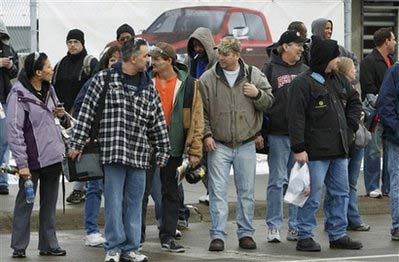
Workers leave the Chrysler Truck Assembly plant in Warren, Mich., Friday, December 12, 2008. Festering animosity between the United Auto Workers and southern Senators who torpedoed the auto industry bailout bill erupted into full-fledged name calling Friday as union officials accused the lawmakers of trying to break the union on behalf of foreign automakers. [Agencies]

The administration said no decisions had been made on the size or duration of the new bailout plan, or what type of concessions might be demanded from the struggling automakers, their workers, stockholders or others.


In a reversal, the most likely rescue option under consideration involved billions of dollars originally ticketed for the bailout of the financial industry. President George W. Bush had long declared that money off-limits to the beleaguered automakers.

General Motors Corp. and Chrysler LLC have warned they are running out of cash and face bankruptcy without some form of assistance. Ford Motor Co., which is in somewhat better shape financially, has been seeking access to a line of credit.

Urgent requests for White House intervention to save the automakers came from President-elect Barack Obama, Republican and Democratic members of Congress and outside groups.

"Under normal economic conditions we would prefer that markets determine the ultimate fate of private firms," White House press secretary Dana Perino said after the failure of a $14 billion bailout bill in Congress. The legislation died when Senate Republicans demanded upfront pay and benefit concessions from the United Auto Workers that union officials rejected.

Perino added, "Given the current weakened state of the US economy, we will consider other options if necessary including use of the TARP program to prevent a collapse of troubled automakers. A precipitous collapse of this industry would have a severe impact on our economy, and it would be irresponsible to further weaken and destabilize our economy at this time."

TARP is the $700 billion Troubled Assets Recovery Program, the financial industry bailout plan enacted in October. All but $15 billion of the first $350 billion has been dedicated to troubled banks or insurance companies, and the Treasury Department is barred from dipping into the second $350 billion without a formal notification of Congress.

No decision has been reached about such a notification, administration officials said. If one is made, Congress could then vote to prevent the action, but it would be unlikely to prevail in a showdown with the president.

Obama, who will inherit the problem next month, even if bailout billions are handed over in the meantime, said, "My hope is that the administration and the Congress will still find a way to give the industry the temporary assistance it needs while demanding the long-term restructuring that is absolutely required."

In a letter to Bush, House Speaker Nancy Pelosi urged the president to demand "the same tough accountability" and taxpayer protections from the automakers as was contained in legislation that cleared the House at midweek.

Michigan Rep. Thaddeus McCotter, a conservative Republican from a state where Ford, GM and Chrysler are headquartered, said, "With the legislative opportunities now exhausted, I urge the president of the United States to immediately release Wall Street TARP funds to the domestic automakers to avoid their impending bankruptcy and its consequent devastation of working families and the depression of our American economy."

It was unclear what role was left to lawmakers after an extraordinary week in which prospects for industry relief seemed to change by the hour.

A week ago, the government reported the loss of 533,000 jobs in November, the worst monthly showing in more than 30 years.

In the days between then and now, the White House and congressional Democrats agreed on a $14 billion measure that would have extended short-term financing to the industry while establishing a powerful new "car czar" to make sure the money was used to turn the Big Three into competitive companies. That bill passed the House on Wednesday but immediately ran into opposition from Senate Republicans who said it did not go far enough.

On Thursday, they demanded the United Auto Workers union agree to accept a lower pay and benefits package that would be in line with compensation earned by workers at US factories producing cars for Japanese companies such as Honda, Toyota and Nissan. In an unprecedented series of negotiations, lawmakers met with representatives of industry and labor on the first floor of the Capitol in hopes of striking a deal — the effort that ultimately collapsed when the UAW balked at the terms demanded.

At a news conference on Friday, UAW President Ron Gettelfinger accused GOP senators who blocked emergency loans of trying to "pierce the heart" of organized labor.

Sen. Bob Corker, R-Tenn., who played a leading role for Republicans, told reporters at the Capitol that the talks came close to success but failed when the UAW refused to commit to lowering its pay-and-benefits package in 2009 so it would be "competitive" with the Japanese companies — a lower threshold, he said, than his previous demand that wages and benefits be "at parity" with foreign counterparts.

He also laid blame at the feet of the administration. "I think it being known that the White House at the end of the day would probably blink probably helped keep us from a deal," he said.

Whatever the reason, the effort stalled when Republicans voted en masse against advancing the original House bill to a final vote late Thursday night.

Read more...

Recession risk 'worse than expected': NDRC

Updated: 2008-12-13

By Fu Jing (China Daily) China is facing "worse-than-expected" risks of an economic downturn, as the global recession looms large, the country's top economic planner said on Friday.

Zhang Ping, minister of the National Development and Reform Commission, said it is "still very hard" to predict when the worsening global financial crisis will hit.


Local vendors pile up carrots while waiting for customers at a vegetable wholesale market in Zheng'an County, Henan province December 11, 2008. [Agencies]

This is the first time a senior Chinese official has outlined the domestic and global economic landscape while the financial crisis, sparked by the US sub-prime crisis, is still unfolding.


"Amid the domestic and global risks and uncertainties, coping with sliding economic growth is top of the government's work agenda," Zhang said.

He made the comments during a speech to senior provincial officials in charge of economic and social development at the opening of a three-day national conference to implement the central government's instructions and guidelines on fighting the financial crisis.

On Wednesday, the government ended a closed-door economic conference by coming up with guidelines to fight the crisis.

As more than 60 percent of China's economy depends on imports and exports, the worsening global economy and contracted overseas demand have already brought "worse-than-anticipated" risks of an economic downturn to China, Zhang said.

"Sliding economic growth is a major challenge for us both this year and next."

China's economic growth slowed to 9.9 percent in the first nine months, after five years of high annual growth of more than 10 percent.

The State Council said earlier that the economy may grow at 9.4 or 9.5 percent this year.

The economic slowdown and fall in profits have spread from coastal regions to central and western China, from export-led companies to other industries and from small and medium-sized enterprises to bigger companies, Zhang said.

"The worsening trend is likely to continue next year," he said.

He urged all parties to be clear-minded about the situation at home and abroad, and be prepared to face the challenges.

Despite some pundits saying the world will shake off the turmoil by the end of next year, Zhang is not so optimistic.

"The worsening turmoil is likely to last for a long time and the global economy will experience a relatively long period of downturn and adjustment," he said.


Read more...

China December Producer Price Index to Drop, Liu Says

By Zhang Dingmin

Dec. 13 (Bloomberg) -- China's producer price index is expected to drop ``sharply'' in December, China Banking Regulatory Commission Chairman Liu Mingkang said.

The world's fourth-biggest economy is shifting toward deflation, Liu told a financial forum in Beijing today. Capital inflows may shift to outflows, with gross domestic product projected around 8 percent next year, he said.

China's producer-price inflation slowed to half the pace estimated by economists in November as commodity and energy costs fell, raising the possibility that the country will slide into deflation as demand wanes at home and abroad.

Prices at the factory gate rose 2 percent in November from a year earlier, the statistics bureau said Dec. 10, after gaining 6.6 percent in October. That was the slowest pace in two years and less than the 4.5 percent median estimate of 15 economists surveyed by Bloomberg News.

The commission will have ``scientific tolerance'' for bad loans next year, Liu said without detailing.

Chinese banks are scaling up lending after the government pledged a 4 trillion yuan ($584 billion) stimulus plan on Nov. 9 to bolster growth as the world heads toward recession. Lenders may suffer further losses on their overseas assets as the global financial crisis remains ``far from over,'' the commission's Vice Chairman Jiang Dingzhi said Nov. 15.

To contact the reporter for this story: Zhang Dingmin in Beijing at Dzhang14@bloomberg.net


Read more...

Japan Notes Complete Weekly Gain as Senate Rejects Auto Bailout

By Theresa Barraclough

Dec. 13 (Bloomberg) -- Japan’s five-year notes completed a weekly gain as stocks tumbled after the U.S. Senate rejected a $14 billion bailout plan for the nation’s automakers.

The securities yesterday rose the most in six weeks as Toyota Motor Corp., which gets more than half its profit in North America, led losses in the Nikkei 225 Stock Average. The dollar yesterday slumped below 90 yen for the first time in 13 years. Bonds also advanced after the Nikkei newspaper yesterday said the Bank of Japan may next week provide its worst assessment of the economy since May 2002.

“With the anxiety of the Big Three and the appreciation of yen to these levels, there is no alternative to buying bonds,” said Jun Fukashiro, senior fund manager at Toyota Asset Management Co. in Tokyo.

The yield on the 0.9 percent bond due December 2013 fell 3.5 basis points this week to 0.845 percent in Tokyo at Japan Bond Trading Co., the nation’s largest interdealer debt broker.

Ten-year yields declined two basis points, or 0.02 percentage point, yesterday to 1.39 percent. Yields are up two basis points on the week.

Ten-year bond futures for March delivery jumped 0.32 this week to 139.42 at the Tokyo Stock Exchange. The dollar fell as low as 88.53 yen, the weakest since August 1995, and the Nikkei 225 Stock Average slid 5.6 percent yesterday.

Japan’s bonds typically move in the opposite direction to stocks. Benchmark 10-year yields had a correlation of 0.78 with the Nikkei 225 in the past two weeks, according to Bloomberg data. A value of 1 would mean the two moved in lockstep.

‘Over With’

“It’s over with,” Majority Leader Harry Reid said late Dec. 11 on the Senate floor in Washington, referring to the automaker bailout. “I dread looking at Wall Street tomorrow.” The Senate thwarted the bailout plan when a bid to cut off debate on the bill fell short of the required 60 votes.

“The U.S. bailout plan is affecting the stock market,” boosting bonds, said Takashi Nishimura, an analyst at Mitsubishi UFJ Securities Co., a unit of Japan’s largest bank by assets, in Tokyo. “The downgrading of the economic assessment is a step forward toward another rate cut.”

The Bank of Japan may change its assessment of economic activity to “worsening,” from “increasingly sluggish,” at its two-day policy meeting ending Dec. 19, the Nikkei newspaper said yesterday, without citing anyone. BOJ Deputy Governor Hirohide Yamaguchi said on Dec. 11 policy makers need to be aware that downside risks are increasing and the bank needs to consider various options when setting policy.

Tankan Index

The Tankan index of confidence among large manufacturers will slide to minus 23 in December from minus 3, according to the median estimate of economists surveyed by Bloomberg before the Dec. 15 report. The decline would be the biggest since 1975, when it fell 21 points in the wake of the first oil shock. A negative number means pessimists outnumber optimists.

“Next week’s Tankan is bond-buying material,” said Akihiko Inoue, an analyst in Tokyo at Mizuho Investors Securities Co., one of the 24 primary dealers that are required to bid at government debt sales.

There was a 36 percent chance yesterday the BOJ will cut borrowing costs by the end of March, according to calculations by JPMorgan Chase & Co. using overnight interest-rate swaps. The key overnight lending rate is 0.3 percent.

Demand for bonds this week was limited on concern the government will sell additional debt to cover a shortfall in tax revenue. Issuance for the year ending March 31 will rise from the originally planned 105.1 trillion yen ($1.17 trillion), two finance ministry officials said Dec. 10.

Lower Rates

The finance ministry will also boost debt sales to investors including banks and life-insurance companies in the year starting April 1, according to a Bloomberg survey of primary dealers. Bond offerings to private investors will rise to 112.8 trillion yen next fiscal year, the survey showed. The finance ministry will announce its issuance plan on Dec. 19.

The Asahi newspaper reported yesterday that the government plans to provide 3 trillion yen to large and midsize businesses by buying their commercial paper and lending money at low rates.

The plan may alleviate pressure on bank lending and lead to lower money-market rates, allowing investors to borrow more money to invest in bonds, said Hitomi Kimura, a bond strategist at JPMorgan Securities Japan Co., another primary dealer.

“It’s positive for the money-market for now,” Tokyo-based Kimura said. “Two- and five-year notes will have room to rally if rates come down.”

One-month commercial paper with the second-strongest credit rating yielded 1.9 percent yesterday, more than double the Tokyo interbank offered rate for yen loans, according to Tokyo Tanshi Co. Three-month Tibor rose to 0.915 percent yesterday, the 25th day of gains, Bloomberg data show.

To contact the reporter on this story: Theresa Barraclough in Tokyo at tbarraclough@bloomberg.net.


Read more...

Toyota May Report 2nd-Half Operating Loss, Asahi Says

By Stanley White

Dec. 13 (Bloomberg) -- Toyota Motor Corp., Japan's largest automaker, may report an operating loss of at least 100 billion ($1.1 billion) in the fiscal second half as a global recession and a strengthening yen crimp sales, the Asahi newspaper said.

Losses in the October-March period may reduce the automaker's full-year profit by 80 percent or more, forcing the company to lower its earnings forecasts, the Asahi reported, without citing anyone. Calls to the company's offices in Tokyo and Toyota City, Japan weren't answered.

The maker of Corolla cars last month forecast the biggest drop in profit in at least 18 years as a global slump cripples auto demand and gains in the yen erode the value of overseas sales. President Katsuaki Watanabe predicted the smallest profit in nine years as higher fuel costs and the credit crunch hurt vehicle sales in the U.S., the world's largest auto market.

Toyota said on Nov. 6 it expects operating profit to plunge 74 percent this fiscal year to 600 billion yen, which is also down 63 percent from its previous forecast.

Car sales last month may have fallen more than expected, the newspaper said. The yen's 23 percent gain against the dollar and 34 percent rise against the euro this year will also erode overseas earnings, according to the newspaper.

The dollar traded at 91.07 yen at 4:27 p.m. in New York, compared with 91.45 yesterday, after dropping as much as 3.2 percent to 88.53, the lowest level since August 1995. The euro

Output Cuts

Sales in the U.S., traditionally the company's most profitable market, plunged the most in 28 years last month as the recession forced consumers to cut spending. Auto sales in the U.S., the world's largest auto market, fell to the lowest annual rate in 26 years last month. Toyota's sales slipped 34 percent.

Domestic sales plunged 28 percent in November, as industrywide sales dropped to the lowest tally in 39 years for the month. Toyota sold 83,000 vehicles in Europe in October, down 14 percent from a year ago. In the first 10 months of this year, European sales dropped 6.4 percent.

In response, the company is also cutting output. Toyota, which opened its seventh North American auto assembly plant last week, said it plans to further reduce production at factories in the U.S. and Canada. It halted production of Tundra pickups at its San Antonio plant for more than three months.

The company is eliminating nine days of output by extending an annual holiday shutdown at its Georgetown, Kentucky, facility and closing the location for two additional days in January, the company said Dec. 5.

Holiday shutdowns are also extended at a plant in Fremont, California, that Toyota shares with GM and at plants in Cambridge and Woodstock, Ontario, the company said.

To contact the reporter on this story: Stanley White in Tokyo at swhite28@bloomberg.net


Read more...

Asian Currencies Climb in Week, Led by Won, Rupiah, on Stocks

By Kim Kyoungwha

Dec. 13 (Bloomberg) -- Asian currencies climbed this week, led by the South Korean won and the Indonesian rupiah, on optimism that interest-rate cuts and economic stimulus plans will revive demand for emerging-market assets.

All of the 10 most-active regional currencies strengthened this week as the Dollar Index slumped the most in at least a decade. The Malaysian ringgit touched a one-month high and the Philippine peso reached the strongest since October 15. South Korea, Japan and China said they enhanced their currency swap arrangements to ensure stability in the foreign-exchange market.

“The propensity in recent weeks is for money managers to focus their flows on opportunities in undervalued currencies,” said Dwyfor Evans, a currency strategist with State Street Global Markets in Hong Kong. “The extreme risk aversion we’ve had in the past months is gone and I assume that’s on the back of monetary and fiscal policies globally.”

The currencies trimmed the week’s gains after regional stocks fell yesterday on concern General Motors Corp. and Chrysler LLC won’t have enough cash to survive after the U.S. Senate rejected a $14 billion bailout plan for automakers.

The won rose as much as 10 percent this week, the most since October, before paring gains to 7.5 percent to 1,372.50 per dollar yesterday, according to Seoul Money Brokerage Services Ltd.

South Korea and Japan will increase an existing won-yen arrangement to $20 billion from $3 billion, according to statements by the central banks of both countries yesterday. China and South Korea will sign an accord worth 38 trillion won ($28 billion), the People’s Bank of China said.

‘Panic Subduing’

The arrangement will help boost the supply of dollars and make it easier for banks and companies to get funding. South Korea’s economy will grow 2 percent next year, the slowest in 11 years, from an estimated 3.7 percent this year, the Bank of Korea said yesterday.

“The gloomy economic prospect has partly been priced in,” said Roh Sang Chil, a currency dealer with Kookmin Bank, South Korea’s biggest lender in Seoul. “The extreme fear and panic that there will be no floor in the won is subsiding.”

Indonesia’s rupiah had its best week since 2001 as the government told companies and individuals to seek approval for currency purchases topping $100,000 a month.

Slowing Demand

“The new foreign-currency ruling will slow down the demand for dollars,” said Enrico Tanuwidjaja, an economist at Oversea- Chinese Banking Corp. in Singapore. “There’s still the possibility for the rupiah to weaken once people start to take stock on how bad the global economy has become.”

The rupiah, which fell 0.5 percent yesterday, strengthened 5.9 percent this week to 11,050 versus the dollar, according to data compiled by Bloomberg.

The yuan headed for the biggest weekly advance since August on signs China is allowing currency appreciation to prevent global funds from leaving the country as growth in the world’s fourth-largest economy cools.

The currency rose for an eighth day, extending this year’s gain to 6.7 percent, the best among the 10 most-traded Asian currencies outside Japan. Assistant Finance Minister Zhu Guangyao last week vowed to keep the currency at a “reasonable and balanced” level.

The yuan strengthened 0.56 percent this week to 6.8427 a dollar in Shanghai from 6.8812 at the end of last week, according to the China Foreign Exchange Trade System.

Rate Cut

Thailand’s baht capped its best week in more than a year as the biggest cut in interest rates on record spurred optimism the economy will weather the global slump. The currency ended a four-week slide as the opposition Democrat party, favored by anti-government protesters, said it wooed some members of the now dissolved People Power Party to support its British-born leader for premier.

The baht gained 1.9 percent this week to 34.99 a dollar, Bloomberg data show. Malaysia’s ringgit headed for its biggest weekly gain since the end of a dollar peg in 2005, rising 1.5 percent this week to 3.5825.

Elsewhere, the Taiwan dollar advanced 0.7 percent this week to NT$33.315 against the U.S. currency. The Philippine peso climbed 2 percent to 48.105. The Indian rupee gained 2.1 percent to 48.56 and the Vietnamese dong was little changed at 16,982.50.

To contact the reporters on this story: Kim Kyoungwha in Beijing at kkim19@bloomberg.net.


Read more...

Asian Stocks Gain This Week on Stimulus Plans; Cnooc Climbs

By [bn:PRSN=1] Chua Kong Ho []

Dec. 13 (Bloomberg) -- Asian stocks rose this week, led by energy and raw-materials producers, after U.S. President-elect Barack Obama pledged the biggest public works program in about 50 years and governments stepped up measures to arrest the recession.

BHP Billiton Ltd., the world’s largest mining company, gained 10 percent and Cnooc Ltd. rose 24 percent as metals and oil climbed. Komatsu Ltd., the world’s No. 2 maker of construction machinery, gained 22 percent after Obama planned the largest spending package since President Dwight D. Eisenhower created the interstate highway system. Honda Motor Co. tumbled 12 percent yesterday, paring the week’s gain to 16 percent, after the Senate voted down a bill to provide $14 billion in emergency funds for General Motor Corp. and Chrysler LLC.

“Governments, not only the U.S., must spend to replace the growth that will be lost from weak consumer spending,” said Jonathan Ravelas, a strategist at Banco de Oro Unibank Inc. in Manila, which has more than $6 billion in trust assets under management. “Investors have been waiting for this kind of stimulus to cushion the effects of a global slowdown.”

The MSCI Asia Pacific Index advanced 6.1 percent to 84.38 this week. The measure rose every day this week except yesterday, when markets sank after the U.S. Senate thwarted a rescue plan for U.S. automakers. Energy and raw-materials stocks led gains among the 10 industry groups this week.

Market Tumble

MSCI’s Asian index has plunged 46 percent in 2008 as global financial companies’ losses and writedowns from the collapse of the U.S. subprime-mortgage market neared $1 trillion.

Shares on the MSCI gauge are now valued at 10.1 times trailing earnings after falling to as low as 8.2 times last month. That’s half the 19.5 times on Nov. 11 last year, when the measure hit a peak of 172.32. Prior to the current market turmoil, the price-earnings ratio never dropped below 10, according to Bloomberg data.

Japan’s Nikkei 225 Stock Average gained 4 percent to 8,235.87. Japan Prime Realty Investment Corp. gained 37 percent after the Nikkei newspaper said the government will extend credit lines of as much as 2 billion yen ($22 million) to small and midsize developers as banks grow reluctant to lend.

China’s CSI 300 Index fell 2.6 percent, as the nation’s exports fell for the first time in seven years in November, home sales fell and retail sales grew at the slowest pace in nine months. Most other markets in Asia advanced this week.

Government Measures

Governments worldwide have introduced measures this year to buttress their economies from the worst financial crisis since the Great Depression. Obama said on Dec. 6 he will boost investment in roads, bridges and public buildings to create and preserve 2.5 million jobs.

India cut its repurchase rate to 6.5 percent from 7.5 percent on Dec. 6 and the government said it will spend an extra 200 billion rupees ($4 billion) in the year ending March 31. South Korea slashed its benchmark interest rate to a record low of 3 percent to stave off its first recession since 1998.

Komatsu, which gets half its sales overseas, jumped 22 percent to 1,106 yen.

Japan’s consumers were the most pessimistic in at least 26 years, according to the Cabinet Office yesterday. Sony Corp. and Toyota Motor Corp. were among the companies that announced production and job cuts this week.

Commodity Producers

BHP gained 10 percent to A$28.82. Nippon Mining Holdings Inc., which last week agreed to the biggest oil company merger in Japan since 1999, gained 20 percent to 346 yen. Cnooc, China’s largest offshore oil explorer, jumped 24 percent to HK$7.21.

A measure of six metals traded on the London Metal Exchange gained 4.1 percent this week, while oil rose 14 percent to $46.54 a barrel.

Honda Motor Corp., Japan’s second-largest automaker, surged 33 percent in the four days this week before tumbling 12 percent yesterday, after the Senate rejected a bailout plan for U.S. automakers that was passed by the House.

“Investors have been betrayed again by U.S. politicians,” said Yasuhiro Miyata, who helps manage about $109 billion at DIAM Co. in Tokyo. “Even with the knowledge that we are in the midst of a crisis, they were unable to come to an agreement and investors have decided to abandon ship. This could have a substantial effect on unemployment.”

BlueScope Steel Ltd., Australia’s largest steelmaker, tumbled 21 percent to A$2.85, after announcing plans to sell A$550 million ($364 million) in stock at a 23 percent discount.

To contact the reporter responsible for this story: Chua Kong Ho in Shanghai at kchua6@bloomberg.net


Read more...

U.S. Stocks Advance as Technology Shares Rise; GM, Energy Fall

By Whitney Kisling

Dec. 12 (Bloomberg) -- U.S. stocks advanced as speculation the government will boost spending on technology overshadowed concern a bailout of carmakers won’t bring the nation out of a recession, spurring a 3.3 percent rebound by the Standard & Poor’s 500 Index from the day’s low.

Intel Corp. and Micron Technology Inc. rose more than 5.2 percent after Nancy Pelosi said the House is likely to act next month on an economic-stimulus measure that would boost computer expenditures. General Growth Properties Inc. surged 25 percent, leading a real-estate rally, after refinancing debt to stave off bankruptcy. General Motors Corp. and energy stocks fell.

The S&P 500 increased 0.7 percent to 879.73 after falling as much as 2.6 percent. The index swung between gains and losses at least 30 times and jumped more than 1 percent in the final four minutes of trading. The Dow Jones Industrial Average climbed 64.59 points, or 0.8 percent, to 8,629.68. The VIX, a measure of how much investors are paying for protection from stock declines, slipped 2.7 percent to 54.28, the lowest since Nov. 4.

“The market is hovering, waiting for some kind of catalyst to get it going,” said Thomas Nyheim, a Greenville, Delaware- based fund manager for Christiana Bank & Trust Co., which oversees $4 billion. “We can see valuations are attractive, but I think the next real catalyst will be a major stimulus package and that’s not until the first quarter of next year.”

The Senate’s rejection last night of $14 billion in emergency loans to GM and Chrysler LLC spurred a global rout in equities that sent Europe’s Dow Jones Stoxx 600 Index down 2.7 percent and the MSCI Asia Pacific Index to a 4.2 percent slide.

Rebound, Resume Slide

GM and Ford Motor Co. rebounded, driving the U.S. stock market higher, after the White House said it might finance an industry rescue with funds set aside for banks. GM later resumed its slide. Technology shares gained the most among 10 industries in the S&P 500 after Pelosi said the House will act next month on as much as $600 billion in spending to fund improvements in broadband internet technology and making environmentally friendly improvements to the nation’s electric-power grid.

Intel, the world’s biggest computer chipmaker, added 5.3 percent to $14.75. Micron, the largest U.S. memory-chip maker, rose 12 percent to $2.07. They helped drive technology companies in the S&P 500 to a 2.4 percent advance.

General Growth jumped 25 percent to $1.80. The second- largest U.S. mall owner refinanced $814 million of mortgage loans and retired a $58 million bond. Real-estate companies in the S&P 500 rose 8.7 percent collectively, the most among 24 industries.

GM Drops

CB Richard Ellis Group Inc. gained 21 percent to $4.08. Developers Diversified Realty Corp. rallied 13 percent to $5.69.

GM fell 4.4 percent to $3.94 in its fourth straight day of declines. It lost as much as 37 percent earlier. Ford added 4.8 percent to $3.04.

Implied volatility, the key gauge of options prices and a measure of how much investors are paying for insurance against stock declines, surged for GM, the nation’s biggest automaker. The figure for at-the-money contracts expiring in 30 days rose 4.4 percent to 293.4, highest among S&P 500 companies behind XL Capital Ltd.

Neither the Treasury nor the White House’s statements today indicated whether the funds from the Troubled Asset Relief Program would come with terms or concessions. Treasury Secretary Henry Paulson, who until today had resisted using the bank bailout money on carmakers, had repeatedly insisted that any injection of funds must include a plan ensuring “viability” for the companies.

FDIC-Backed Notes

JPMorgan Chase & Co. climbed 3.3 percent to $30.94. The largest U.S. bank by assets raised $250 million in a sale of additional notes backed by the Federal Deposit Insurance Corp., according to data compiled by Bloomberg.

Wachovia Corp. rallied 5.4 percent to $5.29, while Wells Fargo & Co. gained 3.2 percent to $26.72. Financials had the second-steepest gain among 10 S&P industries, adding 2.1 percent.

Energy shares in the S&P 500 slumped 0.9 percent as crude oil lost 3.3 percent to $46.40 a barrel in New York. Goldman Sachs Group Inc. cut its first-quarter forecast for the price of oil by half to $30. Occidental Petroleum, the fourth-largest U.S. energy company, slid 4.7 percent to $55.12.

The VIX, as the Chicago Board of Options Exchange Volatility Index is known, has fallen 33 percent since rising to 80.86, the highest in its 18-year history, on Nov. 20.

The S&P is poised for a 40 percent loss this year, the steepest annual slump since 1931, as writedowns and credit losses neared $1 trillion amid the worsening financial crisis.

More Declines?

New York University Professor Nouriel Roubini, who predicted the global financial crisis, said shares will keep falling.

“I’m still quite bearish on U.S. and global equities,” he said in an interview with Bloomberg Television. “They’ve fallen a lot, but they might surprise on the downside. U.S. and global equities could be 15-to-20 percent lower before they start to recover toward the end of next year.”

Earlier declines in the market today also came after FBI agents arrested Bernard Madoff, a former chairman of the Nasdaq Stock Market. Madoff allegedly confessed that he defrauded investors of $50 billion by running his firm, Bernard L. Madoff Investment Securities LLC, like a “giant Ponzi scheme” and “paid investors with money that wasn’t there.”

“His market making operations are big, his investor base was widespread and the fraud will destroy confidence in some areas of money management,” Peter Boockvar, a New York-based equity strategist at Miller Tabak & Co., wrote in an e-mail to clients.

To contact the reporters on this story: Whitney Kisling in New York at wkisling@bloomberg.net.


Read more...