Economic Calendar

Tuesday, December 2, 2008

Bancolombia, Cosan, MRV, Penoles, Sadia: Latin Equity Preview

Dec. 2 (Bloomberg) -- The following companies may have unusual price changes today in Latin America trading. Stock symbols are in parentheses and share prices reflect the previous close.

The MSCI Latin America Index fell 7.6 percent yesterday to 1,874.1.

Brazil

Banco Sofisa SA (SFSA4 BS): The bank controlled by Brazil’s Burmain family may buy back up to 6 percent of outstanding shares during the next year, Sofisa said yesterday. The board approved the repurchase of as many as 2.25 million preferred shares. Sofisa fell 4 percent to 3.65 reais.

Cosan SA Industria e Comercio (CSAN3 BS): The world’s biggest sugar-cane processor said it will pay $715 million to acquire Exxon Mobil Corp.’s Brazilian service stations and other fuel-distribution assets. Cosan will also take over $175 million in debt held by Esso Brasileira de Petroleo Ltda as part of the previously announced deal, it said in a regulatory filing. Cosan fell 9.8 percent to 10.10 reais.

MRV Engenharia e Participacoes SA (MRVE3 BS): The builder of homes for low-income families said it plans to buy back as many as 7 million common shares after the stock dropped 79 percent this year. MRV intends to repurchase up to 9.3 percent of its outstanding stock over the next 365 days, the company said in a regulatory filing. MRV fell 11 percent to 8 reais.

Sadia SA (SDIA4 BS): The food company that reported a third-quarter loss on currency derivative contracts said in a regulatory filing the potential loss from dollar contracts was reduced to $966 million from $2.36 billion at the end of September. Sadia fell 8.2 percent to 3.03 reais.

Colombia

Bancolombia SA (BCOLO CB): Colombia’s biggest lender said it sold a 67 percent stake in a property in Cartagena to CMB SA for the equivalent of $9.7 million. Separately, Bancolombia said it sold $36.1 million in mortgage loans to Titularizadora Colombiana SA, which will sell securities backed by the mortgages. Bancolombia fell 2.4 percent to 11,620 pesos.

Mexico

Industrias Penoles SAB (PE&OLES* MM): Frensillo Plc, the silver unit of Penoles, said it will acquire the shares of Canadian mining company Mag Silver it doesn’t already own. A Fresnillo unit will offer $4.54 a share for the remaining 80.2 percent of Mag Silver. Penoles fell 13 percent to 100.73 pesos.


Read more...

US officially in recession, Dow falls sharply

Updated: 2008-12-02

(China Daily) NEW YORK -- The reality that the United States is indeed in recession and that the downturn may well be prolonged sent Wall Street plunging Monday, hurtling the Dow Jones industrials down nearly 700 points and wiping out more than half of last week's big gains. All the major indicators fell more than 7 percent, with the Standard & Poor's 500 index down nearly 9 percent.


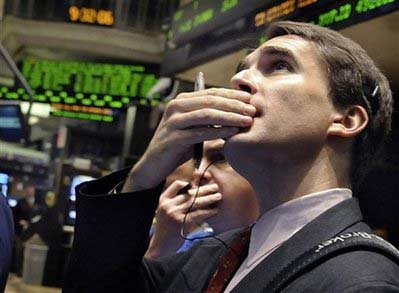
Traders work on the floor of the New York Stock Exchange, Monday, December 1, 2008. [Agencies]

The market spent the day absorbing a litany of bad news that convinced investors that the optimism that fed a 1,276-point gain in the Dow over five sessions was premature. Stocks first slid on initial reports that the first weekend of the holiday shopping season, while better than some retailers and analysts feared, saw only modest gains. That had Wall Street worried that the rest of the season would be disastrous, a troubling thought not only for retailers but for an economy that is dependent on consumer spending for its growth.

According to figures released by ShopperTrak RCT, a research firm that tracks total retail sales at more than 50,000 outlets, sales over Friday and Saturday rose just 1.9 percent.

Meanwhile, downbeat economic reports on the country's manufacturing sector and construction spending only added to investors' concerns. Speeches from Federal Reserve Chairman Ben Bernanke and Treasury Secretary Henry Paulson also did little to assuage investors about the downturn.

The day's news reminded investors, who last week were buying on a burst of optimism, that the economy is still in serious trouble. Then, at midday, Wall Street got confirmation of what everyone has suspected for months, that the nation is indeed in a recession. The National Bureau of Economic Research, considered the arbiter of when the economy is in recession or expanding, said the US recession had begun a year ago, in December 2007.

That assessment made the retail sales figures all the more unnerving.

"Unfortunately, two-thirds of the American economy is based on the spending of the American consumer," said Mike Stanfield, chief executive of VSR Financial Services. "When the consumer pulls back, it's very hard for the economy to gain much traction."

Investors had been hopeful that last week's rally, when the major indexes shot up by double digit percentages, was a sign that some stability had returned to a market badly shaken by months of discouraging economic data. But analysts expect economic concerns to weigh on the market for some time to come.

"Everyone knows the recession is on us, the question is now will it be short and shallow or long and severe," Stanfield said.

Chuck Widger, chief executive of investment management firm Brinker Capital, expects the volatility to continue until investors have better visibility on the future.

"Investors are looking for better data on the economy," he said. "We've got baked in pretty nasty assumptions for the economy this quarter. The markets are looking ahead to the first quarter for data that will confirm or deny the bad news."


Although Monday's plunge was notable because it cut short a five-day rally, the first such winning streak for the Dow and the Standard & Poor's 500 index since July 2007, it also fit what has become a pattern on Wall Street. The market has made a number of big, optimistic moves higher, including triple-digit gains in the Dow, only to quickly give them back as another batch of bad news arrives.

According to preliminary calculations, the Dow Jones industrial average fell 679.95, or 7.70 percent, to 8,149.09. The S&P 500 index dropped 80.03, or 8.93 percent, to 816.21, while the Nasdaq composite index fell 137.50, or 8.95 percent, to 1,398.07.

Only 218 stocks were in positive territory on the New York Stock Exchange with 2,693 declining. Volume came to 1.62 billion shares.

The Russell 2000 index of smaller companies fell 56.07, or 11.85 percent, to 417.07.

Bond prices rose. The yield on the benchmark 10-year Treasury note, which moves opposite its price, fell to 2.76 percent from 2.92 percent Friday. The yield on the three-month T-bill, considered one of the safest investments and an indicator of investor sentiment, slipped to 0.02 percent from 0.05 percent Friday. The lower the yield, the more anxious investors tend to be.

The market received no relief after a pair of speeches from Paulson and Bernanke about the economy.

Paulson said the administration is looking for more ways to tap a $700 billion financial rescue program and will consult with Congress and the incoming Obama administration. The program has distributed $150 billion out of the $250 billion earmarked to buy stock in banks as a way to boost their resources so they can lend more.

He said the administration is looking at other ways to utilize the rescue package, including alternatives for providing capital to financial institutions.

Meanwhile, Bernanke said in another speech Monday that further interest rate cuts are "certainly feasible," but he warned there are limits to how much such action would revive the economy. The central bank's key interest rate now stands at 1 percent, a level seen only once before in the last half-century.

Many economists predict policymakers will drop the rate again at their next meeting on Dec. 15-16. And, there have certainly been enough weak economic news to compel the Fed to make another cut.

There was no shortage of disappointing economic news on Monday. The Institute for Supply Management, a trade group of purchasing executives, said its index of manufacturing activity fell to a 26-year low in November. Meanwhile, the Commerce Department said construction spending fell by a larger-than-expected amount in October.

Stanfield also said investors have lost some confidence in recent moves by the government to bolster the financial system. "The financials are still lagging, which in my opinion shows a lack of confidence in (Treasury Secretary) Paulson and the undertaking of the Fed and the Treasury," he said.

Analysts say investors have been frustrated by the government's change in strategy as it implements its $700 billion financial bailout program; the Treasury originally said it would buy soured mortgage debt from banks, then decided to buy stock in the banks. Last week, with the rescue of Citigroup Inc., the government again said it was buying the bank's failed debt.

The government injected a fresh $20 billion into the banking giant and said it would guarantee up to $306 billion of the bank's risky assets. Banking stocks were among the biggest sectors pulling the overall market down on Monday.

Citigroup tumbled $1.84, or 22.2 percent, to $6.45. Morgan Stanley shares dropped $3.40, or 23.1 percent, to $11.35. Goldman Sachs Group Inc. fell $13.23, or 16.7 percent, to $65.76.

Retailers were among the day's poorest performers. Wal-Mart Stores Inc. fell $2.87, or 5.1 percent, to $53.01, while JCPenney Co. tumbled $2.44, or 12.8 percent, to $16.55.

Light, sweet crude dropped $5.15 to settle at $49.28 a barrel on the New York Mercantile Exchange after OPEC decided not to cut production at an informal meeting in Cairo on Saturday. The Organization of the Petroleum Exporting Countries, which accounts for about 40 percent of global supply, reduced output quotas in October by 1.5 million barrels a day.

The dollar fell against other major currencies. Gold prices also fell.

Overseas, Japan's Nikkei stock average fell 1.35 percent. At the close, Britain's FTSE 100 was down 5.19 percent, Germany's DAX index was down 5.88 percent, and France's CAC-40 was down 5.59 percent.



Read more...

Forex Exchange Morning Report

Daily Forex Fundamentals | Written by Westpac Institutional Bank | Dec 02 08 02:05 GMT |

News And Views

This week's mood reverts to the negative sentiment prevailing two weeks ago. US equities fell over 5% on an awful ISM release, one part of that index at a 60 year low. Combined with recent PMI figures for Eurozone, UK, Russia, and China at record lows, and well below expectations, we have a bigger picture of markets not yet discounting the bad news. Until expectations are lower than the actual readings, a positive medium-term reversal in equities and risk-currencies is unlikely to occur.

The NZD fell overnight in Europe with the poor news and the fall in US equities, from above 54 cents to just above 53 cents, and is currently tracking sideways at around 0.5350. Interest rates for 3 month bank bills fell a whopping 38bp, and expectations for a larger 150bp cut on Thursday are increasing. The size of the RBA's interest rate cut, announced today at 16:30, will be the highlight event.

AUD also fell on the above bad news, from around 0.6480 to just above 0.6380, but recovered better than the NZD did, and is currently around 0.6550. The AUD/NZD cross has broken through the initial target of 1.20, in fact touching 1.21.

The EUR fell from around 1.27 to briefly dip under 1.26, but has recovered somewhat to 1.2660. USD/JPY had one of the largest currency falls reflecting a new safe haven rush, from around 95.30 to just above 93, and is currently not higher at 93.30.

US factory ISM falls from 38.9 to 36.2 in Nov. The factory ISM continued its three month plunge in November, falling to its lowest since 1982, when quarterly GDP growth was printing as low as -6% annualised. Almost all the activity components continued to slide, indicating a steeper pace of decline than in October. New orders fell below 30, pointing to likely further slides in the other activity indices in coming months. The exception was exports which fell at the same pace as in October, after solid growth through the first three quarters of 2008. Prices continued to fall sharply, to a six decade low, reflecting lower fuel, food and other commodity prices.

US construction spending fell 1.2% in October, exactly in line with Westpac's forecast, but there was a surprise substantial upward revision back in August (from 0.3% to 2.4% growth) which should impart a positive bias in the next revision to Q3 GDP growth due in the final report later this month.

Japanese wages slip -0.1%. The sharp fall in production is already weighing on labour incomes with wages dropping -0.1%yr in Oct, vs expectations of a slight +0.1%yr gain.

Euroland factory PMI for November was revised down from 36.2 to 35.6, making that index's already steep decline even steeper. The factory PMI is now at deeply recessionary levels. That point was accentuated by the further 1.6% slump in German retail spending at the start of the fourth quarter.

UK factory PMI collapsed again in Nov, to a new record low at 34.4, a level that we expect would be consistent with a decline in Q4 GDP growth of 1% or greater (we will firm up that view once the services PMI is released later this week). This news, the lack of substantial 'front-loading' in last week's fiscal stimulus package and the likelihood that November inflation will tumble from 4.5% yr to around 3.7% yr, means we are inclined to expect a BoE rate cut somewhat steeper than the 50bp we had been forecasting for this Thursday. A 75bp cut is probably more likely than 100bp given the stated view in the policy committee minutes to the Nov meeting that there is some merit in the argument that scope needs to be left to allow for further rate cuts (i.e. don't do it all at once!). Other data included weak consumer and mortgage lending figures for October.

Canadian GDP growth accelerated from an upwardly revised 0.6% annualised in Q2 to 1.3% in Q3, despite a slightly weaker than expected 0.1% gain in the September monthly GDP report.

Outlook

Our NZD bias is back to negative, after last week's temporary reversal, and 0.52 is now vulnerable during the week. Today, an RBA cut of 100bp would be higher than expected, and support the AUD, and, to a lesser extent, the NZD. A 75bp move would likely be neutral, while any less would add to the current negative sentiment surrounding the currencies.

Country Release Last Forecast
Aus Q3 Current Account Balance AUDbn -12.8 -12.8

Q3 Net Exports Contribution to GDP, ppts 0 -0.4

Q3 Public Sector Spending 1.80% 0.90%

Oct Retail Sales (s.a) -1.1% -0.4%

RBA Policy Announcement (2:30pm) 5.25% 4.50%
US Nov Auto Sales mn ann'lsd 10.6 9.8

Fedspeak: Plosser

Jpn Nov Monetary Base %yr 1.40% -
Eur Oct PPI %yr 7.90% 7.40%
UK Nov PMI Construction 35.1 35

Westpac Institutional Bank
http://www.wib.westpac.co.nz/

Disclaimer

All customers please note that this information has been prepared without taking account of your objectives, financial situation or needs. Because of this you should, before acting on this information, consider its appropriateness, having regard to your objectives, financial situation or needs. Australian customers can obtain Westpac's financial services guide by calling +612 9284 8372, visiting www.westpac.com.au or visiting any Westpac Branch. The information may contain material provided directly by third parties, and while such material is published with permission, Westpac accepts no responsibility for the accuracy or completeness of any such material. Except where contrary to law, Westpac intends by this notice to exclude liability for the information. The information is subject to change without notice and Westpac is under no obligation to update the information or correct any inaccuracy which may become apparent at a later date. Westpac Banking Corporation is regulated for the conduct of investment business in the United Kingdom by the Financial Services Authority. © 2004 Westpac Banking Corporation. Past performance is not a reliable indicator of future performance. The forecasts given in this document are predictive in character. Whilst every effort has been taken to ensure that the assumptions on which the forecasts are based are reasonable, the forecasts may be affected by incorrect assumptions or by known or unknown risks and uncertainties. The ultimate outcomes may differ substantially from these forecasts.


Read more...

What Is Behind The Dollar Rally?

Daily Forex Fundamentals | Written by GFT | Dec 02 08 01:30 GMT |
The Stories in the Currency Market
  • NZD/JPY ( -308 pips or -5.88%)
  • GBP/JPY ( -805 pips or -5.47%)
  • AUD/JPY ( -300 pips or -4.75%)
THE STORIES IN THE CURRENCY MARKET
  • USD: What is Behind the Dollar Rally?
  • GBP: British Pound Takes a Beating
  • AUD: RBA to Cut 75bp
  • CAD: Strongest GDP Growth in 1 Year
  • NZD: Oil Prices Drop $5 to $49.28
  • EUR: Weak Economic Data Supports Need for Larger Rate Cut
  • JPY: BoJ Prepares for Emergency Meeting
EXPECTATIONS FOR UPCOMING FED MEETINGS

** PERCENTAGES MAY NOT ADD UP TO 100% BECAUSE OF THE PROBABILITY OF LARGER OR SMALLER MOVES BEYOND THOSE SHOWN ON THIS TABLE

US DOLLAR: WHAT IS BEHIND THE DOLLAR RALLY?

Fresh concerns about the global economy have triggered sharp gains in the US dollar and the Japanese yen. Risk aversion continues to seep through the markets as the National Bureau of Economic Research finally admits that the US economy fell into recession in December 2007. The first trading day of the last month in the year has been exceptionally brutal with the Dow Jones Industrial Average falling more than 635 points or 7 percent. Even President Elect Barack Obama’s nomination of Hillary Clinton as Secretary of State has failed to help the markets.

Dollar Remains the Safe Haven Play, Bernanke Signals More Rate Cuts

There is no question that the meltdown in the equity market singlehandedly triggered the sell-off in the currency market today. Most people knew that the US economy was already in recession, but as reality hits with the official NBER announcement, investors bailed out of equities once again. In fact, we have seen a global flight to safety today with stock exchanges across Europe slipping more than 5 percent. The flight to safety has led to repatriation back into US dollars even though there is still more trouble ahead for the US economy. On day when manufacturing indexes across the globe hit decade to record lows, the US Federal Reserve was the only central bank to offer practical reassurance. Fed Chairman Ben Bernanke said in a speech today that further interest rate cuts are certainly feasible and even though their scope for conventional rate policy is limited, their other options include buying long term Treasuries or agency securities in substantial quantities.

Cyber Monday May Not Save the US Economy

Investors are looking to Cyber Monday in the hopes that retail sales may support the economy but even if consumers spent more this year than last, it is a result of discounts rather than underlying demand. Foot-traffic at the nation’s retailers on Black Friday was stronger than expected but many forecast that because the discounts were so deep this season, often reaching more than 50%, increased sales will not transfer into strong profits. The shopping event that transpired last Friday was more of an act of desperation by retailers than anything else. Industry groups, such as the National Retail Federation, note that weekend traffic fell-off significantly as buyers felt satisfied that they took advantage of all available discounts during Friday’s rush. In addition, more shoppers indicated that they were already done with their holiday shopping this year than last. Buyers also specified that gift purchases will be constrained to the younger audience, with older friends and family agreeing to forgo adult gifts. This type of behavior suggests that the momentum may be difficult to sustain for the remainder of the month.

Dollar Rally Should Continue

This is the week where the problems in the US economy will come to forefront as reality sets in and investors realize the US is still in big trouble. If the data is as bad as we expect, the dollar rally should continue. We said often that recession trades such as short EUR/JPY and USD/JPY should thrive in this current environment and that is exactly what we have seen today. Contributing to the sell-off in US equities was the ISM manufacturing report which fell to a 26 year low. Every single subcomponent of the report either declined or remained unchanged with big drops seen in the prices paid and employment components. As we week progresses, we will be looking at the leading indicators for non-farm payrolls for clues on the degree of job losses in the month of November. The manufacturing ISM report suggests that the sector will see its 29th consecutive month of job losses. The fate of the Big 3 automakers will play a central role in determining whether this continues.

GBP/USD: BRITISH POUND TAKES A BEATING

With the recession in the UK economy in full swing and the Bank of England scheduled to cut interest rates this week, further weakness in the British pound was expected. However not many people could have anticipated the degree of the sell-off that we saw in the British pound today. The currency fell 3 percent or close to 500 pips against the US dollar, 2.8 percent (230 pips) against the Euro and a whopping 5.4 percent (800 pips) against the Japanese Yen. This price action indicates that the latest pieces of UK economic data suggest that the economy may be in weaker state than everyone initially anticipated. The Bank of England has a tough decision ahead of them and a full percentage point rate cut is the minimum that we expect on Thursday.

The contraction in the UK manufacturing sector continues with the purchasing managers’ index falling to a record low of 34.4 in the month of November. Not only was the index much weaker than expected, but the new orders component also slipped to a record low. The deterioration in business confidence amid the mild improvements in consumer confidence suggests that consumers may not be translating their less pessimistic attitude into stronger spending. Mortgage approvals also fell to the lowest level in 9 years as the credit markets remain tight. Bank of England Governor King has previously said that the single most challenging task at hand is to get credit to flow into the economy again. This is one of the main reasons why the central bank has been very aggressive in recent weeks. If the BoE still believes that over-delivering is the right solution, then we could see a bigger move on Thursday. Even if rates are only cut by 100bp, the next rate cut will certainly not be their last. While the Monetary Policy Meeting of December 4th will likely see rates decline to 2.00 percent, interest rates may not hit a bottom until 1.00 percent.

AUD/USD: RESERVE BANK EXPECTED TO CUT 75BP

It is a big night for Australia with retail sales, current account and an interest rate decision on the economic calendar. The Reserve Bank of Australia is expected to cut interest rates by 75bp to 4.5 percent. Of the major currencies, Australia has the second highest interest rate, but that has not stopped the Australian dollar from being the second worst performing of the year against the US dollar. The RBA has already cut interest rates by 175bp this year and the monetary easing this evening will drive Australian rates to 6 year lows. Since the OECD believes that Australia will avoid recession and the government believes that the weakness of the Australian dollar should help support growth, it remains to be seen whether the RBA will signal further rate cuts. If they do, the Australian dollar could break 63 cents but if their statement is neutral, the Australian dollar should rally. Like the rest of the world, Australia reported a sharp decline in their manufacturing PMI report for the month of November. There was no data from New Zealand overnight, but Canada reported the fastest pace of annualized GDP growth in 1 year. Although the Canadian dollar initially rallied after the reports, the gains were not sustained as oil prices slipped and the Bank of Canada warned that a slowdown in growth will prompt continued rate cuts.

EUR/USD: WEAK ECONOMIC SUPPORTS NEED FOR LARGER RATE CUT

The theme of today’s trading can be emphasized as broad contraction in global manufacturing. We have seen Manufacturing-related indicators from across the globe show that the world may truly be in a Manufacturing recession. Euro-zone PMI was reported to be the worst on record since the figure was established a decade ago. German and Italian PMI reiterate the results from the broader measure. German Retail Sales were also much weaker than expected, showing a 1.6 percent compared to a +0.5 percent forecast. EUR trading responds with seemingly small declines amidst some impressive falls in GBP/USD and USD/JPY. At this time, all attention will be concentrated on Thursday’s ECB rate decision. Today’s economic results certainly support the need for a larger rate cut. When compared to it peers, the ECB has not reacted with much force when easing monetary policy, perhaps opening the door to a sizeable rate cut later this week. Tomorrow, we will see EZ Producer Prices, likely to elicit little attention as the focus has long been diverted from inflation.

USD/JPY: BOJ PREPARES FOR EMERGENCY MEETING

Although the Bank of Japan’s plans to hold an emergency policy meeting this week should have helped spur demand for the Japanese Yen, it was the sharp drop in equities that really drove the currency higher. Once again, the Yen has outperformed all of the major currencies including the US dollar as risk aversion hits the markets. However the announcement from the BoJ should not go unnoticed. Recognizing that interest rates are at ultra low levels, the BoJ is searching for other ways to stimulate the economy. According to the Japanese press, the bank will be looking into creating a special lending program aimed at stimulating lending by bands. Under the plan, the BoJ would accept lower credit rating corporate bonds as collateral. Even though any announcement from the BoJ should help the Japanese financial system, it may not impact the Japanese Yen. Keep an eye on equities as the Nikkei may open lower, adding pressure on the Japanese Yen crosses.

AUD/USD: Currency in Play for the Next 24 Hours

AUD/USD will be the currency in play for the next 24 hours. The Australians are engineering one of their most influential economic days of this month. Among the vast array of expected economic indicators, the Current Account Balance and Retail Sales Trend will be released at 00:30 GMT and the much anticipated RBA Rate Decision is scheduled for 3:30 GMT.

AUD/USD has been able to maintain itself within the range-bound Bollinger band zone for the last few days. The pair has been in a volatile consolidation phase that has lasted for most of the month of November. Traders are still debating whether or not the economic conditions in Australia warrant the further continuation of a strong downtrend. Several areas of support exist below current prices. While the first and second-standard deviation Bollinger bands will be important levels, the most significant support should be in the form of the lows placed at 0.6084. Lying above, resistance takes shape at 0.6609, which saw its significance develop as it has resisted several rally attempts in the last week. If this resistance level is broken, it is conceivable that prices may be able to extend toward the 0.7000, a major high placed on November 4th. However, a break of the 0.6084 may be the start of a new leg in this crippling bout of Aussie devaluation.

Kathy Lien
Global Forex Trading
http://www.gftforex.com

DISCLAIMER: GFT refers to Global Futures & Forex, Ltd. and all of its divisions, branches and subsidiaries, including Global Forex Trading and GFT Global Markets UK Limited. GFT Global Markets UK Limited is authorized and regulated by the United Kingdom Financial Services Authority. Each investment product is offered only to and from jurisdictions where solicitation and sale are lawful. Trading of foreign exchange contracts, contracts for differences, derivatives and other investment products which are leveraged, can carry a high level of risk, and may not be suitable for all investors. It is possible to lose more than the initial investment. In Australia, GFT means Global Futures & Forex, Ltd. ARBN 103 508 461, AFS Licence 226625. A Product Disclosure Statement (PDS) is available at www.gft.com.au. You should read and consider the PDS before making any decision to deal in GFT products. © 2008 Global Futures & Forex, Ltd. All rights reserved.


Read more...

Australian Current Account Deficit Narrows on Exports

By Jacob Greber

Dec. 2 (Bloomberg) -- Australia’s current account deficit narrowed for a second straight quarter in the three months through September as exports of coal and iron ore rose.

The shortfall on goods, services and investment shrank to A$9.74 billion ($6.2 billion) from a revised A$14 billion in the second quarter, the Bureau of Statistics said in Sydney today. The median estimate in a Bloomberg News survey of 21 economists was for an A$11.1 billion gap.

Demand from China for coal and iron ore helped boost export income and stoke profits at miners including BHP Billiton Ltd. The current account gap may narrow further as consumers spend less on imported goods such as cars. The central bank will probably cut its benchmark lending rate to a six-year low of 4.5 percent from 5.25 percent at 2:30 p.m. in Melbourne today, economists forecast.

“The tail end of the commodity boom has been favorable to the trade picture,” said Michael Blythe, chief economist at Commonwealth Bank of Australia in Sydney. “That has now turned against us because of fall in commodity prices.”

The Reuters/Jefferies CRB futures index for prices of 19 raw materials has fallen 51 percent since hitting a record on July 2.

Australia’s trade surplus widened in September as exports of coal and iron ore surged, a report showed on Nov. 5.

Net Exports

The Australian dollar rose to 63.69 U.S. cents at noon in Sydney from 63.48 cents before the report was released. The two- year government bond yield was unchanged at 2.99 percent.

The current account is the broadest measure of trade because it includes investment flows as well as goods and services shipments. A deficit represents money Australia has to borrow overseas to pay for the goods and services it imports, and to finance investment not covered by local savings.

Net exports subtracted 0.4 percentage points from economic growth in the third quarter, today’s report showed.

Rio Tinto Group and BHP negotiated price increases this year of as much as 97 percent for iron ore destined for China, helping an economic expansion that’s being eroded by slower household spending, which accounts for about 60 percent of gross domestic product.

Miners’ Profits

A report published yesterday showed business profits rose in the three months through September for a fourth quarter, led by a 19 percent jump in earnings at mining companies.

The government will publish a report tomorrow showing third-quarter gross domestic product probably rose 0.2 percent from the previous quarter, when it grew 0.3 percent, according to the median estimate in a Bloomberg survey of economists.

Central bank Governor Glenn Stevens will cut the benchmark interest rate today for the fourth time in as many months to fuel household spending, according to all 21 economists surveyed by Bloomberg.

Sales of new cars slumped 10.6 percent in the 12 months through October, the biggest annual decline in more than seven years, the government reported on Nov. 19.

A separate report published today shows retail sales rose 0.2 percent in October, taking this year’s monthly average gain to 0.1 percent. Last year, retail sales rose by an average of 0.6 percent.

‘Outlook Weak’

Weaker consumer demand is also hurting earnings at retailers such as David Jones Ltd. Australia’s second-biggest department store chain said last week that sales in the three months ended Oct. 25 fell 6.3 percent.

Chief Executive Officer Mark McInnes said the outlook for the rest of fiscal 2009 is worse than that experienced by the company in the last recession of 1990 to 1991.

The net income deficit narrowed to A$11.1 billion in the third quarter from A$12.7 billion in the previous three months, today’s report showed.

The goods and services trade balance swung to a surplus of A$1.43 billion from a deficit of A$1.26 billion.

To contact the reporter for this story: Jacob Greber in Sydney at jgreber@bloomberg.net


Read more...

New Zealand May Cut Key Rate by Record 1.5 Percentage Points

By Tracy Withers

Dec. 2 (Bloomberg) -- New Zealand central bank Governor Alan Bollard will probably slash the benchmark interest rate this week by a record 1.5 percentage points in an attempt to steer the economy out of its worst recession in 18 years.

The Reserve Bank of New Zealand will cut the official cash rate to 5 percent, according to 10 of 17 economists surveyed by Bloomberg. Seven say Bollard will lower the rate by 1 percentage point at 9 a.m. on Dec. 4 in Wellington.

Central banks are cutting borrowing costs worldwide to try to stimulate spending and investment amid a global recession. New Zealand’s economy, which began contracting in the first quarter, needs lower income taxes, increased government spending and more interest-rate cuts to kick-start growth, economists say.

“Interest rates at the bottom of an economic cycle should be stimulatory and currently they are not,” said Stephen Toplis, head of research at Bank of New Zealand Ltd. in Wellington. “We no longer see any reason the Reserve Bank should waste any time getting them there.”

Finance Minister Bill English, elected on Nov. 8, plans to cut income taxes in April and will this month announce increased government spending on schools and roads to bolster the economy.

Toplis predicts Bollard will lower interest rates by 1.5 percentage points this week and follow with a half-point reduction at his next review on Jan. 29. The official cash rate needs to get to 4 percent or less to stimulate spending, Toplis said.

Currency, Stocks

New Zealand’s currency has fallen 31 percent against the U.S. dollar the past six months and the benchmark NZX 50 stock index slumped 26 percent in the same period after Bollard began cutting interest rates in July.

In October, he reduced borrowing costs by 1 percentage point, which was the biggest move since the central bank began using the official cash rate in 1999.

The economy slipped into a recession in the first quarter amid a drought, soaring energy costs and a slump in the housing market. As the world’s largest economies contract, demand for exports is falling and business investment has stalled, prolonging New Zealand’s own recession.

The International Monetary Fund predicts advanced economies including the U.S. and euro area will contract simultaneously next year for the first time since World War II. The economies of New Zealand’s main trading partners may grow just 0.4 percent in 2009, according to Deutsche Bank AG.

Trade Risks

“We think the Reserve Bank will see substantial downside risks around the outlook for trading-partner growth,” said Darren Gibbs, chief New Zealand economist at Deutsche in Auckland.

Gibbs expects New Zealand’s economy will contract 1.3 percent next year after growing just 0.5 percent in 2008. The economy expanded 3.2 percent last year.

In September, Bollard forecast growth of 1.5 percent next year. He will revise his forecast this week.

Central banks around the world are slashing interest rates in response to a global slump in demand. The Reserve Bank of Australia will probably cut its cash rate target by three quarters of a point to 4.5 percent today, according to 15 of 21 economists surveyed by Bloomberg.

The Bank of England and the European Central Bank will also lower borrowing costs this week, according to separate surveys.

Bollard, 57, is responding to a slump in consumer spending and business confidence that is likely to see the jobless rate rise as companies fire workers to arrest a slide in profits, economists say.

Last month, companies were the most pessimistic about sales and profit in more than 20 years, according to a report released by ANZ National Bank Ltd. More than a fifth of companies said they are likely to fire workers and the proportion of firms expecting profit to decline was the highest in the 21-year history of the survey.

Job Cuts

Air New Zealand Ltd., the nation’s biggest airline, last month said it will fire as many as 200 full-time staff to reduce costs as demand for international travel slows. Half of the jobs will be long-haul cabin crew.

New Zealand’s jobless rate rose to a five-year high of 4.2 percent in the third quarter.

Slowing spending has curbed earnings at children’s clothing stores owned by Pumpkin Patch Ltd., Managing Director Maurice Prendergast said last month.

“We won’t be immune to the pain retailers and brand operators will face, and at this stage we aren’t quite sure where the end will be,” Prendergast told the Auckland-based company’s annual meeting on Nov. 18. The company has fired workers at its head office and reduced staff levels in all stores, he said.

To contact the reporter on this story: Tracy Withers in Wellington at twithers@bloomberg.net.


Read more...

Almunia Pledges to Uphold EU Budget-Deficit Rules

By Ben Sills and Rainer Buergin

Dec. 2 (Bloomberg) -- European Union Commissioner for Monetary Affairs Joaquin Almunia pledged to enforce the bloc’s rules that limit the size of budget deficits as finance ministers clashed over how much fiscal stimulus they can afford.

Finance ministers will begin the process of punishing those countries in breach of the EU’s Stability and Growth Pact early next year, Almunia said at a press conference in Brussels late yesterday. The U.K. and Hungary are already under official scrutiny over their deficits, and Almunia has said that Ireland, which forecasts a 2009 deficit more than twice the EU limit, is set to enter the process soon.

“We need to preserve the credibility of our medium-term strategy to have consolidated public finances,” Almunia said.

Budget deficits are spiraling across the EU as governments increase spending in a bid to limit the damage from the worst financial crisis since the Great Depression. European Commission President Jose Barroso said last week officials should exploit the “maximum flexibility” of the EU’s budget rules as he announced a 200 billion-euro ($250 billion) stimulus package.

The pact allows countries to exceed the EU deficit limit of 3 percent of gross domestic product by “a few” tenths of a percentage point for one year, Almunia said yesterday.

The French government, which the International Monetary Fund expects to exceed the limit this year and next, will boost spending by around 19 billion euros, or 1 percent of GDP, to bolster economic activity, Finance Minister Christine Lagarde said last week. Spain’s government, which posted the bloc’s biggest budget surplus last year, is likely to exceed the deficit limit through 2010, Finance Minister Pedro Solbes said last week.

Tax Cuts

The debate over how much fiscal stimulus EU members can afford is fueling tensions between those in favor of jump- starting economic activity with tax cuts and investment and those concerned about preserving budget discipline.

German Chancellor Angela Merkel yesterday said her party will “swim against the tide” of calls to cut taxes in order to support consumer spending in Europe’s largest economy. Dutch Finance Minister Wouter Bos also called for those countries in breach of the limit to be punished.

Merkel’s government, which posted a deficit of 0.2 percent of GDP in 2007, last month agreed on a program of measures costing 32 billion euros over two years, equivalent to 1.3 percent of its gross domestic product.

First Recession

Europe’s economy fell into its first recession in 15 years in the third quarter after the U.S. subprime mortgage crisis led to bankruptcies on Wall Street and pushed up lending costs worldwide, eroding the confidence of investors and consumers. The U.S. economy, the world’s largest, entered a recession a year ago, the panel that dates American business cycles said yesterday, making the contraction already the longest since 1982.

The malaise leaves the European Central Bank facing calls to accelerate the pace of interest-rate cuts this week. Having reduced its benchmark rate by half a percentage point on two occasions since early October, investors are betting the ECB may lower it as much as three-quarters of a point when its governing council convenes this week.

“Monetary policy cannot produce an adequate response to the crisis and so we need to provide a strong fiscal response,” said Luxembourg Finance Minister Jean-Claude Juncker, who led yesterday’s monthly meeting of euro-area finance chiefs in Brussels. “We all think that the discretionary measures which we can and should take should be timely, they should be temporary and coordinated.”

The finance ministers agreed not to reduce the standard rate of value-added tax in the nations that use the euro, Juncker said. “The U.K.’s done it; we don’t rule out that other members would do it, but the eurogroup will not do it,” he said.

The euro-area economy will shrink by 0.5 percent next year as the world’s advanced economies suffer their first simultaneous recession since the Second World War, the IMF forecasts.

To contact the reporters on this story: Ben Sills in Brussels at bsills@bloomberg.net; Rainer Buergin in Brussels at rbuergin1@bloomberg.net.


Read more...

South Korean GDP Growth Revised to 4-Year-Low of 0.5%

By William Sim

Dec. 2 (Bloomberg) -- South Korea’s economy expanded slower than initially estimated last quarter on weaker exports and domestic demand, adding to concern the nation is headed for its first recession in 10 years.

The economy grew 0.5 percent from the previous three months, the weakest pace since 2004, the Bank of Korea said in Seoul today, down from the 0.6 percent estimate on Oct. 24. Exports fell 1.9 percent from the second quarter, compared with the previously published 1.8 percent

The central bank will probably cut its forecast for 2008 economic growth next week as fallout from the global slowdown increases, an official said today. South Korea is pumping funds into its financial system, cutting taxes, boosting public spending and slashing interest rates to support its $970 billion economy as overseas demand falters.

“We are facing a deeper downturn as both exports and local demand weakens,” said Lee Sang Jae, an economist at Hyundai Securities Co. in Seoul. “The government will make an ‘all-in’ effort to stimulate local demand as exports wane.”

The economy advanced 3.8 percent from a year earlier, less than the previously published 3.9 percent.

Asian nations are being battered by faltering demand for their products amid recessions in the U.S., Japan and Europe and weakening growth in China. South Korea’s exports fell by the most in almost seven years in November as shipments to China, the nation’s biggest overseas market, tumbled 27.8 percent.

Economic Contraction

The economy may contract for the first time in almost six years in the fourth quarter should exports drop in December, Jung Yung Taek, a Bank of Korea statistics official, told reporters today. “That’s a possibility.”

He said the central bank next week is likely to lower its 2008 growth forecast from 4.6 percent.

Korea’s won, Asia’s worst-performing currency this year, dropped 1.5 percent to 1,458.10 per dollar at 10:30 a.m. in Seoul. The Kospi stock index tumbled 3.8 percent to 1,018.62, extending this year’s decline to 46 percent.

Real gross national income, a measure of the country’s purchasing power, declined 3.7 percent last quarter from the previous three months, the biggest drop since 1998, according to today’s report.

President Lee Myung Bak last week urged his ministers to take more steps to stem the biggest crisis since South Korea’s emergency bailout by the International Monetary Fund in 1997.

Interest Rates

The Bank of Korea yesterday lowered lending rates on special U.S. dollar loans earmarked for exporters.

The bank cut the nation’s benchmark interest rate to 4 percent on Nov. 7, the third reduction in four weeks and the most aggressive round of easing in a decade. The board signaled it’s ready to act again, and next meets on Dec. 11.

Domestic demand rose 0.3 percent in the third quarter, less than the initially published 0.4 percent, according to today’s report. Household spending gained just 0.1 percent.

Industrial production declined for the first time in 13 months in October as factories cut output to cope with slowing demand at home and abroad, the government said last week.

Posco, Asia’s third-biggest steelmaker, is slashing planned output by about a third in the fourth quarter. Hyundai Motor Co. has cut overtime production of its sport-utility vehicles and small trucks.

Hyundai Motor, Kia Motors Corp. and South Korea’s three other carmakers sold 8.6 percent fewer vehicles in November as the global economic slump eroded demand, according to Bloomberg News calculations based on data from the companies yesterday.

South Korea’s construction investment was unchanged in the third quarter, down from the initial estimate of a 0.3 percent gain, according to today’s report. Facility investment increased 2.1 percent, down from the previously forecast 2.3 percent.

To contact the reporter on this story: William Sim in Seoul at wsim2@bloomberg.net.


Read more...

Australia to Extend Biggest Rate-Cut Round Since 1991

By Jacob Greber

Dec. 2 (Bloomberg) -- Australia’s central bank will probably cut borrowing costs to a six-year low, extending the biggest round of interest-rate reductions since a recession in 1991, amid signs the economy is close to stalling.

Governor Glenn Stevens will lower the overnight cash rate target to 4.5 percent from 5.25 percent at 2:30 p.m. in Melbourne today, according to 15 of 21 economists surveyed by Bloomberg News. A separate survey shows third-quarter economic growth probably was the weakest since 2002.

Stevens, who says Australia’s biggest mistake would be to talk itself into a recession, aims to restore consumer and business confidence battered by this year’s 44 percent slump in the benchmark S&P/ASX 200 Index of stocks and the biggest drop in house prices since 1978. The bank said last month it has scope to support growth as inflation slows.

“The angst as to whether we’re in a recession or not is reaching fever pitch,” said Adam Carr, a senior economist at ICAP Australia Ltd. in Sydney. “I don’t think the Australian economy is that fragile, but monetary policy is being eased to ward off the global recession’s impacts.”

Stevens and his board cut the benchmark rate by a quarter percentage point in September, followed by a one percentage point reduction in October and a three-quarter point adjustment last month. Today’s meeting is the last scheduled gathering of policy makers until Feb. 3.

Global Cuts

Central banks around the world are slashing interest rates in response to a global slump in demand. The Reserve Bank of New Zealand will probably cut its benchmark by a record 1.5 percentage points to 5 percent on Dec. 4, according to 10 of 17 economists surveyed by Bloomberg.

The Bank of England and the European Central Bank will also lower borrowing costs this week, according to separate surveys.

Australia’s central bank forecast last month that non-farm gross domestic product growth will slow to 1 percent in the 12 months through June from 2.5 percent a year earlier.

GDP growth probably slowed in the three months through September to 0.2 percent from the previous quarter, when it expanded 0.3 percent, economists forecast. That would cut annual growth to 1.9 percent, the smallest gain since the second quarter of 2002. The GDP report will be released tomorrow at 11:30 a.m. in Sydney.

“I hope we don’t slip into negative growth, but you have to accept that it’s possible,” National Australia Bank Ltd. Chairman Michael Chaney said yesterday. “It’s in the interests of everybody for demand to be sustained at a reasonable level.”

Mining Boom

Unlike the U.S., Japan, Europe and U.K., Australia’s economy has so far avoided a recession, boosted by a mining boom that has kept unemployment close to the lowest level in more than three decades. The jobless rate was 4.3 percent in October.

The current account deficit, Australia’s broadest measure of trade, narrowed to A$9.74 billion ($6.2 billion) in the third quarter as exports of coal and iron ore increased, the statistics bureau reported today.

To buttress the economy, Prime Minister Kevin Rudd signaled last week that he may allow the government’s budget to slip into deficit for the first time since 2002.

The government agreed with state leaders on Nov. 29 to spend A$15.1 billion mainly on health and education, to generate 133,000 jobs. Rudd is also giving A$10.4 billion in cash grants to the elderly, first-home buyers and families.

‘Biggest Mistake’

“Given the underlying strengths of the economy, about the biggest mistake we could make would be to talk ourselves into unnecessary economic weakness,” Governor Stevens said Nov. 19.

Policy makers aim to strike a balance between bringing inflation, which surged to 5 percent in the third quarter, back within the bank’s target range of between 2 percent and 3 percent, while avoiding “an unnecessary weakening in demand,” Stevens said last month.

The Reserve Bank expects the inflation rate will fall back within the target range in 2010. A TD Securities Ltd. index, published yesterday, showed consumer prices gained 3 percent in the 12 months through November, the smallest increase in more than a year.

“The Reserve Bank will be forced to cut the cash rate toward 2.5 percent by the middle of 2009” if a domestic recession increases the threat of deflation, said Joshua Williamson, a Sydney-based economist at TD Securities.

There is also rising concern that the property market may follow declines in the U.S. and U.K. after Australian house prices fell 1.8 percent in the third quarter, the most in 30 years.

Stevens “knows it was the 20 percent drop in home prices that poisoned the U.S. and U.K. banking systems,” said Rory Robertson, an economist at Macquarie Group Ltd. in Sydney. “Limiting the drop in average home prices is an unstated but obvious objective of increasingly easy Reserve Bank policy.”

A three quarter percentage point cut in mortgage rates would reduce repayments on an average A$250,000 home loan by about A$130 a month.

To contact the reporter for this story: Jacob Greber in Sydney at jgreber@bloomberg.net


Read more...

Newcastle Coal Exports Rise 59%; Ship Queue at 5-Month High

By Jesse Riseborough

Dec. 2 (Bloomberg) -- Coal exports from Australia’s Newcastle, the world’s biggest export harbor for the fuel, rose 59 percent last week while the number of ships waiting outside the port jumped to the highest in almost five months.

The volume shipped in the week ended 7 a.m. local time yesterday rose to 1.9 million metric tons from a nine-month low of 1.2 million tons a week earlier, Newcastle Port Corp. said today on its Web site. A total of 41 ships, waiting to load 3.4 million tons of coal, were lined up outside the port.

Prices for power-station coal from the port, a benchmark for Asia, slumped to a 13-month low last week amid rising stockpiles of the fuel in China.

Coal ships waited 11.69 days to load coal in the week, up from 9.26 days a week earlier, Newcastle Port said. The waiting time compared with 0.69 day for general cargo vessels last week.

A total of 17 vessels carrying coal left Newcastle in the week ended Nov. 29, Newcastle Port said today in an e-mailed report. Nine ships were bound for Japan, three for South Korea, three for Taiwan and one each for China and Malaysia, it said.

The weekly index for thermal coal prices at the New South Wales port fell $7.50 to $78.19 a metric ton in the week ended Nov. 28 to the lowest since Oct. 26, 2007, according to the globalCOAL NEWC Index. Rio Tinto Group, Xstrata Plc and BHP Billiton Ltd. are among mining companies that ship coal through Newcastle.

To contact the reporter on this story: Jesse Riseborough in Melbourne at jriseborough@bloomberg.net


Read more...

Pirates Give World Markets a Lesson in Economics: Matthew Lynn

Commentary by Matthew Lynn

Dec. 2 (Bloomberg) -- The hijackings of a Saudi Arabian oil tanker and a Yemeni cargo ship by Somali pirates last month would seem to have little to do with the financial crisis.

In fact, the pirates aren’t so different from the bankers who caused the credit crunch and put the global economy on edge.

The pirates only want money, just like the bankers.

They don’t like regulation, just like the bankers.

And they hold the world to ransom, just like the bankers.

Piracy is a serious matter. The world’s most important shipping lanes are faced with virtual closure. Ships and sailors can’t be expected to travel through waters where they are likely to be taken hostage.

The last thing the world needs right now is a threat that slows down world trade even further. Nor can it afford to see an increase in the cost of insuring vessels and freight rates.

And yet, we also must understand that piracy is an economic problem, just like the credit crunch. Political and military solutions alone won’t fix it.

It is turning into a major headache for global trade. The capture of the Saudi tanker Sirius Star on Nov. 15 with a cargo worth an estimated $100 million was the most dramatic example so far of the range and ambition of the pirates. It highlighted a growing threat: At least 581 crew members were taken hostage from January to September this year, compared with 172 in the same period last year, according to the International Maritime Bureau.

Brute Force

The world’s oceans are too big to be effectively policed by overstretched military forces. European naval ships of the 18th and 19th centuries may have successfully defeated earlier generations of pirates, but only by using brute force. It is hard to believe that in the 21st century we will feel comfortable with U.S., Japanese or Russian warships sailing around capturing and executing pirates or raiding their bases.

“There are 2.2 million square miles of sea to police,” says Liam Morrissey, a partner at London-based consulting firm BGN Risk. “It is very hard to protect all of it.”

Ships can always have security guards on board, though they aren’t trained fighters. They are watchmen. Their main job is to call the police, who can usually be there in minutes. At sea, it could take days for naval help to arrive. We can’t expect every vessel to have a platoon of soldiers on board. The costs would be prohibitive.

It isn’t hard to understand the economics of how the pirates operate. Capturing a ship poses no great challenge. They are lightly crewed, and the sailors can hardly be expected to get into gunfights with armed pirates. If the cargo is worth, say, $100 million, it makes sense to pay $10 million in ransom to get it back. It would be madness to refuse. For the pirates, it is a pretty easy living.

Protection Money

At the moment, we seem to be approaching the worst of all possible worlds. Shipping companies either avoid the African coastline. Or else they agree to pay what amounts to protection money for safe passage. Neither is satisfactory in the long term. Over time, the pirates will just grow stronger, the attacks will cover a wider area, and the ransom demands will get even bigger.

The reality is that piracy can’t be fixed at sea. It needs to be fixed on land.

It is the existence of failed states such as Somalia that is allowing piracy to flourish. The pirates need somewhere to launch attacks. They need a base for the ships. They need somewhere to live, and a way of processing ransom payments.

No Government

Any stable government would have cracked down on the pirates operating from its shores, yet Somalia doesn’t have a functioning government. Its gross domestic product per capita is just $600, according to the U.S. Central Intelligence Agency. Life expectancy is less than 50 years. It has “no permanent national government,” according to the CIA Factbook. Those are the conditions in which piracy flourishes.

For the last decade, developed nations have largely ignored the failed states of Africa and elsewhere. They have sent aid, and not worried about restoring proper government. The rise of modern-day pirates shows why that isn’t good enough. You can’t forget poverty and lawlessness in distant countries, imagining it doesn’t have an impact on you. Eventually, it will.

The developed nations need to come up with plans to rebuild the economies of countries such as Somalia, so that they can establish the rule of law. So far, there doesn’t appear to be any will to tackle either the pirates or the failed states in which they have their bases. Yet if we carry on ignoring it, the whole world economy will eventually suffer.

(Matthew Lynn is a Bloomberg News columnist. The opinions expressed are his own.)

To contact the writer of this column: Matthew Lynn in London at matthewlynn@bloomberg.net.


Read more...

Conoco Offers to Sell Indonesian Crude Oil in First Quarter

By Nesa Subrahmaniyan

Dec. 2 (Bloomberg) -- ConocoPhillips, the second-biggest U.S. refiner, offered to sell Indonesia’s Belanak crude oil for loading in the first quarter of 2009, said two traders who received offers.

Details of ConocoPhillips’s offer are as follows:


---------------------------------------------------------------
Crude: Belanak
Quantity: 1.2 million barrels a month
Loading: January-March
Offers close: Dec. 2
Validity: Dec. 5
----------------------------------------------------------------

To contact the reporter on this story: Nesa Subrahmaniyan in Singapore at nesas@bloomberg.net.


Read more...

Commodity Pay Falls Faster Than Oil as Goldman, Funds Retrench

By Lars Paulsson and Chanyaporn Chanjaroen

Dec. 2 (Bloomberg) -- Investment banks may reduce compensation for commodity traders as much as 75 percent as prices of oil and copper fall the most in at least two decades.

The best paid metals and energy traders may earn $1 million to $1.5 million in salary, bonus and related pay this year, down from $5 million to $8 million in 2007, according to estimates by London- based recruitment company Kennedy Associates. Bonuses at Goldman Sachs Group Inc. and Morgan Stanley, the biggest oil-trading banks on Wall Street, may fall 60 percent, according to Armstrong International, another London-based recruiter.

“At the end of the day, the commodity industry is not bullet- proof,” said Jason Kennedy, 38, chief executive officer of Kennedy Associates, whose clients include Merrill Lynch & Co. “It’s following the trend.”

Banks and hedge funds that piled into raw materials as crude, copper and gold rallied for seven straight years, cut jobs during the second half as the Reuters/Jefferies CRB Index tracking prices of grains, fuels and metals declined, heading for its biggest annual drop ever. Goldman Sachs dismissed 10 percent of its employees in November, including cuts in commodities. Zurich-based UBS AG, Switzerland’s biggest bank, said in October it will end over-the-counter trading in industrial metals and energy.

“The manic scramble in commodities in 2007 and early 2008 has calmed down,” said Shaun Springer, 52, chief executive officer of Napier Scott Executive Search Ltd., which has recruited for banks since 1992. “It has moved from a frenzy to nigh on dormant.”

Safer Haven

Banks, brokerages, trading companies and hedge funds have about 5,000 employees in commodities and energy, according to Kennedy Associates.

The firms grew as oil rose to a record $147.27 a barrel on July 11 and gold surpassed $1,000 an ounce in March.

Until July, raw materials markets were among the only bright spots for the financial industry, where losses and writedowns increased to almost $1 trillion since the start of 2007 in the worst financial crisis since the Great Depression. Financial institutions slashed more than 190,000 jobs since June 2007.

Benchmark copper for three-month delivery lost 46 percent this year on the London Metal Exchange and front-month crude oil slipped 47 percent on the New York Mercantile Exchange. Both are heading for the biggest annual decline since at least 1987, while the CRB Index of 19 commodities has declined 33 percent this year.

Spokespeople in London for New York-based Goldman Sachs, Morgan Stanley and Merrill Lynch declined to comment on salary and bonuses.

Executive Pay

Barclays Capital spokesman Will Bowen in London said the bank’s pay decisions “have always been determined on a meritocratic basis across the firm, and this continues to be the case.”

Barclays is bucking the trend by expanding its team by a third this year to more than 300 through hiring and its purchase of Lehman Brothers Holdings Inc.’s North American businesses, Benoit de Vitry, 46, head of commodities, said Nov. 13 in a telephone interview from New York.

Some refugees from Wall Street banks are taking safer positions at utilities and companies such as Amsterdam-based Trafigura Beheer BV, the world’s third-largest independent oil trader and E.ON AG, Germany’s biggest power producer.

Energy traders and risk managers at banks are being paid about 7 percent more than their peers at energy companies, according to Brighton, England-based recruiter Global Resource Solutions Group Ltd. A year ago, the gap was 18 percent.

Oil, gas and power companies pay middle-ranking trading staff average salaries of about 90,000 pounds ($135,000) a year, with senior positions commanding 380,000 pounds, said Global Resource.

‘Best Career Options’

Nuon NV, the second-biggest Dutch utility, hired Gregor McDonald from Dresdner Kleinwort Group as its head of natural gas trading. Matthew Nicholas and Erik Hokmark joined Swiss utility Energie Ouest Suisse from Lehman Brothers.

“For the first time in the past five years utilities and producers are seen as the best career options due to their commitment to the markets coupled with the more aggressive compensation structures that they have adopted,” said Elliot Pickering, a consultant at London-based Human Capital Search, which specializes in recruitment for metals and energy markets.

“We are certainly attracting high calibre candidates from investment banks and hedge funds,” Pierre Lorinet, the chief financial officer at Trafigura, said in an e-mailed statement.

E.ON earned three times as much from buying and selling energy in the third quarter as it did in the first six months of the year.

Dusseldorf, Abu Dhabi

“We have seen increased interest from individuals in the financial sector looking to come over to us, and it’s possible there could be some correlation with the current situation,” Dusseldorf-based E.ON Energy Trading AG Chief Commercial Officer Gareth Griffiths said in an e-mailed response to questions.

Masdar, the Abu Dhabi state renewable-fuels company, hired Itaru Shiraishi from Fortis in Amsterdam as lead carbon finance specialist in November.

RWE Supply and Trading GmbH, a unit of Essen-based RWE AG, Germany’s second-biggest utility, hired Paul Dawson in July from Citigroup Inc. in London as head of market design and regulatory affairs.

Energy and commodity funds will probably lose 40 percent of their employees in a year as returns slide and investors withdraw record amounts of money, said Zug, Switzerland-based Gardner Finance AG, which tracks the performance of 630 funds that invest in natural resources companies and markets.

According to Gardner Chief Executive Officer Michael Laznicka, “there’s no way that some of these managers can sustain their current performances and survive.”

To contact the reporters on this story: Lars Paulsson in London at lpaulsson@bloomberg.net or; Chanyaporn Chanjaroen in London at cchanjaroen@bloomberg.net


Read more...

Shell, Anglo Put A$5 Billion Coal-to-Liquids Project on Hold

By Angela Macdonald-Smith

Dec. 2 (Bloomberg) -- Royal Dutch Shell Plc and Anglo American Plc put on hold plans to develop a A$5 billion ($3.2 billion) coal-to-liquids project in Australia, citing a rise in capital spending estimates and “escalated” construction costs.

The partners will extend studies into the proposed project rather than move forward with development, Roger Bounds, project director at the venture company Monash Energy Holdings Ltd., said in an e-mail. The project was the first to be nominated for development under a clean coal energy alliance formed in May 2006 between Europe’s biggest oil company and the world’s fourth-biggest diversified mining company.

Australia’s Resources Minister Martin Ferguson has been promoting the development of an industry for the conversion of coal and natural gas into cleaner transport fuels to improve security of supply. Australia’s trade deficit in oil and refined fuels reached a record A$12.5 billion in the year ended Sept. 30, EnergyQuest, an Adelaide-based consulting firm, said yesterday.

“Monash Energy and its owners Shell and Anglo American believe that, in the long term, coal-to-liquids may provide an opportunity for Victoria to provide domestically produced clean liquid fuels for Australia and international markets,” Bounds said in an e-mailed response to questions that were relayed by Shell. “However, at this stage, critical requirements for the project are not yet in place.”

Bounds couldn’t be reached for further detail. Peter Batchelor, energy and resources minister in Victoria state, in August last year put the cost of developing the project at A$5 billion.

Carbon Capture

The partners planned to invest almost A$20 million in the two years from September 2006 on technical and commercial studies to identify the best way to set up the plant, according to a June 2008 information sheet on the Monash Energy Web site.

Michael Bradley, a spokesman for Ferguson, declined to comment. Emma Tyner, a spokeswoman for Batchelor, said she couldn’t immediately comment.

The Monash project involves converting brown coal from Anglo’s deposits in the Latrobe Valley 160 kilometers (99 miles) east of Melbourne into synthetic gas for processing into zero- sulfur synthetic diesel. Carbon dioxide emitted during the process would be extracted in a concentrated stream for transport to underground injection wells using a carbon capture and storage technology.

In submissions to government policy reviews, Monash has been calling for greater funding from the Australian government for carbon capture and storage projects and for exemption from the nation’s proposed carbon trading system to help boost project economics.

Shell and Anglo are among eight companies that last week joined as founding members of Australia’s A$100 million carbon capture and storage institute aimed at accelerating low- emissions power generation. Brown coal, the primary energy source in Victoria state for electricity production, emits more greenhouse pollution when burnt than the black variety.

To contact the reporter on this story: Angela Macdonald-Smith in Sydney at amacdonaldsm@bloomberg.net


Read more...