Economic Calendar

Wednesday, December 10, 2008

Brazilian Stocks Drop on Rate, Retail Outlook; Bolsa Climbs

By Alexander Ragir and William Freebairn

Dec. 9 (Bloomberg) -- Brazilian stocks fell for the first time in three days as faster economic growth spurred traders to pare bets the central bank will cut borrowing costs and an analyst said tighter credit will hurt retailer profits.

Cia. Brasileira de Distribuicao Grupo Pao de Acucar, the country’s biggest food retailer, and Globex Utilidades SA fell as much as 6.5 percent after Credit Suisse Group AG cut its rating on the stocks, citing slowing sales. Banco Itau Holding Financeira SA dropped for the first time in six days as a 6.8 percent jump in third-quarter gross domestic product cemented expectations the central bank will leave interest rates unchanged tomorrow.

“The consumer sector is the most affected by rates,” said Julio Martins, who oversees $173 million as investment director at Banco Prosper in Rio de Janeiro. “The downgrades of Globex and Pao de Acucar raised concern about how they’ll be hit by the credit crunch.”

Brazil’s Bovespa Index dropped 0.8 percent to 37,968.11. The BM&FBovespa Small Cap index slipped 0.4 percent. The BM&FBovespa MidLarge Cap index fell 0.5 percent. Chile’s Ipsa rose 0.1 percent, and Mexico’s Bolsa gained 1.3 percent.

Itau retreated 0.9 percent to 29.65 reais.

The yields on Brazil’s interest-rate futures contracts and local bonds rose for the first time in more than a week after the GDP report showed an unexpected acceleration in growth. Investors yesterday pushed yields to an eight-month low on expectations that a worsening economic outlook would damp inflationary pressures, prompting policy makers to begin cutting interest rates in the months ahead.

Maintaining Rates

Brazil’s central bank is forecast tomorrow to leave its benchmark interest rate unchanged at 13.75 percent, according to the median forecast of 46 economists in a Bloomberg survey.

Pao de Acucar fell 6.3 percent to 35.60 reais. Credit Suisse cut the retailer to “underperform.”

“Following the easing of commodity prices (especially after the global credit crisis), we expect same-store sales to decelerate over the next few quarters,” analyst Marcel Moraes wrote in a note yesterday.

Globex, the owner of Brazil’s Ponto Frio consumer- electronics and home-appliance stores, dropped 3.3 percent to 6.19 reais after declining as much as 6.5 percent. Moraes cut its rating on the stock to “underperform” from “neutral,” saying that it is “highly exposed” to tighter credit.

The Bovespa has fallen 41 percent this year, poised for its worst year on record, as the biggest economic crisis since the Great Depression hurt growth prospects and slowed demand for raw materials.

Mexico’s Bolsa Advances

Mexico’s Bolsa index rose for a third day, led by cement- maker Cemex SAB on speculation it could gain from a U.S. plan to stimulate the economy by spending on roads and bridges.

Cemex, North America’s largest cement producer, gets about a fourth of revenue from the U.S. On Dec. 6, President-elect Barack Obama said he would propose the biggest infrastructure spending plan since the 1950s. Cemex also gained as pending sales of existing homes fell less than economists forecast in October. Cemex climbed the most in the Bolsa index, advancing 7.4 percent to 13.58 pesos.

Empresas ICA SAB, Mexico’s biggest construction company, rose to the highest in two months after it authorized the Aramburuzabala family to raise its stake to as much as 10 percent. The Aramburuzabalas said they owned about 5.1 percent of stock in ICA in a filing yesterday with the U.S. Securities and Exchange Commission. ICA rose 7 percent to 21.91 pesos.

Argentina’s Merval climbed 2.1 percent, Colombia’s IGBC gained 2.4 percent and Peru’s Lima General index climbed 5.1 percent.

To contact the reporter on this story: Alexander Ragir in Rio de Janeiro at aragir@bloomberg.net; William Freebairn in Mexico City at wfreebairn@bloomberg.net.


Read more...

Brazilian Stocks Drop on Rate, Retail Outlook; Bolsa Climbs

By Alexander Ragir and William Freebairn

Dec. 9 (Bloomberg) -- Brazilian stocks fell for the first time in three days as faster economic growth spurred traders to pare bets the central bank will cut borrowing costs and an analyst said tighter credit will hurt retailer profits.

Cia. Brasileira de Distribuicao Grupo Pao de Acucar, the country’s biggest food retailer, and Globex Utilidades SA fell as much as 6.5 percent after Credit Suisse Group AG cut its rating on the stocks, citing slowing sales. Banco Itau Holding Financeira SA dropped for the first time in six days as a 6.8 percent jump in third-quarter gross domestic product cemented expectations the central bank will leave interest rates unchanged tomorrow.

“The consumer sector is the most affected by rates,” said Julio Martins, who oversees $173 million as investment director at Banco Prosper in Rio de Janeiro. “The downgrades of Globex and Pao de Acucar raised concern about how they’ll be hit by the credit crunch.”

Brazil’s Bovespa Index dropped 0.8 percent to 37,968.11. The BM&FBovespa Small Cap index slipped 0.4 percent. The BM&FBovespa MidLarge Cap index fell 0.5 percent. Chile’s Ipsa rose 0.1 percent, and Mexico’s Bolsa gained 1.3 percent.

Itau retreated 0.9 percent to 29.65 reais.

The yields on Brazil’s interest-rate futures contracts and local bonds rose for the first time in more than a week after the GDP report showed an unexpected acceleration in growth. Investors yesterday pushed yields to an eight-month low on expectations that a worsening economic outlook would damp inflationary pressures, prompting policy makers to begin cutting interest rates in the months ahead.

Maintaining Rates

Brazil’s central bank is forecast tomorrow to leave its benchmark interest rate unchanged at 13.75 percent, according to the median forecast of 46 economists in a Bloomberg survey.

Pao de Acucar fell 6.3 percent to 35.60 reais. Credit Suisse cut the retailer to “underperform.”

“Following the easing of commodity prices (especially after the global credit crisis), we expect same-store sales to decelerate over the next few quarters,” analyst Marcel Moraes wrote in a note yesterday.

Globex, the owner of Brazil’s Ponto Frio consumer- electronics and home-appliance stores, dropped 3.3 percent to 6.19 reais after declining as much as 6.5 percent. Moraes cut its rating on the stock to “underperform” from “neutral,” saying that it is “highly exposed” to tighter credit.

The Bovespa has fallen 41 percent this year, poised for its worst year on record, as the biggest economic crisis since the Great Depression hurt growth prospects and slowed demand for raw materials.

Mexico’s Bolsa Advances

Mexico’s Bolsa index rose for a third day, led by cement- maker Cemex SAB on speculation it could gain from a U.S. plan to stimulate the economy by spending on roads and bridges.

Cemex, North America’s largest cement producer, gets about a fourth of revenue from the U.S. On Dec. 6, President-elect Barack Obama said he would propose the biggest infrastructure spending plan since the 1950s. Cemex also gained as pending sales of existing homes fell less than economists forecast in October. Cemex climbed the most in the Bolsa index, advancing 7.4 percent to 13.58 pesos.

Empresas ICA SAB, Mexico’s biggest construction company, rose to the highest in two months after it authorized the Aramburuzabala family to raise its stake to as much as 10 percent. The Aramburuzabalas said they owned about 5.1 percent of stock in ICA in a filing yesterday with the U.S. Securities and Exchange Commission. ICA rose 7 percent to 21.91 pesos.

Argentina’s Merval climbed 2.1 percent, Colombia’s IGBC gained 2.4 percent and Peru’s Lima General index climbed 5.1 percent.

To contact the reporter on this story: Alexander Ragir in Rio de Janeiro at aragir@bloomberg.net; William Freebairn in Mexico City at wfreebairn@bloomberg.net.


Read more...

Dean Foods, Electronic Arts, Praxair, Saks: U.S. Equity Preview

By Lynn Thomasson

Dec. 9 (Bloomberg) -- The following companies may have unusual price changes in U.S. trading tomorrow. Stock symbols are in parentheses, and share prices are as of 6 p.m. in New York, unless otherwise specified.

Standard & Poor’s 500 Index futures expiring in December rose 0.2 percent to 891.50. Dow Jones Industrial Average futures increased 4 points, or less than 0.1 percent, to 8,724. Nasdaq- 100 Index futures climbed 0.4 percent to 1,217.

Dean Foods Co. (DF US): The biggest U.S. dairy processor said Chief Executive Officer Gregg Engles has refinanced the remaining portion of a personal loan collateralized by company shares. The new loan doesn’t include a margin-call provision and eliminates the possibility of a forced sale of stock in the event of a share-price decline, the company said. The stock slid 1.6 percent to $15.38 in regular trading.

Electronic Arts Inc. (ERTS US) lost 10 percent to $17.41 in trading after the official close of exchanges. The world’s second-largest maker of video games predicted fiscal 2009 revenue and profit will be lower than previously forecast because of slow holiday sales in North America and Europe. The company said it will reduce costs by making fewer games and increasing job cuts.

Praxair Inc. (PX US) slipped 2.1 percent to $55.75. The largest producer of industrial gases in the Americas reduced its fourth-quarter profit forecast to 95 cents to $1.00 a share, excluding some one-time items. Because of recent cost-reduction actions, the company said it will take a pretax charge of about $120 million in the quarter.

Saks Inc. (SKS US): The luxury clothing chain plans to close its bridal departments except for those in its Manhattan and Beverly Hills stores, the company wrote in a Dec. 1 letter to customers. The stock tumbled 8.9 percent to $4.91 in regular trading.

UAL Corp. (UAUA US): The United Airlines parent raised $150 million by selling 15 Boeing Co. 757 aircraft that it will lease back, the latest effort to generate cash as falling fuel prices force it to post collateral on purchase contracts. UAL shares sank 13 percent to $10.52 in regular trading.

To contact the reporter on this story: Lynn Thomasson in New York at lthomasson@bloomberg.net.


Read more...

U.S. Stocks Retreat on Profit Outlook; FedEx Shares Tumble

By Whitney Kisling

Dec. 9 (Bloomberg) -- U.S. stocks slid, halting a two-day advance, after companies from FedEx Corp. to Danaher Corp. forecast earnings that disappointed investors as the deepening recession crimps sales.

FedEx tumbled 14 percent, its steepest loss in 21 years, after the second-biggest U.S. package-shipping company projected profit below analysts’ estimates amid a “significantly weaker” economy. Danaher, maker of Craftsman tools, slid 4.2 percent. JPMorgan Chase & Co. and Wells Fargo & Co. dropped almost 7 percent as yields on three-month Treasuries turned negative for the first time, signaling increasing stress in credit markets.

“Investors have been schizophrenic here for a couple months, and I don’t see any change in that,” said Henry Herrmann, chief executive officer of Waddell & Reed Financial Inc. in Overland Park, Kansas, which manages about $50 billion. “We still have very thin trading, and there’s a lot of nervousness.”

The S&P 500 lost 2.3 percent to 888.67, extending declines late in the day as a drop in oil snuffed out gains in energy shares. The Dow Jones Industrial Average declined 242.85 points, or 2.7 percent, to 8,691.33 and the Nasdaq Composite Index slipped 1.6 percent to 1,547.34. About three stocks fell for each that rose on the New York Stock Exchange.

Rebound from 11-Year Low

All 10 industry groups in the S&P 500 retreated a day after the benchmark gauge of U.S. equities extended its gain from an 11-year low last month to 21 percent. About 1.4 billion shares changed hands on the floor of the NYSE, 12 percent less than the three-month daily average.

The S&P 500 yesterday marked a technical end to the 14- month bear market as President-elect Barack Obama pledged the biggest public-works spending package since the 1950s. The index has fallen 43 percent from its 2007 record as the collapse of the subprime mortgage market curbed earnings for five straight quarters.

European shares rose for a second day and Asian stocks climbed for a third on expectations stimulus plans from the U.S. to India will buoy the global economy. PPR SA, owner of the Gucci luxury-goods brand, and Daimler AG, the world’s second- largest maker of luxury cars, jumped more than 4 percent, while Australia’s BHP Billiton Ltd. climbed 4.5 percent.

Stocks will climb in 2009 in the face of falling earnings and a slowdown in economic growth because of cheap valuations, according to strategists at Credit Suisse Group AG, Deutsche Bank AG and Merrill Lynch & Co. The S&P 500 may rise to 1,050 by the end of 2009 from yesterday’s close, a team of Credit Suisse strategists wrote in a note today. Goldman Sachs Group Inc.’s chief investment strategist David Kostin projected a 21 percent gain by the end of next year as the economy stabilizes.

FedEx, Con-Way

FedEx fell $10.78 to $63.65 after saying annual profit may be as much as one-third lower than analysts expected. Larger rival United Parcel Service Inc. fell $4.11 to $54.51, the most since Oct. 22.

FedEx dragged industrial companies in the S&P 500 down 3.3 percent collectively. Union Pacific Corp. slid 7.4 percent to $46.90 after Merrill Lynch & Co. cut the railroad operator’s shares to “neutral” from “buy.”

Con-way Inc., the second-biggest U.S. trucker, reduced its full-year 2008 earnings forecast to as much as 20 percent less than analysts’ average estimate as freight demand fell to 2003 levels. The company also cut 1,450 jobs. The shares slid 14 percent to $22.19, the lowest level in more than seven years.

Danaher Corp. fell 4.2 percent to $49.78. The company said fourth-quarter profit will be lower than previously forecast. Danaher will close 13 factories and cut 1,700 jobs because of the deteriorating economy.

‘The Real Economy’

“You’re going to have to get used to this for the next three months; you’re going to see lowering of guidance,” said Robert Lutts, president and chief investment officer at Cabot Money Management, which oversees $400 million in Boston. “This is the real economy.”

Kroger Co. helped lead a group of companies that sell consumer staples down 2.7 percent after saying third-quarter profit fell because of insurance costs related to Hurricane Ike. Shares of the biggest U.S. grocery chain fell 6.7 percent to $25.47. Safeway Inc., the third-largest, lost 6.7 percent to $22.04.

Wal-Mart Stores Inc. fell 3 percent to $55.81 after the world’s largest retailer said it’s “temporarily” suspending a share repurchase program because of “instability in credit markets” and the shrinking economy.

Profit Slump

The 496 companies in the S&P 500 that reported third- quarter results saw an average 18.3 percent decline in profits, prompting analysts to cut estimates for next year. They now project profit growth of 8.2 percent for S&P 500 companies in 2009, about one-third of their forecast of 23 percent at the end of the third quarter, according to data compiled by Bloomberg.

Fewer Americans signed contracts to buy previously owned homes in October, signaling the housing slump will extend into a fourth year. The index of signed purchase agreements, or pending home resales, fell a less-than-forecast 0.7 percent to 88.9 from a revised 89.5 in September, according to a report from the National Association of Realtors. Gains in the South and Northeast offset weakness in the West and Midwest.

General Motors Corp., the largest U.S. automaker whose shares surged 21 percent yesterday, fell 4.7 percent to $4.70. Congressional Democrats sent President George W. Bush a draft proposal for a $15 billion, short-term aid package for U.S. automakers. Some Senate Republicans have expressed doubt about the plan, with one top Republican saying disputes remain over a “deeply flawed” proposal.

‘Implosion’

General Motors has lost more than half its value this quarter alone, as it pleaded for a multibillion-dollar government bailout to keep it from collapsing.

Ford Motor Co., the second-biggest U.S.-based automaker, declined 4.4 percent to $3.23.

The U.S. government may end up holding stakes in GM, Ford and Chrysler LLC if Congress and the White House reach agreement. Under the proposed rescue, details of which are still being discussed, the Treasury would get warrants for stock equivalent to 20 percent of any government loans. With GM seeking as much as $10 billion and valued at $3 billion, the government may become the biggest shareholder.

“The thing that has shaken people more than anything else is the implosion of these major household names,” said Bruce McCain, chief investment strategist at Key Private Bank in Cleveland, which manages $30 billion. “When the auto industry looked like it was on the verge of disappearance the market hit a low. That really shakes people.”

Negative Yields

S&P 500 financial companies, which have rebounded 39 percent collectively from a 13-year low on Nov. 20, dropped the most of 10 industry groups today, losing 4.9 percent.

JPMorgan fell 6.9 percent to $33.96, while Wells Fargo Co. slid 6.6 percent to $30.50.

Yields turned negative after the Treasury sold $27 billion of three-month bills yesterday at a discount rate of 0.005 percent, the lowest since it starting auctioning the securities in 1929. The U.S. also sold $30 billion of four-week bills today at zero percent for the first time since it began selling the debt in 2001.

T. Rowe Price Group Inc. was cut to “sell” from “neutral” at Goldman Sachs Group Inc. on “rising fundamental headwinds.” T. Rowe, the Baltimore-based money manager, slid 6.9 percent to $34.13, the first decline in six trading sessions.

SunTrust Banks Inc., Georgia’s largest lender, declined 11 percent to $30.04, while Bank of New York Mellon Corp. slid 10 percent to $27.63.

More than $31 trillion has been erased from the value of global equities this year, while debt losses and writedowns at the world’s largest lenders and insurers approach $1 trillion.

To contact the reporter on this story: Whitney Kisling in New York at wkisling@bloomberg.net.


Read more...

Foreign Exchange Market Commentary

Daily Forex Technicals | Written by HY Markets | Dec 10 08 03:44 GMT |

EUR/USD closed lower on Tuesday due to profit taking as it consolidated some of Monday's rally but remains above the 10-day moving average crossing. The mid-range close sets the stage for a steady opening on Wednesday. Stochastics and the RSI are turning bullish signaling that sideways to higher prices are possible near-term. Closes above the reaction high crossing are needed to confirm that a short-term low has been posted. If it renews this fall's decline, weekly support crossing is the next downside target.

USD/JPY closed lower on Tuesday as it extends the decline off November's high. The low-range close sets the stage for a steady to lower opening on Wednesday. Stochastics and the RSI are overbought and are turning bullish hinting that a short-term bottom might be in or is near. Closes above the reaction high crossing are needed to confirm that a short-term bottom has been posted. If it extends the decline, October's low crossing is the next downside target.

GBP/USD closed lower on Tuesday as it consolidated some of Monday's rally. The low-range close sets the stage for a steady to lower opening on Wednesday. Stochastics and the RSI are turning neutral hinting that a short-term low might be in or is near. Closes above the 10-day moving average crossing are needed to confirm that a short-term low has been posted. If it renews this fall's decline, the 2001 low crossing is the next downside target.

USD/CHF closed higher on Tuesday and the low-range close sets the stage for a steady to lower opening on Wednesday. Stochastics and the RSI are neutral to bullish signalling that sideways to higher prices are possible near-term. If it renews last month's rally, weekly resistance crossing is the next upside target. Closes below the reaction low crossing are needed to confirm that a short-term high has been posted.

HY Markets
http://www.hymarkets.com


Read more...

Daily Technical Analysis

Daily Forex Technicals | Written by FX Instructor | Dec 10 08 03:25 GMT |

EURUSD Outlook

The EURUSD made indecisive movement yesterday. The pair attempted to push lower, bottomed at 1.2799 but further bearish momentum was rejected as the pair whipsawed to the upside, hit the top at 1.3000 and closed at 1.2924. After break the former triangle formation on 4h the pair is now have a new bullish channel. Although the market seem to have some hesitations lately, the Hammer candlestick formation seen on 4h chart suggesting that we might have another potential bullish momentum in nearest term testing 1.3052 and then 1.3217 area. Immediate support is seen at 1.2895 followed by 1.2800.

EURUSD Daily Supports and Resistances:

S1= 1.2815
S2= 1.2706
S3= 1.2614
R1= 1.3016
R2= 1.3108
R3= 1.3217

GBPUSD Outlook

The GBPUSD failed to maintain it's bullish momentum yesterday. The pair bottomed at 1.4679 and closed at 1.4755. We have a triangle formation on 4h chart suggesting that the pair is in consolidation phase. I would like to remind us about the Hammer and Doji candlestick formation appeared on 12/04/2008 (Thursday) and 12/05/2008 (Friday) on daily chart should still be a warning of a potential bullish reversal. A break from the triangle formation could provide us some trade opportunities. Immediate support is seen at 1.4679 (yesterday's low). Initial resistance at 1.4830. A break above that level could trigger further bullish momentum towards 1.5050 area. CCI in neutral area on 4h chart.

GBPUSD Daily Supports and Resistances:

S1= 1.4656
S2= 1.4558
S3= 1.4437
R1= 1.4875
R2= 1.4996
R3= 1.5094

USDJPY Outlook

The USDJPY was traded lower yesterday. The pair break to the downside from ranging area (93.60-92.50), bottomed at 91.93 and closed at 92.30. However there are some upside pressures early today in Asian session as the pair was traded higher around 92.50 at the time I wrote this comment. We have a bearish channel on 4h chart, but CCI just cross -100 line up both on 4h and daily chart suggesting a potential upside pressures. Immediate support is seen at 91.93 (yesterday's low). Initial resistance at 92.75. A break above that level could trigger further bullish momentum towards 93.50 area.

USDJPY Daily Supports and Resistances:

S1= 91.80
S2= 91.30
S3= 90.68
R1= 92.92
R2= 93.54
R3= 94.04

USDCHF Outlook

The USDCHF made indecisive movement yesterday by opened and closed at almost the same price (1.2049 and 1.2051). We have a longer bearish candlestick following 2 Hanging Man formation on weekly chart suggesting a potential bearish reversal scenario. This fact is also supported by weekly CCI in overbought area and heading down on weekly chart. The bias is on the downside. Immediate resistance is seen at 1.2080 followed by 1.2150. Initial support at 1.2000. A break below that level could trigger further bearish momentum towards 1.1820 area.

USDCHF Daily Supports and Resistances:

S1= 1.1979
S2= 1.1908
S3= 1.1810
R1= 1.2148
R2= 1.2246
R3= 1.2317

FX Instructor LLC
www.fxinstructor.com

The information has been prepared for information purposes only. The document is not intended as personalized investment advice and does not constitute a recommendation to buy, sell or hold investments described herein. This information contained herein is derived from sources we believe to be reliable, but of which we have not independently verified. FXInstructor LLC assumes no responsibilities for errors, inaccuracies or omissions in these materials, nor shall it be liable for damages arising out of any person's reliance upon this information. FXInstructor LLC does not warrant the accuracy or completeness of the information, text, graphics, links or other items contained within these materials. FXInstructor LLC shall not be liable for any indirect, incidental, or consequential damages including without limitation losses, lost revenues or lost profits that may result from these materials. Opinions and estimates constitute our judgment and are subject to change without notice. Past performance is not indicative of future results


Read more...

Obama works to distance himself from Ill. governor

Updated: 2008-12-10

(China Daily) WASHINGTON – Though Barack Obama isn't accused of anything, the charges against his home-state governor — concerning Obama's own Senate seat no less — are an unwelcome distraction. And the ultimate fallout is unclear. As Obama works to set up his new administration and deal with a national economic crisis, suddenly he also is spending time and attention trying to distance himself from Illinois Gov. Rod Blagojevich and charges that the governor was trying to sell the now-vacant Senate post.


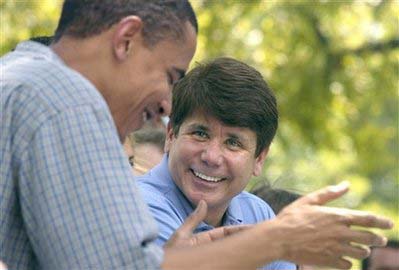
In this Aug. 17, 2005, file photo Sen. Barack Obama, D-Illinois, left, laughs with Illinois Gov. Rod Blagojevich during Governor's Day at the Illinois State Fair in Springfield, Ill. Blagojevich was roused from bed and arrested Tuesday, Dec. 9, 2008, after prosecutors said he was caught on wiretaps audaciously scheming to sell now President-elect Barack Obama's vacant Senate seat for cash or a plum job for himself in the new administration. [Agencies]

The president-elect was blunt and brief in addressing the case on Tuesday: "I had no contact with the governor or his office, and so I was not aware of what was happening" concerning any possible dealing about Blagojevich's appointment of a successor.


It's Obama's first big headache since his election last month, and Republicans were anything but eager to let it go away.

Said Rep. Eric Cantor of Virginia, the new GOP House whip: "The serious nature of the crimes listed by federal prosecutors raises questions about the interaction with Gov. Blagojevich, President-elect Obama and other high ranking officials who will be working for the future president."

Added Robert M. "Mike" Duncan, chairman of the Republican National Committee: "Americans expect strong leadership, but President-elect Barack Obama's comments on the matter are insufficient at best."

In Chicago, US Attorney Patrick Fitzgerald said prosecutors were making "no allegations" that Obama was aware of any scheming.

And Blagojevich himself, in taped conversations cited by prosecutors, suggested that Obama wouldn't be helpful to him. Even if the governor was to appoint a candidate favored by the Obama team, Blagojevich said, "they're not willing to give me anything except appreciation."

The two Illinois politicians have never been especially close and have largely operated in different Democratic Party camps in the state. Blagojevich's disdain for Obama was clear in court documents; he is quoted as calling the president-elect a vulgar term in one phone conversation recorded by the FBI.

Still, at the very least, the episode amounts to a distraction for Obama at an inopportune time just six weeks before he's sworn into office. It also raises the specter of notorious Chicago politics, an image Obama has tried to distance himself from during his career.

There were signs the continuing investigation could still involve him.

His statement that he didn't have contact with Blagojevich about the Senate seat seems to conflict with that of top adviser David Axelrod, who told Fox News Chicago on Nov. 23: "I know he's talked to the governor, and there are a whole range of names, many of which have surfaced, and I think he has a fondness for a lot of them."

On Tuesday, Axelrod issued a statement saying: "I was mistaken. ... They did not then or at any time discuss the subject."

It also appears that Obama friend Valerie Jarrett, an incoming senior White House adviser, is the person referred to repeatedly in court documents as "Candidate 1." That individual is described as a female who is "an adviser to the president-elect" and as the person Obama wanted appointed to the Senate seat. Court papers say that "Candidate 1" eventually removed "herself" from consideration for the Senate seat.

In a Nov. 11 phone conversation with an aide, Blagojevich talked at length about "Candidate 1" and said he knew that Obama wanted her for the open seat but "they're not willing to give me anything except appreciation. (Expletive) them."

One day later, Jarrett, a Chicago businesswoman who is one of three co-chairmen of Obama's transition team and was a high-level adviser to his presidential campaign, made it known that she was not interested in the seat. And, on Nov. 15, Obama announced that Jarrett would be a senior White House adviser and assistant for intergovernmental relations.

Obama has maintained a cordial but distant relationship with Blagojevich during the governor's tenure. He supported his fellow Democrat for re-election in 2006, even though the governor backed someone else over Obama in the US Senate Democratic primary race in 2004. Obama has said little about the many misconduct allegations that have piled up against Blagojevich, and he has complimented Blagojevich for running "a sound administration" with "the right priorities."

Obama's circle of major Illinois political allies and supporters is largely separate from Blagojevich's, with two major exceptions. Both Obama and Blagojevich got extensive money and support from Chicago businessman Antoin "Tony" Rezko, who is now under federal indictment. And Obama is close to Illinois Senate President Emil Jones, who has been the governor's staunchest legislative ally.

At least one top aide to Obama, Michael Strautmanis, previously worked for Blagojevich. Obama has appointed Strautmanis to serve as White House chief of staff to the presidential assistant for intergovernmental relations and public liaison. The Chicago native was legislative director and counsel to Blagojevich when the governor was a member of Congress and then helped Blagojevich win the governorship in 2002. There is no indication that Strautmanis is involved in the case.

More details on the case could be forthcoming.

Court documents say they don't include all calls dealing with the governor's efforts regarding the Senate seat appointment. And many people in the documents are referred to by aliases; there's little doubt their identities will eventually surface.

In Chicago, Obama largely kept a low profile as word of Blagojevich's arrest spread.

He went to a gym to work out as he does most mornings but canceled a previously scheduled FBI briefing and, instead, headed to his transition office next door to the federal courthouse. He stayed there and mostly out of sight until a midday meeting with former Vice President Al Gore on environmental and energy issues. That was supposed to be the news of the day out of the Obama office but the president-elect found himself peppered with questions about Blagojevich when reporters entered the Gore meeting for a photo op.

"Like the rest of the people of Illinois I am saddened and sobered by the news that came out of the US attorney's office today. But as this is an ongoing investigation involving the governor, I don't think it would be appropriate for me to comment on the issue at this time," Obama said — and then he said he wasn't aware of Blagojevich's maneuvering.

Robert Gibbs, an Obama spokesman, said: "We did not know about this recent part of the investigation until today."

In court documents, FBI Special Agent Daniel Cain detailed several phone calls between Blagojevich and his aides that were intercepted on court-authorized wiretaps over the past month. Blagojevich is accused of conspiring to sell or trade the vacant Senate seat for personal benefits for himself and his wife, Patti. Among his alleged desires: a Cabinet post, placement at a private foundation in a significant position, campaign contributions or an ambassadorship.

Read more...

Economy bad all over - even before current crisis

Updated: 2008-12-10 WASHINGTON – Things really are bad all over -- and they had gone bad even before the housing and finance industries crashed and sent the US economy into a tailspin.

New census data shows that throughout the first half of the decade, the slumping US economy touched nearly every community in the country. Incomes dropped while poverty and unemployment rose in the vast majority of the nation's cities and towns.

Small and medium-sized cities in the Midwest, already suffering from an ailing auto industry, were hit the hardest, with unemployment rates doubling or tripling in communities throughout Michigan, Ohio, Indiana and Illinois.

The numbers weren't as bad in other parts of the United States, but no region was spared, with incomes dropping as home prices escalated. The result: an unsustainable housing market that ultimately fueled the current economic crisis.

"For a while we were on a binge of living beyond our means," said David Wyss, chief economist at Standard and Poor's, the credit rating service. "We were financing our spending habits by treating houses like giant ATMs."

The data, which is being released Tuesday, is the first detailed economic, social and demographic information for small- and medium-sized US cities since the 2000 census. It was collected over three years, from 2005 through 2007, providing a mid-decade snapshot of every community with at least 20,000 residents.

The data comes from the American Community Survey. Census takers interview 3 million households a year for the survey, which produces annual data for geographical areas with populations of 65,000 or more. For areas with at least 20,000 people, the survey produces three-year averages.

The new numbers explain why the housing bubble burst and why the economy was such a big issue in this year's presidential campaign. They also explain why voters soured so much on US President George W. Bush's handling of the economy, even before the current financial crisis.

The years covered by the report include the housing market at its peak. Incomes had started to rise while poverty and unemployment rates had begun to fall, following the recession earlier in the decade.

But in the vast majority of America's cities and towns, economic conditions never fully reached the prosperity that marked the beginning of the decade.

The Associated Press analyzed economic data from the 2,000 or so cities and towns across the nation with populations of 20,000 or more, comparing the 2005-2007 data to figures from the 2000 census.

Among the findings:

-- Median household income dropped in 79 percent of the cities and towns. Incomes dropped in the wealthiest communities as well as the poorest. Charleston, Ill., home to Eastern Illinois University, saw the biggest drop, 31 percent, to a median household income of just under $21,000.

Nationally, incomes dropped by 4.3 percent during the period, to $50,007.

-- The poverty rate increased in 70 percent of the cities and towns. Athens, Ohio, home to Ohio University, had the highest poverty rate, at 52.3 percent, in the 2005-2007 period.

Nationally, the poverty rate increased from 12.4 percent to 13.3 percent since the start of the decade.

-- The unemployment rate increased in 71 percent of the cities and towns. Muskegon, Mich., a city of about 40,000 near Lake Michigan, had the highest unemployment rate, at 22.1 percent.

Nationally, the unemployment rate increased from about 4 percent in 2000 to 6.6 percent in the 2005-2007 period.

-- Median home values increased in 92 percent of the cities and towns studied, doubling and tripling in many cities, mainly in California. Nationally, the median home value increased 26 percent, to $181,800.

It's not surprising that many communities were doing better in 2000 than they were mid-decade, said Scott Hoyt, senior director of consumer economics at Moody's Economy.com.

"The year 2000 was at the end of an incredible boom that lasted a decade," Hoyt said.

Incomes were up, unemployment was down and the dot-com bubble had not yet burst on Wall Street.

"We just didn't have enough years of expansion" this decade, he said.


Read more...

Sony to cut 16,000 jobs, slash costs

Updated: 2008-12-10

(China Daily) Japan's Sony Corp said it will cut 16,000 jobs, curb investment and pull out of businesses to save $1.1 billion a year as the financial crisis ravages demand for its electronics products.


People look at Sony TV sets at an electronic shop in Tokyo December 9, 2008. [Agencies]

The job cuts are the biggest announced by an Asian company so far in the crisis and underscore the challenges facing Sony, which has fallen behind Apple Inc's iPod in portable music and is losing money on flat TVs.

Sony said it would cut 8,000 regular workers, or roughly 4 percent of its workforce of 185,800, and an equal number or more temporary and contract staff.

But analysts warned the measures may not be bold enough to streamline a sprawling empire that ranges from semiconductors to movies and insurance. The cuts are also risky because they mean Sony will be investing less in future growth.

"The number sounds big, but this staff reduction won't be enough. Sony doesn't have any core businesses that generate stable profits," said Katsuhiko Mori, a fund manager at Daiwa SB Investments.

"After the workforce reduction, the next thing we want to see is what is going to be the business that will drive the company."

Sony is not the only one suffering. Japanese rival Panasonic lowered its earnings forecasts last month while South Korea's Samsung Electronics Co said on Monday it would cut capital investment and warned of tough times.

Sony's US shares, which have fallen more than 60 percent this year, rose 2 percent to $20.45 in early trading in New York. In Frankfurt, its shares rose 4.83 percent to 16.07 euros.

Sony flagged the need for restructuring in October when it more than halved its annual profit forecast, blaming slowing demand for its Bravia liquid crystal display TVs and Cyber-shot digital cameras and a firmer yen.

The restructuring is a setback for Chief Executive Howard Stringer, who had implemented a major make-over after taking the helm in 2005, and until recently seemed to have put the company on a recovery track.

It also underlines the grim outlook for Sony and its rivals during the year-end shopping season and into next year as the financial crisis grows into a recession that has already engulfed the United States, parts of Europe and Japan.

"The outlook for the global economy suggests that things would become tougher for Sony next year, and it cannot expect a recovery without these restructuring measures," said Fujio Ando, senior managing director at Chibagin Asset Management.

Currency Impact

Sony, along with other Japanese exporters, has also been hit hard by a surging yen against the dollar and euro, which cuts into the value of its profits and makes its products less competitive in overseas markets.

Sony said it would raise prices on some electronics products in Europe in response to the weak euro.

South Korean competitors Samsung and LG Electronics have found some relief in the weaker won.

Both companies have adjusted production to cope with falling orders and say they do not plan to cut staff, but analysts are not so sure.

"Japanese electronics makers suffer more than their rivals in South Korea because of the stronger yen," said Lee Min-hee, an analyst at Dongbu Securities in Seoul. "But going forward, Korean manufacturers could consider more drastic measures."

Sony said it would delay boosting output for LCD TVs in Slovakia and outsource production of image sensor chips, as it aims to cut electronics investment 30 percent in the next business year compared with a prior plan.

It also unveiled plans to reduce its network of 57 manufacturing sites by five or six through outsourcing and by shifting and consolidating factories to low-cost areas. Earlier this week it announced the closure of a videotape plant in France.

Sony said it would detail the effect of the restructuring on earnings in its third-quarter results in January. It has already warned that it may need to revise down its profit forecasts further due to yen strength.

Other technology and auto manufacturers could follow suit in the coming weeks with their own restructuring plans, raising the prospect for industry realignment.

"Sony's restructuring might be followed by other Japanese manufacturers. With the stronger yen, a lot more companies will probably need to do similar reductions. There will be more mergers, sales of units and restructuring in Japan," Daiwa SB's Mori said.


Read more...

Japan Oct. Core Machinery Orders: Statistical Summary (Table)

By Shizuka Muragishi

Dec. 10 (Bloomberg) -- Japanese machinery orders, excluding shipbuilding and utilities, fell 4.4 percent in October from September, seasonally adjusted, the Cabinet Office in Tokyo said.


===============================================================================
Oct. Sept. Aug. July June May
2008 2008 2008 2008 2008 2008
===============================================================================
------------Month-on-Month Percent Change------------
Total orders -14.4% -3.0% -1.2% -8.5% -4.8% 10.8%
Private -3.6% 0.9% -10.8% -6.6% 5.5% 4.9%
-------------------------------------------------------------------------------
Ex-ships, utils (core) -4.4% 5.5% -14.5% -3.9% -2.6% 10.4%
3-month % change -15.7% -10.4% -2.0% 7.7% 0.6% -5.1%
3-month annualized -49.6% -35.6% -7.7% 34.8% 2.5% -18.9%
-------------------------------------------------------------------------------
Manufacturers -2.2% 9.7% -13.9% -10.4% 3.9% 12.2%
Non-manufacturers* -2.3% -1.3% -14.9% -2.4% -3.3% 8.8%
Public -0.2% -1.0% -4.4% -4.9% 4.4% -13.9%
===============================================================================
Oct. Sept. Aug. July June May
2008 2008 2008 2008 2008 2008
===============================================================================
Foreign -37.2% 3.1% 14.8% -14.4% -12.1% 21.1%
Agency -9.8% 13.6% -10.6% 2.0% -19.7% 15.2%
-------------Year-on-Year Percent Change-------------
Total orders -27.2% -2.8% -10.1% -4.6% 4.9% 3.6%
Private -15.2% -4.3% -9.0% -2.4% 17.9% 2.3%
-------------------------------------------------------------------------------
Ex-ships, utils (core) -15.5% -4.2% -13.0% -4.7% 9.7% 5.1%
-------------------------------------------------------------------------------
Manufacturers -18.4% -8.6% -12.2% -4.9% 13.8% -1.0%
Non-manufacturers* -13.7% -0.1% -13.6% -4.9% 12.4% 10.5%
Public -9.6% 1.5% -9.1% -2.4% -31.1% -17.5%
Foreign -44.2% -2.5% -9.3% -7.2% 0.8% 6.8%
Agency -13.2% 1.4% -27.4% -3.7% -9.5% 14.8%
---------------------Yen Levels----------------------
Total orders 2,025.8 2,366.6 2,439.9 2,470.6 2,699.3 2,835.2
Private 1,021.0 1,059.4 1,049.7 1,177.1 1,260.8 1,195.6
-------------------------------------------------------------------------------
===============================================================================
Oct. Sept. Aug. July June May
2008 2008 2008 2008 2008 2008
===============================================================================
Ex-ships, utils (core) 899.7 940.7 891.7 1,042.8 1,085.1 1,114.6
Manufacturers 424.4 433.7 395.3 459.2 512.4 493.3
Non-manufacturers* 482.9 494.3 500.8 588.4 603.1 623.4
Public 216.6 216.9 219.1 229.3 241.0 230.7
Foreign 689.7 1,099.0 1,065.7 928.5 1,084.6 1,233.4
Agency 93.6 103.8 91.4 102.2 100.1 124.8
===============================================================================

NOTE: Monthly data are seasonally adjusted. Yen levels in billions. Three-month percentage changes are calculated as the three-month average change from the prior three-month average. *: Excludes shipping and utilities.

SOURCE: Economic and Social Research Institute, Cabinet Office

To contact the reporter on this story: Shizuka Muragishi in Tokyo at smuragishi@bloomberg.net


Read more...

Philippine Nannies Fade in Remittance Race as India Takes Jobs

By Karl Lester M. Yap

Dec. 10 (Bloomberg) -- Sonny del Pilar tried for eight years to get work as a sailor so he could join the Philippines’ 8.7 million overseas workers, sending money to his brother’s family of nine rather than living with them in a Manila slum.

The 33-year-old gave up this year and set up a small shop in front of his house selling stuffed toys. He says competition from Indians, Bangladeshis and Syrians is making it harder for Filipinos to find jobs as seamen.

“I work not just for myself but for my family and my siblings,” del Pilar said in Manila. “I don’t know if I can still find work abroad. It depends on God’s will.”

The Philippines, which for four decades has sent what the government called “modern heroes” to work overseas, is facing the first decline in remittances in eight years. A global recession is reducing job opportunities abroad just as a surge in cheaper labor from China, India and elsewhere ramps up competition. That’s threatening revenue that accounts for more than a tenth of the Philippines’ $144-billion economy.

“Times are changing, and we are being overtaken little by little,” said Victor Fernandez, president of the Manila-based Philippine Association of Service Exporters, Inc.

China, Mexico, Bangladesh and Syria have all outpaced the Philippines in remittance growth in the past decade. India will be the biggest recipient of earnings from overseas workers this year, getting $30 billion. That’s almost twice as much as the Philippines, according to World Bank estimates.

Retraining Program

As many as 50,000 Filipino workers could lose their overseas jobs next year as the global recession forces factories to close in Taiwan and elsewhere, BusinessWorld newspaper reported on Dec. 5, citing Labor Secretary Marianito Roque.

Concern that fewer overseas jobs will exacerbate the 7 percent unemployment rate, second-highest in the Asia-Pacific region after Indonesia, prompted President Gloria Arroyo in October to announce a “massive” retraining program. She also created a 100-billion-peso ($2 billion) “human capital” fund.

“The Filipino is the most desired worker in the world and we want to keep it that way,” said Augusto Boboy Syjuco, director general of the Technical Education and Skills Development Authority or Tesda, which trains Filipinos to make them more employable. “We have to prepare during a slowdown.”

A record 1.08 million Filipino workers went overseas last year, according to the Philippine Overseas Employment Administration. Still, three-quarters of the 305,554 who found work were nannies and maids -- the largest category -- as well as tailors, electricians and factory workers. Those low-skill jobs compete with cheaper labor from countries such as India.

Foreign Exchange

At risk is the nation’s largest source of foreign exchange after exports. Money sent home from abroad accounts for 11.6 percent of the Philippine economy, compared with 2.4 percent for India and 2.8 percent for Mexico, according to the World Bank.

Still, the $201 that remittances provide for each Filipino far exceeds the $20 per Chinese and $26 per Indian this year, and Philippine per-capita remittance growth has exceeded that of those two countries and Mexico in the past five years.

Philippine economic growth may fall to an eight-year low of 3.5 percent in 2009, the International Monetary Fund said last month. Slowing spending has already hurt profit at the nation’s banks, retailers and telephone companies.

“A decline in remittances represents a loss of income for the Philippines economy,” said UBS AG economist Edward Teather in a Nov. 7 note. Money sent home by Filipinos working overseas may drop 5 percent next year, he predicted.

More in Canada

That can make a difference for Philippine families, whose average income in 2006 was 14,394 pesos ($292) per month. In contrast, a Filipino who works as a nurse in Canada can earn a minimum of $1,974 a month, according to the Philippine Overseas Employment Administration.

The strategy of encouraging citizens to seek jobs overseas dates to the 1970s, when Philippine workers went to Middle Eastern countries during the oil boom. In 1994, then-President Fidel Ramos created Tesda to upgrade the workforce. His administration also coined the term “modern heroes” to refer to those who support families at home.

Tesda, which offers 185 courses including software development, bartending and underwater welding in its 125 schools and 4,567 partner institutions, received half of the government’s annual $100 million budget for labor last year and produced a record 1.7 million graduates.

Expensive Pay

While the investment has paid off, the government’s salary regulations have also made Filipinos more expensive compared with workers from India and elsewhere.

Most Filipinos seeking low-skilled jobs overseas rely on placement agencies that are required to comply with Philippine government rules on minimum salaries. That means at least $250 a month for Filipinos working as construction laborers in Saudi Arabia, compared with as little as $110 a month accepted by other nationalities, said Fernandez.

“We have been sitting on our laurels for too long,” said Fernandez, whose group includes more than 750 recruitment agencies. “The Philippines must improve its competitiveness by upgrading our skills and deregulating the salary offers and benefits to overseas workers.”

Cecille Derilo, who worked illegally as a paper cutter in Tokyo earning 150,000 yen ($1,600) a month three years ago, is taking that advice and going back to school. Derilo, 29, is learning how to weld carbon steel pipes at a Tesda training center in Manila, helped by a government scholarship.

“It is hard to get a job overseas unless you have a skill that companies are looking for,” she said. “Everybody wants to go overseas so I have to study to be more competitive.”

To contact the reporter for this story: Karl Lester M. Yap in Manila at kyap5@bloomberg.net.


Read more...

World Bank’s ‘Wrong Advice’ Left Silos Empty in Poor Countries

By Alison Fitzgerald and Helen Murphy

Dec. 10 (Bloomberg) -- Inside and out, the rusted towers of El Salvador’s biggest grain silo show how the World Bank helped push developing countries into the global food crisis.

Inside, the silo, which once held thousands of tons of beans and cereals, is now empty. It was abandoned in 1991, after the bank told Salvadoran leaders to privatize grain storage, import staples such as corn and rice, and export crops including cocoa, coffee and palm oil.

Outside, where Rosa Maria Chavez’s food stand is propped against a tower wall, price increases for basic grains this year whittled business down to 16 customers a day from 80.

“It’s a monument to the mess we are in now,” says Chavez, 63.

About 40 million people joined the ranks of the undernourished this year, bringing the estimate of the world’s hungry to 963 million of its 6.8 billion people, the Rome-based United Nations Food and Agriculture Organization said yesterday. The growth didn’t come just from natural causes. A manmade recipe for famine included corrupt governments and companies that profited on misery. Another ingredient: The World Bank’s free- market policies, which over almost three decades brought poor nations like El Salvador into global grain markets, where prices surged.

“The World Bank made one basic blunder, which is to think that markets would solve problems of such severe circumstances,” said Jeffrey Sachs, director of the Earth Institute at Columbia University and a special adviser to UN Secretary-General Ban Ki- moon. “But history has shown you need to help people to get above the survival threshold before the markets can start functioning.”

‘The Washington Consensus’

Created in 1944, the Washington-based World Bank Group spent much of its first 35 years dispensing low-interest loans, grants and development advice to poor countries with an eye toward promoting self-reliance. In 1980, the bank’s executives began attaching conditions to loans that required “structural adjustments” in the recipients’ national economies. The mandates were designed to have poor countries cut import tariffs, reduce government’s role in enterprises such as agriculture and promote cultivation of export crops to attract foreign currency.

The philosophy, which came to be known as “The Washington Consensus,” was based in part on assumptions that importing basic grains would be inexpensive and that farmers in developing nations could earn more producing exports. Food prices had fallen for years and few economists thought that would change, said Mark Cackler, manager of the bank’s Agriculture and Rural Development Department in Washington.

Exporter to Importer

In 2007 and the first half of 2008, an index of more than 60 food commodity prices compiled by the FAO rose 82 percent. While costs have since eased, they were 20 percent higher on Nov. 1 than at the end of 2006.

The increases hit hard in countries such as El Salvador, which had adopted the principles of the Washington Consensus in return for loans. El Salvador’s Central Reserve Bank said the total amount of the lending was “not available.” The Agriculture Ministry did provide this measure of their effects: The country was a net exporter of rice 20 years ago; now it imports 75 to 80 percent of what it consumes.

The World Bank has “given consistently wrong advice,” said Jose Ramos-Horta, the president of East Timor in Asia and the 1996 Nobel Peace Prize winner.

“It is their advice -- that buying externally is cheaper than producing -- that has resulted in this,” he said.

‘More Than Underinvestment’

Current and former World Bank officials say small countries hurt their own agriculture industries by suppressing prices, taxing farms, inflating exchange rates and favoring urban development. They reject the assertion that structural adjustment loans hurt developing nations’ self-sufficiency.

“The premise that this crisis was caused by these policies is something that we don’t agree with,” said World Bank spokeswoman Geetanjali Chopra. “This crisis was caused by much more than underinvestment in agriculture.”

Still, in nations such as Honduras and Ghana, imports of basic grains climbed after governments eliminated agricultural subsidies, sold off grain stores or decreased tariffs to get World Bank loans in the 1990s, according to data from the UN’s FAO.

In Honduras, 23,000 rice farmers went out of business, and employment from rice fell to 11,200 people from 150,000 after the government trimmed import duties, according to the human rights group Oxfam International. Honduran farms now supply 17 percent of the domestic demand for rice, down from 90 percent before the tariffs changed.

McNamara’s Shift

In Ghana, the World Bank required a tariff reduction on rice to 20 percent from 100 percent. Imports tripled, said Raj Patel, a scholar at the Center for African Studies at the University of California at Berkeley.

The free-market policies were a sharp turn from the bank’s earlier efforts -- led by former bank President Robert McNamara - - to develop poor countries’ domestic agriculture and self- reliance, said Uma Lele, a World Bank economist from 1971 to 1991 and 1995 to 2005.

McNamara, who oversaw the escalation of the U.S. war in Vietnam as defense secretary under presidents John F. Kennedy and Lyndon Johnson before joining the bank in 1968, shifted his views. He introduced the structural adjustment concept in 1979, in a speech in Manila urging rich nations to open their markets to imports from poor countries.

“Developing countries will need to carry out structural adjustments favoring their export sector,” he said in the speech. McNamara, 92, declined to comment for this story.

Free Market Principles

World Bank officials were frustrated that their investment in agriculture through the 1970s wasn’t paying off, especially in Africa, said Pierre Landell-Mills, a bank economist at the time.

“There were state marketing organizations that were a complete nightmare of mismanagement and corruption,” said Landell-Mills, 69, now a principal at the Policy Practice, a public policy consulting group in Brighton, England, in a June interview. “There were unsustainable subsidies.”

The “preferred solution,” he said, was to dismantle the marketing boards, shrink governments and remove barriers to entrepreneurship. McNamara in 1980 approved the first three structural adjustment loans. By 1985, they made up more than 25 percent of the World Bank’s total lending, according to Kyle Peters, its country services director.

Free-market principles were on the rise in the U.S. and the U.K., the bank’s major funders. Margaret Thatcher had become British prime minister in 1979 with promises of privatizing state-owned enterprises. Ronald Reagan was elected U.S. president in 1980, pledging to cut taxes and government programs.

New Ideas, New Staff

Reagan appointed Alden “Tom” Clausen, a former chief executive officer of Bank America Corp., to succeed McNamara in 1981. The new bank president was convinced “that you could fight poverty better and more efficiently and more quickly if you get the policies of a country right,” Clausen said in an interview.

“I loved structural adjustment loans, and I made a lot of them,” he said.

As the bank’s philosophy evolved, so did its staff. Clausen hired Anne Krueger, an economist known for her advocacy of “getting prices right” by removing government controls, as vice president for economics and research in 1982. She “reshuffled the central economics staff,” wrote Devesh Kapur, in the bank’s official history, “The World Bank: Its First Half Century.”

“Of course the direction of research had changed,” Krueger, 74, said in an interview on Aug. 25. She acknowledged that some economists left because they didn’t agree with the bank’s focus. “Research moved away from big planning models with unreasonable incentives and swung toward things that were much more conducive to agriculture.”

‘Dysfunctional Systems’

Krueger led a five-volume study that concluded developing countries were hurting their own agriculture with tax and exchange rate policies. She said the bank’s free-trade principles boosted output and growth.

“These were largely dysfunctional systems,” she said. “It made sense to reduce tariffs so that countries could produce the goods that they were most efficient at.”

After leaving the bank in 1986, Krueger became first deputy managing director of the International Monetary Fund, which makes loans to help countries correct balance of payment problems and promotes economic policies.

As structural adjustment loans grew, the portion of the World Bank’s lending devoted to agriculture fell, to about 8 percent in 2000 from 30 percent in 1980. Last year, farm-related loans made up 12 percent of the bank’s $24.7 billion portfolio.

‘A Human Face’

“One of the reasons we have problems today is because of the cuts in agriculture,” said Montague Yudelman, 86, who was director of the World Bank’s agriculture department under McNamara. “If they’d made a continuously high level of investment, we’d have been in much better shape.”

By the late 1980s critics began saying the bank, along with the IMF, was fostering poverty and dependence. UNICEF, the United Nations Children’s Fund, in 1987 published a two-volume study titled, “Adjustment With a Human Face.” It concluded that some of the bank’s programs led to increases in malnutrition and disease in poor nations and urged new strategies to protect the most vulnerable people.

In 1995, just 30 days into his tenure as bank president, James Wolfensohn promised changes.

During a meeting with representatives of 12 non-profit organizations, Wolfensohn heard their argument that 15 years of adjustment lending had wiped out small farmers in countries from Africa, Latin America and Asia, damaging their ability to feed people. Some called for the bank to be disbanded.

‘A Different Way’

“What I’m looking for is a different way of doing business in the future,” Wolfensohn, a former Australian Olympic fencer and New York banker, told them. Wolfensohn, 75, who left the World Bank in 2005, declined to be interviewed for this story.

The bank’s commitment to free-market principles didn’t waver.

In 2000, as a condition for a $6.8 million agriculture loan in East Timor, the bank demanded that publicly funded agricultural service centers be privatized and rejected money for a public grain silo and slaughterhouse, according to Tim Anderson, a political economy lecturer at the University of Sydney. He has written several papers on East Timor’s development.

It also turned down proposals for the government to provide research and advice to farmers and to supply seeds and fertilizer because, “such public sector involvement has not proved successful elsewhere,” according to a World Bank mission report that year.

Small Farms Ignored

At the time, there was already evidence that private entrepreneurs weren’t serving so-called smallholders, who the bank says make up 60 percent of the world’s 2.5 billion farm households.

A 1998 study by Michael L. Morris, then a senior economist and project coordinator with the International Maize and Wheat Improvement Center in El Batan, Mexico, found that private seed companies in Africa focused on supplying large commercial operations and “often ignored small-scale, subsistence-oriented farmers located in remote areas.” Morris, 53, is now the World Bank’s lead agriculture economist for the Africa region.

In its 2008 World Development Report, the bank acknowledged that limiting governments’ participation in agriculture had hurt small farmers -- citing Morris’s 10-year-old study as part of the evidence.

“The expectation was that removing the state would free the market for private actors to take over these functions -- reducing their costs, improving their quality, and eliminating their regressive bias. Too often, that didn’t happen,” the bank said in the report.

No ‘Evil Force’

In 2000, Wolfensohn defended the bank to critics. During a meeting at Prague Castle that year, he told an invited crowd of 300 activists, bankers and government officials: “You should not regard us as a black and evil force. Maybe we’ve gotten things wrong. I’m sure we have in many cases.”

The next year, several non-profit groups that had worked with the bank to study its loan conditions released a report saying that the policies “have undermined the viability of small farms, weakened food security and damaged the natural environment.”

In response to the criticism from the Structural Adjustment Participatory Review International Network, the bank issued its own analysis that listed successes as well as missteps. It concluded that the required changes in agriculture were too much, too soon.

Lessons Learned

“The lessons for future policies are that agricultural adjustments are complex and require a sequence of modest steps,” the bank said in the report.

In August 2004, James Adams, the World Bank’s head of operations policy, declared the end of structural adjustments.

“We have abandoned the prescriptive character of the old policy,” Adams said in a statement. At the same time, he said, the underpinnings of the Washington Consensus “remain important themes of economic policy.”

The next year, the bank demanded that Niger privatize its irrigation systems, according to a 2007 report by Eurodad, a Brussels-based coalition of 56 non-profit groups. The requirement “has seriously damaging effects on poor farmers’ access to a precious and scarce resource,” said the report, based on an analysis of the bank’s databases. In all, the group found economic policy conditions were attached to 71 percent of loans and grants.

The World Bank in May pledged $1.2 billion for a Global Food Response Program that’s designed to speed money to the neediest countries without the usual red tape. As of last month the Bank approved $364 million for 25 countries and $541 million more is designated for 10 others.

Trade Talks Stalled

Current Bank President Robert Zoellick, a former U.S. trade representative, has promised to double agriculture spending while touting free trade as a solution to rising food prices. Zoellick, 55, declined to be interviewed.

Poor countries remained skeptical of open markets during the latest round of World Trade talks in Geneva, in July. They insisted that they be allowed to raise tariffs to protect domestic agriculture, stalling the negotiations.

El Salvador, meanwhile, has invested about $240 million in agriculture since 2004. It now gives farmers a $30 bag of the seed of their choice and a $30 sack of fertilizer.

“The World Bank had a very short-term vision; it couldn’t have been more wrong,” said Mario Salaverria, El Salvador’s agriculture minister, as he inspected corn in Sonsonate province, about 50 kilometers (31 miles) west of San Salvador.

His country must regain self-sufficiency, he said. “We can stop using our cars because of price increases, but we can’t stop eating.”

(Recipe for Famine: Part 3 of 7.)

To contact the reporters on this story: Alison Fitzgerald in Washington at Afitzgerald2@bloomberg.net; Helen Murphy in Bogota at hmurphy1@bloomberg.net.


Read more...

Japan’s Wholesale Inflation Slows for Third Month as Oil Drops

By Mayumi Otsuma

Dec. 10 (Bloomberg) -- Japan’s wholesale inflation slowed for a third month, adding to evidence that price pressure in the world’s second-largest economy is fading.

Producer prices, the costs companies pay for energy and raw materials, climbed 2.8 percent in November from a year earlier after a revised 5 percent increase in October, the Bank of Japan said in Tokyo today. The median estimate of 27 economists surveyed by Bloomberg News was for 2.8 percent.

A decline in fuel and materials prices offers little respite to companies, whose earnings are being eroded by a deepening global slowdown. Sales and profits at Japanese businesses will probably decline this fiscal year and the next, the first back-to-back declines since 1993, Daiwa Institute of Research said last week.

“Other things being equal, the improvement in the terms of trade due to lower energy and materials prices will be a plus for corporate earnings,” said Takehiro Sato, chief Japan economist at Morgan Stanley in Tokyo. “However, volume effects associated with lower demand will likely exceed the positive price effect for the time being.”

Producer prices fell 1.9 percent in November from October, when they declined 1.4 percent, the central bank said today.

Crude oil has lost 70 percent of its value since peaking at $147.27 in July. Soybeans, corn and wheat have slumped after climbing to records this year.

The Bank of Japan’s overseas commodity index, which shows changes in costs including oil, steel, copper and wheat, slid 41.2 percent in November, the biggest drop since the central bank started compiling the data in 1990.

Deflation Return

Japan’s economy shrank in the third quarter at a pace of faster than initially predicted, a government report showed yesterday. The downturn is prompting some economists to say deflation may return.

Core consumer prices, which exclude fresh food and are the central bank’s preferred measure of inflation, have decelerated for two months. Corporate service prices, the costs businesses pay for services such as transport and rent, tumbled for the first time in two years.

Central bank Governor Masaaki Shirakawa said last week Japan’s “price situation has changed drastically” and consumer inflation “may turn negative briefly” in the year starting April 1. Policy makers need to see whether the drop in commodity prices spreads to other goods and services and prompts consumers to expect further falls, he said last month.

“Until recently, the Bank of Japan was worried about a surge of inflation, but now their headache is shifting to the risk of deflation,” said Hiroaki Muto, a senior economist at Sumitomo Mitsui Asset Management in Tokyo. He added he expects the economy to continue to contract through the third quarter of next year.

Global Slump

Toyota Motor Corp., the world’s second-largest automaker, last month said its profits will fall at the fastest pace in at least 18 years in the year ending March 31 as a global slump cripples auto demand and gains in the yen erode the value of overseas sales. Honda Motor Co. and Nissan Motor Co. are also predicting larger-than-expected drops in earnings.

“Japan’s producer prices will probably start to fall as early as the first quarter of 2009, given the accelerating pace of commodity price declines,” said Hiroshi Watanabe, an economist at Daiwa Research in Tokyo. “Companies are losing reason to ask for higher prices even though they have yet to cover all cost increases caused by oil price gains.”

To contact the reporter on this story: Mayumi Otsuma in Tokyo at motsuma@bloomberg.net


Read more...