Economic Calendar

Saturday, November 15, 2008

Billionaire Merckle Said to Seek Aid After Volkswagen Squeeze

By Angela Cullen, Aaron Kirchfeld and Sheenagh Matthews

Nov. 15 (Bloomberg) -- Germany's billionaire Merckle family is seeking to prop up an investment company battered by wrong- way bets on Volkswagen AG shares and plunging stock markets, three people familiar with the situation said.

A group of more than three-dozen banks, including Deutsche Bank AG and Commerzbank AG, are trying to reach an agreement on a loan to aid the Merckle's closely-held VEM Vermoegensverwaltung GmbH, based in Dresden, said the people, who declined to be identified because the talks are private.

A failure could have repercussions for Merckle's holdings, which span as many as 30 companies in the cement, machinery and pharmaceutical industries, said the people. The group of banks signed a so-called standstill agreement that blocks them from making claims on outstanding loans as they try to hammer out a rescue, according to one of the people.

``The banks would be better off to bail out the company than let it run into the ground,'' said Stefan Mueller, managing partner at Proprietary Partners AG in Frankfurt. ``But it's difficult for banks to reach financing agreements in the current environment. A lot of people have lost money in the stock market, including on Volkswagen.''

The banks, which also include state-owned Landesbank Baden- Wuerttemberg and Royal Bank of Scotland Group Plc, may agree on a bridge loan by early next week to avoid a potential collapse, the people said.

Forbes List

Adolf Merckle, 74, whose estimated $9.2 billion fortune put him 94th on Forbes' list of the world's richest people this year, may be forced to sell his Ulm, Germany-based generic-drug company Ratiopharm GmbH and other assets, said the people. VEM also owns about 25 percent of HeidelbergCement AG, Germany's biggest cement maker.

Spokesmen for Frankfurt-based Deutsche Bank and Commerzbank, Germany's largest banks, RBS of Edinburgh and Stuttgart-based LBBW declined to comment. Merckle and Susanne Friess, VEM's managing director, didn't return calls seeking comment. No one replied to a message left on a VEM answering machine requesting comment.

VEM became caught in a so-called short squeeze after betting Wolfsburg, Germany-based Volkswagen's stock would fall, according to the people. Porsche SE's Oct. 26 announcement that it planned to increase its stake in Volkswagen to 75 percent sparked a race by short-sellers to buy from a shrinking pool of stock, causing Volkswagen shares to surge more than fourfold in two days.

``Volkswagen was a large trade gone wrong for many,'' said Lawrence Peterman, investment director at Eden Financial Ltd. in London.

Economic Slowdown

The Merckle investment company is seeking loans from banks amid a credit crunch that began with the collapse of the U.S. subprime-mortgage market last year and worsened after the bankruptcy of Lehman Brothers Holdings Inc. in September. The German economy, Europe's largest, is in the worst recession in at least 12 years, the Federal Statistics Office in Wiesbaden said on Nov. 13.

The German government, mirroring similar actions in countries such as the U.S. and U.K., rushed a 500 billion-euro ($636 billion) bank-rescue plan through parliament Oct. 17 that has been tapped by banks including Commerzbank, Hypo Real Estate Holding AG and state-owned lenders.

``The shock waves pushed out by the financial crisis have hit Germany full on, if later'' than other countries, the government's five independent economic advisers said earlier this week. They called on Chancellor Angela Merkel, 54, to expand a 50 billion-euro fiscal stimulus package to help revive growth.

Germany's HDAX Index, which tracks the 110 most highly capitalized stocks, has tumbled more than 40 percent this year, business confidence fell to a five-year low last month and manufacturing orders plunged in September.

HeidelbergCement

In addition to VEM's holding in HeidelbergCement, stakes held by other Merckle firms and associated companies mean the family controls about 86 percent of the cement maker, data compiled by Bloomberg show. The stock has dropped by more than half this year, cutting its market value to 6.4 billion euros.

HeidelbergCement bought Hanson Plc, a producer of building materials, for 7.85 billion pounds ($11.6 billion) last year, financed in part with loans.

Ratiopharm's press office didn't immediately answer a request for comment left on two answering machines. Brigitte Fickel, a spokeswoman for HeidelbergCement, didn't immediately return a call seeking comment.

The cost of protecting bonds sold by HeidelbergCement stood at record levels on yesterday, according to CMA Datavision prices at 3:30 p.m. in London. Contracts linked to the cement maker cost 24 percent in advance and 5 percent a year, meaning it cost 2.4 million euros upfront and 500,000 euros a year to protect 10 million euros of debt from default for five years, according to CMA Datavision prices.

To contact the reporters on this story: Angela Cullen in Frankfurt at acullen8@bloomberg.net; Aaron Kirchfeld in Frankfurt at akirchfeld@bloomberg.net; Sheenagh Matthews in Frankfurt at smatthews6@bloomberg.net


Read more...

G-20 to Back Stimulus, Smooth Over Regulation Split

By Michael McKee and Simon Kennedy

Nov. 15 (Bloomberg) -- World leaders meeting in Washington today are moving to shore up the deteriorating world economy, while papering over differences on additional regulation of financial markets.

Members of the Group of 20 will endorse steps already underway to fight a global recession by pursuing active monetary and fiscal policies and propose ways to bolster the role of the International Monetary Fund, French officials told reporters on condition they not be named.

They will hide disagreements between the U.S. and European governments over the future shape of the international financial system. Leaders will commit to toughening domestic market regulations before the end of April and meet again to discuss joint efforts by May after U.S. President-elect Barack Obama takes office, the French officials said.


``It's difficult to imagine the heads of state getting together on the worst financial crisis since the Depression and announcing only baby steps,'' said Tony Crescenzi, chief bond market strategist for Miller Tabak & Co. in New York. ``The G-20 will almost certainly want to give the impression that broad and coordinated actions will be taken to combat the financial crisis.''

Tumbling stock markets and forecasts for global recession are putting pressure on the G-20 leaders, who last night met for a dinner of quail, roast lamb and pear torte at the White House. They will release a statement after further talks today.

A Recession

Statistics released yesterday showed the euro area entered a recession in the third quarter for the first time since the single currency was introduced a decade ago, and retail sales in the U.S. fell by the most on record in October. The Standard & Poor's 500 index fell 38 points yesterday to close at 873, a loss of 6 percent for the week and 41 percent for the year so far.

``Obviously this crisis has not ended,'' President George W. Bush told reporters as he arrived at the summit. ``There's more work to be done.''

Their first step is raising government spending to boost growth as the credit crunch delays the effect of recent interest rate cuts. G-20 countries including the U.K., Japan, China and Germany are rolling out stimulus packages. Democratic lawmakers in the U.S. are signaling they will enact a second round of stimulus legislation.

Cooperation

``I've been pressing for cooperation on fiscal and monetary policy,'' U.K. Prime Minister Gordon Brown said today. He acknowledged the ability to ease policies differs between economies.

Several other initiatives, in the works for some time, were announced on the eve of the summit.

The first central clearinghouse for the $33 trillion credit- default swap market should be in operation by year-end in the U.S., under an agreement signed yesterday by three U.S. financial regulators.

The Federal Reserve, Commodity Futures Trading Commission and Securities and Exchange Commission agreed to provide consistent oversight of credit-default swaps, which are unregulated contracts that are traded privately.

The clearinghouse would back trades and absorb losses in case of a dealer failure. Some in Europe have been pushing for a clearinghouse under government control, or within the IMF. Investors, supported by the Fed, want it to be independent. The New York Fed has been meeting with groups including CME Group Inc., Intercontinental Exchange Inc. and NYSE Euronext on plans to create a privately run organization.

Aso's Offer

The IMF will have a role, along with the Financial Stability Forum in conducting ``early warning exercises'' and issuing joint risk assessments of financial markets, the two organizations said yesterday. The FSF includes officials from the Group of Seven nations along with Australia, Singapore, Switzerland and the Netherlands.

Separately, Japanese Prime Minister Taro Aso's office said his government will offer up to $100 billion in lending to the IMF at the summit and ask other nations to give further resources. Ways will also be discussed today to widen the role of emerging markets in the Fund.

The leaders are also likely to agree on the need for improving oversight of banks whose operations, and problems, cross national borders. The so-called Basel accords, developed in 1988 and 2004 to create international standards for regulation, risk management and disclosure, failed to prevent the current crisis.

College of Regulators

European Union nations, led by the U.K.'s Brown, want the world's top 30 banks to be placed under the supervision of a panel of regulators.

At a Nov. 7 meeting in Brussels, EU leaders called for the creation of regulatory ``colleges'' that would bring together bank regulators from various nations to coordinate oversight.

Still to be discussed is how much, if any, power those colleges might have. The U.S., under Bush, has rejected international supervision of its banks. Some European governments, particularly in smaller and Eastern European nations, also don't want to cede oversight of their own banks and insurers to authorities in financial centers such as London, Paris and Frankfurt.

Also likely to be left for another day will be European calls for more international market regulation, with curbs on executive pay and hedge funds. The statement will set a deadline of March 31 for authorities to implement measures at home such as extending surveillance of hedge funds and toughening rules for credit rating companies.

European Cracks

Discussion over cross-border policies will wait until later talks. Bush argues in his weekly radio address today that government intervention in markets is not a ``cure-all.''

There may also be cracks emerging in Europe's position. German Chancellor Angela Merkel favors a more gradual strengthening of regulators and existing rules rather than the sweeping revamp of controls favored by French President Nicolas Sarkozy, according to a German government document obtained by Bloomberg News.

It states that governments should forego setting up a new ``architecture'' to control in favor of improving the tools of existing institutions to stave off crises. Still, Merkel said yesterday that she'll do ``everything to ensure that there are more rules to prevent us from ever having to face such a situation again.''

The leaders have already signaled they plan to hold additional meetings after Obama takes office. The president-elect won't attend this week's meeting, sending former Secretary of State Madeleine Albright and former Republican Representative Jim Leach to meet delegations instead.

G-20 members are Argentina, Australia, Brazil, Canada, China, France, Germany, India, Indonesia, Italy, Japan, South Korea, Mexico, Russia, Saudi Arabia, South Africa, Turkey, the U.S., the U.K. and the European Union.

The Netherlands and Spain are also represented, as are the IMF, World Bank, and United Nations.

To contact the reporter on this story: Michael McKee in Washington at mmckee@bloomberg.netSimon Kennedy in Washington at Skennedy4@bloomberg.net;


Read more...

African Tea Prices Plunge at Auction as Crunch Deters Buyers

By Antony Sguazzin and Ron Derby

Nov. 14 (Bloomberg) -- African tea prices plunged the most since March 2006 as the global financial crisis deterred buyers and rainfall in Kenya boosted supplies.

The average tea price at a weekly auction in Mombasa, Kenya dropped 12 percent to $1.79 a kilogram (2.2 pounds) at the Nov. 10 and 11 sales, from $2.04 a week earlier, Mombasa-based Africa Tea Brokers Ltd., the founding broker of the auctions, said in an e-mailed statement today.

The weekly auctions sell tea from most African producers excluding South Africa and countries in west Africa. Buyers range from Egypt and Pakistan to Russia and the U.K.

``This is in response to the global credit crunch,'' David Mwashumbe, a spokesman for Africa Tea, said in an interview from Mombasa today. ``The buying countries are saying that tea is no longer a priority, they are cash strapped.''

Heavy rains across Kenya, the world's biggest exporter of black tea, are also boosting supplies of the leaves with some consignments not being bought, he said.

Of the 7.63 million kilograms on offer this week 5.67 million kilograms were sold, Africa Tea said. The amount of tea on offer will rise to 7.71 million kilograms next week and 8.75 million kilograms the week after.

Tea is also sold at auctions in Colombo, Sri Lanka, and at sales in Malawi, India and Indonesia.

To contact the reporter on this story: Ron Derby in Johannesburg at rderby1@bloomberg.net To contact the reporter on this story: Antony Sguazzin in Johannesburg at asguazzin@bloomberg.net


Read more...

Sudan Economic Growth to Slow After Oil Plunges More Than Half

By Heba Aly

Nov. 14 (Bloomberg) -- Economic growth in Sudan, sub- Saharan Africa's third-biggest oil producer, may slow to 6 percent next year after crude prices more than halved, Central Bank of Sudan Governor Sabir Hassan said.

The economy has grown an average of about 8 percent over the last decade, Hassan said in an interview yesterday in the capital, Khartoum. The International Monetary Fund estimates growth will slow to 7.7 percent next year from 8.5 percent in 2008, according to its Web site.

``We will be targeting only a 6 percent rate of growth, which is well below our 10-year track record,'' Hassan said. ``This is going to be a very difficult year. There are a lot of uncertainties, not only locally but internationally.''

Benchmark crude oil prices have fallen about 61 percent from a record $147.27 on July 11 because of concerns a global recession will cut demand. Sudan pumped 457,000 barrels of oil a day in 2007, up 38 percent from a year earlier, according to the BP Statistical Review of World Energy. Output in the north African country ranks behind Nigeria and Angola, sub-Saharan Africa largest producers.

Sudan is currently preparing its 2009 budget and since June, projected revenue has fallen 20 percent to 18 billion Sudanese pounds ($8.1 billion), Hassan said. Oil revenue makes up 49 percent of government revenue, he said.

``Under normal circumstances,'' the national budget is based on an oil price of $70 a barrel, Hassan said. This year, it is being based on a price of $50 a barrel. Sudan exports between 300,000 and 350,000 barrels of oil a day.

``The budget of this year is one of the most difficult budgets that we have ever seen,'' Hassan said.

Details of this year's 22 billion pound budget haven't been released yet because it hasn't been approved by parliament.

To contact the reporter on this story: Heba Aly in Khartoum via Johannesburg at pmrichardson@bloomberg.net.


Read more...

A EURUSD Range Trade With A Breakout Contingency

Daily Forex Technicals | Written by DailyFX | Nov 15 08 08:14 GMT |
Why Would EURUSD Stay in a Range?

Levels to Watch:

  • Range Top: 1.2850 (Trend, Fib, Swing High)
  • Range Bottom: 1.2330 (Pivot)

The epitome of liquidity and direction for the industrialized components of the currency market, EURUSD continues to cut a volatile range. Friday's event reflects the even fundamental standing both the Euro Zone and US share. The former has confirmed its recession and the latter is accelerating into its own economic slump. The US is the source of the liquidity crisis, but this is easily balanced out by the fact the ECB has a lot more room to cut rates.

For a setup, EURUSD's descending wedge offers a clear congestion trade (that could setup up a profitable breakout position under the right circumstances). Resistance is predominately in a falling trend line from Oct 1st (with five tests), but has a solid base in a nearby fib at 1.2280. Main support is a long-term pivot at 1.2475.

Suggested Strategy

  • Short: Entry orders will be set at 1.2815 is set well enough below the trendline to be triggered.
  • Stop: The initial stop is set above the Nov 11th swing high at 1.2945. To protect profit, we will move the stop on the second lot to breakeven when the first target is hit.
  • Target: The first objective equals risk (130) at 1.2685. The second target will be 1.2555.

Trading Tip - Usually, when the market's most heavily traded currency pair stands as a good range candidate, it suggests that overall market is experiencing congestion. However, our interest in a short-term EURUSD range is attractive only when we taken into account the potential for a near-term breakout. That is exactly what our suggested strategy takes into account. Congestion in the currency market is prevalent; but a look to the level of volatility underlying price action and the steady deterioration of the global economic forecast suggests breakouts are highly probable across the board. From a fundamental standpoint, we would expect a rise in risk aversion to swell; and technically, EURUSD is at the bottom of its dominant bear-trend and developing a short-term descending wedge. Both sides of the analysis spectrum are leaning towards a downside breakout; and that is why we are only looking for a short position on the developing range (trailing the stop on our second lot could open door to riding any bearish breakout momentum). To reduce risk, we will cancel open orders by Tuesday's close or should spot hit 1.24 first.

Event Risk Euro Zone And US

Euro Zone - Bigger fundamental themes are beginning to drive euro price action - namely: interest rate expectations and fading forecasts for an economic recession. With the GDP numbers from the EZ confirming a technical recession this week - and data further bolstering expectations for worst through the next two quarters - the probability that the ECB will turn to aggressive rate cuts is growing quickly. The growth outlook will be a major economic driver long after the interest rate factor has evaporated. In times of fear and market-wide risk unwinding, investors are less concerned with returns and more concerned with forecasting how long and severe the depression will be. This is an ongoing issue for all economies and currencies; but for the euro, a few key economic indicators will help adjust the baring on forecasts. PMI readings, confidence surveys and the OECD's growth forecast for November will cover everything.

US - When determining the main fundamental driver of the US dollar, we merely need to look at the currency's long-term direction. As it is clearly bullish until this point, we know that risk sentiment is overshadowing concerns such near record lows on interest rates and expectations for a harsh economic recession. Therefore, we know the G20 meeting that will be wrapped up by Saturday could hold significant probabilities for volatility. Though these meetings don't often offer worthwhile results (and especially not the level of help needed by the markets today), there is always the probability of something more significant than the market is pricing in. Moving down our list of priorities, the road markings for the eventual rebound of the oncoming recession and ongoing interest rate slump will fall to inflation and housing data. The CPI numbers will not only provide scope for the Fed reaching 0.50 percent, it will also establish the cost of living for consumers - the life blood of the economy.

Data for November 17 - November 24 Data for November 17 - November 24
Date European Economic Data Date US Economic Data
Nov 21 EZ PMI Composite (NOV A) Nov 19 Consumer Price Index (OCT)
Nov 21 PMI Services (NOV A) Nov 19 House Starts (OCT)
Nov 24 IFO - Business Climate (NOV) Nov 20 Leading Indicators (OCT)
Nov 24 EZ OECD Economic Outlook (NOV) Nov 24 Existing Home Sales (OCT)

DailyFX

Disclaimer

Investment in the currency exchange is highly speculative and should only be done with risk capital. Prices rise and fall and past performance is no assurance of future performance. This website is an information site only. Accordingly we make no warranties or guarantees in respect of the content. The publications herein do not take into account the investment objectives, financial situation or particular needs of any particular person. Investors should obtain individual financial advice based on their own particular circumstances before making an investment decision on the basis of the recommendations in this website. While we try to ensure that all of the information provided on this website is kept up-to-date and accurate we accept no responsibility for any use made of the information provided. All intellectual property rights are the property of Daily FX. Daily FX and its affiliates, will not be held responsible for the reliability or accuracy of the information available on this site. The content herein is provided in good faith and believed to be accurate, however, there are no explicit or implicit warranties of accuracy or timeliness made by Daily FX or its affiliates. The reader agrees not to hold Daily FX or any of its affiliates liable for decisions that are based on information from this website. Daily FX highly recommends that before making a decision, the reader collects several opinions related to the decision and verifies facts from at least several independent sources.


Read more...

U.S. Manufacturing Expected to Hit Record Low, Will the Dollar Pull Back?

Daily Forex Fundamentals | Written by DailyFX | Nov 15 08 07:59 GMT |
Trading the News: U.S. Empire Manufacturing

What's Expected

Time of release: 11/17/2008 13:30 GMT, 08:30 EST
Primary Pair Impact : EURUSD
Expected: -26.8
Previous: -24.6

Effect the U.S. Empire Manufacturing report had over EURUSD for the last 3 months

October 2008 U.S. Empire Manufacturing

The Empire manufacturing index slipped to its lowest level since recordkeeping began in 2001 as mounting fears of a global meltdown pushed firms to cutback on production. The survey fell to -24.6 from -7.4 in September as firms became fearful that the global economy may face a recession. The breakdown of the report showed that new orders plunged to -20.45 from 4.38 in the previous month, while the employment component fell for the fourth consecutive month in October. The data suggests that firms are aggressively cutting back on employment and production as growth prospects for the domestic economy turns bleak, and may lower production even further over the coming months as exports demands falter.

September 2008 U.S. Empire Manufacturing

Manufacturing activity in New York weakened in September as the Empire index unexpected slipped to -7.4 from 2.8 in August despite an increase in orders. A deeper look into the report showed that new orders rose to 4.38 from -2.20, while shipments increased to 0.64 from -0.86. Increased turmoil in the financial market paired with a slowdown in consumer spending led firms to lower their growth forecasts, and conditions may only get worse as employment opportunities remain weak. In addition, fears of a worldwide recession have emerged as the credit crunch spills into the global economy, and may lead firms to cutback on production as demands from aboard begin to waver. The lack of stability in the financial sector has led policymakers all over the globe to increase their efforts in order to stave off a severe downturn in their economy, and may lead the FOMC to ease policy further as growth fears intensify.

August 2008 U.S. Empire Manufacturing

The Empire manufacturing survey unexpectedly increased to 2.8 from -4.9 in July as lower input costs led firms to increase their growth forecast. Increased demands from abroad paired with falling commodity prices have certainly helped firms to deal with the slowdown in the domestic economy, but conditions may only get worse over the coming months as growth prospects for the world's largest economy deteriorate. Rising unemployment paired with the ongoing downturn in the housing and credit sector could drag on private-sector consumption over the coming months, which would only heighten the downside risks to growth for the U.S. Moreover, as growth outlook turns increasingly dim, the Fed may look to lower borrowing costs further in order to avoid a severe downturn in the economy.

How To Trade This Event Risk

Growth prospects for the U.S. are expected to deteriorate further as the Empire Manufacturing survey is widely expected to reach a new record low in October. Economists project the index to fall to -26.8 from a record low reading of -24.6 in September as growth fears push firms to cutback on outputs. Industrial production in the U.S. declined 2.8% in September to record its biggest monthly decline since 1974, and economic activity may weaken further over the coming months as the economy heads into a recession. The ISM report showed that manufacturing contracted at its fastest pace in 26 years as the index plunged to 38.9 from 43.5 in September. A deeper look into the report showed that new orders decline to 32.2 from 38.8, while new export orders plunged to 41.0 from 52.0. Fading demands from home and abroad suggests that conditions may only get worse as fears of a global recession intensify, and firms may continue to cutback on employment in order to lower costs. Claims for unemployment benefits rose 516K to 3.9M in the week ending November 1st to reach its highest level in 25 years. In addition, the economy lost another 240K jobs in October, following a 284K drop in the prior month, which pushed the unemployment rate to a 14 year high. The data suggests that employment opportunities will become increasingly scarce over the coming months, and economic activity may remain subdued well into the next year as the downturn in the economy accelerates. Meanwhile, the dour outlook for the economy has raised speculation that policymakers will increase their efforts to avoid a deep and severe recession as Fed Fund Futures are showing a 100% chance that the FOMC will lower the benchmark interest rate once again in December. Mounting expectations for a rate reduction by the Fed may lead the U.S. dollar to pare gains as a result, but as the flight to safety continues, the greenback may continue to benefit from its safe haven status.

Trading the given event risk may not be as clear cut as some of our other trades, but an unexpected rebound in manufacturing from its record low could improve growth forecasts for the U.S., and would certainly favor a bullish dollar trade. As a result, an improvement in the Empire survey will set the stage of a short EURUSD trade, and we will look for a red, five-minute candle following the release to trigger an entry on two lots of the euro-dollar. We will place our initial stop at the nearby swing high (or reasonable distance), and this risk will determine our first target. Our second target will be based purely on discretion, and in order to preserve our profits, we will move the stop on the second lot to breakeven once the first half of the trade reaches its target.

On the other hand, fears of a global meltdown paired with deteriorating fundamentals suggests that firms will look to cut production even further as demands falter, and a record low reading could stoke increased selling pressures for the greenback. Therefore, a dismal manufacturing release will certainly favor a long EURUSD trade, and we will follow the same strategy as the short trade mentioned above, just in reverse.

DailyFX

Disclaimer

Investment in the currency exchange is highly speculative and should only be done with risk capital. Prices rise and fall and past performance is no assurance of future performance. This website is an information site only. Accordingly we make no warranties or guarantees in respect of the content. The publications herein do not take into account the investment objectives, financial situation or particular needs of any particular person. Investors should obtain individual financial advice based on their own particular circumstances before making an investment decision on the basis of the recommendations in this website. While we try to ensure that all of the information provided on this website is kept up-to-date and accurate we accept no responsibility for any use made of the information provided. All intellectual property rights are the property of Daily FX. Daily FX and its affiliates, will not be held responsible for the reliability or accuracy of the information available on this site. The content herein is provided in good faith and believed to be accurate, however, there are no explicit or implicit warranties of accuracy or timeliness made by Daily FX or its affiliates. The reader agrees not to hold Daily FX or any of its affiliates liable for decisions that are based on information from this website. Daily FX highly recommends that before making a decision, the reader collects several opinions related to the decision and verifies facts from at least several independent sources.


Read more...

Buffett’s Berkshire Boosts Stake in ConocoPhillips on Oil Bet

By Erik Holm, Edward Klump and Linda Shen

Nov. 15 (Bloomberg) -- Warren Buffett’s Berkshire Hathaway Inc. became the largest shareholder in oil producer ConocoPhillips and took a stake in manufacturer Eaton Corp. in the third quarter as stock markets tumbled.

Berkshire had more than 83 million shares in Houston-based ConocoPhillips as of Sept. 30, compared with about 17.5 million on March 31, the company said yesterday in a regulatory filing. Buffett also disclosed a reduced holding in Bank of America Corp. and more shares of NRG Energy Inc., the second-biggest power producer in Texas. The Standard & Poor’s 500 Index dropped 8.9 percent in the three months ended Sept. 30.

Berkshire, which purchased MidAmerican Energy Holdings in 2000 and reported record profits last year from selling holdings of PetroChina Co., is betting on a long-term increase in energy demand worldwide. Global oil consumption will increase about 25 percent to 106 million barrels a day by 2030, the International Energy Agency said this week.

“Buffett is thinking decades ahead,” said Jeff Matthews, author of “Pilgrimage to Warren Buffett’s Omaha” and founder of hedge fund Ram Partners LP. “He’s thinking about oil production falling and an eventual doubling of worldwide demand as countries like China reach U.S. levels.”

ConocoPhillips traded as low as $67.31 a share in the third quarter after closing 2007 at $88.30. The company slipped $1.79, or 3.6 percent, to $47.39 in New York Stock Exchange composite trading yesterday before Berkshire’s disclosure.

Waiting for Spring

Buffett, the world’s preeminent stock picker, has said he’s also spending his own money to buy U.S. stocks as prices decline amid the worst financial crisis in 75 years. Buffett is Berkshire’s chief executive officer and makes most of the firm’s investing decisions.

Berkshire held about 59.7 million ConocoPhillips shares as of June 30, Buffett revealed in a separate filing. Buffett, 78, won permission from regulators to omit that number from his second- quarter filing and withhold it until yesterday to prevent copycat investing.

ConocoPhillips rose 86 cents, or 1.8 percent, to $48.25 at 7:59 p.m. in New York in extended trading. Bill Tanner, a spokesman for ConocoPhillips, had no immediate comment.

Berkshire increased holdings in NRG Energy by 54 percent to 5 million shares, a 2.2 percent stake. The firm was the object of a takeover offer from Exelon Corp. after the Princeton, New Jersey- based company lost half of its market value in two months. NRG’s board of directors this month rejected the offer.

Buffett also disclosed a 1.8 percent stake in Cleveland-based Eaton, the maker of parts for Boeing Co. planes and Volkswagen AG cars.

Eaton Corp.

“Eaton fits exactly with his investment strategy,” said Gerald Martin, a finance professor at American University’s Kogod School of Business in Washington. “He likes to say that he wants to invest in companies that he can understand, that he can really get his arms around, and take a look at them and project their cash flows.”

Eaton rose $1.44, or 3.5 percent, to $42.55 in extended trading. Prices for new Berkshire holdings typically jump as mutual funds and individual investors mimic the stock picks. Martin co-wrote a study in 2007 that found buying after such disclosures would have delivered annualized returns of about 25 percent over 31 years, double the performance of the S&P 500. Eaton spokesman Peter Parsons declined to comment.

Buffett cut his stake in Bank of America by almost half, while increasing his investment in U.S. Bancorp. Charlotte, North Carolina-based Bank of America, which purchased money-losing mortgage lender Countrywide Financial Corp. in July, has lost 64 percent of its market value in the last 12 months.

Changing Perceptions

“It’s pure speculation on my part, but it could be that the Countrywide acquisition changed his perception,” Martin said of Buffett.

Bank of America spokesman Scott Silvestri had no comment.

The U.S. Bancorp holdings rose 6.3 percent to 72.9 million shares from the second quarter. Berkshire is the Minneapolis-based bank’s largest shareholder. Buffett lowered the stake in Wells Fargo & Co., the largest bank on the U.S. West Coast, less than a percent to 246.4 million shares.

Buffett cut his stake in Home Depot Inc., the largest U.S. home-improvement store, by 12 percent to 3.7 million shares and trimmed holdings of No. 2 Lowe’s Cos. by 7 percent to 6.5 million. Holdings of CarMax Inc., the largest U.S. used-car dealer, fell 13 percent to 18.4 million.

Berkshire is also the largest shareholder of companies including Coca-Cola Co. and American Express Co. as of Sept. 30, with a portfolio worth $76 billion. Buffett discloses non-U.S. holdings in filings with regulators in those countries.

Buffett, named America’s richest man by Forbes magazine, built Berkshire from a failing textile manufacturer into a $155 billion holding company by investing premiums from insurance subsidiaries such as Geico Corp. in out-of-favor securities and buying businesses whose management he deemed superior.

Berkshire shares, which rose in 17 of the last 20 years, are down about 29 percent since Dec. 31.

To contact the reporters on this story: Erik Holm in New York at eholm2@bloomberg.net; Edward Klump in Houston at eklump@bloomberg.net; Linda Shen in New York at Lshen21@bloomberg.net


Read more...

Hartford, Lincoln, Genworth Buy S&Ls, May Gain Treasury Funds

By Andrew Frye

Nov. 15 (Bloomberg) -- Hartford Financial Services Group Inc.,Genworth Financial Inc. and Lincoln National Corp. plan to buy lenders, a move that may entitle the insurers to billions of dollars from the Treasury's bank rescue fund.

Hartford, which posted a $2.6 billion third-quarter loss, jumped 21 percent in New York trading after agreeing to buy Sanford, Florida-based Federal Trust Corp. for $10 million. That may allow the insurer to convert to a savings-and-loan holding company and qualify for $1.1 billion to $3.4 billion from the Treasury, according to a company statement yesterday.

Genworth and Lincoln also sought recognition as S&L holding companies as they seek to buy thrift institutions in Minnesota and Indiana, Office of Thrift Supervision spokesman Bill Ruberry said. They're following American Express Co., Goldman Sachs Group Inc. and Morgan Stanley, which sought bank status to get U.S. backing and bolster themselves against the worst financial crisis since the Great Depression.

``Wave a wand and suddenly Hartford is not an insurance company but a bank -- it's voodoo,'' said Jim Glickenhaus, who helps manage $2 billion at Glickenhaus & Co. in New York. Treasury and lawmakers ``need to take a deep breath and see what they're doing.''

Aegon NV, the Dutch insurer that got a 3 billion-euro lifeline from the Netherlands last month, said it wants to buy Suburban Federal Savings Bank of Crofton, Maryland. Aegon owns U.S. insurer Transamerica.

Hartford surged $2.19 to $12.65 at 4:15 p.m. in New York Stock Exchange composite trading, after touching $9.55 earlier in the day. The stock is down 82 percent this year. Chief Executive Officer Ramani Ayer is seeking a second capital injection, five weeks after investment losses forced the company to sell $2.5 billion in stock and bonds to Allianz SE.

Declining Equities

Lincoln dropped 5.2 percent to $14.35 and Genworth, based in Richmond, Virginia, fell 3.9 percent to $1.47.

Hartford joins more than 50 regional banks that applied to tap the government aid program by yesterday's deadline. Treasury Secretary Henry Paulson's $250 billion recapitalization program injected $125 billion into nine of the largest lenders, and set aside more than $46 billion to buy preferred shares from smaller and regional banks. New York-based American International Group Inc. got $40 billion from a separate $100 billion fund in the Treasury's Troubled Asset Relief Program.

Hartford is ``looking for maximum flexibility and stability,'' Ayer said in the company's statement. Securing capital on the government's terms ``could be a prudent course in this market environment.''

Genworth, Lincoln

The insurer was rocked by the declining value of equities that back client annuities and a slump in bonds tied to ailing financial companies. Ayer announced plans this month to cut 500 jobs, or about 2 percent of staff, after the insurer had its credit grade cut by Fitch Ratings.

Genworth, whose stock is down 94 percent this year, plans to buy Inter Savings Bank of Maple Grove, Minnesota, Ruberry said. Richmond, Virginia-based Genworth was hurt by a surge in claims at its mortgage insurance division as well as investment losses. Philadelphia-based Lincoln is seeking to acquire Newton County Loan & Savings of Goodland, Indiana, he said.

``We've said previously that the TARP program is one of a series of levers we are considering,'' Genworth spokesman Al Orendorff said, reading from a prepared statement. Laurel O'Brien, a spokesman for Lincoln, didn't return an after-hours phone call seeking comment.

To contact the reporter on this story: Andrew Frye in New York at afrye@bloomberg.net


Read more...

Eisai Wins U.S. Drug Regulator Approval for Epilepsy Treatment

By Kartik Goyal

Nov. 15 (Bloomberg) -- The U.S. unit of Eisai Co., the maker of world's best-selling drug for Alzheimer's disease, has won the approval of the U.S. Food and Drug Administration to sell its Banzel drug for the treatment of epilepsy.

The drug, Banzel, an adjunctive treatment for partial-onset seizures in adults and adolescents of 12 years of age and older will be marketed in January 2009, the company said in a PRNnewswire statement.

To contact the reporter on this story: Kartik Goyal in New Delhi at kgoyal@bloomberg.net.


Read more...

Euro Area Suffers First Recession; Downturn May Turn `Deep'

By Fergal O'Brien and Simon Kennedy

Nov. 15 (Bloomberg) -- The European economy is down and may be out for some time.

After falling into its first recession since the introduction of the single currency almost a decade ago, economists at Bank of America Corp., Deutsche Bank AG and Citigroup Inc. say the euro-area economy will worsen in the current quarter and growth won't return until late 2009.

``The third quarter looks like a walk in the park compared to what lies ahead,'' said Thomas Mayer, chief European economist at Deutsche Bank in London. ``This will be a deep recession.''

The downturn leaves policy makers scrambling to limit its depth. The European Central Bank is set to cut interest rates again next month, having raised them as recently as July, while governments are lining up fiscal stimulus programs. Their efforts may come too late to prevent the recovery from lagging behind that of the U.S.

Gross domestic product in the 15 euro nations shrank 0.2 percent for the second straight quarter in the three months through September, the European Union's Luxembourg-based statistics office said yesterday. Germany, Ireland and Italy are now suffering a recession, while Spain's economy contracted for the first time in 15 years and the Netherlands and Portugal stagnated. The French economy unexpectedly expanded.

Multiple Shocks

Europe's economy is suffering from multiple shocks, including the euro's rise to a record $1.60 in mid-summer and oil's jump to an unprecedented $147 a barrel in July. The cost of credit then surged globally after the September collapse of Lehman Brothers Holdings Inc., forcing banks to cut lending to businesses and households and shattering demand for euro-area exports from the U.S. to Hungary.

The ECB last week lowered its benchmark rate by a half- point to 3.25 percent, the second such reduction in a month. As inflation ebbs, policy makers are now signaling further cuts when they meet in Frankfurt on Dec. 4.

Economists at Citigroup expect a reduction of at least 75 basis points next month, while those at JPMorgan Chase & Co. yesterday revised their forecast to show the main rate reaching 1 percent next year, the lowest since the ECB took the reins of monetary policy a decade ago.

The ECB is still moving too slowly and the recession proves the bank was wrong to raise rates in July, even though inflation was at its strongest in almost 16 years at the time, said Marco Annunziata, chief economist at Unicredit MIB in Milan.

`Painful Proof'

``We now have painful proof that there has been an excessive degree of complacency, which implies that the policy response in Europe is well behind the curve,'' he said.

ECB President Jean-Claude Trichet said in an interview with Bloomberg Television in Frankfurt yesterday that the central bank's ``considerable'' policy action, which extends to lending cash to banks, would help restore sentiment in the economy. ``Confidence will grow back,'' he said.

Governments that once bet their economy would avoid a recession are also looking to act although their ability to do so is limited by EU budget-deficit limits with Italy and France among those already running shortfalls. German Chancellor Angela Merkel said this week that she is considering boosting her 50 billion-euro ($63.3 billion) stimulus program.

Merkel and other leaders from the world's largest nations are meeting in Washington this weekend to discuss increased government spending and other ways to stop the rot. Retail sales in the U.S. dropped in October by the most on record as the economy headed for its worst slump in decades, data showed yesterday.

Sluggish Reaction

The sluggish reaction of European policy makers means growth won't return to the euro region until the final three months of next year, said Mayer at Deutsche Bank. That is two quarters later than what he expects in the U.S. where the Federal Reserve has already cut its benchmark interest rate to 1 percent.

``Policy in the euro area has been less flexible than in the U.S.,'' said Mayer. ``Things aren't going to get much better next year in Europe.''

Europe's downturn surprised even economists who in July saw just a 35 percent chance of a recession occurring in 2008, according to the median of 26 forecasts. Policy makers expressed confidence earlier in the year that the economy would dodge a recession even as the U.S. faltered. The European Commission began the year predicting growth of 1.5 percent in 2009, only to cut its forecast to just 0.1 percent as the financial crisis escalated.

The recession is the first in 15 years for the countries that use the euro and the fifth since the early 1970s, said Ben May, an economist at Capital Economics Ltd. The downturn of the early 1990s lasted four quarters, while the two of the 1980s lasted six months.

The broad decline across the region, its weaker potential growth rate in recent years and recessions elsewhere in the world mean ``it may be optimistic to expect a rapid pick-up in growth next year,'' May said.

To contact the reporters on this story: Fergal O'Brien in Dublin at fobrien@bloomberg.net; Simon Kennedy in Paris at Skennedy4@bloomberg.net.


Read more...

Amazon, Sony To Develop Less-Complex Product Packages, NYT Says

By Jeran Wittenstein

Nov. 15 (Bloomberg) -- Companies including Sony Corp., Microsoft Corp. and Amazon.com Inc. are developing alternative product packages in an effort to avoid alienating and injuring customers with complex packaging, the New York Times reported.

Hard-to-penetrate packaging causes frustration among customers and sends about 6,000 Americans to the hospital each year because of injuries incurred while trying to open packages, the newspaper said, citing data from the Consumer Product Safety Commission.


Read more...

Chinese Insurers' Premium Income May Top $147 Billion This Year

By Zhang Dingmin

Nov. 15 (Bloomberg) -- Chinese insurers' premium income may reach 1 trillion yuan ($147 billion) this year, according to China Insurance Regulatory Commission Vice Chairman Wei Yingning.

The nation's insurance protection fund, designed to protect policyholders in the event of insurer failures, has grown to more than 13 billion yuan, Wei told a financial conference in Beijing today.

Premiums totaled 793.9 billion yuan in the first nine months, up 49 percent from a year earlier, industry data showed.

To contact the reporter for this story: Zhang Dingmin in Beijing at Dzhang14@bloomberg.net


Read more...

China to Develop Financial Innovations, Reforms, Regulator Says

By Zhao Yidi and Zhang Shidong

Nov. 15 (Bloomberg) -- China plans to develop financial- market innovations and reforms even as the U.S. subprime mortgage meltdown has triggered a global financial crisis, the country's securities regulator said.

``We will conduct in-depth research into new situations in the international markets,'' Yao Gang, vice chairman of the China Securities Regulatory Commission, said today at the International Finance Forum in Beijing. ``China will continue its reforms and opening of capital markets.'' Yao also said the securities regulator will encourage more companies to sell bonds to raise funds.

China's securities regulator has been taking measures to delay sales of state-owned funds and initial public offerings in its attempts to stabilize stock markets during the worst financial crisis since the Great Depression. The benchmark CSI 300 Index has dropped 64 percent this year.

The securities regulator will continue working on boosting market confidence and tightening scrutiny of potential insider trading, Liu Xinhua, assistant chairman of the agency, said on Nov. 13 during a conference in Beijing.

To contact the reporter on this story: Zhao Yidi in Beijing at at yzhao7@bloomberg.net; Zhang Shidong in Shanghai at szhang5@bloomberg.net


Read more...

Chinese Banks Face Rising Bad Loans, Narrower Margins

By Zhang Dingmin

Nov. 15 (Bloomberg) -- Chinese banks face rising bad loans and narrowing profit margins as the central bank cuts interest rates to boost expansion in the world's fourth-largest economy, the banking regulator said.

Lenders may suffer further losses on their overseas assets as the global financial crisis remains ``far from over,'' China Banking Regulatory Commission Vice Chairman Jiang Dingzhi told a financial forum in Beijing today.

Chinese banks are scaling up lending after the government pledged a 4 trillion yuan ($590 billion) stimulus plan on Nov. 9 to bolster growth as the world heads toward recession. The nation's six largest listed banks will report declining profits in 2009 as lower interest rates will shrink margins and loan defaults may increase, HSBC Holdings Plc said in a research note Nov. 12.

``Bad loans are already showing an upward trend, especially in the property market where the mortgage default risk is growing at an accelerating pace,'' Jiang said, without elaborating. ``We can't take this light-heartedly.''

The People's Bank of China has cut interest rates three times this year after economic expansion cooled to 9 percent in the third quarter, the slowest pace in five years. Banks reduced their average bad-loan ratio to 5.49 percent at the end of September, from 6.3 percent at the end of March, as they enhanced risk controls.

``China's banks are feeling pain from rate cuts, plus direct and indirect impacts from the current global financial crisis,'' Hong Kong-based HSBC analysts Todd Dunivant, Shary Wu and Katherine Lei wrote in a Nov. 12 report.

`Good Health'

China's banking system remains ``in good health'' with all major indicators at their best levels ever, Jiang said. Banks' total assets, 59.3 trillion yuan at the end of September, were five times the level of 10 years ago when the Asian financial crisis happened, he added.

China Construction Bank Corp., the nation's second-largest, said Nov. 13 it will increase its full-year lending target by as much as 50 billion yuan in response to the government's economic stimulus plan. Lending will focus on railways, roads and airport construction as well as the real estate industry.

To contain the impact from global financial turmoil, the CBRC will enhance risk assessment of foreign banks operating in China, Jiang said, without being specific. The regulator will also strengthen monitoring of ``large'' capital outflows.

``Our judgment is that losses at the world's financial institutions will widen further, and capital shortfalls will become more serious,'' Jiang said. ``The financial crisis won't end in the near term.''

Deposit Insurance

The need for the establishment of a deposit insurance system in China to protect its savers in the event of banks failing ``has become more urgent,'' the official said on the sidelines of the conference. It's ``not very likely'' that such a system can be set up by the end of the year, Jiang said, declining to give a timetable.

Bank of China Ltd., the nation's largest foreign-exchange lender, said Oct. 29 that third-quarter profit rose at the slowest pace in two years as loan demand declined and writedowns on securities tied to subprime mortgages and other U.S. credit investments widened to $3.6 billion.

To contact the reporter for this story: Zhang Dingmin in Beijing at Dzhang14@bloomberg.net


Read more...

China, Japan, Korea to Mull Boosting Bilateral Swaps

By Keiko Ujikane and Seonjin Cha

Nov. 15 (Bloomberg) -- China, Japan and South Korea agreed to enhance economic cooperation and consider boosting bilateral currency swaps to protect against the global financial crisis, the countries' finance ministers said.

The ministers said they would ``expedite the process'' of the Chiang Mai Initiative on multilateral swaps, according to the statement, released after a meeting on the sidelines of the Group of 20 summit in Washington. South Korea's Finance Ministry sent the statement by e-mail.

``The Asian region faces challenges including slower economic growth and financial market fluctuations,'' the statement said. ``We concurred that we should be well-prepared against the adverse effects of the global financial turmoil and the risks of further slowdown in the world economy.''

Any cooperation on currencies would be a victory for South Korean President Lee Myung Bak, who pushed to expedite an Asian foreign exchange pool when he met with Japan's Prime Minister Taro Aso in October in Beijing. The won is the worst performer among Asian currencies this year, putting pressure on Lee to broker an agreement.

The won has fallen 33 percent against the dollar and 42 percent against the yen this year. Investors have sold South Korea's stocks, bonds and other assets amid fear that a global recession will damp demand for exports, the country's main growth engine.

Support the Won

Today's statement could help support the won after the U.S Federal Reserve on Oct. 30 agreed to provide $30 billion to the Bank of Korea, said Lee Sang Jae, an economist at Hyundai Securities Co. in Seoul. Still, ``the fundamental factors causing dollar shortages in emerging markets, capital outflow because of the U.S. financial crisis, remain,'' he said.

Finance ministers from 13 Asian nations, including South Korea, Japan and China, agreed in May to create a pool of at least $80 billion in foreign-exchange reserves to be tapped to protect their currencies. That was an expansion of the so-called Chiang Mai Initiative, a deal allows countries to lend each other money at favorable terms if help is needed to support their exchange rates.

South Korea, Japan and China would provide about 80 percent of the pool, according to a statement after finance ministers met in Madrid in May. The rest would be provided by the 10 members of the Association of Southeast Asian nations.

Fukuoka Meeting

South Korea already has a currency-swap agreement of $4 billion with China and $13 billion with Japan. Leaders of the three Asian nations are scheduled to meet Dec. 14 in Fukuoka, Japan.

South Korea's won has dropped every week except one since Lehman Brothers Holdings Inc. filed for bankruptcy on Sept. 15 as investors exited emerging markets.

Finance ministers from the three nations met in Washington yesterday on the sideline of the G-20 leaders' summit. President George W. Bush invited the G-20 leaders, who represent almost 90 percent of the world economy, for their first-ever summit to discuss responses to the global financial crisis.

To contact the reporters on this story: Keiko Ujikane in Tokyo at kujikane@bloomberg.net


Read more...

China Can't Let Crisis End Reform, Central Bank Says

By Li Yanping

Nov. 15 (Bloomberg) -- China can't let the global credit crisis derail financial reforms that have benefited the public and helped the nation's banks weather the turmoil, said Yi Gang, vice governor of the People's Bank of China.

``Although there have been doubts in the market on whether China's financial reforms should continue after this crisis led to massive government bailouts and nationalization of financial institutions, China's bank reforms can't backtrack,'' Yi said at a conference in Beijing today.

The worst financial crisis since the Great Depression has caused about $966 billion of writedowns and credit losses among financial institutions worldwide, according to data compiled by Bloomberg. The U.S. Treasury has initiated a $700 billion rescue plan to shore up distressed financial institutions.

``The U.S. and Europe may need to rethink financial innovations that exceed real economy needs and have pushed risks beyond control,'' said Zhao Xijun, a finance professor at Renmin University in Beijing. ``China's financial services are under- developed by comparison, so we need to push ahead with reforms.''

Banks in China sold shares, accepted foreign strategic investors and enhanced risk management over the past three years to avoid repeating the bad-loans crisis earlier this decade, when the government spent $650 billion rescuing them. Limited buying of subprime debt has helped the banks avoid bigger losses.

`Unimaginable Shock'

``State-bank reform has been a success, benefiting people and greatly enhancing financial services,'' Yi said. ``China's banks may have taken an unimaginable shock from this financial tsunami if they hadn't completed shareholding reforms.''

Reforms based on market principles must continue to help shield banks from future risks during economic cycles, Yi said today. Banks will also be ``tested'' when the nation's currency gradually become convertible and when interest rates are further liberalized, he added.

``The economic downturn has already started, and banks must be well prepared,'' Yi said.

China's economy expanded at the slowest pace in five years between July and September as the global crisis trimmed exports and industrial production and may send developed economies into recession. China announced a $586 billion economic stimulus package on Nov. 9 and also relaxed monetary policy to spur growth.

``China's banks are on the right tracks and they have learn a lot about risk management over the past few years, so such reforms should move forward,'' said Renmin University's Zhao.

The central bank has cut interest rates three times since September, lending weight to the coordinated emergency reductions by the Federal Reserve and five other monetary authorities on Oct. 8. President Hu Jintao is in Washington today with leaders from the Group of 20 nations to discuss how to counter the financial crisis.

To contact the reporters on this story: Li Yanping in Beijing at yli16@bloomberg.net


Read more...

South African Rand Has Weekly Gain Versus Dollar as Stocks Rise

By Mike Cohen

Nov. 15 (Bloomberg) -- South Africa's rand rose for a second day against the dollar, posting a weekly gain, as stocks climbed and investors increased stakes in higher-yielding, emerging-market assets.

The rand advanced 1.2 percent this past week, paring its decline this year to 32 percent as foreigners sold the country's shares and bonds, partly on concern it will struggle to finance its current-account gap amid the world's worst financial-market crisis since the 1930s. Europe's Dow Jones Stoxx 600 Index rose 2.1 percent and the MSCI Asia Pacific Index added 1.2 percent.

``The rand is taking its direction from offshore equity markets,'' said George Glynos, managing director in Johannesburg of Econometrix Treasury Management, which advises clients on bond and foreign-exchange transactions. ``The European equity markets are all in the green at the moment. That is one of the reasons why emerging markets, generally speaking, are responding to lower levels of risk aversion.''

Against the dollar, the rand gained 2.1 percent to 10.0473 late yesterday in Johannesburg, from 10.2600 on Nov. 13. Earlier, it fell to as low as 10.5051.

South Africa's benchmark FTSE/JSE Africa All Share Index of stocks climbed for the first day in four, advancing 1.7 percent. The index fell 33 percent this year.

The price of platinum rose 0.8 percent yesterday, while gold added 0.9 percent. The two metals are South Africa's biggest exports.

Government bonds climbed, with the yield on the benchmark 13.5 percent security due September 2015 falling 14 basis points to 8.78 percent. The yield on the 13 percent note maturing in August 2010 lost 13 basis points to 9.2 percent. Yields move inversely to bond prices.

``Over the past couple of weeks, we have also very clear indications that foreigners are starting to see value in South African bonds,'' Glynos said. ``We have seen bond inflows to the tune of about 11 billion rand so far for the month of November.''

To contact the reporter on this story: Mike Cohen in Cape Town at mcohen21@bloomberg.net


Read more...

Wall Street ends turbulent week sharply lower

Updated: 2008-11-15

(China Daily) NEW YORK -- Wall Street ended a turbulent week with another astonishing show of volatility Friday, with stocks plunging, recovering and then plunging again as investors absorbed another wave of downbeat economic news.

The Dow Jones industrials fell almost 340 points and the major indexes all fell sharply for the second straight week.

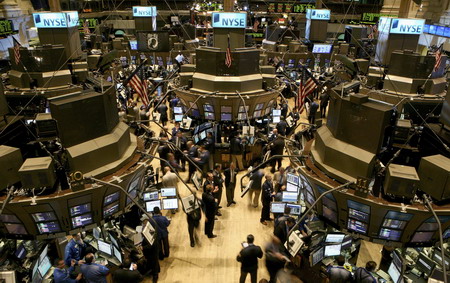
Traders work on the floor of the New York Stock Exchange, November 14, 2008. US stocks fell at the open on Friday on more gloomy news pointing to a deepening global economic downturn, a day after Wall Street had its biggest surge in two weeks. [Agencies]

Hedge fund selling in advance of a Saturday deadline contributed to the market's gyrations, and some retrenchment was to be expected following a big rally Thursday, when the Dow rallied more than 550 points after falling near its lows for the year. But there was plenty of discouraging news for investors to focus on, including comments from Federal Reserve Chairman Ben Bernanke that the markets remain under "severe strain" and a sobering report on October retail sales.

Analysts believe the market is still searching for a bottom after last month's huge losses, and that the pattern of volatility will continue for some time, selling, even on technical reasons like looming deadlines for cashing out hedge fund holdings, is still coming against a backdrop of an extremely weak economy.

"Clearly, the trading crowd like hedge funds can take this market in any direction they want to. Anybody looking to build a position is just not confident," said Joseph V. Battipaglia, chief investment officer at Ryan Beck & Co.

The session saw another stream of bad news. Bernanke said during a speech in Frankfurt, Germany, that he would work closely with other central banks to try to alleviate the global financial crisis and left open the door to a fresh interest rate cut. The Fed is scheduled to meet Dec. 16 at its last regularly scheduled meeting this year.

While Wall Street would like to see another rate cut, many investors aren't sure, given the litany of bad economic and corporate news, of how effective a rate reduction would be in the near term. Many investors are still trying to assimilate the idea that the economy's downturn will be protracted, lasting well into next year and perhaps longer.


"The economic news continues to be very negative," said Ben Halliburton, chief investment officer of Tradition Capital Management. "The realization that '09 is going to be a very bad year for economic activity is starting to dawn on people and they are starting to digest how bad it's going to be."

The Commerce Department reported that retail sales plunged by the largest amount on record in October as consumers cut back on spending in the wake of the financial crisis. Retail sales fell by 2.8 percent last month, surpassing the old mark of a 2.65 percent drop in November 2001 in the wake of the terrorist attacks that year.

The market got more disappointing consumer news from retailers Abercrombie & Fitch Co. and JCPenney Co. Both warned that profits will come in below Wall Street's already lowered projections as retailers head into a holiday shopping season that could be among the slowest on record.

The great fear on the Street is that Americans' reluctance to spend will extend what is already a serious economic downturn. A barrage of negative consumer news sent stocks tumbling earlier in the week.

The market drew some brief comfort in the afternoon from comments from Treasury Secretary Henry Paulson, who told CNBC that capital injections in the banking sector will help stimulate lending. He also defended the decision to not buy toxic assets from banks, saying that it would not work as quickly; the move helped send stocks falling earlier this week.

There was disquieting news from the tech sector that weighed on the Nasdaq composite index. Sun Microsystems Inc. said it will cut up to 6,000 workers, or about 18 percent of global staff, as part of a massive restructuring plan. And handset maker Nokia Corp. warned the global economic slowdown will weigh on sales next year.

The Dow fell 337.93, or 3.82 percent, to 8,497.31, at its lows of the day. The Dow fell more than 300 in early trading, recovered to a slim advance and then turned sharply lower at the end of the day as hedge funds cashed out. Fund investors had a Nov. 15 deadline for withdrawing their money, which forced the funds in turn to sell stocks.

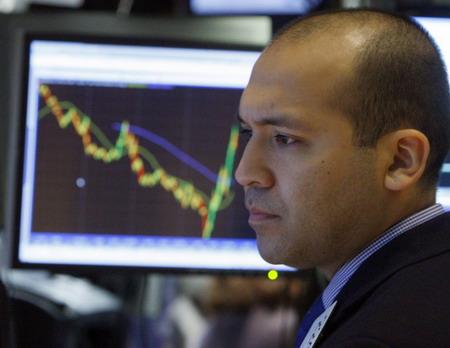
A trader works on the floor of the New York Stock Exchange, November 14, 2008. US stocks fell at the open on Friday on more gloomy news pointing to a deepening global economic downturn, a day after Wall Street had its biggest surge in two weeks. [Agencies]

The Standard & Poor's 500 index fell 38.00, or 4.17 percent, to 873.29, and the Nasdaq stumbled 79.85, or 5.00 percent, to 1,516.85.

The Russell 2000 index of smaller companies fell 34.71, or 7.07 percent, to 456.52.

Declining issues outpaced advancers by about 4 to 1 on the New York Stock Exchange, where consolidated volume came to 5.73 billion shares, compared with 7.67 billion on Thursday.

For the week, the Dow lost 4.99 percent, the S&P fell 6.20 percent and the Nasdaq tumbled 7.92 percent.

The major indexes have fallen dramatically since their highs of October 2007 as the housing and credit crises have taken their toll on the economy. The Dow is down 40 percent from its closing record of 14,164.53, while the S&P 500 is off 44.2 percent from its record close of 1,565.15. The Nasdaq is off 46.9 percent from its then 7 1/12-year high of 2,859.12.

The Dow's surge Thursday was the third-largest single-session point gain on record, following the 889-point rise on Oct. 28 and the 936-point surge on Oct. 13. The rally came after three days of selling that wiped out about $1 trillion in shareholder value.

Wall Street's violent swings in recent weeks are part of the market's ongoing "bottoming" process, analysts say, in which the market retests the lows hit last month. The market is expected to remain volatile, as evidenced by past recoveries from a bear market.

Randy Frederick, director of trading and derivatives at Charles Schwab & Co., said the sell-off could be attributed in part to investors not wanting to hold on to stocks going in to the weekend, particularly ahead of a meeting of Group of 20 international leaders in Washington. The meeting could bring decisions on how to help the troubled global financial system.

"Certainly in this market we've had a lot of late Friday sell-offs," he said. "The government has been very insistent on making major announcements on Sunday nights."

Bernie McGinn, chief executive of McGinn Investment Management, said the market needs to have a sustained rally for a couple of days to lure buyers back into the market. For the moment, he believes the market will continue to fluctuate based on events like earnings or government reports.

"We're in the middle of chaos," he said. "That's what it is, pure and simple."

The volatility helped send government bond prices higher as investors looked for safety. The three-month Treasury bill's yield fell to 0.14 percent from 0.20 percent late Thursday, and the yield on the benchmark 10-year Treasury note fell to 3.72 percent from 3.85 percent late Thursday. Lower yields indicate higher demand.

Meanwhile, the price of a barrel of light, sweet crude fell $1.20 to settle at $57.04 a barrel on the New York Mercantile Exchange. Oil has been falling for the same reason as stocks, the fear of a deep global recession.

Shares of major retailers fell as the string of disappointing earnings and outlooks continued. JCPenney lost $2.01, or 10.4 percent, to $17.27. Abercrombie & Fitch tumbled $4.65, or 20.7 percent, to a 52-week low of $17.79.

The dollar rose against other major currencies. Gold prices also rose.

Overseas, Japan's Nikkei closed up 2.72 percent and Hong Kong Hang Seng rose 2.43 percent. In European trading, London's FTSE 100 was up 1.53 percent, Germany's DAX rose 1.31 percent, and France's CAC-40 added 0.98 percent.


Read more...