Economic Calendar

Sunday, December 7, 2008

Japan 5-Year Notes Complete 2nd Weekly Drop on Supply Concerns

By Theresa Barraclough

Dec. 6 (Bloomberg) -- Japanese five-year government notes completed a second weekly drop on concern the Ministry of Finance will increase debt sales next year to fund economic- stimulus spending.

Five-year yields yesterday climbed from near the lowest since April after the Nikkei newspaper said bond sales may exceed the government’s 30 trillion yen ($325 billion) ceiling for the year ending March 31. The Tokyo interbank offered rate for yen loans, known as Tibor, increased for a 20th day yesterday, adding to speculation higher costs will deter investors from borrowing to buy debt.

“Investors are very aware of next year’s issuance plan so bonds tend to be weak this time of year,” said Takashi Nishimura, an analyst in Tokyo at Mitsubishi UFJ Securities Co., a unit of Japan’s largest bank by assets. “Tibor is one of the hurdles for the JGB market.”

The yield on the 1 percent note due September 2013 rose one basis point this week to 0.88 percent in Tokyo at Japan Bond Trading Co., the nation’s largest interdealer debt broker. The price declined 0.048 yen to 100.550 yen. A basis point is 0.01 percentage point.

Ten-year bond futures for December delivery declined 0.25 this week to 139.13 as of the afternoon close on the Tokyo Stock Exchange yesterday.

Tibor increased to 0.899 percent yesterday, from 0.876 on Nov. 28, according to data compiled by Bloomberg. That’s the highest since March 1998.

Lower Revenue

The government may lower its estimate for this fiscal year’s tax revenue by 6.5 trillion yen because of a decline in corporate earnings, the Nikkei newspaper said yesterday, citing an unidentified official.

The Ministry of Finance said Dec. 3 it may increase sales of short- and mid-term government debt, reiterating comments it make last month.

“Fears of a loosening of fiscal policy will probably limit the room for JGB yields to decline, despite growing deflation expectations,” Tomoko Fujii, Tokyo-based head of Japan economics and strategy at Bank of America Corp., wrote in a report on Dec. 4.

Ten-year bonds yesterday completed a fourth week of gains before a central bank report next week economists estimate will show wholesale inflation slowed last month. Yields fell 2.5 basis points this week.

Inflation-linked bonds worldwide are yielding more than conventional debt, signaling investors expect deflation, or a decline in consumer prices.

Producer Prices

The extra yield 10-year conventional Japanese bonds offer over similar-maturity inflation-linked debt, known as the breakeven rate, was minus 259 basis points yesterday, according to data compiled by Bloomberg. The U.S. five-year breakeven rate was minus 39 basis points and the three-year U.K. breakeven spread was minus 197 basis points on Dec. 4.

Producer prices, the costs companies pay for energy and raw materials, may have increased 2.8 percent in November from a year earlier, down from a 4.8 percent gain in October, according to a Bloomberg News survey of economists. The Bank of Japan report is due Dec. 10.

There was a 25 percent chance yesterday the central bank will cut interest rates by the end of March, according to calculations by JPMorgan Chase & Co. using overnight interest- rate swaps. The BOJ’s target rate is 0.30 percent.

The central bank on Dec. 2 said it will start corporate debt rated BBB or higher as collateral from commercial banks on Dec. 9 to encourage them to lend more to companies.

To contact the reporter on this story: Theresa Barraclough in Tokyo at tbarraclough@bloomberg.net.


Read more...

South African Rand Declines in Week on Global Recession Concern

By Vernon Wessels

Dec. 6 (Bloomberg) -- South Africa’s rand fell against the dollar this past week as the stock market declined with those around the world on concern the global economy is headed toward a recession.

The rand weakened as the country’s benchmark index of equities fell in the week by the most since October on concern slumping economies in the U.S. and euro region will erode demand for higher-yielding emerging-market assets. South Africa’s currency also slipped after reports showed manufacturing shrank at the fastest pace in at least nine years in November.

“There is general apathy toward emerging markets like South Africa because of the global slowdown,” said David Gracey, head of foreign-exchange trading at Nedbank Group Ltd. in Johannesburg. “There isn’t a lot of offshore flow” into the country because of the negative economic data, he said.

The rand fell 3.8 percent this past week to 10.4300 per dollar by 5:35 p.m. in Johannesburg yesterday. Against the euro, it dropped 3.6 percent to 13.2122.

South Africa’s benchmark FTSE/JSE Africa All Share Index fell 9.1 percent this past week, the biggest drop since the five days ended Oct. 10. The MSCI World Index lost 8.2 percent.

Africa’s biggest economy relies on purchases of its stocks and bonds to fund the current-account deficit, which will reach 7.6 percent of gross domestic product this year, Finance Minister Trevor Manuel said on Oct. 21. Economic growth will slow to 3.7 percent this year from 5.1 percent in 2007, he predicted.

Foreigners sold almost 68 billion rand ($6.6 billion) more than they bought of the country’s assets.

Limited Declines

Declines for the rand may be limited amid speculation the central bank will lower interest rates on Dec. 11, helping to boost growth in the continent’s biggest economy.

“The global environment has deteriorated so rapidly that they’ll have to consider a rate cut,” said George Glynos, the managing director of Econometrix Treasury Management in Johannesburg. “Investors may rotate increasingly back into South African bonds and equities as the growth outlook improves.”

Slowing inflation and lower oil prices may persuade the South African Reserve Bank to cut its main rate from 12 percent, the highest level in more than five years.

Consumer-price growth slowed for a second month in October, easing to 12.4 percent, still double the central bank’s 6 percent ceiling. Oil has slipped almost 70 percent since reaching a record on July 11.

Government bonds rose in the week, with the yield on the benchmark 13.5 percent security due September 2015 falling 21 basis points to 8.07 percent. The yield on the 13 percent note maturing in August 2010 dropped 40 basis points to 7.91 percent. Yields move inversely to bond prices.

To contact the reporter on this story: Vernon Wessels in Johannesburg at vwessels@bloomberg.net


Read more...

Saturday, December 6, 2008

Paulson signs out with hugs, laughs

Updated: 2008-12-06
By Wu Jiao and Li Xiaokun (China Daily)


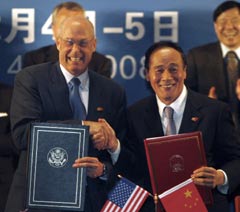
US Treasury Secretary Henry Paulson (L) and Chinese Vice Premier Wang Qishan (R) trade agreements and shake hands at the Eco Partnership signing ceremony during the US China Strategic Economic Dialogue in Beijing December 4, 2008. [Agencies]

In his many years as the United States' top China hand, Henry Paulson captured the hearts, or at least the cameras, of the Chinese media.

Images of him hugging former vice-premier Wu Yi and fervently shaking hands with her successor Wang Qishan were just two among many that made the front pages of the nation's press.

On Friday, the 62-year-old Treasury secretary gave photographers one more opportunity, as he addressed the fifth Sino-US SED, his last time as head of the US delegation.

The former Wall Street banker, and member of the outgoing Bush administration, will step down next month.

In a farewell speech to his Chinese counterparts, Paulson said: "We all can be proud of what we have built through the SED.

Our countries will no doubt face challenges, but with the foundation of mutual respect, trust and candor fostered by the SED, I have no doubt we will come through them."

Clearly in high spirits, Paulson laughed heartily several times during his meeting with President Hu Jintao on Friday afternoon at the Great Hall of the People, providing plenty of his trademark photo opportunities.


Chinese President Hu Jintao (R) meets with United States Treasury Secretary Henry Paulson at the Great Hall of the People in Beijing, capital of China, Dec. 5, 2008. [Agencies]

The past five rounds of SED talks, all of which Paulson took part in, have tackled many difficult issues, including food safety, trade and the environment.

Wu Xiaoqiu, an economics professor at Beijing's Renmin University of China, said: "Dialogue and communication is the right way to solve problems between the two major economies."

While Paulson has been criticized by some US lawmakers for not pressing China on its currency, he once told reporters that it was the SED that prevented Congress from passing legislation that would have deepened tensions between the two countries.

The question now is who will continue Paulson's work.

Although New York Federal Reserve President Timothy Geithner, who assisted Paulson in the recent US bailout action, has been named as the next Treasury secretary, some experts wonder if the Treasury Department will continue to be a key agency in steering the bilateral relationship, or even if the SED will continue at all.

Lawrence Summers, the incoming director of the National Economic Council; Vice-President-Elect Joseph Biden Jr; and Senator Hillary Rodham Clinton, Obama's choice for secretary of state, are all expected to be major coordinators on China policy.

However, none of them has the China experience that Paulson brought with him from his tenure at Goldman Sachs.

Paulson demurred on the question of how the Obama administration will handle the SED and China relations.

On his departure from the Treasury, he said earlier that he expects China to continue to play a part in his life, although he drew the line at learning Mandarin. "I've got a very poor ear for languages," he said.


Read more...

Asian Stocks Fall This Week as Recession Deepens, Oil Plunges

By Chua Kong Ho

Dec. 6 (Bloomberg) -- Asian stocks fell this week as the deepening global recession slashed consumer demand, driving commodity prices lower and dragging down materials companies and oil drillers.

BHP Billiton Ltd., the world’s biggest mining company, dropped 16 percent after oil fell more than $100 a barrel from its record in July and copper prices slumped. Honda Motor Co. sank 21 percent as November U.S. sales plunged the most since 1981. Surfwear maker Billabong International Ltd. tumbled 25 percent in Sydney after cutting its earnings forecast as its U.S. customers deferred deliveries amid the economic contraction.

“The world is in recession and earnings will fall next year for most companies the world over, including Asia,” said Hugh Young, managing director at Aberdeen Asset Management Ltd. in Singapore, overseeing about $45 billion. “Asia is in pretty good shape for surviving, not in great shape for growing.”

The MSCI Asia Pacific Index fell 3.8 percent to 79.52 this week. Raw-materials producers had the biggest percentage decline among the 10 industry groups.

MSCI’s Asian index has plunged 50 percent in 2008 as global financial companies’ losses and writedowns from the collapse of the U.S. subprime-mortgage market neared $1 trillion. Shares on the MSCI gauge are now valued at 9.7 times trailing earnings after falling to as low as 8.2 times last month. That’s half the 19.5 times on Nov. 11 last year, when the measure hit a peak of 172.32. Prior to the current market turmoil, the price-earnings ratio never dropped below 10, according to Bloomberg data.

U.S. Recession

The U.S. entered a recession in December 2007, the National Bureau of Economic Research, a private, non-profit panel of economists that dates American business cycles, said Dec. 1. A government report said the number of Americans receiving jobless benefits in the week ended Nov. 22 jumped to the most since December 1982. A separate report showed orders at U.S. factories in October sank the most since July 2000.

Central banks worldwide stepped up efforts to arrest the economic slowdown. The European Central Bank cut its main refinancing rate by 75 basis points, the most in its 10-year history, while the Bank of England cut its benchmark rate to 2 percent, the lowest level since 1951. The Swedish and Danish central banks also lowered their key rates. The Bank of Korea said it would make a one-time interest payment on central bank reserves and buy more securities.

Japan’s Nikkei 225 Stock Average dropped 7 percent to 7,917.51. Australia’s S&P/ASX 200 Index retreated 6.8 percent. Most markets in Asia fell this week.

BHP declined 16 percent to A$26.15. Inpex Corp., Japan’s largest explorer, sank 14 percent to 529,000 yen. Woodside Petroleum Ltd., Australia’s second-biggest oil producer, retreated 16 percent to A$30.46.

Commodities Retreat

Crude oil has dropped from a peak of $147.27 on July 11 to $41.65 a barrel on the New York Mercantile Exchange. Oil prices may slide below $25 a barrel next year if the global recession spills over into China, Francisco Blanch, a London-based analyst at Merrill Lynch, said Dec. 4.

A measure of six metals traded on the London Metal Exchange, including copper and zinc, fell 14.8 percent this week.

“We’re in an environment where demand is coming off, and that’s putting commodities under pressure,” said Matt Riordan, who helps manage $3 billion at Paradise Investment Management in Sydney. “Things have been slowing down pretty sharply.”

Rio Tinto Group, the third-largest mining company, tumbled 31 percent to A$32, the biggest percentage decline on MSCI’s Asian gauge, on concern it may have difficulty refinancing debt due next year. The company plans to close its iron-ore mines in Western Australia for 12 days as part of an earlier decision to reduce output.

Vehicle Sales

Honda, Japan’s No. 2 automaker, fell 21 percent to 1,653 yen. The carmaker withdrew from Formula One racing, cutting at least 20 billion yen ($216 million) in costs, after its U.S. vehicle sales plunged 32 percent in November.

Toyota Motor Corp. dropped 12 percent to 2,650 yen. Bridgestone Corp., the world’s largest tiremaker, dropped 14 percent to 1,376 yen.

General Motors Corp. Chef Executive Rick Wagoner told lawmakers he would accept strict conditions for a U.S. loan to stay afloat, including a promise to return the money and file for bankruptcy if his company doesn’t fulfill the terms.

Sack Workers

“Regardless of whether the U.S. automakers go bankrupt or stay afloat, they’ll have to sack workers,” said Yoshinori Nagano, a senior strategist at Daiwa Asset Management Co., which manages about $96 billion in Tokyo. “Should the companies collapse, it may trigger a series of business failures and worsen an already weakened U.S. economy.”

Billabong declined 25 percent to A$7.94. The U.S. recession has accelerated a slowdown in demand for clothing and surfing accessories, causing earnings per share to fall in the six months ending December, the Gold Coast, Australia-based company said Dec 4.

Indonesia’s PT Bumi Resources, Asia’s biggest exporter of power-station coal, slumped 25 percent to 760 rupiah after the country’s stock exchange said the company should use internal funds to fund a repurchase of its shares, instead of selling debt.

To contact the reporter responsible for this story: Chua Kong Ho in Shanghai at kchua6@bloomberg.net


Read more...

Brazilian Stocks Gain on Rate-Cut Speculation; Bolsa Rises

By Paulo Winterstein and Alexander Ragir

Dec. 5 (Bloomberg) -- Brazilian stocks staged a late-day rally, paring losses for the week, on speculation that slowing economic growth and easing inflation may give the central bank room to cut interest rates next year.

Banco do Brasil SA, Latin America’s biggest government- controlled bank, jumped 7.9 percent, leading gains for financial companies as traders increased bets the benchmark rate will fall half a percentage point by January 2010. B2W Cia. Global do Varejo, Brazil’s largest online retailer, climbed the most on the Bovespa index on the prospect that lower rates will spur consumer spending. Vivo Participacoes SA rose for a second day as investors sold commodity producers and bought phone stocks.

“The good inflation signals takes away the possibility some economists were floating that there could be inflation with very low growth,” said Joao Pedro Brugger, chief equity portfolio manager at Leme Investimentos in Florianopolis, Brazil, which oversees about $35 million. “It gives space for the central bank to join other policy makers in aggressively cutting rates to stimulate the economy.”

The Bovespa rose 0.6 percent to 35,347.39, paring a weekly drop to 3.4 percent. The BM&FBovespa Small Cap index gained 1 percent. The BM&FBovespa MidLarge Cap index added 0.2 percent. Mexico’s Bolsa advanced 0.8 percent and Chile’s Ipsa increased 0.1 percent.

Inflation in Latin America’s biggest economy slowed to 0.36 percent in November, lower than the forecasts from all 40 economists in a Bloomberg survey. A separate report earlier this week showed industrial output growth slowed more than forecast in October, signaling the global slowdown is hitting Brazil harder and faster than economists predicted.

Yields Drop

The yield on Brazil’s overnight futures contract for January 2010 delivery fell 37 basis points, the sixth straight daily decline, to 13.33 percent. The rate is the lowest since April 17 and is 42 basis points, or 0.42 percentage point, below the central bank’s overnight rate.

Itau Corretora said today that with Brazil’s growth outlook worsening, its estimate of 13 percent for the benchmark lending rate was “too high.” Raymond James & Associates has forecast a half-percentage point cut to 13.25 percent next year. The next rate-setting policy meeting is scheduled for Dec. 9-10.

The European Central bank cut interest rates by three- quarters of a percentage point yesterday to contain the fallout from the financial crisis. Central banks in England, Sweden and Indonesia also lowered borrowing costs.

Banco do Brasil climbed 7.9 percent to 15.75 reais, the highest in a month.

B2W Varejo lead a rally in retailers, advancing 8.8 percent to 22.35 reais for the biggest gain since October.

Telephone Shares

Vivo, Brazil’s largest mobile-phone carrier, rose 6.6 percent to 31.85 reais.

“When commodities prices fall, as we see today, phone carriers’ shares become more attractive,” Alex Pardellas, analyst at Banif Investment Banking in Sao Paulo, said in an interview yesterday.

The Bovespa earlier dropped as much as 3.2 percent after metal prices tumbled and Banco Santander SA recommended avoiding flat-steel makers because of the “dreary” outlook for auto sales. Usinas Siderurgicas de Minas Gerais SA, Brazil’s second- biggest steelmaker, fell 1.8 percent to 22.20 reias.

Petroleo Brasileiro SA slid 2.4 percent to 18.16 reais as crude prices tumbled to the lowest in almost four years. Petrobras, as the state-controlled oil company is known, lost 9.5 percent for the week.

Mexico’s Bolsa index also reversed earlier declines, led by plastics maker Mexichem SAB after it said sales next year will rise by almost a third.

Mexichem, Latin America’s largest maker of plastic pipes, rose the most in the Bolsa index after it said its 2008 sales may reach 30.3 billion pesos ($2.2 billion), a 32 percent jump from last year. The shares gained 5.9 percent to 12.30 pesos.

Argentina’s Merval index increased 0.8 percent, Colombia’s IGBC index fell 1 percent and Peru’s Lima General index declined 2.7 percent.

To contact the reporter on this story: Paulo Winterstein in Sao Paulo at pwinterstein@bloomberg.net; Alexander Ragir in Rio de Janeiro at aragir@bloomberg.net.


Read more...

U.S. Stocks Jump as Hartford Surges on Boosted Profit Forecast

By Elizabeth Stanton

Dec. 5 (Bloomberg) -- U.S. stocks jumped, reversing an early slide, as Hartford Financial Services Group Inc. led a rally in insurers after increasing its profit forecast and saying it’s weathering the credit crisis.

Hartford, which tumbled 92 percent in 2008 before today, doubled and all 21 insurance companies in the Standard & Poor’s 500 Index advanced. Prudential Financial Inc. and MetLife Inc. climbed at least 22 percent as UBS AG said they may benefit from potential regulatory changes. The gains helped the market overcome a morning tumble spurred by government data showing the nation lost the most jobs in 34 years last month as the recession deepened.

“The bad news is out; people know the economy’s lousy,” said Barry James, president of James Investment Research in Xenia, Ohio, which oversees $2 billion. “The market is so oversold that we’re entering into what I’d call a bear-market rally.”

The S&P 500 rose 3.7 percent to 876.07 after retreating 3.2 percent earlier. All 10 industry groups advanced as the benchmark index for U.S. stocks pared losses in its fourth weekly retreat since October. The Russell 2000 Index of small U.S. companies climbed 4.9 percent to 461.09. The Dow Jones Industrial Average added 259.18 points, or 3.1 percent, to 8,635.42.

Rebound Extended

The S&P 500 extended its rebound from an 11-year low on Nov. 20 to 16 percent, gains driven in part by speculation the Federal Reserve will cut interest rates and Congress will pass another economic stimulus. Still, the benchmark index for U.S. equities is down 40 percent in 2008, headed for its worst year since 1931, after the collapse of the subprime mortgage market reduced average profits for five consecutive quarters.

The S&P 500 trimmed its weekly loss to 2.3 percent, while the Dow fell 2.2 percent and the Nasdaq Composite decreased 1.7 percent in the week.

Hartford jumped a record 102 percent to $14.59 and pared its yearly loss to 73 percent. The insurer raised its full-year operating profit forecast and said the capital outlook at its insurance subsidiaries is “strong.” The company’s operating businesses are “performing well, particularly in light of the challenging markets,” Chief Executive Officer Ramani Ayer said.

Insurance Rally

The S&P 500 Financials Index added 8.6 percent for the steepest advance among 10 industry groups, as insurance companies climbed 14 percent collectively. Prudential jumped 35 percent to $28.52. MetLife gained 22 percent to $30.76. Bank of America Corp., JPMorgan Chase & Co. and Citigroup Inc. each climbed at least 4.1 percent.

Hartford, Prudential, MetLife, Lincoln National Corp. and money manager Ameriprise Financial Inc. would benefit if the National Association of Insurance Commissioners opts to relax capital requirements for managers of variable annuities, UBS’s Andrew Kligerman wrote in a report today. The association is likely to reach a decision by year-end and could announce one as early as Dec. 9, Kligerman said.

Annuities are retirement products that guarantee buyers income for life in return for an up-front payment.

Financial stocks in the S&P 500 last week traded for an average of 0.8 times book value, the lowest in at l3 years. Banks are posed for their worst annual drop on record and have plunged 66 percent since reaching an all-time high in February 2007.

SanDisk, Micron

SanDisk Corp. climbed 14 percent to $9.23. The world’s largest maker of memory cards used in digital cameras is poised to benefit from a reduction in the supply of so-called NAND semiconductors, American Technology Research said in upgrading the stock to “buy” from “neutral.”

AmTech analyst Dinesh Moorjani also upgraded Micron Technology Inc. to “buy,” citing falling supply. The largest U.S. memory chip maker gained 13 percent to $2.04, helping push an index of technology companies to the second-biggest advance in the S&P 500.

The market’s earlier retreat came after the Labor Department reported that the nation lost 533,000 jobs last month, 59 percent more than the average estimate in a Bloomberg survey. The decrease exceeded all 73 forecasts in the survey. The unemployment rate rose to 6.7 percent, the highest level since 1993.

“We’re looking at a pretty ugly economic outlook, but an awful lot of that is being reflected” in stock prices, Leo Grohowski, chief investment officer at Bank of New York Mellon Wealth Management, which oversees $158 billion, said on Bloomberg Television.

General Motors Corp. fell 0.7 percent to $4.08 after saying it will cut production at four North American plants next year. GM, the biggest U.S. automaker, and rivals Ford Motor Co. and Chrysler LLC are asking Congress for a combined $34 billion to stay afloat. Lawmakers are considering options such as providing automakers with enough aid to get them through next year’s first quarter on condition they make significant progress on restructuring their operations.

To contact the reporter on this story: Elizabeth Stanton in New York at estanton@bloomberg.net.


Read more...

Friday, December 5, 2008

Non-Farm Payrolls Drop -533k, More Losses to Come

Daily Forex Fundamentals | Written by GFT | Dec 05 08 14:47 GMT |

Non-farm payrolls dropped 533k last month with the unemployment rate soaring to 6.7%, the highest level since 1993. September and October job losses were also revised to worse numbers. There is no capitulation bottom when it comes to the labor market which means that negative non-farm payrolls will continue. This number spells big trouble for the next retail sales reports and will pressure the Federal Reserve to make the tough decision of cutting interest rates by 75bp on December 16 to 0.25%.

The weak labor market number will mean two things - more weakness for US equities and the possibility of the Federal Reserve taking interest rates to zero. By extension, it will lead to weakness in USD/JPY, EUR/USD, GBP/USD and all of the Japanese Yen Crosses.

Here are my thoughts on why large job losses will continue beyond number - fade any bounces in non-farm payrolls in the coming months

Large Job Losses to Continue Beyond November

Don't expect the job losses to end in November either. More layoffs have been announced this past week by companies like JPMorgan and AT&T. The current recession is the closest to the 1980s recession, when job losses continued for 17 consecutive months. Even the recession in 2001, which was shallower than the current recession had 15 consecutive months of job losses. Therefore non-farm payrolls should continue to remain negative into the first half of 2009. Furthermore, a large drop in non-farm payrolls does not mean that we have hit a bottom.

In analyzing non-farm payrolls data during past recessions, we see that at the beginning of an official recession, as defined by the National Bureau of Economic Research, non-farm payrolls start to decline rapidly. However after falling between 200k and 300k, job cuts stall and then pick up once again. We saw this trend in the 1981 to 1982 recession, the 1990 to 1991 recession and during the 2001 recession. It should happen again in 2009.

The following chart illustrates the double dip trend of non-farm payrolls during the 2001 and recession.

GFT Forex

Here are the charts for 1991 and 1981

GFT Forex

GFT Forex

Kathy Lien
http://www.gftforex.com

DISCLAIMER: GFT refers to Global Futures & Forex, Ltd. and all of its divisions, branches and subsidiaries, including Global Forex Trading and GFT Global Markets UK Limited. GFT Global Markets UK Limited is authorized and regulated by the United Kingdom Financial Services Authority. Each investment product is offered only to and from jurisdictions where solicitation and sale are lawful. Trading of foreign exchange contracts, contracts for differences, derivatives and other investment products which are leveraged, can carry a high level of risk, and may not be suitable for all investors. It is possible to lose more than the initial investment. In Australia, GFT means Global Futures & Forex, Ltd. ARBN 103 508 461, AFS Licence 226625. A Product Disclosure Statement (PDS) is available at www.gft.com.au. You should read and consider the PDS before making any decision to deal in GFT products. © 2008 Global Futures & Forex, Ltd. All rights reserved.


Read more...

Employment: Teeth of the Recession Continue to Grind

Daily Forex Fundamentals | Written by Wachovia Corporation | Dec 05 08 14:43 GMT |

Nonfarm employment fell 533,000 with declines in manufacturing, construction, retail & business services and finance. Meanwhile, the unemployment rate rose to 6.7 percent with the diffusion index down to just 40 percent. Aggregate hours declined for the eighth month in a row, signaling a drop of five percent in fourth quarter GDP.

Employment Declines Signal Broad Consumer Weakness

  • Job declines were widespread with losses in manufacturing, construction and retail, financial and business services. The only bright spots remaining are health care and education.
  • Over the last year, the breadth of industries adding jobs has dropped sharply suggesting broad weakness in consumer spending and dismal consumer confidence.

Unemployment Up, Output Down

  • Rising unemployment rates have been driven by a loss of jobs and are consistent with weakness in consumer spending and the drop in consumer sentiment. Unemployment rates remain significantly different by education cohort.
  • Hours worked have declined, and this drop is consistent with negative five percent growth in fourth quarter GDP.

Wachovia Corporation
http://www.wachovia.com

Disclaimer: The information and opinions herein are for general information use only. Wachovia Corporation and its affiliates, including Wachovia Bank, N.A., do not guarantee their accuracy or completeness, nor does Wachovia Corporation or any of its affiliates, including Wachovia Bank, N.A., assume any liability for any loss that may result from the reliance by any person upon any such information or opinions. Such information and opinions are subject to change without notice, are for general information only and are not intended as an offer or solicitation with respect to the purchase or sales of any security or any foreign exchange transaction, or as personalized investment advice. Securities and foreign exchange transactions are not FDIC-insured, are not bank-guaranteed, and may lose value.


Read more...

Canada's Job Bonanza Comes to an Abrupt Halt

Daily Forex Fundamentals | Written by RBC Financial Group | Dec 05 08 14:18 GMT |

Employment dropped by 70,600 in November, a much steeper decline than market expectations of a 25,000 dip. Some of the weakness reflected anticipated job cuts associated with the temporary hiring of workers for October's federal election. StatsCan reported that 27,000 public administration jobs were cut in November. The unemployment rate edged up to 6.3% from 6.2% in October marking a two-year high.

The decline in public sector jobs was almost matched with a similar number of private sector job cuts. There were cuts to both full-time (-32,400) and part-time (-38,000) employment. The goods sector saw the number of employed fall by 32,800, while service sector jobs were reduced by 37,800. There were large job losses in agriculture (-10,100) and manufacturing (-38,300) on the goods side with trade (-8,900), transportation and warehousing (-26,000) and educational services (-15,600) supplementing the job cuts in public administration on the services side of the economy. Tempering these declines somewhat were increases in the scientific services, health care, food and accommodation services and cultural industries.

Ontario bore the brunt of job losses in the month, with 66,000 workers cut from payrolls, 42,000 of which were in manufacturing positions. Ontario's unemployment rate jumped to 7.1% from 6.5% in October.

The key wage measure in the report, average hourly wages for permanent workers, rose 0.5% in November with the year-over-year rate picking up pace to 4.7% from 4.2% in October.

The sharper-than-expected cut to November payrolls and the steady increase in the unemployment rate from its recent low of 5.8% in February are consistent with an economy that is gearing down after a modest acceleration in growth in the third quarter. The deepening recession in the United States and persistent financial market turmoil are negatively affecting Canada's growth outlook and we expect they will weigh on the labour market going forward.

Our forecast is that the unemployment rate will continue to drift higher into next year as weak demand for Canadian exports and slower consumer and business spending lead to more job losses. Today's data is the one of the final reports before the Bank of Canada's meeting next week. We expect the Bank to lower the overnight rate by 50 basis points to 1.75% as policymakers try to cushion the economy from the impact of these downward pressures.

RBC Financial Group
http://www.rbc.com

The statements and statistics contained herein have been prepared by the Economics Department of RBC Financial Group based on information from sources considered to be reliable. We make no representation or warranty, express or implied, as to its accuracy or completeness. This report is for the information of investors and business persons and does not constitute an offer to sell or a solicitation to buy securities.


Read more...

Canada's Job Bonanza Comes to an Abrupt Halt

Daily Forex Fundamentals | Written by RBC Financial Group | Dec 05 08 14:18 GMT |

Employment dropped by 70,600 in November, a much steeper decline than market expectations of a 25,000 dip. Some of the weakness reflected anticipated job cuts associated with the temporary hiring of workers for October's federal election. StatsCan reported that 27,000 public administration jobs were cut in November. The unemployment rate edged up to 6.3% from 6.2% in October marking a two-year high.

The decline in public sector jobs was almost matched with a similar number of private sector job cuts. There were cuts to both full-time (-32,400) and part-time (-38,000) employment. The goods sector saw the number of employed fall by 32,800, while service sector jobs were reduced by 37,800. There were large job losses in agriculture (-10,100) and manufacturing (-38,300) on the goods side with trade (-8,900), transportation and warehousing (-26,000) and educational services (-15,600) supplementing the job cuts in public administration on the services side of the economy. Tempering these declines somewhat were increases in the scientific services, health care, food and accommodation services and cultural industries.

Ontario bore the brunt of job losses in the month, with 66,000 workers cut from payrolls, 42,000 of which were in manufacturing positions. Ontario's unemployment rate jumped to 7.1% from 6.5% in October.

The key wage measure in the report, average hourly wages for permanent workers, rose 0.5% in November with the year-over-year rate picking up pace to 4.7% from 4.2% in October.

The sharper-than-expected cut to November payrolls and the steady increase in the unemployment rate from its recent low of 5.8% in February are consistent with an economy that is gearing down after a modest acceleration in growth in the third quarter. The deepening recession in the United States and persistent financial market turmoil are negatively affecting Canada's growth outlook and we expect they will weigh on the labour market going forward.

Our forecast is that the unemployment rate will continue to drift higher into next year as weak demand for Canadian exports and slower consumer and business spending lead to more job losses. Today's data is the one of the final reports before the Bank of Canada's meeting next week. We expect the Bank to lower the overnight rate by 50 basis points to 1.75% as policymakers try to cushion the economy from the impact of these downward pressures.

RBC Financial Group
http://www.rbc.com

The statements and statistics contained herein have been prepared by the Economics Department of RBC Financial Group based on information from sources considered to be reliable. We make no representation or warranty, express or implied, as to its accuracy or completeness. This report is for the information of investors and business persons and does not constitute an offer to sell or a solicitation to buy securities.


Read more...

U.S. Payrolls Plunge

Daily Forex Fundamentals | Written by RBC Financial Group | Dec 05 08 14:19 GMT |

Today's labour force report was very weak, with payrolls dropping by a breathtaking 533,000 in November. Revisions to the data for October and September were also to the downside, with October's job losses revised up to 320,000 from 240,000 and September's decline revised to 403,000 from 284,000. The household survey indicated that the unemployment jumped 0.2% to 6.7% in November to stand at its highest level since October 1993.

The weakness was broad-based; only government employment rose (by a paltry 7,000) of the major industry categories. Goods producers cut payrolls by 163,000, while service-providers trimmed a whopping 370,000 from their payrolls.

Manufacturers cut another 85,000 positions, while the construction industry reduced employment by 82,000. Wholesalers (-23,000) and retailers (-91,000) also continued to pare back their workforce. Transportations companies lost 147,000 and financial firms trimmed 32,000 jobs.

The average workweek slipped to 33.5 hours and hours worked in the manufacturing sector fell 40.3 hours, down from 41 as recently as July. Overtime hours continued to slide and came in at 3.3 hours. The index of aggregate weekly hours, which reflects the combined effect of hours and employment, fell 0.9% in November, building on October's 0.4% dip. In October/November, this index contracted at an annualized 5% compared to the third-quarter average.

The monthly pace of wage gains, which slowed to a 0.2% rate in recent months, picked up to 0.4% in November and the year-over-year rate of the key wage measure in the report picked up to 3.7% from 3.6% in October.

The U.S. economy has shed 1.9 million jobs so far in 2008, the fastest 11-month decline since the period ending January 2002, with the unemployment rate rising two percentage points in the past 12 months. With the number of unemployed growing rapidly, a financial market crisis that has yet to let up and a housing market still in recession, U.S. consumers are likely to continue to retrench and we expect another significant contraction in spending in the fourth quarter.

Earlier reported data for November present an equally bleak picture and we forecast that the U.S. economy will contract at a 3.5% annualized pace in the quarter, which would mark the largest one-quarter slump since the early 1980s. This round of bleak economic news sets up for the Fed to lower the funds target again when they meet later this month and we anticipate a 50 basis-point rate cut to be announced. While there are some tentative signs that interbank funding rates and mortgage rates have eased up a bit in recent weeks, there's still a ways to go before credit market conditions will provide support to the economy, which means that the Fed will work to keep rates low and be vigilant in supporting areas of the market that come under duress.

RBC Financial Group
http://www.rbc.com

The statements and statistics contained herein have been prepared by the Economics Department of RBC Financial Group based on information from sources considered to be reliable. We make no representation or warranty, express or implied, as to its accuracy or completeness. This report is for the information of investors and business persons and does not constitute an offer to sell or a solicitation to buy securities.


Read more...

Bini Says ECB Cut ‘Adequate,’ Must Now Be Passed on

By Lorenzo Totaro and Flavia Krause-Jackson

Dec. 5 (Bloomberg) -- The European Central Bank did an “adequate” move yesterday as it lowered the benchmark interest rate by three-quarters of a percentage point to 2.5 percent, executive board member Lorenzo Bini Smaghi said.

“I think this was an adequate move,” Bini Smaghi said in a radio interview with Italy’s RAI broadcaster. “It is now necessary that this cut is passed on to consumers with a mortgage and companies.”

The European Central Bank’s rate reduction yesterday was the biggest in its history. Policy makers are battling to restore the flow of credit in the world’s industrialized economies after the financial crisis intensified in the wake of Lehman Brothers Holdings Inc.’s bankruptcy in September.

“There was a moment of panic after the collapse of Lehman Brothers,” Bini Smaghi said. “Citizens were wondering if their savings were safe. But this panic has subsided thanks to the strong reaction of the system, of governments and of the central bank.”

Bini Smaghi said that investors in financial markets are now showing “a lot prudence.”

“People are investing in very liquid financial tools such as deposits and government bonds,” he said. “This limits the economic recovery and the normal activity of intermediation, but we avoided and overcame the panic.”

The European Central Bank predicts a “modest” economic recovery in 2009, Bini Smaghi said.

To contact the reporters on this story: Lorenzo Totaro at in Rome or ltotaro@bloomberg.netFlavia Krause-Jackson in Rome at fjackson@bloomberg.net;


Read more...

U.S. November Employment Situation: Statistical Summary (Table)

By Kristy Scheuble

Dec. 5 (Bloomberg) -- Following is a summary of the November employment situation from the Labor Department.


==============================================================================
Nov. Oct. Sept. Aug. July June 3-month
2008 2008 2008 2008 2008 2008 Average
==============================================================================
Unemployment rate 6.7% 6.5% 6.1% 6.1% 5.7% 5.5% 6.4%
Rate (3 decimals) 6.682% 6.502% 6.125% 6.055% 5.682% 5.505% 6.436%
Avg. hourly earnings 0.4% 0.3% 0.2% 0.4% 0.3% 0.3% 0.3%
Avg. weekly hours 33.5 33.6 33.6 33.7 33.7 33.7 33.6
------------------------------------------------------------------------------
Nonfarm employment -533 -320 -403 -127 -67 -100 -419
Previous estimate n/a -240 -284 -127 -67 -100 n/a
Net Revision -199
Manufacturing -85 -104 -69 -61 -40 -44 -86
Previous estimate n/a -90 -56 -61 -40 -44 n/a
Household employment -673 -297 -222 -342 -72 -155 -397
------------------------------------------------------------------------------
==============================================================================
Nov. Oct. Sept. Aug. July June 3-month
2008 2008 2008 2008 2008 2008 Average
==============================================================================
------------Monthly Change in Employment------------
Nonfarm employment -533 -320 -403 -127 -67 -100 -419
Total private -540 -362 -384 -139 -106 -110 -429
Goods-producing -163 -167 -117 -70 -54 -86 -149
Construction -82 -64 -55 -20 -23 -50 -67
Manufacturing -85 -104 -69 -61 -40 -44 -86
Service providing -370 -153 -286 -57 -13 -14 -270
Trade, transport -147 -101 -121 -47 -38 -20 -123
Retail trade -91 -62 -76 -28 -22 -8 -76
Information -19 -6 -6 -4 -9 -5 -10
Financial -32 -31 -23 -10 -7 -13 -29
Business services -136 -63 -65 -50 -23 -55 -88
Temporary help -78 -45 -45 -38 -24 -36 -56
Education, health 52 28 -4 62 44 71 25
Leisure, hospitality -76 -25 -52 -16 -24 0 -51
Government 7 42 -19 12 39 10 10
------------------------------------------------------------------------------
==============================================================================
Nov. Oct. Sept. Aug. July June 3-month
2008 2008 2008 2008 2008 2008 Average
==============================================================================
----------------------Earnings-----------------------
Avg. hourly earnings $18.30 $18.23 $18.17 $18.14 $18.06 $18.00 $18.23
MOM% change 0.4% 0.3% 0.2% 0.4% 0.3% 0.3% 0.3%
YOY% change 3.7% 3.6% 3.4% 3.6% 3.4% 3.4% 3.6%
Avg. weekly earnings $613.05 $612.53 $610.51 $611.32 $608.62 $606.60 $612.03
MOM% change 0.1% 0.3% -0.1% 0.4% 0.3% 0.3% 0.1%
YOY% change 2.8% 3.0% 2.8% 3.3% 3.1% 2.8% 2.9%
--------------------Hours of Work--------------------
Total private 33.5 33.6 33.6 33.7 33.7 33.7 33.6
MOM% change -0.3% 0.0% -0.3% 0.0% 0.0% 0.0% -0.2%
Manufacturing 40.3 40.5 40.5 40.9 41.0 41.0 40.4
MOM% change -0.5% 0.0% -1.0% -0.2% 0.0% 0.0% -0.5%
Overtime 3.3 3.5 3.5 3.7 3.8 3.8 3.4
--------------------Aggregate Hours--------------------
Aggregate hours index 104.7 105.7 106.1 106.8 106.9 107.0 105.5
3-month annualized -5.1% -3.0% -2.2% -1.8% -1.7% -0.9% n/a
MOM% change -0.9% -0.4% -0.7% -0.1% -0.1% -0.1% -0.7%
==============================================================================
Nov. Oct. Sept. Aug. July June 3-month
2008 2008 2008 2008 2008 2008 Average
==============================================================================
-----------Labor Force Status (thousands)-------------
Pool available labor 15,695 15,046 14,544 14,172 13,781 13,387 15,095
Level change 649 502 372 391 394 134 508
Augmented Unemp. Rate 9.8% 9.4% 9.1% 8.9% 8.6% 8.4% 9.4%
Civilian labor force 154,616 155,038 154,732 154,853 154,603 154,390 154,795
Level change -422 306 -121 250 213 -144 -79
Participation rate 65.8% 66.1% 66.0% 66.1% 66.1% 66.1% 66.0%
Employment 144,285 144,958 145,255 145,477 145,819 145,891 144,833
Level change -673 -297 -222 -342 -72 -155 -397
Employment ratio 61.4% 61.8% 62.0% 62.1% 62.4% 62.4% 61.7%
Unemployment 10,331 10,080 9,477 9,376 8,784 8,499 9,963
Level change 251 603 101 592 285 12 318
Avg. duration (wks) 18.8 19.7 18.4 17.4 17.1 17.5 19.0
Median duration 10.0 10.6 10.2 9.2 9.7 10.0 10.3
Not in labor force 80,212 79,575 79,628 79,253 79,261 79,237 79,805
Level change 637 -53 375 -8 24 366 320
Job leavers 9.0% 9.3% 10.2% 10.7% 9.8% 9.9% 9.5%
==============================================================================
Nov. Oct. Sept. Aug. July June 3-month
2008 2008 2008 2008 2008 2008 Average
==============================================================================
--------------------Diffusion Index--------------------
Private nonfarm 27.6 37.8 35.9 46.2 38.3 42.3 33.8
3-mo. average 33.8 40.0 40.1 42.3 42.3 44.8 n/a
Manufacturing 21.4 26.8 25.0 37.5 26.8 30.4 24.4
3-mo. average 24.4 29.8 29.8 31.6 33.9 36.7 n/a
==============================================================================
NOTE: All figures seasonally adjusted. Employment figures in thousands.
The augmented unemployment rate is the number of job wanters plus the number
unemployed divided by the labor force plus the number of job wanters.

To contact the reporter on this story: Kristy Scheuble in Washington at kmckeaney@bloomberg.net


Read more...

German Factory Orders Drop; European Demand Collapses

By Joshua Gallu and Gabi Thesing

Dec. 5 (Bloomberg) -- Manufacturing orders in Germany slumped more than economists expected in October as European demand for plant and machinery collapsed.

Orders, adjusted for seasonal swings and inflation, fell 6.1 percent from September, when they dropped 8.3 percent, the Economy Ministry in Berlin said today. Economists expected a decline of 0.5 percent, the median of 39 forecasts in a Bloomberg News survey showed. It’s the tenth decline in the past 11 months. Bonds rose and the euro dropped.

Manufacturers are cutting output and spending as financial market turmoil pushes up borrowing costs and stalling global growth erodes demand. Europe, Germany’s biggest export market, falls deeper into recession, companies like truck maker MAN AG and chemical maker BASF SE are reining in production. The Bundesbank today forecast the deepest German recession in 16 years for 2009.

“Germany’s industry is drowning,” said Carsten Brzeski, an economist at ING Group in Brussels. “November is unlikely to be any better because no matter how good German products are, if people don’t want to buy, they don’t want to buy. It’s not going to get better any time soon.”

From a year earlier, orders fell 17.3 percent. Foreign demand declined 6.2 percent in the month, today’s report showed, while domestic orders slid 6.1 percent. Euro-area orders slid 7.4 percent, led by an 11.2 percent drop for plant and machinery.

Global Action

Governments and central banks around the world are boosting spending and lowering borrowing costs as the biggest economies slide into the first simultaneous recession since the Second World War. The U.S. economy, the world’s largest, entered a recession a year ago, the panel that dates American business cycles said on Dec. 1, already making the contraction the longest since 1982.

Audi AG, the luxury-car brand of Volkswagen AG, said on Dec. 2 that U.S. sales fell 25 percent last month as the shrinking economy discouraged consumers from making big purchases.

The European Central Bank yesterday delivered the biggest rate cut in its 10-year history, reducing the benchmark rate by 75 basis points to 2.5 percent. That’s the lowest rate since May 2006. The Bank of England cut its key rate by a 100 basis points to 2 percent, after lopping 150 points off that rate last month. The U.K. is the third largest destination for German exports.

“Global and euro-area demand are likely to be damped for a protracted period of time,” ECB President Trichet said at a press conference in Brussels yesterday.

European Contraction

The economy of the 15 euro nations, which buy over 40 percent of Germany’s exports, will probably shrink 0.5 percent next year after growing percent in 2008, ECB staff forecasts showed.

“Leading indicators for German trading partners are in a free fall,” said Andreas Scheuerle, an economist at Dekabank in Frankfurt. “The biggest problems may still be ahead. We’ve seen orders weakening, and if they don’t pick up, the downturn will either sharpen or last longer.”

The 3.75 percent bond due January 2019 rose 0.53, or 5.3 euros per 1,000-euro ($1,271) face amount, to 106.13 by 11:08 a.m. in London. The euro extended its decline to as low as $1.2708 from $1.2763 before German orders figures were released.

European manufacturing contracted by the most on record last month and German business confidence fell to the lowest level in almost 16 years.

ECB Efforts

The ECB’s rate cut “probably won’t help much in the short term, but may lead to a stabilization in the medium term,” said Stefan Bielmeier, an economist at Deutsche Bank AG in Frankfurt. “Basic goods and consumer goods are still developing weakly” and the outlook for the auto industry has deteriorated.

MAN, Europe’s third-largest truck maker, will cut production of commercial vehicles next year and shut plants for as many as 50 working days during the first half of next year. The Munich-based company said Dec. 3 it is bracing for a “very difficult” 2009.

Still, European governments are coordinating a spending plan to cushion their 27-nation economy from the effects of the global recession. German lawmakers today backed a stimulus plan that aims to unlock 50 billion euros ($64 billion) of investment.

Even so, “the continuing adverse factors going into next year are to be rated as severe,” causing the economy to contract 0.8 percent next year, the most since 1993, the Bundesbank said today.

To contact the reporter on this story: Joshua Gallu in Zurich jgallu@bloomberg.net


Read more...

German Bundesbank Sees Deepest Recession in 16 Years

By Gabi Thesing and Christian Vits

Dec. 5 (Bloomberg) -- The German economy, Europe’s largest, will shrink the most in 16 years in 2009 as the global recession hits exports, the Bundesbank predicted.

The economy will contract 0.8 percent next year after expanding 1.6 percent in 2008, the Frankfurt-based central bank said in its semi-annual macroeconomic projections published today. That would be the worst economic performance since 1993, when the economy also slumped by 0.8 percent. Exports will decline 0.5 percent in 2009 after expanding 4.4 percent this year, the projections show.

Germany’s economy is already in a recession as the global financial crisis curbs demand and prompts companies to scale back production. The International Monetary Fund forecasts that advanced economies will contract simultaneously next year for the first time since World War II. Central banks around the world have cut interest rates in an attempt to limit the slump.

Germany’s economy is likely to shrink for a third successive quarter in the final three months of this year and “will therefore be going into next year from an already depressed level and with considerable existing strains in terms of general sentiment,” the Bundesbank said. “The German economy is not expected to pick up again until the projected global economic upturn in 2010.”

‘Massive Cooling’

The Bundesbank forecasts growth of 1.2 percent in 2010.

“A lower exchange rate, the sharp decline in the cost of oil and easing price pressures” are “positive factors for the economy as a whole,” it said. “To a large extent, however, this development reflects the massive cooling of the global economy.”

German business confidence slumped to the lowest level in almost 16 years in November as the global slowdown sapped demand for exports. Manufacturing orders tumbled 6.1 percent in October from the previous month, the government said today.

Germany’s unemployment rate will rise to 8.1 percent next year and 8.5 percent in 2010 from 7.8 percent this year, the Bundesbank forecast. Private consumption is seen growing just 0.1 percent in 2009 after contracting 0.4 percent this year.

“Negative confidence effects as well as gloomier sales prospects are likely to induce households and enterprises to be generally more cautious in their spending.”

Germany’s inflation rate may fall to less 0.5 percent in the middle of 2009 “or even become negative,” the bank said. Still, “deflationary effects, as feared by some, are not likely as things currently stand.”

Inflation in Germany peaked at 3.5 percent in July. It will average 0.8 percent next year and 1.4 percent in 2010, according to the Bundesbank.

The European Central Bank lowered its key rate by three- quarters of a percentage point to 2.5 percent yesterday to cushion the economic slowdown, the biggest cut in its 10-year history.

To contact the reporter on this story: Gabi Thesing in Frankfurt at gthesing@bloomberg.net


Read more...

Kashkari Says TARP Working, Banks Obligated to Lend

By John Brinsley

Dec. 5 (Bloomberg) -- The U.S. Treasury’s $700 billion financial-rescue plan will benefit consumers and businesses because banks have an obligation to lend money they receive from the government, the head of the program said.

“We are confident we are pursuing the right strategy to stabilize the financial system and support the flow of credit to our economy,” Neel Kashkari, the Treasury’s interim assistant secretary in charge of the Troubled Asset Relief Program, said in a speech today in Washington. “As confidence returns, we expect to see more credit extended.”

The comments come as members of Congress heighten their criticism of Treasury Secretary Henry Paulson’s management of the program. Two top Democratic lawmakers yesterday warned that Paulson, who has used all but $20 billion of the first half of the funds, may not get the remaining $350 billion.

Kashkari said the banking system is “more stable” now than in October, when Congress passed the legislation. Firms that have taken money from the program should increase their lending, “particularly in this time of economic disruption,” he told a Mortgage Bankers Association conference.

Banks “have an obligation to continue making credit available to creditworthy borrowers and an obligation to work with borrowers who are struggling to avoid preventable foreclosures,” he said. “This lending won’t materialize as fast as any of us would like, but it will happen much faster as a result of using the TARP.”

‘Healthy Banks’

Kashkari said the narrowing of credit-default swap spreads for the nation’s eight largest banks shows the program is working.

Paulson is under fire for dropping plans to buy toxic mortgage assets, as originally intended, and instead directly injecting capital into banks. Republican lawmakers this week sent a letter to the Treasury chief saying they would block a request for the second half of the funds without more details on how the money is being used.

Senate Banking Committee Chairman Christopher Dodd, Democrat of Connecticut, yesterday said he would be “a very hard person to convince that this crowd deserves to have their hands on the next $350 billion.”

Another Democratic leader, House Financial Services Committee Chairman Barney Frank of Massachusetts, yesterday said The Treasury has ignored the “clear congressional intent” of the TARP to reduce home foreclosures.

Kashkari said the Treasury is working to determine the impact of the capital injections, a point raised by a report this week from the Government Accountability Office, which called on the department to bolster its supervision of the plan.

“Tracking where individual dollars flow through an organization is also difficult,” Kashkari said.

To contact the reporters on this story: John Brinsley in Washington at jbrinsley@bloomberg.net;


Read more...

Canada Lost 70,600 Jobs, Most Since ‘82, on Factories

By Greg Quinn

Dec. 5 (Bloomberg) -- Canadian employment fell by the most since 1982 in November, led by manufacturing, a sign the world’s eighth-largest economy is falling victim to a global recession.

Employers shed a net 70,600 workers, almost three times as many as economists anticipated, after a gain of 9,500 in October. The unemployment rate rose to a two-year high of 6.3 percent from 6.2 percent the month before.

The figures come a day after Prime Minister Stephen Harper suspended Parliament to prevent being toppled by opposition parties who say he hasn’t done enough to help an economy that may have already slipped into recession. Bank of Canada Governor Mark Carney will probably cut interest rates by half a point to 1.75 percent on Dec. 9, the lowest in more than 50 years, according to economists surveyed by Bloomberg.

“It makes a stronger case for the Bank of Canada to move 50 basis points” next week, said Millan Mulraine, an economics strategist at TD Securities Inc. in Toronto. “A case could be made they might do a bit more. Our official call is for 50, but central bankers have shown a willingness to do more.”

Factory owners slashed payrolls by 38,300 workers in November, the most since January 2006, and another 26,000 jobs were lost in transportation and warehousing. Employment in public administration fell by 26,700, after hiring in that sector jumped by 39,800 in October as Canada geared up for national elections on Oct. 14.

Currency Fell

The Canadian dollar weakened 1.5 percent to C$1.2950 per U.S. dollar at 9:28 a.m. in Toronto from C$1.2757 late yesterday.

The economy is suffering from weak demand in the U.S. and slumping prices for commodities such as oil and wheat, which generate about half the country’s export revenue. Automakers and forestry companies have been among the hardest hit.

Ontario, Canada’s manufacturing hub, fared the worst among provinces in November with a 66,000 net job loss. Ontario’s unemployment rate jumped to 7.1 percent from 6.5 percent in October, matching neighboring Quebec for the first time in more than three decades, Statistics Canada said.

Magna International Inc., North America’s largest auto- parts supplier, said Nov. 26 it will close two plants employing 850 workers in Ontario because of “difficult economic conditions” that have sapped vehicle production and demand.

Ontario Woes

Ontario’s job losses continued today, with Canadian Press reporting that General Motors Corp. plans to temporarily eliminate a 700-worker shift at an Oshawa plant in February. General Motors, Chrysler LLC and Ford Motor Co. are seeking government loans to stay afloat and their plants in Ontario are among Canada’s biggest private employers.

Carney and Deputy Governor Pierre Duguay said in speeches last month that policy makers will likely need to cut the bank’s benchmark interest rate because risks to the economy “appear to have shifted to the downside.”

Gross domestic product in Canada will contract 1 percent in the current quarter and 0.4 percent in the first quarter of 2009, meeting the technical definition of a recession, according to government forecasts. Consumer spending is slowing and exports will probably decline next year on commodity prices and as U.S. and global demand wane.

The Organization for Economic Cooperation and Development on Nov. 13 said there will be recessions in the U.S., Japan and the 15-nation euro zone economy next year.

U.S. Jobs

U.S. employers cut 533,000 jobs in November, the fastest pace in 34 years, the Labor Department said today in Washington. The jobless rate rose to 6.7 percent, leaving it above Canada’s for a second month. That hasn’t happened for two straight months since 1981.

Harper yesterday “prorogued” or shut down the country’s legislature for more than seven weeks in a bid to stave off a challenge from opposition parties seeking to bring down his government. Harper, re-elected in October, said Governor General Michaelle Jean, who acts as the country’s head of state, agreed to his request to close Parliament until Jan. 26.

The government’s first order of business will be a budget scheduled for Jan. 27, Harper said, calling on the opposition to work with his administration on a “stimulus” package for the ailing economy.

The political crisis was sparked Nov. 27 when Finance Minister Jim Flaherty presented a fiscal update that included cuts to funding for political parties, limited civil servants’ right to strike and failed to offer a stimulus package to spur economic growth. Three opposition parties said they would oppose the plan and banded together.

To contact the reporter on this story: Greg Quinn in Ottawa at gquinn1@bloomberg.net.


Read more...

U.S. Payrolls Decline by 533,000, Most Since 1974

By Bob Willis

Dec. 5 (Bloomberg) -- U.S. companies slashed payrolls at the fastest pace in 34 years as the economy headed for its deepest and longest recession since World War II.

Employers cut 533,000 jobs last month, bringing losses so far this year to 1.91 million, the Labor Department said today in Washington. November’s drop exceeded all 73 forecasts in a Bloomberg News survey. The unemployment rate rose to 6.7 percent, the highest level since 1993.

“It’s unbelievable,” said Nariman Behravesh, chief economist at IHS Global Insight in Lexington, Massachusetts. “We’re well on our way to the worst recession of the postwar period.”

Payrolls are likely to keep sliding into next year as the collapse in credit and slump in spending hurt companies from General Motors Corp. to Citigroup Inc. and AT&T Inc. President- elect Barack Obama, confronting what he called a “crisis of historic proportions,” announced a plan last week to save or create 2.5 million jobs over two years.

Stock futures sank. Contracts on the Standard & Poor’s 500 index lost 2.1 percent to 829.90 at 8:34 a.m. in New York.

Payrolls were forecast to drop by 335,000, according to the median estimate in the Bloomberg survey. The jobless rate was projected to rise to 6.8 percent. Revisions for September and October increased job losses by 199,000. November was the 11th consecutive drop in payrolls.

‘Very Fearful’

“You are seeing the impact of the lack of credit feeding through to a lot of companies, who are very fearful,” said John Silvia, chief economist at Wachovia Corp. in Charlotte, North Carolina, and a former congressional staff economist. “Consumer confidence is going to be bad. Personal income numbers will be awful. It is going to be a difficult winter for a lot of people.”

Factory payrolls fell 85,000 after decreasing 104,000 in October. The return of 27,000 striking machinists at Boeing Co. last month helped limit the drop.

Economists had forecast a decline of 100,000 manufacturing jobs. The decrease included a loss of 13,100 jobs in auto manufacturing and parts industries.

Today’s report also reflected the housing slump and the worst credit crisis in seven decades. Payrolls at builders dropped 82,000 after decreasing 64,000. Financial firms decreased payrolls by 32,000, after a loss of 31,000 jobs the prior month.

More to Come

“We don’t get the job losses stopping until 2010,” Kurt Karl, chief U.S. economist at Swiss Re in New York, said in a Bloomberg Television interview.

Service industries, which include banks, insurance companies, restaurants and retailers, subtracted 370,000 workers after declining 153,000 in the previous month. Professional and business services, a category that includes temporary workers, eliminated 136,000 jobs. Retail payrolls decreased by 91,300 after a decline of 62,200.

Education and health services industries added 52,000 jobs and government payrolls increased by 7,000.

The employment slump was a key factor in determining the start of the recession. The National Bureau of Economic Research, the arbiter of U.S. business cycles, announced this week that a contraction began in December 2007, the month payrolls peaked.

At 12 months, the recession is already the longest since the 16-month slump that ended in November 1982.

Stimulus Package

The employment report, the second issued since Obama was elected president on Nov. 4, is likely to add to pressures on policy makers to craft additional stimulus measures. Obama named a team that includes New York Federal Reserve Bank President Timothy Geithner as Treasury Secretary-designate and former Fed Chairman Paul Volcker as head of a new White House panel aimed at reviving the economy.

“It’s time to not just address the immediate economic threats but to start laying the groundwork for long-term prosperity,” Obama, 47, said Dec. 3 as he announced former energy secretary Bill Richardson as his nominee for Commerce Secretary. “The most significant issue that we are facing right now is how do we put people back to work.”

The average work week shortened to 33.5 hours, the lowest since records started in 1964, from 33.6 hours, today’s report showed. Average weekly hours worked by production workers dropped to 40.3 hours from 40.5 hours, while overtime decreased to 3.3 hours from 3.5 hours.

Wages Rise

Workers’ average hourly wages rose 7 cents from the prior month, or 0.4 percent, to $18.30. Hourly earnings were 3.7 percent higher than in November 2007. Economists surveyed by Bloomberg had forecast a 0.2 percent increase from October and a 3.4 percent gain for the 12-month period.

U.S. automakers have been particularly hard hit as sales last month dropped to the lowest level in 26 years. The top executives of General Motors, Ford Motor Co. and Chrysler LLC this week appealed to Congress for as much as $34 billion in government assistance.

The Ann Arbor, Michigan-based Center for Automotive Research projects that a collapse of GM would lead to job losses totaling 2.5 million, including 1.4 million people in industries not directly tied to manufacturing. Chrysler yesterday announced it had cut 5,000 jobs last week.

Service companies are also slashing staff. AT&T, the largest U.S. phone company, will cut 12,000 jobs, striving to trim expenses as the U.S. economy falters, the Dallas-based company said in a statement yesterday. Citigroup said last month it plans to eliminate 52,000 jobs.

To contact the reporter on this story: Bob Willis in Washington at bwillis@bloomberg.net


Read more...